

By Foday Moriba Conteh
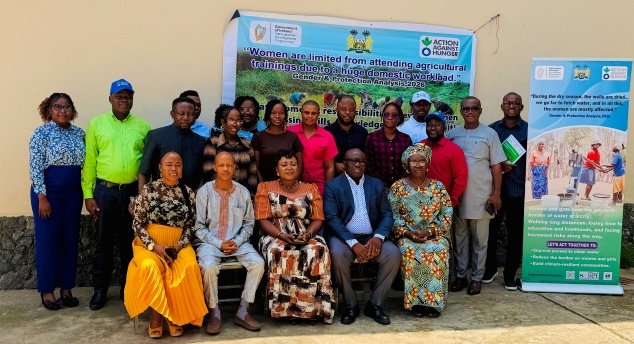
Action Against Hunger (ACF) and its partners on Tuesday, 30 June 2026, concluded a one-day dissemination workshop at the Family Kingdom Resort in Aberdeen, Freetown, where findings of the Gender and Protection Analysis (GPA) report were presented to guide the implementation of the Nutrition-Sensitive Climate Change Adaptation and Mitigation Programme (NuCAMPS).
The analysis, conducted across Bonthe, Falaba and Moyamba districts, provides evidence to strengthen climate-smart agriculture, nutrition outcomes and resilience-building efforts while ensuring that interventions address gender inequalities, protection risks and structural barriers affecting vulnerable groups.
The workshop brought together Government officials, development partners, Civil Society actors, community stakeholders and the media to review findings aimed at improving programme design, targeting and implementation.
In his opening remarks, Action Against Hunger Sierra Leone Country Director, Admire Mukorera, called for stronger collaboration among stakeholders to ensure that climate adaptation and mitigation interventions are gender-responsive and inclusive. He stressed that climate change impacts communities differently due to existing social and economic inequalities, affecting women, men, boys, girls, persons with disabilities and older people in distinct ways.
Admire Mukorera noted that while NuCAMPS seeks to improve agricultural productivity and nutrition, it is critical that such interventions do not reinforce inequality or expose communities to additional protection risks. He emphasized that the programme must promote dignity, safety and inclusion, adding that the GPA provides practical evidence on gender roles, access to resources, decision-making and participation constraints across the targeted districts.
He urged stakeholders to ensure that the report translates into action rather than remaining a reference document, calling for its recommendations to inform programme design, implementation, targeting and monitoring systems.
Admire Mukorera further encouraged partners to strengthen women’s participation in decision-making, improve access to productive resources, adopt safer programming approaches and ensure inclusion of marginalized groups. He also highlighted the report’s relevance for Government Ministries and local councils in strengthening planning and policy development on gender equality and social inclusion.
Representing the Embassy of Ireland, Senior Programme Advisor for Nutrition and Food Security, Dr. Sulaiman Sowe, reaffirmed Ireland’s commitment to supporting nutrition, food security and gender equality initiatives in Sierra Leone. He noted that women constitute about 70 percent of the agricultural workforce but continue to face barriers in accessing land, credit, inputs, and machinery.
Dr. Sulaiman Sowe also highlighted challenges in agricultural mechanization, stating that most equipment are not designed to be gender-inclusive and stressed the need for reforms to ensure women can effectively participate in mechanized farming. He said improving women’s access to agricultural technology is essential for boosting food production and strengthening climate resilience.
He also explained that the NuCAMPS programme, which runs until April 2029, is being implemented by a consortium including Action Against Hunger, the Conservation Society of Sierra Leone, MOCPADA and the Sierra Leone Meteorological Agency. The programme focuses on nutrition-sensitive climate adaptation, improved agricultural productivity and resilience-building in vulnerable communities.
Dr. Sulaiman Sowe further referenced complementary initiatives supported by Ireland, including UN nutrition programmes implemented by UNICEF, FAO, WFP and WHO, as well as other consortia working in multiple districts. He noted that NuCAMPS also includes agro-meteorological stations to provide farmers with climate information for planning and adaptation.
Chairperson of the Parliamentary Committee on Gender and Children’s Affairs, Hon. Catherine Zainab Tarawally, commended Action Against Hunger and the Embassy of Ireland for their continued support to Sierra Leone’s development agenda. She said Parliament remains committed to advancing gender equality, nutrition, and child protection.
The Parliamentarian described the GPA report as an important resource and urged wider dissemination to key institutions, including Ministries and Parliament, to inform policy and programme development. She also called for stronger public awareness of existing laws such as the Prohibition of Child Marriage Act and the Customary Land Rights Act, noting that many citizens remain unaware of their rights.
Hon. Catherine Zainab Tarawally acknowledged progress made in gender equality but emphasized the need for continued efforts to address gender-based violence, improve women’s welfare and strengthen juvenile justice systems. She further encouraged greater collaboration between Action Against Hunger and Government institutions to ensure the report contributes to long-term policy impact.
She also called for expansion of similar studies to other districts to support national-level evidence for planning and decision-making. According to her, women’s participation in leadership must continue to grow, even in a male-dominated society, noting that progress, though gradual, is being achieved.
In his keynote address, Chief Director of the Ministry of Gender and Children’s Affairs, Charles Vandi, described the report as a reflection of structural inequalities affecting women and vulnerable groups. He said women remain the backbone of agriculture but continue to face limited access to land, credit, training and leadership opportunities.
He highlighted that women perform the majority of agricultural work while also carrying unpaid domestic responsibilities, resulting in what he described as “time poverty.” He warned that such inequalities undermine national development efforts if left unaddressed.
Charles Vandi also raised concern over high levels of gender-based violence, citing figures showing that physical violence against women exceeds 48 percent in the project districts, with significant variations across regions. He described violence against women as a consequence of unequal power relations and structural inequality.
The senior Director acknowledged ongoing Government efforts, including the establishment of one-stop centres for survivors of gender-based violence, while noting challenges in access for rural communities. He emphasized that protecting women and children is central to national development and social justice.
He further called for full implementation of key national laws, including the Customary Land Rights Act 2022, the Land Commission Act 2022 and the Gender Equality and Women’s Empowerment Act 2022, to improve women’s access to resources.
On climate change, Charles Vandi stressed that women should be recognized not only as vulnerable groups but also as agents of resilience. He called for women-focused climate information systems, improved energy solutions such as clean cook-stoves and greater participation of women in environmental governance.
Charles Vandi also highlighted ongoing Government initiatives, including the development of a National Child Safeguarding Policy and the implementation of the Spotlight Initiative 2.0, a US$150 million programme aimed at eliminating violence against women and girls.
Earlier, Consultant, Samuel Byrne, of Inspiration Lifeline presented the GPA findings, noting that the study was designed to ensure that NuCAMPS interventions are safe, equitable and evidence-based. He explained that data was collected through focus group discussions, key informant interviews and secondary sources including the DHS 2019 and WFP reports.
Samuel Byrne reported persistent gender inequality across all districts, with women carrying heavy workloads in agriculture and household duties while remaining excluded from land ownership and decision-making structures. He noted that women’s unpaid care burden limits their educational and economic opportunities.
The Consultant also highlighted high levels of gender-based violence, structural barriers in healthcare access, low female literacy rates and widespread food insecurity affecting up to 71 percent of households. He further pointed to inadequate Water, Sanitation and Hygiene (WASH) services, which disproportionately affect women and girls.
On climate change, Samuel Byrne said communities are facing increasing environmental shocks, including irregular rainfall, flooding and heat stress, which are affecting agricultural productivity. He noted that women are already practicing climate-smart agriculture but lack formal recognition and support.
He concluded that gender inequality is the central driver of vulnerability across all sectors and urged that gender equality and protection be integrated into all stages of programme implementation rather than treated as secondary considerations.
The GPA report recommended expanding women’s access to land, strengthening Village Savings and Loan Associations, improving health and WASH services, enhancing climate information systems, promoting disability inclusion, strengthening male engagement and ensuring gender-disaggregated monitoring across all programme components.
The workshop ended with renewed commitments from stakeholders to translate the findings into action to build more inclusive, resilient and climate-adaptive communities across Sierra Leone.