Home Blog Page 1164

Sierra Leone Is Yet To Tap Into Its Untapped Tourism Potentials

Alfie Barrie (Television Anchor)

By Alfie Barrie (Television Anchor)

There is a body of evidence that shows that Sierra Leone is blessed with natural endowment. While other countries are totally bereft of natural beaches and heritage sites and are busy creating artificial beaches (which we in Sierra Leone marvel at) our own  God given beaches and heritage sites lie in waste. The unclean nature of our beaches should be a major scar on every Sierra Leonean conscience. For far too long successive Governments have heavily banked their revenue mobilization drive on the extractive industry (the mining sector) which has proven to be fickle.

The Government is still reeling from the sharp fall in the price of iron ore on the world market couple of years ago which led to the closure of some mining companies in Sierra Leone. So, any administration that only relies on revenues from the mining sector is virtually playing to this widely used dictum of ‘putting once eggs in one basket’. Therefore, diversification of the economy is the best bet. The recent World Bank report on Sierra Leone heavily drills into the concept of economic diversification and one sector that could serve as a major revenue generating stream for the Government is the Tourism sector which the New Direction manifesto heavily espouses.

Having pristine beaches and making our heritage sites even more appealing to the outside world will not just develop our small and medium enterprises, but it has potential to rebrand the image of Sierra Leone as a country that is at peace with itself countering the notion of Sierra Leone being a war-torn country and a place that is infested with viral diseases and a totally dysfunctional state apparatus.

So, the launch of the national tourism census report by the Ministry of Tourism and Cultural Affairs in collaboration with Statistic Sierra Leone couldn’t have come sooner. This geospatial survey gives you an impressive insight about our entire tourist sites in all one hundred and ninety chiefdoms.

I am quiet mindful of the toxic political situation Sierra Leone is currently in, and it is very simple for one to be associated with a political party, but I must admit that the current Minister of Tourism and Cultural Affairs Dr. Memunatu Pratt seem to be steering the ship of that Ministry quite well. Thanks to the recently launched visa on arrival and some reasonable steps taken so far to rid off our beaches from sea weeds and the electrification of some of them coupled with her unwavering willingness to engage everyone in the entertainment sector, plus the flurry of international moves she has embarked on since her appointment and also attracting nearly a hundred thousand tourists last year   signals hope. Conversely, this doesn’t mean all is glitz.

There are still some hurdles that need to be overcome such as properly developing our beaches that meets international standards and also, improving on the road infrastructure especially in far flung tourist site.

I am pretty convinced that with effective political leadership and a multi stake holder approach we will be able to turn the corner and transform our tourism sector into a bourgeoning one that will serve as a reliable revenue generation base for the government and at the same time serve as a magnet to foreigners who find delight in monuments and relics of historic countries like Sierra Leone.

As President Bio reiterated… Is there sufficient progress to meet the Agenda’s goals by 2030?

By Foday Moriba Conteh

In 2015 the United Nation adopted the Sustainable Development Goal’s which committed themselves to 17 life-changing goals, which include ending extreme poverty, giving people better healthcare and achieving equality for women with the aim for all countries to work together to ensure no one is left behind.

According to the 2018 Sustainable Development Goals Report it is disclosed that in sub-Saharan Africa, the HIV incidence among women of reproductive age is 10 times the global average. Nine out of 10 people living in cities breathe polluted air. And, while some forms of discrimination against women and girls are declining, gender inequality continues to hold women back and deprive them of basic rights and opportunities.

In Sierra Leone many people still lack access to safe water supply and sanitation facilities. Scarcity of water, flooding and lack of proper wastewater management, gender inequality continue to hold women back and deprive them of basic rights and opportunities, accentuate economic hardship and hunger in the country with peace and stability of the country at stake. All the above are all highlighted in the SDGs to be addressed by countries by 2030

During an interview at the Future Sustainability Summit on the margins of the Abu Dhabi Sustainability Week, President Bio reiterated his Government’s commitment to achieve the Sustainable Development Goals where he spoke about Government’s efforts at consolidating peace and increasing access to justice for ordinary people and told the delegates about his Government’s commitment to establishing an infrastructure for peace through a Commission for Peace and National Cohesion.

The big question somebody might want to ask is if sufficient progress have been made by the Bio-led Government to meet the Agenda’s goals by 2030.

During the International day for Peace and Democracy celebration in Freetown Vice President Dr. Mohamed Juldeh Jalloh reiterated the establishment of the Peace and National Cohesion Commission.

In his address to Parliament, President Julius Maada Bio was very firm on the establishment of a Peace and National Cohesion Commission but up till now little or no effort has been made for its establishment by this Government.

It a nutshell this Government needs to do more if really this country wants to accomplish the 17 pillars in the Sustainable Development Goals by 2030.

ACCF Raises Awareness on Cervical Cancer

By Foday Moriba Conteh

In order to join the world in celebrating Cervical Health Awareness month and raise the awareness on Cervical Cancer, Archer’s Cervical Cancer Foundation on 18 January 2020 held a one day awareness raising march past from the historical Cotton Tree to the Miatta Conference Centre in the Freetown Municipality.

Speaking to this medium in an interview President of Archer’s Cervical Cancer Foundation, Doreen Archer Campbell ,disclosed that cervical cancer is a type of cancer that occurs in the cells of the cervix ,which is the lower part of the uterus that connects to the vagina, adding that various strains of the human papillomavirus (HPV), a sexually transmitted infection, play a role in causing most cervical cancer.

She noted that the United States Congress designated January as Cervical Health Awareness month as nearly 13,000 women in the United States are diagnosed with cervical cancer each year, but noted that the disease is preventable with vaccination and appropriate screening  tests.

She intimated how ACCF is joining the world to raise awareness on Cervical Cancer, adding that as an organization they have been engaging in raising awareness in various secondary schools within the Freetown Municipality and as always the 18th January is characterised by a Cervical Cancer walk out  informing that  it is against such a backdrop that they held a one day walkout which started at the Cotton Tree to the Miatta Conference Centre and  during the process they undertake educating the public about cervical cancer with the distribution of hand bills containing messages about cervical cancer.

Doreen Archer Campbell maintained that Cervical Cancer awareness raising was her platform presentation topic during the Miss COMAHS Beauty Pageant 2019, adding that she assured participants that she will not only present it but she will ensure that it becomes a reality. Having the Cervical Cancer awareness walk is a dream come true for her and her career.

Obstetrician & Gynaecologist at PCMH , Dr. Valerie John Cole, said that someone can reduce the risk of developing cervical cancer by having screening tests and receiving a vaccine that protects against HPV infection.

Dilating on the signs and symptoms of cervical cancer she mentioned vaginal bleeding after intercourse, between periods or after menopause, watery, bloody vaginal discharge that may be heavy and have a foul odour and pelvic pain or pain during intercourse

She also highlighted the risk factors associated with cervical cancer which include: many sexual partners and that the greater the number of sexual partners, the greater chance of acquiring the disease, adding that  having sex at an early age increases one’s risk of contracting the disease.

Staff of Rokel Commercial Bank, Alice Raymond,a participant expressed appreciation to Archer’s Cervical Cancer Foundation for joining the world to raise awareness on Cervical Cancer which she described as a disease that kills people slowly, adding that many people are ignorant about Cervical Cancer but said with this awareness raising it is believed many have been enlightened about not only the preventive measures but also the risk factors, signs and symptoms.

Dr Francis Kai Kai Launches GHDR

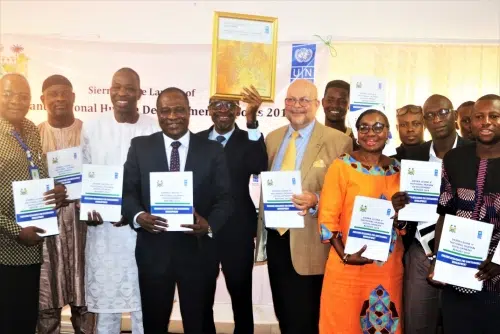
Dr. Francis KaiKai and Dr. Sam Doe present the GHDR and NHDR to the audience at the launch

By Amin Kef Sesay

During the launch of the 2019 Global Human Development Report (GHDR) alongside the National Human Development Report (NHDR) at the Ministry’s offices on 13th December, 2019 Minister for Planning and Economic Development, Dr Francis Kai Kai said:  “We are very determined as a nation to change the landscape and narrative of our poverty and human development estimates within the framework of our current national development plans and the sustainable development goals.”

From when the Human Development Report was first published in 1990, Sierra Leone has made commendable progress in its human development trends more so when considering its recent stormy past. After an 11-year civil war that ended in 2002, the country experienced a slow but gradual economic recovery until 2014-2015 when the Ebola virus health emergency struck followed by the slump in iron ore (Sierra Leone’s leading export commodity) prices.

The effects of these crises have since continued to manifest in the slow economic recovery and growth but overall, Sierra Leone has been and remains resilient in its resolve to sustainably grow and develop better.

“Even in the face of several human tragedies and financial resource constraints, Sierra Leone has demonstrated resilience that defines a pathway to build on the country’s strength and minimizes vulnerabilities,” said UNDP Resident Representative, Dr. Samuel Doe, at the event.

Indeed, Sierra Leone has moved three places up in the Human Development Index (HDI) ranking from 184 in 2018 to 181 out of 189 countries according to this year’s GHDR entitled ‘Beyond Income, Beyond Averages, and Beyond Today’ based on the premise that, inequalities in human development are not just about disparities in income and wealth.

The 2019 Human Development Report (HDR) explores inequalities in human development by going beyond income, beyond averages, and beyond today. The proposed approach sets policies to redress these inequalities within a framework that links the formation of capabilities with the broader context in which markets and governments function.

‘Building Resilience for Sustainable Development’ was the theme of the Sierra Leone 4th National Human Development Report also launched at the same time inspired by the global theme and the country’s development trajectory over the past years and looking forward into a better future.

The report comes in the middle of the preparations for Sierra Leone’s ‘Roadmap to walk out of fragility by 2023’ undertaken by the Ministry of Planning and Economic Development supported by UNDP.

In Sierra Leone, there has been encouraging institutional reforms: many of the appropriate laws, polices, processes and structures for democratic governance and social and economic stability are in place according to the Mo Ibrahim Governance index 2019. Sierra Leone’s trends show commitment to address inequalities.

The human development lens is central to approaching inequality and asking why it matters, how it manifests itself and how best to tackle it. Imbalances in economic power are eventually translated into political dominance. And that, in turn, can lead to greater inequality and environmental disasters. According to the 2019 GHDR, actions at the start of this chain are far easier than relying on interventions farther down the track. The 2019 GHDR contributes to that debate by presenting the facts on inequalities in human development and proposing ideas to act on them over the course of the 21st century.

“We embrace the 2019 Human Development Reports. They indicate that Sierra Leone is making steady progress. They will strengthen our efforts towards achieving better results by providing data and guidance to tackle inequalities that hinder Development” the Statistician General emphasized.

The ‘twin launch’ of the reports, attracted widespread attendance and interest from Government officials from Ministries, Departments and Agencies (MDAs) and traditional stakeholders including the media, civil society groups, donors, UN Agencies, representatives of the diplomatic community and other development partners.

China Donates Rice to Govt. at Education Ministry

By Theresa Kef Sesay

A symbolic handing over of a consignment of rice took place at the Ministry of Basic and Senior Secondary Education (MBSSE) in Freetown. 27,000 50 Kilos bags of rice were handed over to the World Food Program who has been entrusted by Government to champion the feeding of Sierra Leonean school children through the National School Feeding program. Another 30,000 50 Kilos bags of same rice is expected to be handed over to the World Food Program by February, 2020.

In his remarks to dignitaries, the Minister of Basic and Senior Secondary Education, Dr David Moinina Sengeh, registered his appreciation on behalf of the GoSL to the People’s Republic of China for the donation. He also thanked the Minister of Agriculture and Food Security, Mr. Denis Vandy for taking the donated rice away from farmers who are often the traditional beneficiaries of such donations and diverted it to the MBSSE for the national school feeding program. He expressed his appreciation to the President, HE Retired Brigadier-General Julius Maada Bio for his continued commitment to the Free Quality School Education.

The Deputy Minister of Finance Shek Ahmed Fantamadi Bangura spoke eloquently on Government’s position on the rice donation from the People’s Republic of China. He stated that the donation provided “cushion” in the national budget where monies that were to be used to purchase such quantum of rice can now be diverted to some other national priorities. On behalf of the Ministry of Finance, the Deputy Minister reaffirmed Government’s commitment to provide other financial resources that ensure that the World Food Program successfully carry out the school feeding activities without hindrance.

The representatives from the Chinese Embassy expressed their delight for successfully delivering on their promise to the President and people of Sierra Leone. The spokesman for the Chinese Embassy stated that the donation of rice to Sierra Leone is a decision that the two leaders of Sierra Leone and the People’s Republic of China agreed on. He continued to comment that China will continue to assist Sierra Leone whenever possible. He further cautioned the MBSSE and the GoSL not to monetize the donated rice, but rather ensure that it benefits the target beneficiaries.

The symbolic handing over was completed after one of the bags of the donated rice was placed on the conference table and formally handed over to the World Food Program’s Deputy Director Yasuhiro Tsamura.

Yasu, as he is fondly called, assured all about the commitment of the World Food Program in actualizing the President’s desire for school feeding. He expressed his gratitude to the GoSL for choosing his program as the program of choice for the national school feeding. He pointed out the benefits of school feeding on learning outcomes and the development of the human capital of Sierra Leoneans. He asked the GoSL to continue its commitment to support the program by providing the budget needed to augment the resources already at hand.

Fatmata Shaw who represented beneficiaries of the national school feeding from Masahun Kpaka, Pujehun District registered her appreciation for the donation. She asked Government to ensure all children hungry in the country must be fed in order to effectively participate in teaching and learning and achieve expected learning outcomes.

NASSIT Awards IAMTECH

By Salaam Deen Bundu

One of the country’s tertiary institutions that are offering various courses which many young people are pursuing, the Institute of Advanced Management and Technology (IAMTECH) recently was the proud recipient of a prestigious award from the National Social Security and Insurance Trust (NASSIT) for effectively complying with the NASSIT Act No.5 of 2001 in the 2019 Financial Year.

Presenting the award to IAMTECH, the Director of Public Affairs and Customer Service, Osman F. Kamara commended  IAMTECH for receiving such an award from his institution, saying it  shows that they are among the most compliant institutions in the country.

He further praised the Administration of the institution for what he describes as its commitment to pay NASSIT contributions for its staff also encouraging them to continue to do so also underscoring how such will help motivate the institution’s workforce. He, on behalf, of the Director General of NASSIT, presented the prestigious award to IAMTECH for fully honouring their NASSIT obligations for the financial year 2019.

Receiving the award on behalf of IAMTECH, the Head of Communications, Mr. Abdul Karim Kamara, stated that he feels very humble for receiving such an auspicious award. In an elated mood he stated “to us as an institution, we see this award as one won out of merit; we are grateful to God for everything we have gone through as an institution”.

He said they are dedicating the award to God Almighty, the Proprietor Prof. Dr. Paul Kamara and wife Dr. Mrs. Abie Paula Kamara, the Chief Executive Officer Prof. Roseline E. Uyanga, the entire Management and Staff of IAMTECH including the committed students both current and past.

He maintained that it was not a surprise to them to be awarded by no less an institution than NASSIT justifying how they have been paying their employees’ NASSIT obligations every month and on time giving them an edge over other institutions in the same category. He revealed that as an institution they have been with NASSIT since its inception and they are going to ensure that they meet all tax obligations set forth by Government because IAMTECH always puts country first.

He used the forum as an opportunity to advise sister institutions to always honour their NASSIT obligations as by doing so they will be helping in the preparation of a better future for their employees and by extension, contributing to the country’s revenue mobilization.

VP Juldeh Jalloh & UN NCRA Assessment Mission Team Meets

Vice President of Sierra Leone Dr.Mohamed Juldeh Jalloh & the Senior Statistician Ms. Fatouma Sissoco and the Legal Identity Management Expert United Nations Economic Commission for Africa

By Esther Wright

Senior Statistician Ms. Fatouma Sissoco and the Legal Identity Management Expert United Nations Economic Commission for Africa on 16 January 2020 had an interactive session with the Vice President of Sierra Leone Dr.Mohamed Juldeh Jalloh.

The team congratulated the Government and the people of Sierra Leone, as well as NCRA Director General Mohamed Massaquoi and senior government officials for the tremendous progress made in the establishment of the National Civil Registration Authority.

The mission noted that Sierra Leone’s CRVS system is exceptional as it has a system that integrates civil registration, vital statistics and ID management, which is in line with the UN Legal Identity Agenda (UN LIA) and UN statistics division standards and other international best practices.

Because of the Government’s commitment to strengthening the national CRVS and Id management system, Sierra Leone was selected as a pilot country of the recently launched UN LIA.


Internal Affairs Ministry & Conscience International End Training on Statelessness

Cross section of Participants at the training

By Sam Pratt

The Secretariat for Statelessness within the Ministry of Internal Affairs in collaboration with Conscience International, on 16 January 2020 ended a two-day training session for members and non-members of the National Steering Committee to deliberate on matters relating to Statelessness. Discussions during the two day training bordered on the Conventions Sierra Leone had acceded to and their domestication, the National Action Plan that has been drafted and the pathway to achieving the Five Commitments Sierra Leone made in the 2019 Excom.

The over 20 participants included representatives from the Ministries of Internal Affairs, Foreign Affairs and International Cooperation and Social Welfare, Immigration Department, the National Commission for Social Action, the Human Rights Commission, the Births and Deaths Office, Civil Society Organizations and the media.

The training took place at the Grassroots Gender Empowerment Movement (GGEM) Hall on John Street in Freetown.

Statelessness is the position an individual finds him/herself in which he/she is unable to produce proper documentations related to the citizenship of that country he/she has been domiciled nor for any other country. It may surprise readers to know that people are in this position and yet do not know until a situation arises that necessitates the tendering of documentation that speaks for his/her citizenship.

Consequently thereof, the Ministry of Internal Affairs which is the Secretariat for Statelessness in Sierra Leone thought it prudent to train the members and non-members of the National Steering Committee on matters related to Statelessness.

The representative of the Minister of Internal Affairs, Mr. Andrew Kamara, in his keynote address, enlightened that there is a global fight to end statelessness particularly in Sierra Leone and West Africa, a fight the country is fully committed to but lamented that the country is facing many social challenges to end statelessness by 2024.

According to Mr. Andrew Kamara, some of the reasons for statelessness are porous borders, laws/legislations, discrimination and migration, nomadic people, children born to migrants, lack of identification documents. He affirmed that Government has made considerable strides to eradicate statelessness by appointing a Focal Person, acceding to conventions and treaties, undertaken civil registration reforms, visited border areas to identify groups and persons threatened by statelessness and pledged to continue working with various stakeholders to end the menace further underscoring that children and migrants are the most vulnerable to become stateless people.

He continued that a ten-year campaign (2014-2024) has been launched to eradicate statelessness citing the 2015 ECOWAS Abidjan Declaration, that Sierra Leone adopted its National Plan in 2017, disclosing that possible areas for stateless people are Kambia in the North and Yenga in the East revealing that there are 750,000 stateless people in West Africa and 10 million in the world.

Other issues participants highlighted were that Sierra Leone does not have a Migration Policy,    that there is no statistics of stateless people in the country and that there is need for massive sensitization of the public on statelessness.

Lectures were delivered on the following topics, the Background to Statelessness in Sierra Leone, Concept of Statelessness Exercise, the Global Action Plan Exercise, Sierra Leone Nationality Law Exercise, the Abidjan Declaration Exercise, National Action Plan and National Commitment.

It is expected that participants will be Ambassadors of Statelessness by embarking on mass sensitization in the media, in town hall meetings as well as other forums as and when the need arises.

‘University Status is Overdue…’ -MMCET Students Lambasts

Cross Section of Milton Margai College of Education and Technology (MMCET) students on the protest

By Foday Moriba Conteh

Friday 17 January 2020 will go down the annals of history of the Milton Margai College of Education and Technology (MMCET) polytechnic as a turning point a date that will be remembered when aggrieved and frustrated students of the Polytechnic’s three campuses demonstrated peacefully over the undue delay by the authorities to transform the college into a Technical University which they asserted is long overdue.

However, the timely intervention of the Principal of the Polytechnic, Dr. Philip John Kanu, pacified the students as otherwise the situation could have degenerated into chaos and violence.

The students displayed placards some of which read, ‘Transformation of MMCET into a Technical University is long overdue,’   ‘Professor Aiah Gbakima Must Go,’ ‘We Are Tired With the Long Wait,’ ‘The Other Colleges That Have Been Transformed to Universities Are Not Better Than Us’ and ‘We are Tired with NCTVA.’

The students further stated that some of the best students at Fourah Bay College, the Institute of Public Administration and Management and other institutions of higher learning in the country are products of Milton Margai College and threatened to march along the main streets of Freetown to the Ministry of Technical and Higher Education in a week’s time if the college is not transformed into a Technical University accusing the college’s administration of doing little or nothing to pressurize the authorities to take action for which they would no longer listen to the administration.

The Governor of the Congo Cross campus, David Kamara revealed that the college has the manpower and facilities to be transformed into a Technical University citing the equipped workshops, the state-of-the-art laboratory that can even conduct DNA tests and refurbished classrooms, hotels and library in addition to the conducive learning environment in all the three campuses of the polytechnic.

Addressing the aggrieved students, Dr. Kanu articulated that President Dr. Julius Maada Bio values education, the reason education is his flagship project to create change in the lives of the people, assured them that their protests would not go in vain, entreated them to exercise patience as the college administration has appealed to the Tertiary Education Commission for a university status, observed that the Ministry of Technical and Higher Education recently issued a press release that the college, the Freetown Teachers’ College and the Eastern Polytechnic would not be transformed into universities that resulted to students at   the Eastern Polytechnic protesting causing the Ministry to withdraw the unfortunate press release.

Dr. Kanu further guaranteed the students that Government would address the issue with priority, that there is light at the end of the tunnel, that students at the Brookfields Campus wanted to block Jomo Kenyatta Road as a sign of protest and appealed to them to continue with their classes asserting that the President is very sensitive to their plight reiterating that something would soon happen as the application is now with the Tertiary Education Commission and that nothing will stop the college from being transformed into a Technical University.

WFP Recognizes Sierra Leone’s Commitment to School Feeding

By Francis Boima WEF Sierra Leone

This medium has been intimated that the United Nations World Food Programme (WFP) on Thursday 16th January 2020 welcomed an important contribution of 2,850 metric tonnes of rice from the Government of Sierra Leone to support the implementation of the country’s national school feeding programme which is at the centre of the government’s “free quality education” initiative.

The rice donated to Sierra Leone by the People’s Republic of China will complement some US$ 3.6 million (35 Billion Leones) of Government budget allocated to WFP to buy food and provide meals to more than 300,000 primary school children in the districts of Kambia, Pujehun Bombali, Bonthe, Kailahun, Karene, Kenema, Kono, and Port Loko as part of the government-led programme.

The Government of Sierra Leone and WFP signed a Memorandum of Understanding in September 2019 aimed at improving school feeding activities in the country. WFP will focus on boosting capacity in the areas of monitoring, planning, sensitization and food handling, storage and transportation. WFP will also work with the Government to facilitate the gradual handover of the school feeding programme, and its integration into the national social protection basic package that is in line with the National School Feeding Policy.

“We commend the Government of Sierra Leone for including a dedicated line for school feeding in its national budget, which demonstrates its commitment towards this programme,” said Yasuhiro Tsumura WFP’s Deputy Country Director in Sierra Leone. “WFP is honoured to be a partner of choice for its implementation.”

The programme will ensure that children receive timely and adequate nutritious meals that meet their basic food and nutrition requirements, a measure that helps to increase school enrolment and retention rates.

WFP is the world’s largest supporter of school feeding – including in 41 African nations – providing technical and operational support to governments. WFP has handed over school feeding programmes to governments in 31 countries, where school feeding continues to this day.

WFP continues to work closely with partners, agencies and governments to ensure the success of the programme aimed at those who need it most — and especially safeguarding primary school children’s access to balanced, nutritious meals, promoting opportunities to diversify diets with local produce, and reinforcing skills and good habits in nutrition, health and hygiene.

The United Nations World Food Programme is the world’s largest humanitarian organization, saving lives in emergencies, building prosperity and supporting a sustainable future for people recovering from conflict, natural disasters and the impact of climate change.