
Home Blog Page 239

Ministry of Agriculture Empowers Communities with Milling Machines and Youth Training

Ministry of Agriculture Empowers Communities with Milling Machines and Youth Training

Last year, before the rice harvest season, the Ministry of Agriculture distributed milling machines to communities across Sierra Leone to process paddy rice into table rice that meets international standards. This initiative will significantly reduce the reliance on imported rice, encouraging Sierra Leoneans to embrace locally produced rice.

Rice importation has strained Government resources and made imported rice unaffordable for many citizens. Minister of Agriculture, Dr. Henry Musa Kpaka emphasized that supporting farmers with seeds and fertilizer is just one part of the solution. He noted, “It is equally important to help farmers harvest and mill rice to meet the preferences of our people.” The Government has introduced policies to attract private sector investment to ensure the sustainability of this initiative.

In collaboration with the World Bank-funded Food Systems Resilience Program and partners like the World Food Program (WFP), the Ministry of Agriculture is helping farming groups install these milling machines and training community youth to operate them. While the machines are provided to farming groups at no cost, these groups collect minimal fees from individual farmers to cover maintenance and repairs.

This effort aligns with the Feed Salone agenda, a Government plan to reduce rice importation and achieve self-sufficiency in rice production. By investing in the rice sector, the initiative aims to make agriculture more attractive to youth and women, creating opportunities and reducing post-harvest losses.

Currently, the Ministry is training over 200 community youth, including women, to operate and maintain these milling machines nationwide. One of the trainees, Mohamed Kargbo from Kambia District, expressed his gratitude: “I feel fortunate to be part of this agricultural revolution. Thanks to the Government and its partners, my community now owns a milling machine, and we, the community youth, operate it. The stress of manual milling is over for the women. Now, we can clean our local rice to match imported rice; stone-free, well-polished and fit for our tastes”.

The Director of Extension Services, Alpha Yayah Mansaray, highlighted the Ministry’s commitment to reducing hunger and poverty through agriculture. He added, “We are designing programs that equip farmers with sustainable agricultural practices, including climate-smart technologies, to increase productivity and improve livelihoods.”

This initiative marks a significant step toward transforming Sierra Leone’s rice sector and empowering communities to achieve food security and economic resilience.


FSRP and MAFS Award Grants to SLARI Researchers to Enhance Smallholder Farmers’ Productivity

FSRP and MAFS Award Grants to SLARI Researchers to Enhance Smallholder Farmers' Productivity

The Ministry of Agriculture and Food Security (MAFS), through the World Bank-funded Food Systems Resilience Program (FSRP), has awarded research grants to six scientists from the Sierra Leone Agricultural Research Institute (SLARI). These grants will support adaptive farm research aimed at improving smallholder farmers’ productivity and increasing incomes across Sierra Leone.

The grant award ceremony took place on January 24, 2025, in Rokupr, Kambia District. Speaking at the event, Deputy Minister of Agriculture I, Dr. Theresa Tenneh Dick, expressed appreciation to the World Bank for its continued support. Reflecting on her personal experience, she noted that she had once benefited from a similar World Bank-funded initiative. She emphasized the critical role of smallholder farmers in ensuring food security, stating, “Smallholder farmers are the backbone of our food systems. The research supported through this grant will address critical challenges they face and provide solutions to boost productivity and income generation.”

Representing Minister of Agriculture, Dr. Henry Musa Kpaka, Dr. Dick reiterated the Ministry’s dedication to research, stating, “Under Dr. Kpaka’s leadership, we aim to transform SLARI into a center of excellence, delivering innovative technologies that empower smallholder farmers. Through this vision, we can truly achieve the goal of ‘Feed Salone.’”

The six researchers received grants to address key agricultural challenges, including:

  • Operationalizing Cassava Flash Dryer for high-throughput processing of cassava products.
  • Assessing dietary exposure and consumer awareness of major mycotoxins in Sierra Leone’s food supply.
  • Engineering Biogas Systems to convert livestock waste into renewable energy, promoting sustainable waste management.
  • Collecting and characterizing Mangrove Rice Germplasm for breeding and genetic resource conservation along communities in the Great Scarcies River.
  • Applying Biochar to improve soil fertility and enhance cassava productivity on degraded lands.
  • Promoting improved rice parboiling technology for mangrove rice processors in Sierra Leone.

The Director-General of SLARI, Dr. Abdul R. Conteh, commended FSRP for its investment in research, describing the initiative as crucial to addressing the challenges faced by smallholder farmers. He highlighted that the research projects cover diverse areas, all geared towards increasing agricultural productivity and sustainability. Dr. Conteh also emphasized the potential impact of SLARI’s collaboration with the International Institute of Tropical Agriculture (IITA), ensuring that research outcomes directly benefit farmers.

One of the grant recipients, 40-year-old Sofia Mansaray, is conducting research on converting cassava into flour. Her initiative aims to reduce Sierra Leone’s reliance on imported wheat flour by developing a locally produced alternative. “My research will help lower the cost of flour imports, enable Sierra Leone to produce its own flour, and make it more affordable for citizens,” Mansaray explained.

MAFS and FSRP have pledged to closely monitor the progress of the researchers to ensure their findings align with the Feed Salone vision, a national initiative aimed at enhancing food security and driving economic growth in Sierra Leone.

World Bank and MAFS Strengthen FSRP Investments with Implementation Support Mission

World Bank and MAFS Strengthen FSRP Investments with Implementation Support Mission

In a bid to assess the progress and impact of the Food System Resilience Program (FSRP), the World Bank and the Ministry of Agriculture and Food Security (MAFS), in collaboration with implementing partners and key stakeholders, conducted a week-long Implementation Support Mission (ISM). The initiative, which commenced on January 21, 2025, focused on reviewing the program’s achievements, addressing challenges and strategizing for enhanced performance.

The mission kicked off at the FSRP office in Freetown with presentations highlighting the implementation progress. Discussions centered on key milestones, areas of improvement and strategies to optimize outcomes. To validate reported impacts, the World Bank team, alongside Government officials and stakeholders, visited multiple project sites and engaged directly with beneficiaries to ensure the program’s effectiveness in transforming communities.

One of the key locations visited was the Modern Vegetable Garden (MVG) in Newton, Western Rural District. This initiative has provided training and resources to over 25 youths and women, empowering them to become competitive out-growers and establish medium-scale farms. Isata Bangura, one of the beneficiaries, shared her experience: “FSRP trained me in vegetable production, which has significantly improved my productivity and household income.”

In Rokupr, Kambia District, the mission visited a seed storage facility managed by the Sierra Leone Agricultural Research Institute (SLARI) under the Feed Salone Seed System initiative. The facility plays a crucial role in multiplying and preserving foundation seeds. SLARI officials provided a progress report on their efforts to transition the center into a Regional Center of Excellence for Mangrove Rice. Dr. Adetunji Oredipe, the World Bank mission lead, reassured the Ministry of Agriculture and Food Security of continued collaboration to address key challenges in the process.

At the same event, Deputy Minister of Agriculture and Food Security 1, Dr. Theresa Tenneh Dick, awarded grants to six SLARI scientists to conduct adaptive agricultural research aimed at addressing food security challenges in Sierra Leone. Dr. Alfred Dixon, Director of the International Institute of Tropical Agriculture (IITA), lauded the initiative, emphasizing its potential to revolutionize agriculture in the country. The research projects will focus on:

  • Operationalizing a Cassava Flash Dryer for high-throughput cassava processing
  • Assessing dietary exposure and consumer awareness of major mycotoxins in Sierra Leone’s food
  • Developing biogas systems to convert livestock waste into renewable energy
  • Collecting and characterizing Mangrove Rice germplasm for breeding and conservation
  • Applying biochar to improve soil fertility and enhance cassava productivity on degraded lands
  • Promoting improved rice parboiling technology for mangrove rice processors

The mission team also toured SLARI’s Technology Park along the Port Loko-Makeni highway. With funding from FSRP, the park’s expansion is underway, with plans to establish another facility along the Bo-Kenema highway. These centers will provide hands-on training and showcase innovative agricultural technologies for farmer adoption.

In Makari Village, Bombali District, the team visited a rice processing facility managed by Med-Tula Agro Processing Center, which provides inputs such as seed, fertilizer, and mechanized land preparation to 1,000 FSRP rice farming households. Approximately 48% of these households are integrated into Med-Tula’s farmer network, ensuring market access for their harvests through institutional buyers, including school feeding programs. One beneficiary, Haja B. Koroma, shared her transformational journey: “I moved here due to marriage, but my husband abandoned me with two children in university. I used to break stones to pay their fees. Since receiving FSRP support through the agro-dealer, my life has changed. I can now afford their education without loans or manual labor. I am deeply grateful to the government and the World Bank.”

At Robaka Village, cassava farmers initially supported during FSRP’s emergency phase have successfully expanded production. Madam Cole, CEO of the organization, highlighted their achievements: “The emergency support enabled us to scale up production. We reinvested proceeds to acquire cassava processing machines, allowing us to produce gari, flour, and animal feed. However, we still face challenges in infrastructure and gender-friendly machinery.”

MAFS Director of Extension, Alpha Yayah Mansaray, reaffirmed the government’s commitment to supporting multiple agricultural value chains beyond rice, emphasizing increased investments in cassava cultivation and processing. He assured farmers of immediate support to improve harvesting and processing facilities.

The mission brought together representatives from the World Bank, MAFS, SLARI, IITA, the National Fertilizer Regulatory Agency (NaFRA), the National Water Resources Management Agency (NWRMA), the Sierra Leone Meteorological Agency (SLMet) and the National Farmers Federation. During wrap-up meetings on January 27, 2025, the mission team engaged with the Minister of Agriculture and the Minister of Finance to outline concrete action plans for sustaining and expanding the FSRP’s impact in the coming years.

NCRA Intensifies Call to Obtain Biometric ID Card for Identity Protection & Access to Services

NCRA Intensifies Call to Obtain Biometric ID Card for Identity Protection & Access to Services

By Amin Kef (Ranger)

The National Civil Registration Authority (NCRA) continues to redefine the National Identification Card in Sierra Leone, transforming it from a basic tool of identification to a cornerstone of legal and digital identity management. The Biometric ID Card, now an essential requirement for accessing critical services, is designed to streamline identity verification, reduce fraud and offer enhanced security across various sectors, particularly in finance and Government.

The significance of the Biometric ID Card is evident in its ability to address numerous identity-related challenges. This card, issued to both Sierra Leonean nationals and non-nationals, contains unique biometric data, such as fingerprints and photographs, stored in embedded chips, allowing for accurate and secures identity verification. This feature has proven indispensable for verifying citizenship status, gaining access to services like banking and ensuring the integrity of public services.

The introduction of the National Identification Number (NIN) has further bolstered the role of the Biometric ID Card in Sierra Leone’s identity management landscape. Each cardholder is assigned a unique NIN, permanently stored in a centralized National Identity Database, ensuring that no two individuals share the same number. This system is vital in distinguishing individuals with similar names and is essential for accessing a range of Government and private services, including national examinations and work permits for foreign nationals.

The NCRA has been proactive in ensuring widespread access to these ID cards by establishing registration and collection centers across Sierra Leone. These include:


  1. NCRA Headquarters: 2 Walpole Street, Freetown
  2. NCRA Office: 23B Off Kingharman Road, Freetown
  3. NCRA Office: Kennedy Street, Freetown
  4. NCRA Branch Office: 230 Lumley Road, Freetown (By the Roundabout)
  5. NCRA Office: Waterloo, along the Freetown Highway (Opposite the Police Station)
  6. Regional NCRA Offices in Bo, Kenema, Makeni, and Port Loko


For more information or assistance, the NCRA can be contacted through the following channels:

– Mobile: +232 33 939740 / +232 79 578063

– Website: [www.ncra.gov.sl](http://www.ncra.gov.sl)

– Email: info@ncra.gov.sl

For those yet to collect their cards, the NCRA urges prompt action, noting that securing the Biometric ID Card is a crucial step in safeguarding personal identity and accessing essential services without hindrance.

In addition to the roll-out of the Biometric ID Card, the NCRA is also rolling out a new initiative aimed at linking National Identification Numbers (NIN) with mobile phone SIM cards. This nationwide campaign requires all mobile users to link their NIN to their SIM cards. The move is part of a broader strategy to strengthen identity verification, prevent misuse of mobile services and reduce the risk of mobile fraud. Failure to comply with the linkage requirement will result in suspended mobile services, including voice, SMS and mobile money functionalities.

As mobile communication plays a pivotal role in daily life, the NCRA’s efforts to link SIM cards with verified identities are expected to curb illegal activities and ensure better service delivery.

The introduction of the Biometric ID Card and the NIN-SIM linkage initiative represents significant progress in Sierra Leone’s quest to secure its digital landscape, enhance service accessibility and protect citizens from identity theft and fraud. The NCRA continues to urge all residents to act swiftly and comply with these measures to avoid disruption in accessing vital services.

Audit Service Sierra Leone Kicks Off 2024 Audit with MDA Engagements

Audit Service Sierra Leone Kicks Off 2024 Audit with MDA Engagements

In a move to strengthen transparency and accountability in Sierra Leone’s public sector, the Acting Auditor General of the Audit Service Sierra Leone (ASSL), Abdul Aziz, alongside his dedicated team, has commenced engagements with Ministries, Departments and Agencies (MDAs) in preparation for the 2024 audit process. These consultative sessions aim to enhance governance and improve service delivery across the nation.

The engagement process officially began on Monday, 17th February 2025, with a meeting with the Sierra Leone Maritime Administration (SLMA). Subsequent discussions followed with the Ministry of Environment and Climate Change and the Ministry of Lands and Country Planning, held at the ASSL Conference Room on the 12th Floor of the Freetown City Council Building, Wallace Johnson Street in Freetown.

During these high-level interactions, Deputy Auditor General, Aiah Gbondo Tugbawa extended a warm welcome to the heads and representatives of the various MDAs. He reiterated the core objectives of these engagements, which include evaluating the implementation status of previous audit recommendations, identifying challenges faced by MDAs and highlighting institutional progress.

In his address, Abdul Aziz underscored the importance of collaboration between the ASSL and MDAs to tackle issues impeding institutional growth and efficiency. He emphasized a paradigm shift in the ASSL’s audit approach, transitioning from conventional financial audits to a broader, service-oriented model that directly impacts citizens’ lives.

The meetings also served as an interactive platform for MDAs to seek clarifications and voice concerns regarding audit findings. This open dialogue fosters a culture of accountability and continuous institutional improvement. The ASSL team provided insights into recurring irregularities identified in past audits and offered guidance on best practices to address these challenges.

Reassuring the MDAs, Abdul Aziz stated that audits should not be perceived as punitive measures or a “witch hunt” but rather as critical tools for national development. He highlighted that audits are designed to enhance financial management, reinforce accountability and ultimately improve governance and service delivery.

Moving forward, the ASSL plans to extend these engagement sessions to other MDAs, ensuring a comprehensive and systematic approach to the 2024 audit process. These meetings aim to instill a shared sense of responsibility for performance and integrity at all levels of Government, aligning with Sierra Leone’s broader national development objectives.

As the country progresses with its commitment to good governance and fiscal responsibility, these proactive engagements signal a positive step towards a more transparent and efficient public administration system.

Ministry of Agriculture and WFP Unveil High-Tech Rice Milling Houses to Boost Local Production

Ministry of Agriculture and WFP Unveil High-Tech Rice Milling Houses to Boost Local Production

To enhance local rice production, the World Food Programme (WFP) Sierra Leone, in collaboration with the Ministry of Agriculture and Food Security, has inaugurated a state-of-the-art rice milling house in Rokupr, Kambia. The official launch, held on February 20, 2025, was led by the Minister of Agriculture and Food Security, Hon. Dr. Henry Musa Kpaka, alongside representatives from WFP and local Farmer-Based Organizations.

The initiative is part of a broader strategy aimed at improving rice processing, reducing post-harvest losses, and increasing farmer incomes. Traditional rice milling methods have often resulted in significant grain losses and lower-quality rice. However, the introduction of high-tech rice processing facilities is expected to improve efficiency, enhance rice quality, and make locally produced rice more competitive in the market.

Speaking at the launch, Hon. Dr. Henry Musa Kpaka reaffirmed the government’s commitment to strengthening agricultural value chains and achieving rice self-sufficiency in Sierra Leone.

“For too long, our farmers have relied on outdated processing techniques that lead to high post-harvest losses. This investment not only equips them with modern tools to add value to their produce but also marks a critical step towards realizing the Feed Salone vision—a food-secure Sierra Leone where local production meets national demand,” he stated.

The Rokupr facility is the first of ten milling houses set to be established across Sierra Leone under this initiative. The project is being implemented through a partnership between WFP, the Government of Japan, and Satake, a globally renowned Japanese agricultural technology company.

WFP Sierra Leone Country Director, Yvonne Forsen, underscored the significance of the initiative in supporting smallholder farmers and ensuring food security in the country.

“This project is a game-changer for smallholder farmers. By improving processing efficiency and rice quality, we are not only increasing farmers’ incomes but also ensuring that more locally grown rice reaches school meals through the Home-Grown School Feeding Programme,” she noted.

The Home-Grown School Feeding Programme, supported by WFP and the Government of Sierra Leone, sources food directly from smallholder farmers to provide nutritious meals for schoolchildren. The introduction of modern rice milling houses will further strengthen this initiative by ensuring a consistent supply of high-quality, locally milled rice.

Farmers in Kambia have expressed enthusiasm about the new facility, emphasizing that it will save time, reduce losses, and enable them to secure better prices for their rice. With nine more milling houses set to be rolled out in key rice-producing districts, this initiative is expected to play a crucial role in Sierra Leone’s agricultural transformation, aligning with the Feed Salone agenda to achieve self-sufficiency in rice production.

Afrimoney CEO Unveils Instant Payment Switch to Reduce Business Costs

Afrimoney CEO Unveils Instant Payment Switch to Reduce Business Costs

In a major breakthrough for Sierra Leone’s financial sector, the CEO of Afrimoney Sierra Leone Limited, Martison Obeng-Agyei, has announced the launch of the Instant Payment Service, a transformative solution designed to drastically reduce the cost of doing business in the country.

Martison Obeng-Agyei highlighted that, for the first time, mobile money service providers and banks are working collaboratively rather than as competitors to facilitate seamless financial transactions. The new service enables individuals and businesses to transfer money instantly between banks and mobile money platforms, eliminating delays associated with bank clearance and ensuring real-time payment settlements.

“The Instant Payment Service is a game-changer for businesses,” Martison Obeng-Agyei stated. “It addresses long-standing issues such as transaction delays, high operational costs, and the inconvenience of traditional banking processes.”

With this innovative system, customers can effortlessly transfer funds between mobile money accounts and bank accounts, significantly reducing human interaction and cutting down operational expenses for small businesses. Previously, business owners were burdened with transportation costs and long wait times at banks to deposit or withdraw small amounts. Now, with just a mobile device, transactions can be completed within seconds.

Martison Obeng-Agyei further emphasized that the system resolves common challenges faced by users, particularly those embarrassed by repeatedly transferring small amounts of money. The new framework allows for seamless deposits and withdrawals across different financial platforms using a single phone number and banking network.

“This initiative will not only simplify transactions for individuals but also lower operational costs for mobile money operators. Ultimately, these savings will lead to more affordable services for customers,” he added.

The launch of the Instant Payment Service marks a significant milestone in Sierra Leone’s financial landscape, fostering a more inclusive and efficient digital economy. This move is expected to enhance financial accessibility, boost economic activities, and promote cashless transactions across the country.

Legal Notice Issued to Komon Tok for False Allegations Against Gento

Legal Notice Issued to Komon Tok for False Allegations Against Gento

By Amin Kef (Ranger)

Prominent businessman and Chief Executive Officer (CEO) of Gento Group of Companies, Mohamed Gento Kamara, has initiated legal proceedings against the Chief Executive Officer of Komon Tok Media Platform, Ibrahim Mohammad Kargbo, over alleged defamatory statements made on the platform.

The lawsuit, filed both in the United Kingdom and Sierra Leone, accuses the Komon Tok Media Platform of libelously linking Gento Group to notorious cocaine trafficker Jos Leijdekkers. According to legal experts, under UK law, as Ibrahim Mohammad Kargbo is based in the United Kingdom, he has the opportunity to retract the defamatory statements within a stipulated timeframe or provide evidence to substantiate his claims. Failure to do so will result in full legal action being pursued against him.

Gento, through his legal representatives—Church Street Solicitors in London and Yada Williams & Associates in Sierra Leone—has issued formal pre-action letters demanding a retraction and apology for what they describe as baseless allegations linking him to a Dutch national with a criminal background.

On February 18, 2025, Church Street Solicitors, acting on behalf of Gento, issued a Pre-Action Protocol Letter under Media and Communication MC53 to Kargbo, warning of potential legal consequences should the false claims not be retracted. The letter accuses Kargbo and his Komon Tok platform of making unfounded allegations that Kamara had business dealings with Jos Leijdekkers, a Dutch national reportedly involved in drug trafficking.

According to the legal notice, Komon Tok had stated that Leijdekkers was allegedly funding Gento’s government concession agreement for the Banana Island Project. However, the letter emphasizes that no evidence was provided to support such claims, and that the allegations have significantly harmed Kamara’s reputation.

“You are aware, or ought to have been aware, that there is a high possibility that our client’s reputation may suffer as a result of your media publications and announcements,” the letter reads. It further states that Kamara has no connection whatsoever to Leijdekkers and that the businessman has built a reputable career in Sierra Leone through legitimate enterprises.

Church Street Solicitors have demanded that within 14 working days, Kargbo must:

1. Issue a public retraction of the allegations on the Komon Tok platform.

2. Publish a formal apology to Kamara and Gento Group of Companies.

3. Pay legal costs incurred by Kamara in addressing the matter.

The letter warns that failure to comply could result in litigation, which could carry significant financial and reputational consequences for Kargbo and his media platform.

In a separate legal action, Yada Williams & Associates, a leading law firm in Sierra Leone, also issued a defamation notice to Kargbo on February 19, 2025. The firm’s letter references statements made by Komon Tok on February 7 and 9, 2025, alleging that Leijdekkers was financing Gento’s $1.5 billion Seaport Project.

The letter highlights several direct quotes from Komon Tok’s broadcasts, including:

“From what we understand, this guy (Jos) is the one behind the $1.5 billion project Gento Group of Companies is embarking on.”

It also cites Kargbo’s follow-up response after some Sierra Leonean newspapers refuted the allegations:

“Instead of threatening legal action, why won’t Gento Group bring forth tangible evidence to show the source of their finance?”

According to Yada Williams & Associates, these statements falsely imply that Gento and his company are involved in unlawful activities and lack transparency in their business dealings. The legal team argues that such accusations could damage Kamara’s business relationships, credibility, and financial standing both locally and internationally.

The letter demands that Kargbo:

1. Issue a full retraction and apology within 72 hours of receiving the letter.

2. Cease further defamatory publications about Kamara and Gento Group.

The legal representatives warn that failure to comply will result in civil proceedings in either Sierra Leone or the United Kingdom, where Komon Tok operates.

Both legal teams have indicated that if Kargbo does not comply with the demands, lawsuits for defamation will be filed. Such cases could lead to substantial financial damages and further legal costs for Kargbo and his platform.

Legal experts suggest that the case could set a precedent for media accountability in Sierra Leone, particularly regarding the responsibility of online platforms to verify claims before publication.

The ongoing legal dispute has sparked debate about press freedom, responsible journalism, and reputational damage in the digital era. Ibrahim Sesay, a Civil Rights activist argues that unverified accusations can cause significant harm to businesses and individuals.

With legal actions escalating on multiple fronts, this case highlights the growing importance of ethical reporting and the legal consequences of defamatory statements. Whether through a public retraction or a legal showdown, the outcome of this case will likely have a lasting impact on media practices in Sierra Leone and beyond.

Public-Private Partnerships: The Key to a Profitable Film Industry in Sierra Leone

Dr. Tony Morgan
Dr. Tony Morgan with young, talented Sierra Leonean creatives

The premiere of Fatima My Bride on Friday, February 14th, at Golden Beach Cinema was not just another cinematic event—it marked a pivotal moment for Sierra Leone’s growing film industry. Produced, directed and written by Dr. Tony Morgan in collaboration with young, talented Sierra Leonean creatives, the romantic drama highlighted the immense potential of homegrown storytelling and underscored the need for a sustainable film industry.

The overwhelming response to Fatima My Bride reaffirmed the appetite of Sierra Leoneans for locally produced films. However, passion and talent alone are not enough to establish a thriving industry. To transform filmmaking into a profitable and sustainable sector, the country must embrace public-private partnerships (PPPs), where Government support, private investment and industry stakeholders collaborate to build the necessary funding, infrastructure and incentives.

Despite the evident enthusiasm for locally made films, Sierra Leone’s film industry faces significant hurdles—high production costs, limited distribution channels and a lack of structured financial backing. Unlike Nigeria’s Nollywood and Ghana’s Ghallywood, which benefit from Government-backed incentives, Sierra Leonean filmmakers operate in an environment with minimal institutional support.

The Government can take immediate steps to create an enabling environment for the film industry:

  1. Tax Incentives for Film Investors
    Companies that invest in the film sector should receive tax breaks or reduced tariffs on production equipment. This would encourage businesses and entrepreneurs to view the industry as a viable investment opportunity.
  2. Creation of a National Film Fund
    A Government-backed film fund, supported by both public and private sector contributions, could provide grants and low-interest loans to filmmakers, enabling them to produce higher-quality films and elevate the overall standard of the industry.
  3. Investment in Film Infrastructure
    Establishing film villages, complete with sound stages, production studios and post-production facilities, would drastically reduce production costs and attract both local and international filmmakers to Sierra Leone.

For the film industry to become financially sustainable, private investors must recognize its economic potential. The success of Fatima My Bride demonstrates that Sierra Leoneans are willing to pay for quality local content. However, further investment is needed to build the infrastructure that supports consistent production and distribution.

  1. Corporate Sponsorship
    Major companies and brands can partner with filmmakers, offering sponsorships in exchange for brand placement and advertising opportunities within films. This model has proven successful in Nigerian and Ghanaian cinema, where films often feature corporate endorsements as part of their funding strategy.
  2. Cinema and Digital Streaming Investments
    Sierra Leone lacks an extensive cinema network, making it difficult for films to generate revenue. Private investors can capitalize on this gap by funding new cinemas or supporting digital streaming platforms, ensuring greater accessibility for audiences both locally and internationally.
  3. Film Festivals and International Collaborations
    Sierra Leone’s film industry must expand beyond local borders. Organizing annual film festivals can position the country as a hub for African storytelling, attracting global attention and investors. Additionally, partnerships with streaming platforms like Netflix, Amazon Prime and Showmax could help local films reach international audiences.

Dr. Tony Morgan’s work on Fatima My Bride serves as a blueprint for what Sierra Leonean cinema can achieve. By bringing together young, local talent, he has shown that Sierra Leonean films can meet high production standards and attract widespread public interest. His commitment to nurturing the next generation of filmmakers aligns perfectly with the need for stronger investment and policy support. If Government agencies and private stakeholders follow this model, investing in talent and infrastructure, Sierra Leone’s film industry can compete on a regional and global scale.

The premiere of Fatima My Bride was a clear statement of intent; Sierra Leone’s film industry has the talent, the audience and the ambition to succeed. However, long-term sustainability requires strategic action.

To fully commercialize the industry, stakeholders must:

  • Implement tax breaks for film investors
  • Create a film funding body
  • Build more cinemas and streaming services
  • Encourage corporate sponsorship in film
  • Expand Sierra Leonean cinema to international markets

The potential for film to create jobs, boost tourism and contribute to the economy is immense. By combining Government support, private investment and creative innovation, Sierra Leonean cinema can move beyond passion and become a major driver of economic growth.

Fatima My Bride should not only be a landmark film; it should signal the start of a new era for Sierra Leonean cinema. Now is the time to take our stories from the local stage to the global screen.

A special thank you to Her Excellency Dr. Fatima Maada Bio, whose unwavering support made Fatima My Bride a reality.

Appreciation is also extended to:

  • Hon. Princess Dugba
  • Mr. Jimmy Bangura
  • Lord Charlie Haffner Senior
  • Leone Casino
  • Eco Blue Natural Spring Water
  • Sierra Fishing
  • Mr. David Navo
  • Ministry of Tourism
  • Ministry of Communication
  • Sierra Leone Local Content Agency

Their collective support underscores the power of collaboration in building a strong and sustainable film industry in Sierra Leone.


At SLCRA’s Landmark AGM… Justice Momoh-Jah Stevens Urges Court Reporters to Uphold Accuracy and Integrity

By Amin Kef (Ranger)

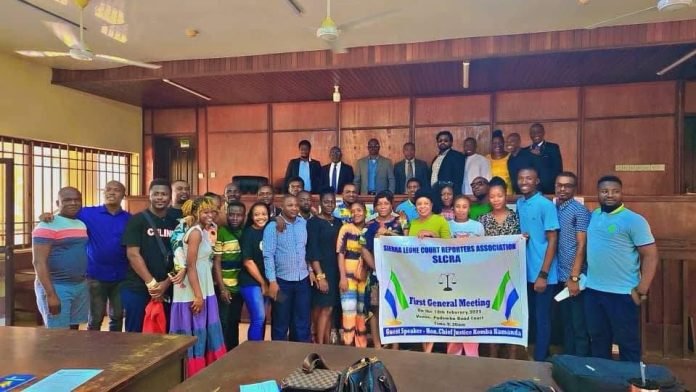
The Judiciary of Sierra Leone witnessed a historic moment on Tuesday, February 18, 2025, as the Sierra Leone Court Reporters Association (SLCRA) held its first Annual General Meeting (AGM) in 17 years. Despite the Republic of Sierra Leone Armed Forces Day public holiday halting regular court sittings, a special court session was convened at Court No. 1, Pademba Road Courts, to mark the milestone event.

Justice Momoh-Jah Stevens presided over the session, alongside Magistrates Sahr Kekura and Santigie Bangura, with the Judiciary’s Head of Communications and Public Relations, Elkass I.L. Sannoh, in attendance. The SLCRA delegation was led by its President, Salifu I.B.S. Conteh and Vice President, Jane Mansaray, while the Sierra Leone Association of Journalists (SLAJ) was represented by its President, Ahmed Sahid Nasralla, Secretary General Alhaji Manika Kamara and Financial Secretary Mohamed Konneh.

In his opening remarks, SLCRA President, Salifu Conteh, emphasized the necessity of professional training in court reporting, noting that court reporters are not mere social media commentators but key contributors to judicial transparency. He urged reporters to deepen their understanding of legal frameworks, including the newly enacted Criminal Procedure Act 2024, to enhance the accuracy of judicial reporting.

Delivering the keynote address, Justice Momoh-Jah Stevens underscored the significance of court reporting in strengthening judicial accountability and transparency. He highlighted the necessity for court reporters to be well-versed in procedures across all levels of the judiciary; from the Magistrate Court to the Supreme Court. Stressing the importance of factual and impartial reporting, he called on SLAJ to collaborate with international partners, such as the United Nations Development Programme (UNDP), to facilitate capacity-building initiatives for court reporters.

Justice Momoh-Jah Stevens reaffirmed the Judiciary’s commitment to an open-door policy under Chief Justice Komba Kamanda, assuring court reporters of continued engagement to ensure accuracy in judicial reportage. He also encouraged reporters to uphold ethical standards, emphasizing that professional reporting plays a crucial role in fostering public confidence in the judiciary.

Magistrate Sahr Kekura provided insights into the rules governing Magistrate Court proceedings, highlighting common legal misunderstandings among reporters. He clarified terminologies such as ‘discharged’ versus ‘acquitted and discharged’ and reinforced that bail remains free unless specific legal grounds dictate otherwise.

Magistrate Santigie Bangura, in his submission, elaborated on the critical role of court reporters in shaping public perception of the judiciary. He emphasized that accurate, responsible reporting strengthens judicial credibility and enhances transparency in the legal system.

SLAJ Secretary General Alhaji Manika Kamara commended SLCRA for successfully organizing its first AGM, attributing the milestone achievement to financial support from the government’s annual subvention to SLAJ. He encouraged court reporters to formalize their SLAJ membership, as eligibility for leadership roles within SLCRA is contingent on affiliation with the parent body.

SLAJ President Ahmed Sahid Nasralla extended gratitude to the Judiciary for its continued support of court reporters and called for greater collaboration between SLAJ and the Judiciary to advance ethical court reporting. As he nears the end of his tenure, he expressed appreciation for the trust placed in him by the media fraternity over the past five years.

The event concluded with a constitutional review session, moderated by lawyer Edward Ishmail Saidu Kanu of Davies & Dainkeh Law Firm, setting the stage for SLCRA’s operational framework moving forward. The AGM was adjourned to the same time next year, marking the beginning of a new era for court reporting in Sierra Leone.

With the Judiciary’s firm backing and the commitment of stakeholders, Justice Momoh-Jah Stevens’ call for enhanced professionalism and training in court reporting is expected to drive meaningful progress in the sector.