The Environment Protection Agency Sierra Leone has concluded its three-day Collaborating, Learning and Adapting (CLA) Conference, with stakeholders highlighting key environmental and public health concerns, including lead exposure, plastic pollution and threats to protected areas.
The conference ended on Thursday, March 26, at the Freetown City Council Auditorium, bringing together policymakers, experts and development partners.
On the final day, panel discussions focused on various topics including conservation planning, marine governance and pollution control.
A session on the Western Area Peninsular Project looked at conservation priorities in the Western Area Peninsula National Park, with participants stressing the need for data-driven planning to address growing environmental pressure.
Another panel discussed lessons from Sierra Leone’s Biodiversity Beyond National Jurisdiction (BBNJ) process, highlighting the need to strengthen systems for managing marine resources.
During another separate discussion on the Lead Exposure Elimination Project (LEEP), experts raised concerns about the dangers of lead poisoning.
Ibrahim Mansaray, Chemical Control Officer at the EPA, said lead contributes to about 1.6 million deaths globally each year. He added that an estimated 2.3 million children in Sierra Leone have high levels of lead in their blood.
He also revealed that tests on 27 paint samples collected in Freetown showed that 47 percent contained high levels of lead, including one imported paint with over 32,000 parts per million.
EPA Manager, Gibrilla Kamara said Government has a responsibility to strengthen regulations to protect citizens, especially women and children, while ensuring compliance with international standards.
Mohamed Bah of the Sierra Leone Standards Bureau noted that efforts are ongoing to align national regulations with ECOWAS standards, but pointed out challenges in laboratory capacity for paint testing.
Delivering her remarks, the Deputy Minister of Environment and Climate Change, Mimi Sobba-Stephens, called for stronger plastic laws to address pollution.
She said poor disposal of plastics continues to affect the environment and public health and emphasized that proper legislation would reduce single-use plastics, improve waste management and create jobs. She also highlighted collaboration between the National Waste Management Organisation and the Freetown City Council to improve waste systems.
Meanwhile, the Executive Director of the National Protected Area Authority, Sheikh Ahmed Tunis, warned that Freetown could face a serious water crisis within five years if the Western Area Peninsula is not protected.
He said the park is critical for protecting the Guma Dam, which supplies water to the city and plays a key role in biodiversity and climate resilience.
The conference ended with calls for stronger collaboration and practical actions to address Sierra Leone’s environmental challenges.
ECOWAS Ministers Convene in Freetown to Drive West Africa’s Digital Transformation Agenda
By Foday Moriba Conteh
Ministers responsible for Telecommunications, Information and Communication Technologies (ICT) and Digitalization from across the Economic Community of West African States converged in Freetown on Friday, March 27, 2026, for the 20th ECOWAS Ministerial Meeting, in what has been widely described as a pivotal moment for advancing regional digital transformation and integration in West Africa.
Hosted by the Government of Sierra Leone, the high-level meeting brought together policymakers, technical experts, development partners and private sector stakeholders in a hybrid format, allowing participation both physically in Freetown and virtually. The gathering underscored a shared commitment among ECOWAS member states to harness digital technologies as a catalyst for economic growth, innovation and inclusive development.
The meeting followed four days of intensive technical deliberations by experts from member states, whose recommendations formed the basis of ministerial discussions. Those preparatory engagements highlighted the increasing recognition across the sub-region that digitalization is central to unlocking productivity, enhancing governance and expanding opportunities for citizens.
Proceedings commenced with an opening session marked by high-level statements from key officials, including Sierra Leone’s Minister of Planning and Economic Development, Madam Kenyeh Barlay, ECOWAS Commissioner for Infrastructure, Energy and Digitalization, Sediko Douka, and other regional stakeholders. The session was formally opened by Sierra Leone’s Minister of Communication, Technology and Innovation, Madam Salima Monorma Bah, who also chaired the meeting.
In her remarks, Madam Kenyeh Barlay emphasized the transformative potential of digital investments, noting that strengthening digital infrastructure and services is essential for improving public service delivery and stimulating economic growth. She highlighted Sierra Leone’s leadership within ECOWAS under President Julius Maada Bio, stressing that digital transformation aligns with one of his administration’s key priorities; unlocking economic integration within the region.
“A harmonized digital market allows our youth, entrepreneurs and SMEs to trade across borders as easily as they do within their own communities,” she stated, reinforcing the vision of an “ECOWAS of People.”
Delivering a keynote address, Vice President of Sierra Leone, Dr. Mohamed Juldeh Jalloh, underscored the urgency of deepening regional cooperation to build a unified digital market. He emphasized that such a market would reduce the cost of doing business, enable cross-border trade and create tangible opportunities for citizens across West Africa.
He further noted that under the leadership of Julius Maada Bio as Chair of the ECOWAS Authority of Heads of State and Government, there is a need to prioritize interoperable digital infrastructure built on inclusivity, accessibility and strong governance frameworks. Officially opening the ministerial discussions, the Vice President called for practical and forward-looking decisions that would translate policy commitments into real benefits for citizens, stressing the importance of expanding access, strengthening digital trust and ensuring no one is left behind.
Adding a regional perspective, Lacina Konè, Director General and CEO of Smart Africa, highlighted the importance of policy harmonization, coordinated implementation and shared infrastructure in achieving successful digital transformation. He referenced the Cotonou Declaration as a key milestone in strengthening regional cooperation and sustaining momentum toward a unified digital future.
Similarly, ECOWAS Commissioner for Internal Services, Habib Yaya Bappah, commended Sierra Leone for hosting the meeting and acknowledged the growing role of ICT in driving regional development. He pointed to significant progress made across the region, including the operationalization of Cyber/ICT Confidence Building Measures, the establishment of an Information Sharing and Analysis Centre, bilateral roaming agreements and the consolidation of common positions for international spectrum negotiations.
He further highlighted institutional advancements such as the creation of Digital Forensics Laboratories, strengthened national Computer Security Incident Response Teams (CSIRTs), regional hackathons and the development of a harmonized e-government strategy. Those efforts, he noted, are critical to building a resilient and secure digital ecosystem in West Africa.
Madam Salima Monorma Bah, in her statement, stressed the need for deeper integration across digital platforms in the region. She pointed out that while countries have made strides in developing innovative systems, the real challenge lies in ensuring interoperability across borders.
“By aligning our policies on data protection and cybersecurity, and collectively tackling the growing threat of disinformation, we are not just connecting technologies; we are securing a resilient and inclusive digital economy for every citizen in the ECOWAS region,” she said.
Central to the ministerial discussions was a comprehensive suite of policy and regulatory instruments aimed at harmonizing the digital landscape across member states. Key among those was the Revised Supplementary Act on Personal Data Protection, designed to safeguard citizens’ information and build trust in digital systems.
Ministers also reviewed updated cybersecurity frameworks, a Regional E-Government Strategy to modernize public service delivery and initiatives to harmonize electronic communication regulations. The continued implementation of regional roaming frameworks, as well as collaborative work on open data and cybercrime, featured prominently in discussions.
The meeting progressed through structured sessions, including the presentation of the Experts’ Meeting report, deliberations on its recommendations and the eventual adoption of both the report and its accompanying policy directions. Ministers also addressed emerging issues affecting the ICT sector, fostering dialogue on challenges and opportunities within the rapidly evolving digital landscape.
Throughout the deliberations, there was a strong emphasis on translating policy into action. Ministers focused on practical measures to expand broadband access, strengthen regulatory frameworks, build human capacity and support innovation ecosystems capable of sustaining long-term growth.
The meeting concluded with the adoption of a final report prepared by the ECOWAS Commission Secretariat, which is expected to guide future policy implementation and collaborative initiatives across member states. Closing remarks from participating Ministers reaffirmed a shared commitment to sustained cooperation and collective action in achieving the region’s digital transformation goals.
With the session coming to an end, a clear consensus emerged: West Africa’s digital transformation is gaining momentum. Strengthened regional cooperation, harmonized policies and a shared vision are pointers that ECOWAS member states are positioning themselves to fully harness the opportunities of the digital age, paving the way for improved connectivity, enhanced service delivery and inclusive economic growth across the region.
Gendemeh, Saquee and Associates, led by Kai Joseph Saquee, has secured the dismissal of an injunction filed by House of Stars Season 2 winner, Babina Simeon, against Valentine Mark King, in a bid to halt the staging of House of Stars Season 3 scheduled for March 29, 2026.
Babina Simeon, popularly known as Lolo Simeon, had taken legal action against the producer of the show, seeking an interim injunction to stop the commencement and airing of Season 3.
The matter was heard at the Fast Track and Admiralty Court in Freetown, where the claimant’s legal team argued for an order to restrain the production of the upcoming season. However, the Defence Team from Gendemeh, Saquee and Associates represented by Joseph Kai Saquee, strongly opposed the application.
Following intense legal arguments from both sides, the presiding judge, Justice Leonard Taylor, rejected the application for injunctive relief filed by Babina Simeon.
In her application, Babina Simeon had also sought a court order to restrain the show’s producers, Kings Empire, from requiring her to participate in promotional activities for Season 3. Her argument was anchored on Clause 5 of the contract she signed with the show’s Management, which she claimed exempted her from obligations tied to subsequent seasons.
However, Justice Leonard Taylor ruled that the claimant failed to establish sufficient legal grounds for the granting of the injunction. The court found that the relief sought was not justified based on the facts and arguments presented.
The ruling effectively clears the way for House of Stars Season 3 to proceed as scheduled, while affirming that Babina Simeon remains bound by the terms of her contract, including any promotional responsibilities stipulated therein.
That decision marks another development in what has become a contentious relationship between the Season 2 winner and the show’s organizers and adds to the growing public conversation in Sierra Leone contractual obligations, artist rights and transparency within the entertainment industry.
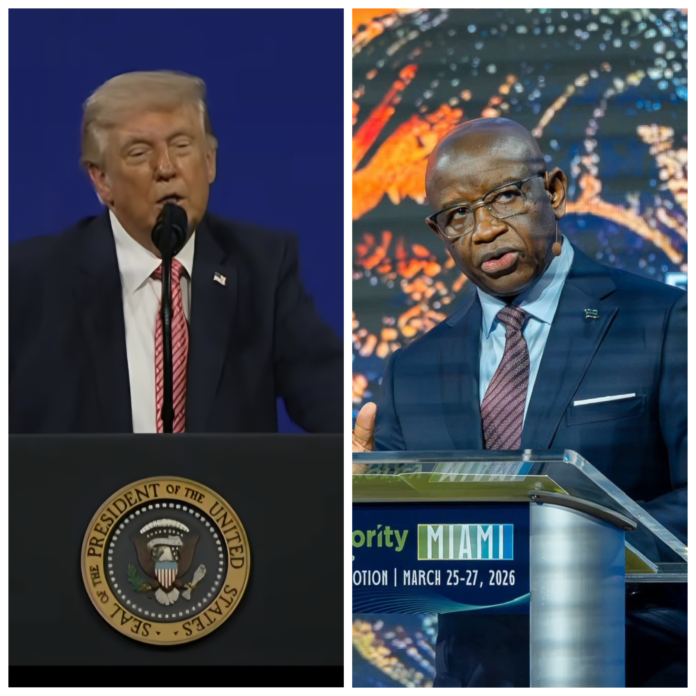
U.S. President Donald Trump has recognized Sierra Leone’s President Julius Maada Bio, during his closing presidential address at the 4th FII PRIORITY Summit on Friday March 27, 2026 in Miami, Florida, describing world leaders in attendance as “incredible people doing incredible work.”
The recognition came at the climax of the high-level global investment forum, which brought together Heads of State, policymakers, investors and business leaders from across the world to deliberate on pressing global challenges and opportunities. President Trump, addressing the distinguished audience, praised the caliber of leadership present and underscored the importance of collective global action in shaping economic growth and resilience.
“We have some of the most respected leaders in the world here tonight… Presidents, Prime Ministers and top officials… it’s an honor to have you all with us… truly incredible people doing incredible work,” President Trump stated in his closing remarks.
Although the acknowledgment was delivered collectively, President Julius Maada Bio, who was among the prominent leaders present at the summit, received a special commendation from President Donald Trump. “ Also, I want to thank the President of Sierra Leone, Julius Maada Bio…..Maada Bio, I love that name, thank you…”.
It marked a significant moment for Sierra Leone’s growing visibility and influence on the global stage. His participation reflects the country’s increasing engagement in international dialogue on development, investment and economic transformation.
Earlier, President Bio delivered a keynote address at the summit, calling for a more inclusive and equitable global economic system. He urged world leaders, investors and development partners to prioritize human capital development and sustainable growth as central pillars for addressing global inequality and fostering long-term resilience.
“Our focus is on building human capital as the most sustainable pathway to economic transformation,” President Bio stated, highlighting the importance of education as a driver of national development. He pointed to Sierra Leone’s flagship Free Quality Education initiative as a transformative policy expanding access to learning and improving outcomes for young people nationwide.
President Bio emphasized the urgent need for strengthened global cooperation to tackle shared challenges such as economic inequality, climate change and limited access to quality education. He noted that Africa, and Sierra Leone in particular, is ready to engage meaningfully with international stakeholders to unlock opportunities for innovation and growth.
He further called for responsible and impact-driven investment, urging global investors to align profitability with social value. According to him, investments in developing countries should go beyond financial returns to create jobs, strengthen institutions and improve livelihoods.
On climate change, President Bio raised concern about the disproportionate impact of environmental challenges on vulnerable nations. He called for increased international support to finance adaptation and mitigation efforts, while reaffirming Sierra Leone’s commitment to sustainable environmental management.
On the margins of the summit, President Bio also held bilateral discussions with Ecuador’s Vice President, María José Pinto González Artigas, focusing on strengthening cooperation in key areas such as education, healthcare, gender equality and women’s empowerment. Both sides expressed optimism about building a mutually beneficial partnership.
The FII PRIORITY Summit continues to serve as a strategic platform for advancing dialogue on global investment, innovation and inclusive growth. President Trump’s recognition of world leaders, including President Bio, coupled with the Sierra Leonean leader’s strong advocacy for inclusive development, reinforced the central message of the summit: that global progress depends on visionary leadership, strategic partnerships and a shared commitment to building a more equitable and sustainable future.
U.S. President Donald Trump recognized Sierra Leone’s President Julius Maada Bio during his closing presidential address at the 4th FII PRIORITY
By Amin Kef (Ranger)
U.S. President Donald Trump has recognized Sierra Leone’s President Julius Maada Bio during his closing presidential address at the 4th FII PRIORITY Summit on Friday March 27, 2026 in Miami, Florida, describing world leaders in attendance as “incredible people doing incredible work.”
The recognition came at the climax of the high-level global investment forum, which brought together heads of state, policymakers, investors and business leaders from across the world to deliberate on pressing global challenges and opportunities. President Trump, addressing the distinguished audience, praised the caliber of leadership present and underscored the importance of collective global action in shaping economic growth and resilience.
“We have some of the most respected leaders in the world here tonight… presidents, prime ministers, and top officials… it’s an honor to have you all with us… truly incredible people doing incredible work,” President Trump stated in his closing remarks.
Although the acknowledgment was delivered collectively, President Julius Maada Bio was among the prominent leaders present at the summit, marking a significant moment for Sierra Leone’s growing visibility and influence on the global stage. His participation reflects the country’s increasing engagement in international dialogue on development, investment and economic transformation.
Earlier, President Bio delivered a keynote address at the summit, calling for a more inclusive and equitable global economic system. He urged world leaders, investors and development partners to prioritize human capital development and sustainable growth as central pillars for addressing global inequality and fostering long-term resilience.
“Our focus is on building human capital as the most sustainable pathway to economic transformation,” President Bio stated, highlighting the importance of education as a driver of national development. He pointed to Sierra Leone’s flagship Free Quality Education initiative as a transformative policy expanding access to learning and improving outcomes for young people nationwide.
President Bio emphasized the urgent need for strengthened global cooperation to tackle shared challenges such as economic inequality, climate change and limited access to quality education. He noted that Africa, and Sierra Leone in particular, is ready to engage meaningfully with international stakeholders to unlock opportunities for innovation and growth.
He further called for responsible and impact-driven investment, urging global investors to align profitability with social value. According to him, investments in developing countries should go beyond financial returns to create jobs, strengthen institutions and improve livelihoods.
On climate change, President Bio raised concern about the disproportionate impact of environmental challenges on vulnerable nations. He called for increased international support to finance adaptation and mitigation efforts, while reaffirming Sierra Leone’s commitment to sustainable environmental management.
On the margins of the summit, President Bio also held bilateral discussions with Ecuador’s Vice President, María José Pinto González Artigas, focusing on strengthening cooperation in key areas such as education, healthcare, gender equality and women’s empowerment. Both sides expressed optimism about building a mutually beneficial partnership.
The FII PRIORITY Summit continues to serve as a strategic platform for advancing dialogue on global investment, innovation and inclusive growth. President Trump’s recognition of world leaders, including President Bio, coupled with the Sierra Leonean leader’s strong advocacy for inclusive development, reinforced the central message of the summit: that global progress depends on visionary leadership, strategic partnerships and a shared commitment to building a more equitable and sustainable future.
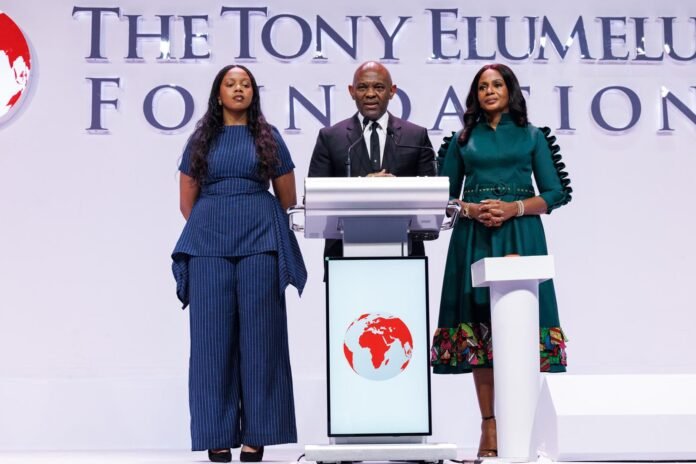
Oge Elumelu, daughter of Founder and Co-Founder, Tony Elumelu Foundation; Tony O. Elumelu, CFR, Founder, Tony Elumelu Foundation, Dr Awele V. Elumelu, OFR, Co-Founder, Tony Elumelu Foundation
FOR IMMEDIATE RELEASE
Over 27,000 Africans empowered by TEF Entrepreneurship Programme
51% Women in 2026 Cohort, Signalling Rise of Female-Led Enterprises
$16 Million to Be Deployed through TEF Entrepreneurship Programmes in 2026 to Fund African Entrepreneurs
Abuja, Nigeria – March 22, 2026 – The Tony Elumelu Foundation (TEF), Africa’s leading philanthropy empowering entrepreneurs, has announced 3,200 young African entrepreneurs across all 54 African countries for the 2026 cycle of the TEF Entrepreneurship Programmes; driving poverty alleviation, catalysing job creation and ensuring inclusive economic empowerment.
With this latest announcement, TEF has now funded, trained and mentored over 27,000 African entrepreneurs, reinforcing its position as the largest private-sector driver of entrepreneurship in Africa. This underpins TEF’s stance on Africapitalism; Tony Elumelu’s economic belief that African entrepreneurs are the key drivers of the continent’s socio-economic transformation.
The 2026 cohort reflects the diversity, ambition and resilience of Africa’s entrepreneurial ecosystem, with 51% women, 75% aged 18–35, reinforcing youth-driven economic transformation, 30% from rural communities, expanding access beyond urban centres and 13 selected entrepreneurs reported to be thriving with disabilities. The 2026 Tony Elumelu Entrepreneurs’ businesses span sectors including agriculture, AI, green economy, healthcare and fintech. Crucially, 91% of selected entrepreneurs are at idea or early-stage, underscoring TEF’s role as a true last-mile enabler of opportunity.
In 2026, the Tony Elumelu Foundation will empower:
1,751 entrepreneurs via Heirs Holdings Group companies – Heirs Energies, Transcorp Power, Transcorp Hotels, and United Capital
1,049 entrepreneurs in partnership with the European Commission, OACPS, BMZ and GIZ
100 entrepreneurs in partnership with Sèmè City Development Agency
100 entrepreneurs in partnership with DEG, the German Development Agency
100 entrepreneurs in partnership with the IKEA Foundation, UNICEF’s Generation Unlimited and the Dutch Government
100 entrepreneurs in partnership with UNDP and the Rwandan Ministry of Youth and Arts
The announcement, held at the Transcorp Hilton, Abuja and broadcast globally, marks the 2026 cycle of the TEF Entrepreneurship Programme, with entrepreneurs selected from over 265,000 applications, one of the largest entrepreneurial selections on the continent.
The 2026 applications successfully submitted on TEFConnect, TEF’s proprietary digital platform, were subject to TEF’s rigorous and highly competitive selection process, where applicants were assessed on their demonstrated financial understanding and entrepreneurial mindset, as well as the feasibility, demand and scalability of their business ideas. This year’s cohort reflects the depth of entrepreneurial talent across the continent, with strong representation across key sectors including agriculture, artificial intelligence, healthcare, and the green economy.
The selection process was conducted by Ernst & Young, to ensure independent assessment.
Each selected Tony Elumelu Entrepreneur will receive $5,000 non-refundable seed capital, a world-class business training on TEFConnect, one-on-one mentorship, and access to global networks and investment opportunities.
Speaking at the announcement, Tony O. Elumelu, C.F.R., Founder of TEF and Group Chairman of Heirs Holdings said, “What we do is about democratizing luck and spreading prosperity, because everyone deserves the opportunity to succeed. I believe that no one but us will develop Africa. I also believe that the future of our continent is in the hands of our youth. What we do at the Tony Elumelu Foundation is not because we have so much to spread but because we see it as self-enlightened interest to make sure that everyone is given the opportunity to succeed. Because poverty, anywhere, is a threat to all of us everywhere. So the more prosperity we spread and we share, the more young Africans will mobilise, realising that one person alone cannot change Africa.
To our 2026 Tony Elumelu Foundation beneficiaries, I say congratulations. Your success will make the difference.”
Dr. Awele Elumelu, OFR, TEF Co-Founder, emphasized the scale of unmet demand, “ I want to again continue to encourage those who have not been selected this year. Don’t give up. There is still hope.
We received over 265,000 applications, yet only 3,200 could be selected. This is why we continue to call on partners to join us. The future of Africa is indeed in the hands of these young entrepreneurs.”
Somachi Chris-Asolula, TEF CEO added, “We received over 265,000 applications from across the entire continent. 265,000 individuals who have chosen not to wait, but who have chosen to create. Today, we are celebrating all African entrepreneurs. We are celebrating the African entrepreneurial spirit, a spirit of resilience, hard work, capacity, and immense talent. Under Tony Elumelu’s visionary leadership and strategic guidance, we are empowered and committed in making sacrifices to ensure that our young African entrepreneurs help us eradicate poverty, ensure inclusive economic empowerment, and create the millions of jobs that our continent so desperately deserves.”
Oge Elumelu, daughter of the Founder and co-Founder of TEF reflected on the Tony Elumelu Foundation’s journey, “Being able to witness the unravelling of this year’s selection process is truly exciting. And having been in attendance from the first TEF Forum, which was in 2015, to seeing where it is now is truly just incredible. And so I am really honoured to be here. And well done and congratulations to the 2026 cohort.”
Since its inception, the Tony Elumelu Foundation has:
For Media Inquiries: moyo.awotile@tonyelumelufoundation.org
Partner, TEF Alumni and TEF Mentor Testimonials at the Ceremony
“Our partnership with the Tony Elumelu Foundation speaks volumes. Together, we are intentionally empowering young entrepreneurs, especially women, and supporting them to grow sustainable businesses that transform lives. There is nothing more transformative than enabling young African entrepreneurs to become economic drivers in their communities. What TEF is building is fundamental to Africa’s future.”
— Massimo De Luca, Head of Cooperation, EU Delegation to Nigeria
“265,000 young Africans applied this year – that alone shows the strength, ambition, and potential of this continent. What the Tony Elumelu Foundation has created is not just a legacy, it is a live wire that will continue to power Africa’s future through entrepreneurship and job creation.”
— Nadi Albino, Deputy Director UNICEF Gen-U
“We are proud to partner with the Tony Elumelu Foundation in creating hope at scale. This is how we address Africa’s biggest challenges, by empowering people to build and thrive. Our commitment is growing because we have seen the impact. When you empower entrepreneurs, you unlock opportunity, stability, and prosperity across entire regions.”
— Dr Owen Omogiafo OON, President/GCEO Transcorp Group
“Our partnership with the Tony Elumelu Foundation enables us to empower youth at scale, expanding opportunity and prosperity far beyond our core operations. Through this partnership, we continue to transform lives across Africa, and we are proud to deepen our commitment to supporting entrepreneurs and communities.”
— Osa Igiehon, CEO, Heirs Energies
“We are proud to be associated with the Tony Elumelu Foundation. The impact being generated is creating a powerful multiplier effect across Africa. Our partnership is rooted in purpose, to drive prosperity, support entrepreneurs, and ensure their success stories continue to grow across the continent.”
— Peter Ashade, Group CEO, United Capital Group
“The world doesn’t reward ideas. It does reward execution and ultimately results. Seeing thousands of entrepreneurs empowered by the Tony Elumelu Foundation is a powerful testament to the momentum of African enterprise. I am proud to be part of a mission that is investing in people, because Africa’s growth depends on it.”
— Najim Abdulrazaq, TEF Mentor
“The Tony Elumelu Foundation aligns with my core belief, that Africa’s progress will be driven by entrepreneurs solving real problems. I have seen firsthand how the Tony Elumelu Foundation equips entrepreneurs with the skills, confidence, and capital to build sustainable businesses.”
— Adaeze Charlyn Udom, TEF Mentor
Thanks to the funding from the Tony Elumelu Foundation, we’ve generated a turnover of $154,000, created 13 jobs, and trained 280 young entrepreneurs.”
Haruna Diop, Malian 2021 Tony Elumelu Foundation Alumni
“Thanks to the support from the Tony Elumelu Foundation, I was able to manage my project and spread a positive environmental impact. We also created job opportunities and helped more than 30 people.” Sabrina Berrehal, Algerian 2024 Tony Elumelu Foundation Alumni
“We have generated revenue of over $500,000 and created employment in farming for 12,000 farmer agents and aggregators. Our farmers, who previously earned $2 per day, now earn $4.50 per day.”
Aisha Langat, Kenyan 2024 Tony Elumelu Foundation Alumni
“Thanks to funding from the Tony Elumelu Foundation, we were able to increase our impact by supporting more than 15 SMEs, including 5 in the clean energy sector and 5 in bioenergy. Our company has generated $160,000 in revenue and created more than 13 jobs. We are supporting clean cooking in our community, helping reduce CO₂ emissions, combating deforestation, and promoting sustainable development.”
Prince Hangi, Congolese 2023 Tony Elumelu Foundation Alumni
“With the US $5,000 investment from the Tony Elumelu Foundation we have been able to impact over 20,000 people and that includes households and institutions such as your schools, clinics etc. We have also been able to raise US $30,000 more in funding in South Africa. We are really grateful to the Tony Elumelu Foundation for the opportunity. Thank you for making a conducive environment for economic growth.”
Kemiso Motholo, South African 2024 Tony Elumelu Foundation Alumni
Somachi Chris-Asoluka, CEO, Tony Elumelu Foundation; Tony O. Elumelu, CFR, Founder, Tony Elumelu Foundation, Dr Awele V. Elumelu, OFR, Co-Founder, Tony Elumelu FoundationOge Elumelu, daughter of Founder and Co-Founder, Tony Elumelu Foundation; Tony O. Elumelu, CFR, Founder, Tony Elumelu Foundation, Dr Awele V. Elumelu, OFR, Co-Founder, Tony Elumelu FoundationSomachi Chris-Asoluka, CEO, Tony Elumelu Foundation; Oge Elumelu, daughter of Founder and Co-Founder, Tony Elumelu Foundation; Tony O. Elumelu, CFR, Founder, Tony Elumelu Foundation, Dr Awele V. Elumelu, OFR, Co-Founder, Tony Elumelu Foundation
Njala University Officially Commences Construction of Modern Medical School in Bo
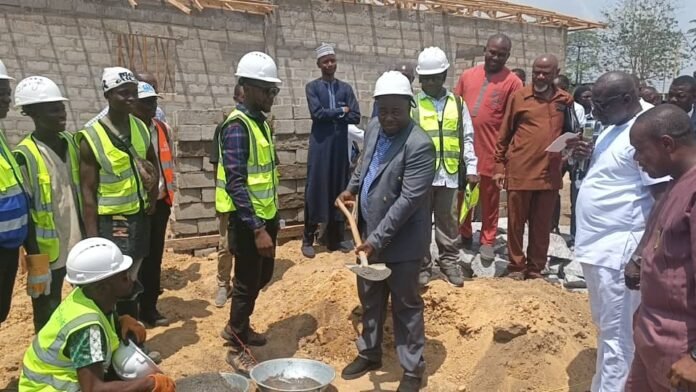
Njala University has officially commenced construction of a modern Medical School building at its Bo Campus, Kowama location, marking a significant milestone in the advancement of medical education in Sierra Leone. The sod-turning ceremony, held on March 24, 2026, brought together key stakeholders from Government, academia and the health sector, all underscoring the strategic importance of the project to national development.
Speaking at the ceremony, the Chancellor of Njala University, Professor Sahr Moses Gevao, described the occasion as a historic step toward the establishment of a fully-fledged Medical School. He noted that the university has already laid critical groundwork, including the development of anatomy and physiology laboratories, as well as the recruitment and training of qualified academic and technical personnel. He further emphasized that the medical curriculum has been carefully aligned with both national and international standards, supported by investments in essential textbooks and digital learning platforms.
The Vice-Chancellor and Principal of Njala University, Professor Bashiru Mohamed Koroma, highlighted the project as a strategic investment aimed at strengthening both medical education and the country’s healthcare system. He explained that the new facility will feature modern teaching spaces, laboratories and simulation environments designed to train competent and ethically grounded health professionals. He added that the university is adopting an integrated approach that combines education, research and service delivery, guided by the One Health framework. Professor Bashiru Mohamed Koroma commended the Government, development partners and the Bo community for their continued support, describing the project as a foundation for a lasting legacy.
Providing an overview of the project, the Director of Physical Plant Services, Santigie Sesay, disclosed that the Medical School building will be an L-shaped, two-storey structure designed to meet modern sustainability standards with a gold-standard rating. According to him, the facility will include six classrooms with a combined capacity of 1,200 students, two laboratories, four offices and adequate restroom facilities. He revealed that the project is being funded through a university bank loan and internal contributions, with construction commencing in March 2026 and to be completed by August 2026. United Construction and Engineering Services has been contracted to execute the project.
Also speaking at the event, the Deputy Vice-Chancellor for Bo Campus, Professor Rashid Ansumana, reaffirmed the university’s commitment to ensuring the successful delivery of the project. He noted that the Directorate of Physical Plant Services will closely supervise the construction process to ensure adherence to high-quality standards. He expressed confidence in the technical team, stating that the building is expected to be completed within five months and ready for use in the next academic year.
Representing the Ministry of Health, Deputy Minister, Dr. Charles Edward Lahai Senesie described the initiative as timely and aligned with national health priorities. He stressed that Sierra Leone continues to face a shortage of trained health professionals, making investments in medical education both urgent and necessary. He added that the new facility will expand training capacity, improve learning conditions and reduce reliance on foreign institutions for medical training. Dr. Charles Edward Lahai Senesie reaffirmed the Ministry’s commitment to supporting the initiative, noting that its long-term benefits will be reflected in improved healthcare delivery nationwide.
In his remarks, the Permanent Secretary of the Ministry of Technical and Higher Education, Mohamed Sheick Kargbo, emphasized the importance of institutional self-reliance, particularly in the context of limited public resources. He commended Njala University for its proactive approach, noting that such initiatives not only enhance infrastructure but also strengthen institutional credibility and attract strategic partnerships. He encouraged continued collaboration between Government and higher education institutions to sustain progress in the sector.
The commencement of the Medical School building project marks a major step forward for Njala University and signals renewed hope for the development of a stronger, more resilient healthcare system in Sierra Leone.
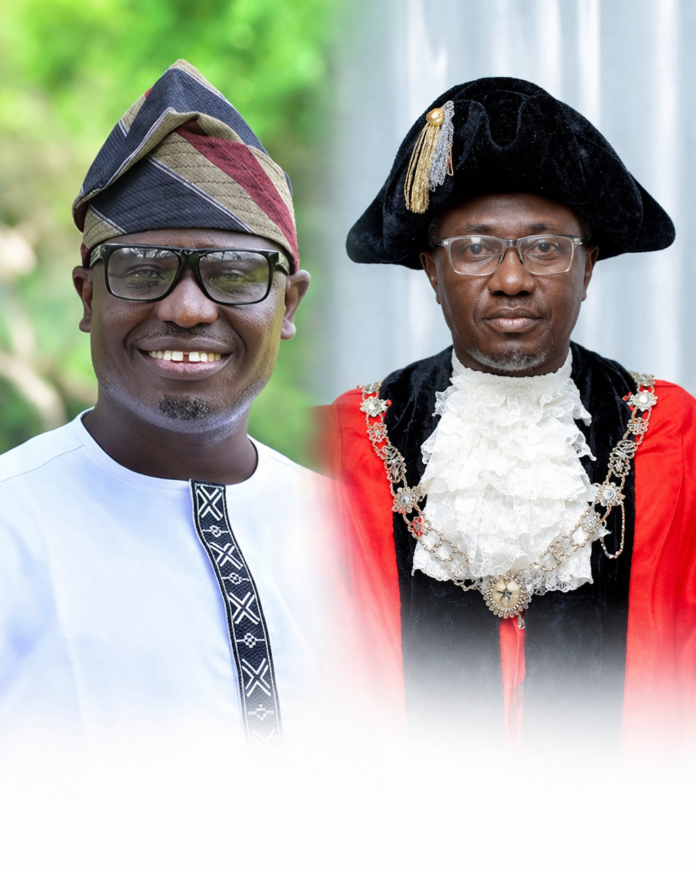
As public interest grows around the functioning of local councils, particularly in urban centres like Freetown, attention has increasingly turned to the Local Government Act 2022 and its provisions on leadership succession. Questions about who takes charge when a Mayor is absent, incapacitated or when the office becomes vacant have become central to understanding how local governance operates in Sierra Leone.
The Local Government Act 2022, which repealed and replaced the 2004 legislation, provides a detailed legal framework governing the structure, powers and administration of local councils. At the heart of this framework is the position of the Mayor, legally referred to as the District Council Chairman in the case of city and municipal councils, who serves as the political head of the local authority.
The Mayor is responsible for presiding over council meetings, overseeing development planning, ensuring implementation of council decisions and supervising administrative functions. Given the weight of these responsibilities, the law establishes clear mechanisms to ensure that leadership continues seamlessly in the Mayor’s absence or when the office becomes vacant.
A critical distinction made by the Act is between “absence” and “vacancy.” While both situations involve the Mayor not performing duties, they are treated differently under the law, with separate procedures and implications.
In cases of temporary absence, such as when the Mayor is unavailable due to travel, illness or other short-term circumstances, the law provides a straightforward line of authority. The Deputy Mayor, officially known as the Deputy District Council Chairman, immediately steps in to perform the Mayor’s duties. The Deputy Mayor is elected alongside the Mayor as a running mate, ensuring political alignment and continuity in governance.
The Act explicitly mandates that the Deputy Mayor “shall assist the District Council Chairman in the performance of his functions and act in the absence of the District Council Chairman.” This provision ensures that there is no interruption in leadership and that council operations proceed as normal.
However, the law goes a step further to address a more complex situation; what happens if both the Mayor and Deputy Mayor are absent at the same time?
In such cases, the Act empowers the council itself to maintain continuity. A Councillor is selected from among elected councillors to preside over meetings. This is not an automatic succession but rather a temporary arrangement agreed upon by council members present.
The law clearly states that “the District Council Chairman or in his absence the Deputy District Council Chairman or in his absence a Councillor appointed by the Councillors from among themselves, shall preside at meetings of the Council.”
It is important to note that in this scenario, the Councillor does not assume the office of Mayor or Deputy Mayor. Instead, the Councillor merely acts as a presiding officer for the purpose of conducting council meetings. The role is strictly temporary and limited in scope, ensuring that council deliberations and decisions are not delayed.
A more significant situation arises when there is a vacancy in the office of the Mayor. Unlike absence, a vacancy implies that the Mayor can no longer continue in office. The Act outlines several circumstances under which such a vacancy may occur, including death, resignation, removal from office, disqualification or acceptance of another public position.
When a vacancy occurs, the legal response is more structured and consequential. The Deputy Mayor steps in to assume the responsibilities of the Mayor, effectively acting as the head of the council. This arrangement underscores the importance of the Deputy Mayor’s role, not merely as an assistant but as a constitutional backup to the Mayor.
The transition is designed to be immediate, ensuring that governance does not stall. The Deputy Mayor continues to provide leadership, oversee council activities and maintain administrative stability while further legal or electoral processes are considered.
These processes may include the organisation of a by-election, particularly if the vacancy occurs early in the Mayor’s term. While the Act provides for by-elections to fill vacancies in council seats, the broader administrative and political processes involved in replacing a Mayor may require coordination with national authorities, including the Ministry responsible for local government.
An even more complex scenario arises when both the offices of Mayor and Deputy Mayor become vacant simultaneously. Although the Act does not provide a detailed step-by-step procedure for this rare occurrence, it offers enough guidance to ensure that governance continues in the interim.
In such circumstances, councillors can temporarily take charge of proceedings, particularly in presiding over meetings, while formal mechanisms are activated to address the leadership gap. These mechanisms may involve directives from the central government or the conduct of elections to fill the vacant positions.
Legal experts note that the absence of an explicit provision for simultaneous vacancies does not create a governance vacuum. Instead, it reflects the flexibility of the law, allowing institutions to rely on existing structures and administrative processes to resolve such situations.
The provisions on succession highlight the broader objectives of the Local Government Act 2022, particularly its emphasis on decentralization, accountability and institutional resilience. By clearly outlining who takes over at every level of leadership disruption, the Act ensures that local councils remain functional, responsive and capable of delivering services to citizens.
For residents, understanding these provisions is essential. It not only clarifies how decisions continue to be made during periods of leadership transition but also reinforces confidence in the stability of local governance systems.
Governance analysts argue that such clarity is critical in strengthening democratic institutions at the grassroots level. When citizens understand how leadership transitions are managed, it reduces uncertainty and promotes transparency in public administration.
Ultimately, the Local Government Act 2022 establishes a well-defined hierarchy of authority within local councils. From the Mayor to the Deputy Mayor and, when necessary, to councillors, the law ensures that leadership is always present, even in challenging circumstances.
As Sierra Leone continues to advance its decentralization agenda, the effectiveness of local councils will depend not only on leadership but also on public awareness of the legal frameworks that guide their operations. The provisions on succession serve as a vital component of that framework, reinforcing continuity, stability and accountability in local governance.
The Opposition Leader of Parliament, Abdul Kargbo, has provided a detailed clarification on the provisions of the Local Government Act 2022, emphasizing that the law does not recognize or provide for the appointment of an “Acting Mayor” in situations where both the Mayor and Deputy Mayor are absent.
His clarification comes amid increasing public debate and concerns over leadership continuity within local councils, particularly in major municipalities across the country.
Speaking on the matter, Hon. Abdul Kargbo explained that the Act only makes limited provisions to ensure that council activities, especially meetings, can proceed in the temporary absence of both the Mayor and Deputy Mayor. He pointed specifically to Section 16(3) of the Act, which states that the Mayor shall preside over council meetings or in his or her absence, the Deputy Mayor and in their absence, a councillor appointed from among elected councillors.
According to him, that provision is strictly procedural and should not be misinterpreted as conferring executive authority on any councillor selected to preside over such meetings. “The law is very clear. The Councillor appointed in such circumstances is only mandated to preside over meetings. That role does not translate into assuming the office or powers of the Mayor,” he stated.
Hon. Abdul Kargbo further stressed that the absence of a Mayor does not in itself create a vacancy in the office. He referenced Section 13(1) of the Act, which outlines specific conditions under which the office of Mayor can be declared vacant. Those include death, resignation, lawful removal from office, disqualification or any other circumstances provided for under the law.
He maintained that unless one of those conditions is met, the office remains legally occupied, regardless of whether the Mayor is temporarily unavailable. “Temporary absence or unavailability does not constitute a vacancy in law and cannot be used as a basis for any individual to assume or exercise the powers of the office outside what the Act provides,” he emphasized.
The Opposition Leader also highlighted the critical role of the Deputy Mayor in maintaining continuity in local governance. He noted that the Act empowers the Deputy Mayor to act in the absence of the Mayor, ensuring that administrative functions, decision-making processes and service delivery are not disrupted.
However, he clarified that even in situations where both the Mayor and Deputy Mayor are unavailable; the law does not permit the creation of an “Acting Mayor” position. Instead, the council may only designate a Councillor to preside over meetings on a temporary basis, strictly within the limits defined by the Act.
In addition, Hon. Abdul Kargbo underscored the importance of quorum in validating Council proceedings. Citing Section 16(6), he explained that a council meeting can only be considered legally constituted if at least half of all councillors are present. For meetings involving financial matters, the requirement is higher, with at least three-fourths of councillors required to form a quorum.
He warned that any decisions taken in the absence of the prescribed quorum would lack legal validity and could be subject to challenge. “Without quorum, there is no legal competence for the council to deliberate or make binding decisions,” he noted.
Observers say the clarification provided by Hon. Abdul Kargbo is significant in reinforcing proper interpretation of the Local Government Act 2022, particularly at a time when questions around leadership roles and authority within local councils continue to emerge.
Governance experts argue that the Act draws a clear distinction between “absence” and “vacancy,” ensuring that while administrative continuity is preserved, the integrity of legally established offices is not compromised.
They further note that by limiting the role of Councillors in such situations to presiding over meetings, the law prevents the unauthorized assumption of executive powers and safeguards the structure of local governance.
Hon. Abdul Kargbo’s position ultimately underscores the importance of strict adherence to the law in managing leadership transitions, ensuring that governance at the local level remains both effective and legally sound.
Councillor Ibrahim Gbla, a member of the ruling Sierra Leone People’s Party (SLPP), who was appointed by SLPP Councillors as Acting Mayor, has publicly rejected being referred to as the Acting Mayor of the Freetown Municipality, clarifying that his role is limited to leading the party’s Councillors at the City Council.
In a viral video currently circulating on Social Media, Ibrahim Gbla, who was interviewed by a journalist, dismissed claims that he had been designated as Acting Mayor. He emphasized that his appointment by the SLPP was strictly to serve as leader of the party’s 18 councillors within the Freetown City Council.
“I want to make it clear that I am not an Acting Mayor; my party has asked me to serve as the SLPP Councillors’ leader at council. If you look at my social media page, there is nothing like Acting Mayor,” he stated.
The clarification comes amid growing public discussion about his role, with some earlier narratives suggesting that he had assumed an Acting Mayoral position.
Public confidence in the independence of media and civil society institutions in Sierra Leone is facing renewed scrutiny, following the release of a citizens’ perception survey conducted by CHRDI. The findings paint a concerning picture of declining trust in institutions traditionally regarded as watchdogs of democracy.
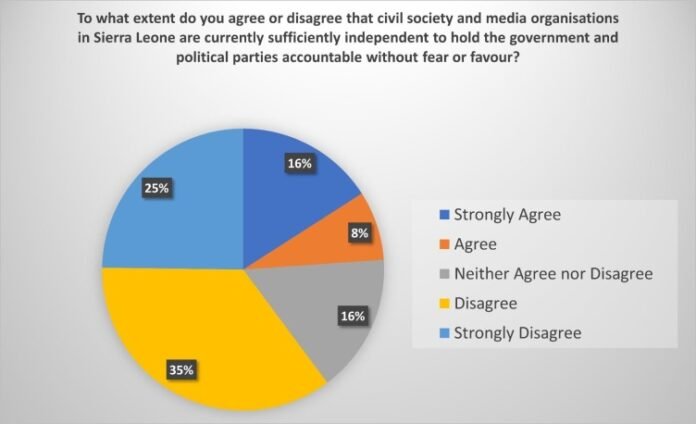
According to the poll, a significant majority of respondents expressed doubt about the ability of media and Civil Society Organizations to hold Government and political actors accountable without fear or favour. The data indicates that approximately six in ten citizens believe those institutions are not sufficiently independent, raising serious questions about the strength of democratic oversight in the country.
A breakdown of the survey results shows that 35% of respondents disagreed with the notion that media and civil society are independent, while an additional 25% strongly disagreed. In contrast, only 16% strongly agreed and 8% agreed that those institutions operate freely and without undue influence. Meanwhile, 16% of respondents remained neutral, suggesting a segment of the population that could be influenced by future developments in governance and accountability.
Analysts say the disparity between negative and positive perceptions, captured in what has been described as a “6-to-2 ratio”, underscores a growing credibility gap. Particularly notable is the intensity of sentiment among respondents, with those who “strongly disagree” outnumbering those who “strongly agree” by nearly ten percentage points. That imbalance signals not only skepticism, but also deep-seated concern about institutional performance.
Observers have warned that such perceptions, if left unaddressed, could weaken public trust in democratic processes. Media and Civil Society Organizations are widely regarded as essential pillars in promoting transparency, amplifying citizen voices and checking excesses of power. When those institutions are perceived as constrained, whether by political pressure, economic influence or fear, the broader system of accountability risks erosion.
Equally important is the group of undecided respondents, which constitutes 16% of those surveyed. Experts suggest this “silent middle” represents an opportunity for reform-minded actors. By demonstrating professionalism, courage and independence in reporting and advocacy, media houses and Civil Society Organizations could rebuild confidence and strengthen their legitimacy in the eyes of the public.
The findings come at a time when conversations around governance, transparency and civic engagement are gaining momentum across Sierra Leone. Stakeholders have increasingly emphasized the need for institutional reforms, legal protections and ethical standards that safeguard the independence of journalists and civil society actors.
Ultimately, the survey serves as both a warning and a call to action. A resilient democracy depends on fearless institutions capable of speaking truth to power. Rebuilding public trust will require deliberate efforts to ensure that accountability mechanisms function without intimidation or compromise, allowing citizens to once again believe that their voices and the institutions that represent them can operate freely and effectively.