
Home Blog Page 68

Lǒr Restaurant Raises the Bar for World-Class Cuisine in Freetown

By Foday Moriba Conteh

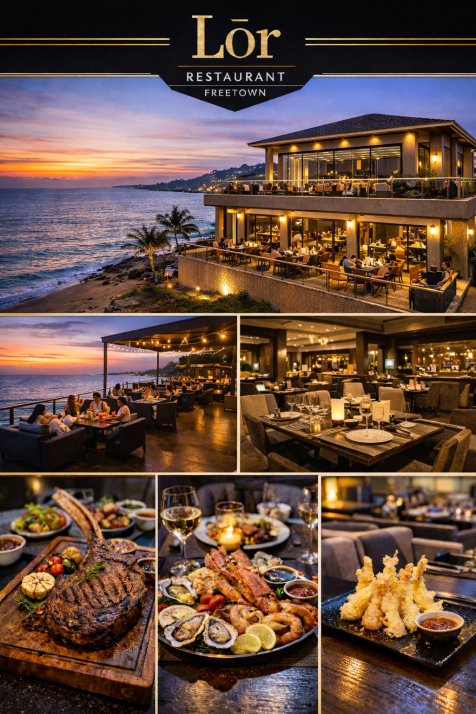
Freetown’s fast-evolving hospitality industry has gained a glittering new star with the emergence of Lǒr Restaurant, an upscale dining destination already reshaping culinary expectations in Sierra Leone.

Located along the scenic Goderich–Peninsular corridor in Juba, the restaurant has become one of the capital city’s most talked-about venues; offering an inspired blend of global flavours, refined ambience and attentive service that appeals to cosmopolitan diners and casual food lovers alike.

Lǒr Restaurant stands apart for its seamless fusion of authentic Sierra Leonean favourites with some of the world’s most celebrated culinary traditions. Diners experience exquisite selections ranging from classic Italian pastas and Japanese sushi to richly spiced Indian and Lebanese dishes.

At the heart of Lǒr’s menu is a promise of craftsmanship. A brigade of international and locally trained chefs meticulously curate every plate, combining fresh ingredients with inventive presentation and bold flavour profiles.

“We serve food we are proud of,” a member of the kitchen team revealed.
“Each dish reflects quality, passion and creativity.”

Lǒr sources ingredients from trusted local suppliers; a move that guarantees freshness while supporting agriculture and small producers across the value chain.

Guests stepping into Lǒr are greeted by a modern, stylish atmosphere that blends open-air relaxation with contemporary elegance. Floor-to-ceiling glass design, calming lighting and a panoramic rooftop space overlooking the Atlantic provide the setting for memorable meals, celebrations and business gatherings.

Whether enjoying an intimate dinner or a lively weekend outing, guests say the ambience lifts the dining experience beyond the ordinary.

A defining hallmark of Lǒr Restaurant’s success is its polished service culture.
The professional front-of-house team is known for friendliness, attention to detail and consistently warm interactions.

“Our goal is to make every guest feel valued,” a staff supervisor noted.
“Dining should be an experience; not just a meal.”

The restaurant also stands ahead on convenience, offering multiple payment options including Visa, Mastercard, mobile transfers and cash; an added comfort for international travelers and corporate visitors.

Ample parking and valet support further reduce the typical stress associated with busy dining districts.

While Lǒr continues to win rave reviews, particularly for its signature grilled meats, pasta selections and Insta-famous golden tomahawk steak; some guests have noted peak-hour delays and occasional inconsistencies in high-demand items such as sushi.

Management has assured patrons that continuous improvement is underway, including strengthened staff training and streamlined kitchen operations to deliver faster, more consistent service.

Lǒr Restaurant’s rise comes at a time of renewed interest in Sierra Leone as a leisure and tourism destination. Growing numbers of residents, expatriates and visitors are demanding world-class dining, and establishments like Lǒr are helping redefine the capital’s modern identity.

Industry watchers say the restaurant contributes to expanding employment, raising culinary standards and placing Freetown on the map of competitive West African dining cities.

With word-of-mouth recommendations multiplying and social media attention surging, Lǒr Restaurant is poised for growth. Guests continue to return for birthdays, romantic dinners, corporate lunches and relaxed evening outings—each visit promising an experience worth sharing.

From the first bite to the final farewell, Lǒr positions itself not merely as a restaurant, but as a lifestyle destination—a place where food, culture and atmosphere unite on the shores of the Atlantic.

Key Information

Address: Peninsular Highway, Juba, Freetown
Phone: +232 90 002000
Cuisine: Sierra Leonean, Italian, Japanese, Lebanese, Indian, International
Hours: 9:00AM – 11:00PM (Weekdays), open till 12:15AM (Weekends)
Payments: Cash, Visa, Mastercard, Digital Transfers

Lǒr Restaurant — Where Fine Dining Meets the Atlantic Horizon

President Bio Declares 2026 a “Year of Action,” Urges Unity, Discipline, and Shared Responsibility

President Dr. Julius Maada Bio

By Amin Kef (Ranger)

President Dr. Julius Maada Bio has called on Sierra Leoneans at home and abroad to embrace 2026 as a decisive “Year of Action,” stressing that the country has reached a critical turning point where stability must now translate into tangible improvements in the daily lives of citizens.

In his New Year’s Day National Address on Thursday 1 January 2026, the President struck a sober but hopeful tone, acknowledging the economic and social pressures confronting families while expressing confidence that the difficult decisions taken in recent years have laid a solid foundation for progress. He emphasized that 2026 would not be a year for “easy words or quick assurances,” but one demanding steady leadership, careful choices, and collective effort.

“Many families have begun this year with concern, but also with hope,” President Bio said, thanking Sierra Leoneans for their patience, resilience, and sense of responsibility during challenging times. He noted that citizens’ endurance had helped keep the nation steady amid global and domestic shocks.

Placing Sierra Leone’s situation within a broader global context, President Bio observed that countries worldwide are grappling with high living costs, fiscal constraints, climate pressures, and uncertainty. While acknowledging that Sierra Leone has not been immune to these realities, he insisted the country is “not helpless.”

According to the President, tough but necessary decisions taken in recent years to stabilize the economy, strengthen public institutions, and rebuild confidence are beginning to bear fruit. “The year 2026 is an important turning point,” he declared, adding that the focus must now shift from stabilization to delivery.

He outlined clear benchmarks by which government performance would be judged: improved public services, more affordable food, job creation, and effective responses to citizens’ needs. He pledged prudent management of public finances, stressing that government would live within its means, avoid short-term fixes, and ensure transparent and responsible use of public resources.

“Some decisions will be painful in the present,” he admitted, “but they are taken to protect our children’s future and prevent recurring crises.”

Food security emerged as a central pillar of the President’s address, with renewed emphasis on the Government’s flagship Feed Salone Programme, described as a cornerstone of the Big Five Game Changers. President Bio reiterated that a nation unable to feed itself remains vulnerable.

In 2026, he said, government would intensify efforts to boost domestic food production and improve the movement of produce from farms to markets. Farmers are to benefit from better inputs, equipment, storage, and transportation, measures aimed at shielding families from high food prices while giving farmers the confidence to plan and invest.

The President also highlighted agriculture as a key avenue for youth employment, noting that modern farming demands skills, organization, and commitment. “When agriculture works, it creates jobs, supports rural families, and strengthens the entire economy,” he said, framing Feed Salone as a programme rooted in dignity, work, and national self-reliance.

Reaffirming his administration’s people-centred development agenda, President Bio underscored continued investment in education, with greater attention to quality and skills that prepare young people for work and responsible citizenship. Healthcare, particularly primary care, maternal and child health, and access to essential medicines, will also remain a priority.

The President spoke firmly about the growing threat of drug abuse, especially the use of Kush, which he described as destructive to lives and communities. He pledged that those involved in the production and sale of drugs would face the full force of the law, while government would also strengthen prevention, treatment, and rehabilitation services for those seeking help.

Addressing the youth directly, President Bio urged young people to reject addiction and embrace learning, meaningful work, and discipline. “Sierra Leone needs your energy, your ideas, and your sense of responsibility,” he said.

Looking ahead, the President stressed the need to broaden the country’s economic base in 2026 and beyond. He identified agriculture and agro-processing, fisheries, mining, tourism, renewable energy, oil and gas prospects, and the digital economy as key growth sectors.

Small and Medium-Sized Enterprises (SMEs) were described as central to job creation and community development. President Bio assured local and international investors that his government remains committed to removing barriers, improving access to finance, and creating an enabling environment in which businesses can thrive.

With political parties beginning preparations for the 2028 General Elections, President Bio appealed for responsible conduct from all political actors. He warned that political competition must never undermine peace, weaken institutions, or disrupt public service delivery.

The President reaffirmed his government’s commitment to implementing the recommendations of the Tripartite Agreement, describing the reforms as essential to restoring confidence in the electoral process and rebuilding trust in democracy.

In his closing remarks, President Bio reminded Sierra Leoneans that no nation resolves all its challenges in a single year. What matters, he said, is a clear direction and the discipline to stay the course.

He called on citizens to uphold the Constitution, respect the rule of law, act with integrity, and place the national interest above narrow considerations. Drawing strength from the country’s shared religious and traditional values, he expressed confidence that unity, patience, and steady effort would yield lasting progress.

“I enter this New Year fully aware of our challenges, yet confident in our collective strength,” President Bio concluded, wishing the nation a productive, peaceful, and hopeful 2026, and invoking God’s blessings on the Republic of Sierra Leone.

SLAJ President Sets Bold Media Agenda for 2026, Reinforces Press Freedom

SLAJ president, Alhaji Manika Kamara

By Amin Kef (Ranger)

The President of the Sierra Leone Association of Journalists (SLAJ), Alhaji Manika Kamara, has extended warm New Year greetings to members of the media fraternity and reaffirmed the Association’s commitment to strengthening press freedom, institutional growth and professional excellence.

In a comprehensive New Year message marking his first six months in office, the SLAJ President highlighted achievements, ongoing reforms and renewed priorities aimed at empowering journalists and deepening the media’s role in the country’s democratic development.

Reflecting on his stewardship since assuming office, Kamara said the last six months have been defined by purposeful and inclusive leadership.

“With your trust, we have worked to lay a solid foundation for a more united, professional and resilient media sector,” he stated.

Among the achievements recorded, Kamara underscored capacity-building programmes rolled out specifically for female journalists across the country.

The initiatives, centred on Digital Media Literacy and Public Financial Management, are expected to enhance women’s visibility and influence in the newsroom and beyond.

“This journey has begun, and 2026 will bring more opportunities,” he assured.

Another milestone is SLAJ’s acquisition of plots to establish regional secretariats in the North and South — a move aimed at decentralising operations and strengthening member services outside Freetown.

Manika Kamara said the expansion was part of wider efforts to embed SLAJ’s presence in communities and ensure nationwide representation.

The SLAJ President expressed appreciation to His Excellency President Dr. Julius Maada Bio for increasing the Association’s annual subvention, describing it as recognition of the media’s democratic role.

However, Kamara struck a firm tone on independence: “Our gratitude does not dilute our mandate. SLAJ remains fearless, uncompromising, and fully committed to press freedom and media welfare.”

On recent legal reforms, SLAJ welcomed the 2025 Counterterrorism Act, particularly the amendments that reflected media concerns. He commended the Attorney General and Members of Parliament for listening to the sector.

However, Kamara emphasised that advocacy continues, with unresolved concerns around Section 44 (2) of the Cyber Security and Crime Act. SLAJ is also pushing for a dedicated chapter on media rights in the ongoing constitutional review.

Kamara noted that SLAJ’s Revised Constitution 2024 is now operational, with new strategic committees activated to promote transparency, accountability and governance across SLAJ and its affiliate bodies.

The SLAJ President congratulated the Sierra Leone Reporters Union on hosting its first AGM in over 20 years, calling it a historic democratic milestone.

He also celebrated SLAJ’s ex-officio member, Ahmed Sahid Nasralla, for his appointment as Chairman of the African Federation of Journalists’ Climate Change Working Group — a continental honour for Sierra Leone’s media industry.

Kamara extended appreciation to donor institutions, foreign missions and development partners — including the EU, German, British, U.S., Indian, Irish and Cuban embassies — for sustained investment in media development.

He also highlighted SLAJ’s productive engagements with the Independent Media Commission and Right to Access Information Commission.

Looking ahead, the SLAJ President appealed for a peaceful, united and responsible political atmosphere as the country moves through 2026.
“I urge citizens, political actors and national institutions to prioritise coexistence, responsible governance and the public interest,” he said.

Kamara acknowledged the hard work of SLAJ’s leadership, regional executives, and past presidents whose wisdom continues to guide the Association.
He reaffirmed his commitment to building a credible, ethical and independent press working in the service of the nation.

“As we welcome 2026, let us continue to shape national progress with courage, responsibility and journalistic integrity,” he concluded.

Happy New Year 2026.

“Well-Documented Sierra Leone is Our Priority,” Says NCRA Director General

Director General of the National Civil Registration Authority (NCRA), Mohamed Mubashir Massaquoi

By Ibrahim Sesay

The Director General of the National Civil Registration Authority (NCRA), Mohamed Mubashir Massaquoi, has pledged a more efficient, inclusive and technology-driven civil registration service in 2026, assuring citizens that “no Sierra Leonean will be left behind” as the country advances toward a fully documented population.

In a New Year message delivered on behalf of the Authority’s leadership and staff, Massaquoi expressed deep gratitude to President Dr. Julius Maada Bio for the continued trust placed in the NCRA to spearhead one of the Government’s most critical governance pillars — identity management and civil registration.

“As the first light of 2026 dawns on our beloved nation, I am filled with profound gratitude,” he said. “I am thankful to His Excellency the President for granting me the privilege to serve and help drive the transformative ‘Big Five’ Game Changers agenda.”

The NCRA Director General lauded staff working across the country as the backbone of the reform process, noting that many of them continue to operate under difficult field conditions to ensure accuracy in recording vital events.

“To my dedicated NCRA colleagues, you are the true heartbeat of this institution,” he said.

He praised their professionalism and patience in dealing with thousands of walk-in applicants daily, recording births and deaths, certifying marriages, and registering citizens and residents.

“You are the quiet architects of trust between the State and its people,” Massaquoi emphasized. “Every accurate record you create is a brick in the edifice of good governance, social protection and national planning.”

Massaquoi extended appreciation to citizens and residents who continue to engage with the NCRA — even when systems are slow or when long distances make access challenging.

“Your trust is the greatest endorsement of the reforms we are delivering together,” he stated, adding that the Authority remains committed to improving customer service and expanding access nationwide.

He reiterated that a functional national registry is key to electoral integrity, targeted social programmes, justice administration, and economic inclusion.

Outlining the institution’s priorities for the year, Massaquoi announced a renewed commitment to strengthening national identity systems and enhancing service delivery across the country.

Key priorities include:

  • Faster and more reliable service delivery at all touchpoints
  • Digitisation of processes for greater accuracy and accessibility
  • Increased presence in remote and underserved communities
  • Unwavering institutional integrity from frontline staff to management

“With our national mandate, we will build on the momentum,” he assured. “We will move closer to our shared dream: a Sierra Leone where every life is counted and no one is left behind.”

The NCRA Chief described full national documentation as the “bedrock of a modern, prosperous, and equitable Sierra Leone,” and reaffirmed his commitment to building a system where every citizen can claim their rights and opportunities.

He wished all Sierra Leoneans peace, health, and progress in the year ahead.

“May every Sierra Leonean feel seen, counted and valued,” he concluded. “Together, we will secure our gains and build a dignified, well-documented Sierra Leone destined for greatness.”

Man Electrocuted While Tampering with Power Transformer at Hill Station

By Alvin Lansana Kargbo

The Electricity Distribution and Supply Authority (EDSA) has strongly condemned the persistent vandalism and illegal interference with electricity infrastructure across Sierra Leone, following a fatal incident involving one of its transformers at the Limkokwing University of Creative Technology, Hill Station.

In a statement issued on Tuesday, December 31, 2025, EDSA disclosed that the tragic incident occurred on Tuesday, December 29, 2025, when an unidentified individual attempted to illegally tamper with a transformer that was actively in operation. According to findings from a joint investigation conducted by EDSA and the Sierra Leone Police, the individual reportedly attempted to detach a Medium Voltage Riser from the installation.

During the illegal operation, the individual was electrocuted and later found lifeless beside the transformer. Upon confirming the death, officials from EDSA, in collaboration with the Sierra Leone Police, immediately alerted the Connaught Hospital Mortuary to retrieve the body and commence burial procedures in line with established national protocols.

EDSA noted that this unfortunate incident is not isolated. The Authority revealed that it has recorded several similar cases in recent times in Bo, Kenema, and other parts of Freetown, where acts of theft and vandalism targeting electricity infrastructure have resulted in serious injuries and fatalities. These incidents, the Authority emphasized, are largely linked to unauthorized attempts to steal electrical components or interfere with high-voltage installations.

“The Authority strongly condemns all acts of vandalism, theft, and unlawful interference with electricity infrastructure,” the statement said, stressing that such actions not only disrupt electricity supply to homes, businesses, and critical institutions, but also pose grave risks to human life and property.

EDSA warned that all electricity installations, including transformers, cables, and substations, carry extremely high voltage and are inherently dangerous. The Authority reiterated that only trained and authorized technical personnel are permitted to handle or access such facilities.

Members of the public have been urged to remain vigilant and to promptly report any suspicious activities around EDSA infrastructure to the nearest police station or EDSA office. The Authority emphasized that public cooperation is essential in safeguarding national power assets and ensuring uninterrupted electricity supply.

While condemning the unlawful act, EDSA also expressed sympathy to the bereaved family. “EDSA extends its heartfelt condolences to the family of the deceased,” the statement read, adding that the Authority remains committed to improving safety, protecting its infrastructure, and delivering reliable and sustainable electricity services across the country.

The Authority further called on communities to see electricity infrastructure as shared national assets that must be protected in the collective interest of development, safety, and economic growth.

CHRDI Highlights Major Human Rights & Governance Gains in 2025, Sets Ambitious Agenda for 2026

By Amin Kef (Ranger)

As Sierra Leone closes the chapter on 2025, the Campaign for Human Rights and Development International (CHRDI) has released a comprehensive summary of activities carried out during the year, underscoring its role as a critical voice in promoting accountability, transparency, and democratic values across the country.

According to the organization, 2025 was marked by strengthened partnerships, institutional engagement, and a renewed commitment to frontline human-rights protection, particularly in policing, detention monitoring, justice access, and public policy advocacy.

One of the year’s flagship initiatives involved extensive public education on the Draft Data Protection Bill. CHRDI conducted six capacity-building and stakeholder forums targeting university students, public institutions, private-sector players, and residents across four Freetown communities.
Supported by Access Now (USA), the outreach helped broaden understanding of digital rights, privacy, and the need for data safeguards in an evolving technological landscape.

CHRDI also intensified work around police detention practices and rights-based policing. A total of 137 police officers received training on human rights principles and detention standards, equipping frontline security personnel with improved knowledge on lawful arrest and custody procedures.

Complementing this effort, CHRDI conducted independent monitoring at 11 police stations in Freetown, engaging directly with 6,397 detained persons.

The organization reported the following detention breakdown:

  • Male detainees: 5,861 (91.6%)
  • Female detainees: 536 (8.38%)
  • Released on bail during visits: 427

The figures, CHRDI noted, demonstrate ongoing systemic gaps and a continued need for oversight, transparency, and legal safeguards for citizens in detention.

CHRDI tracked and monitored 76 cases across Freetown’s three main court buildings, while continuing to push for greater judicial openness and administrative accountability.

In furtherance of its access-to-information campaign, the organization submitted three Freedom of Information requests and formally filed two complaints against the Judiciary for alleged violations of the Right to Access Information Act and related provisions governing public disclosure.

The organization secured support from International IDEA to conduct a baseline study on electoral violence linked to the 2023 elections—providing evidence for future reform and election management strategies.

CHRDI also convened specialized training on climate governance for journalists, civil society players, and public officials, aligning human-rights advocacy with climate justice and environmental accountability frameworks.

A strategic MOU was signed with the Ministry of Youth Affairs, signalling a commitment to deepening civic participation and expanding youth engagement in public policy discourse.

To widen its influence, CHRDI maintained active representation in national and international forums—contributing expertise on governance, rule of law, and rights protection while influencing policy architecture at multiple levels.

The organization says 2026 will usher in an even more assertive and impactful operational year.

“We will remain resolute in exposing and confronting human rights abuses, challenging oppression and injustice, and advancing democracy, freedom, and accountability in Sierra Leone,” the statement affirmed.

With partnerships, research evidence, and grassroots mobilization at the core of its strategy, CHRDI insists it will continue to shape public policy, strengthen citizen awareness, and defend human dignity wherever violations occur.

As the nation transitions into a new year, CHRDI’s work stands as a reminder that democracy thrives when civic institutions, watchdog groups, and engaged citizens work collectively to demand transparency, justice, and long-term social progress.

APC Acting Chairman Declares End to Party Divisions: “2026 Is the Year of Unity!”

Acting National Chairman of the All People’s Congress, Alhaji Osman Foday Yansaneh

By Foday Moriba Conteh

The Acting National Chairman of the All People’s Congress, Alhaji Osman Foday Yansaneh, has issued a strong New Year message of peace, reconciliation, and love, urging party members and supporters to embrace unity and collective purpose as the party prepares for future political engagements.

In his 1st January 2026 New Year address, Alhaji Yansaneh extended heartfelt greetings to APC members and supporters both at home and abroad, describing the New Year as a critical moment for reflection, understanding, and renewal of shared commitment within the party.

He acknowledged that the APC, like many political organisations, has experienced moments of disagreement and internal tension in recent times. However, he stressed that the New Year presents an opportunity for healing and renewed focus on what unites the party rather than what divides it.

“This New Year calls us to peace, reconciliation, and genuine love,” the Acting Chairman noted, urging members to forgive past hurts, soften their language, and place the interest of the party above personal or factional differences, particularly as the APC moves closer to its party conventions.

Alhaji Yansaneh made a passionate appeal for the dissolution of camps and rival groupings within the party, calling instead for total loyalty to what he described as “Team APC.” He emphasised that unity of purpose, discipline, and shared energy are essential for rebuilding a formidable political organisation capable of winning national elections in 2028.

He further underscored that patience, humility, and mutual respect must guide interactions among party stakeholders, adding that only through collective effort can old wounds be healed, trust rebuilt, and the APC repositioned as a credible alternative government focused on national service.

In a significant move aimed at consolidating unity, the Acting National Chairman disclosed that the APC National Executive has agreed to engage key stakeholders, including former flagbearers and aspirants. He confirmed plans to meet Dr. Samura Mathew Wilson Kamara, Alhaji Chief Sam Sumana, and all flagbearer aspirants as part of efforts to foster inclusiveness and internal cohesion.

According to him, such engagements are critical to addressing internal concerns and responding to the aspirations of what he described as a “depressed people” yearning for unity, hope, and effective leadership within the party.

Drawing from local wisdom, Alhaji Yansaneh invoked a popular Sierra Leonean proverb, stating: “No bad road nor dae wey nor get end,” to reassure members that current challenges can be overcome through perseverance and collective resolve.

He concluded his message by wishing all APC members and supporters a Happy New Year, expressing hope that peace, unity, and love would guide the party and the nation in 2026 and beyond.

The message has been widely viewed as a renewed call for internal reconciliation and strategic unity within the APC as it positions itself for the political contests ahead.

Royal Fitness Kickstarts 2026 with Premium Wellness Programs and Global-Standard Gym Experience

By Foday Moriba Conteh

Royal Fitness has opened the New Year with renewed momentum, expanded services, and a bold commitment to transform Sierra Leone’s health and fitness landscape. Located along the Peninsular Highway in Juba, Freetown, the state-of-the-art fitness centre continues to cement its reputation as one of the nation’s most elite wellness establishments.

Launched with the vision of bringing international fitness excellence to Sierra Leone, Royal Fitness has built a thriving community committed to healthier lifestyles. In 2026, the centre is doubling down on service delivery, customer experience and equipment quality—making it the go-to hub for anyone pursuing personal fitness, professional athletic targets, or sustainable wellness.

Holistic Fitness for Every Body

More than just a gym, Royal Fitness offers a complete wellness ecosystem designed to serve beginners, fitness enthusiasts, and professional athletes alike. Members enjoy access to extensive training zones featuring advanced cardio machines, precision-engineered weightlifting stations, and fully equipped aerobics and yoga studios.

Certified trainers are available around the clock to guide users toward safe, structured and effective workouts. Whether the goal is weight loss, strength training, body sculpting or endurance building, personalised training programmes ensure that members progress with confidence and purpose.

Lifestyle Support to Maximise Results

Royal Fitness has also introduced lifestyle-enhancing programmes to help members reach and sustain their goals. These include:

  • Group fitness classes such as spinning, Zumba and aerobics
  • One-on-one personal coaching sessions
  • Nutrition and diet counselling to complement physical training

A Royal Fitness representative described the mission as simple but powerful:
“Fitness is not a luxury—it is a necessity. Our commitment in 2026 is to motivate Sierra Leoneans to take charge of their health and experience a new chapter of wellness.”

World-Class Fitness Equipment in Freetown

What separates Royal Fitness from traditional gyms is its investment in the world’s best fitness equipment brands—giving Sierra Leoneans access to the technology and engineering normally found in elite training centres, Olympic complexes and high-end global resorts.

Technogym – The Olympic Standard

The Italian wellness leader is famous for its digitally integrated equipment, allowing users to track, analyse and personalise workouts. Technogym serves as the official supplier for the Olympic Games and top international hotel brands.

Panatta – Precision Crafted in Italy

Known for its ergonomic engineering, Panatta equipment mirrors natural body movement, improving efficiency and reducing injury risk. Its FreeWeight HP and Monolith series are global favourites among strength coaches.

Arsenal Strength – American Performance Power

Favoured by military training bases and top athletes, Arsenal Strength is built for pure power, durability and high-performance routines.

A Fitness Community with Purpose

Royal Fitness offers:

  • A clean, safe and motivating environment
  • Flexible membership packages for individuals, families and corporate groups
  • A culture of encouragement, discipline and positive transformation

As Royal Fitness kickstarts 2026, it continues to stand as a beacon of personal wellness and national health consciousness.

For registration or membership inquiries, contact (090) 001000.

Royal Fitness—where health meets excellence and every member is treated like royalty.

President Bio Condemns Religious Violence, Calls for Peace at Mano River Basin Muslim Conference

By Amin Kef (Ranger)

President Julius Maada Bio has renewed his call for peace, tolerance, and religious harmony across West Africa, as he addressed a sub-regional Muslim prayer conference held in eastern Sierra Leone, strongly condemning all forms of religious violence and hate speech.

The President, accompanied by First Lady Fatima Maada Bio, attended the conference on Tuesday, December 30, 2025, in Kpandebu Dama Town, Kenema District. The event was organised by the Sierra Leone chapter of the Kormende Progressive Union and brought together Islamic scholars, clerics, and delegates from across the Mano River Basin.

The annual conference, which rotates among Sierra Leone, Liberia, Guinea, and Côte d’Ivoire, provided a platform for collective prayers of thanksgiving to Allah for peace, life, and unity throughout the sub-region. Special prayers were also offered for the leadership and citizens of the four Mano River Basin countries, with participants calling for sustained stability, harmony, and cooperation.

Delivering his goodwill message, President Bio expressed gratitude to delegates who travelled from neighbouring countries to attend the gathering, describing the conference as a powerful demonstration of faith-driven unity at a time when many societies are grappling with division and intolerance.

He noted that the gathering went beyond religious rituals, describing it as a sacred assembly dedicated to gratitude and reflection. According to the President, the presence of participants from different countries underscored the unifying power of religion when grounded in peace and shared values.

President Bio emphasised that authentic knowledge of the Holy Qur’an and the Bible promotes compassion, tolerance, and respect for human dignity, rather than violence or exclusion. He cautioned religious leaders against preaching messages of hatred, urging them instead to use their influence to foster peaceful coexistence within their communities.

Calling on Islamic scholars across the Mano River Basin to be ambassadors of peace, the President said religious leaders have a moral responsibility to guide followers toward unity and understanding, particularly in a region with deep cultural and spiritual ties.

Highlighting Sierra Leone’s longstanding tradition of religious tolerance, President Bio pointed to the country’s strong interfaith relationships, including shared worship spaces, inter-marriages, and mutual respect between Muslims and Christians. He described Sierra Leone as a living example of how diverse religious beliefs can coexist peacefully and encouraged other nations to draw lessons from that experience.

Reaffirming his government’s commitment to religious freedom, President Bio pledged continued support for initiatives that promote national unity, social cohesion, and peaceful coexistence. He urged citizens of the Mano River Basin to reject division and live together in harmony, regardless of religious, political, or regional differences.

The conference concluded with prayers for peace in 2026 and renewed calls for collective responsibility in safeguarding stability across the sub-region.

Commerce and Mortgage Bank Bags National Development Award 2025 for Driving Private Sector Growth

By Amin Kef (Ranger)

Commerce and Mortgage Bank has been honoured with the National Development Award 2025, conferred by Diaspora Focus, in recognition of the bank’s transformative leadership, strong customer service culture, and sustained contribution to private sector development and nation building.

The prestigious award was presented during the 14th edition of the National Development Awards (NaDA) ceremony held on December 19, 2025, at the Bintumani Hotel. The high-profile event attracted senior government officials, captains of industry, civil society leaders, and members of the Sierra Leonean diaspora, all gathered to celebrate institutions and individuals making meaningful contributions to national progress.

According to the official citation, Commerce and Mortgage Bank was recognised for its strategic role in expanding access to finance, delivering customer-centred banking solutions, and supporting enterprises that drive economic growth and job creation across the country. The organisers highlighted the bank’s operational reforms, service delivery standards, and responsiveness to market needs as key factors aligning with Sierra Leone’s broader agenda of economic transformation and inclusive development.

Presenting the award, Diaspora Focus underscored the importance of strong and resilient financial institutions in national development, particularly in emerging economies. The organisation noted that Commerce and Mortgage Bank’s consistency in innovation, efficiency, and service excellence has positioned it as a dependable partner for businesses, entrepreneurs, and households navigating Sierra Leone’s evolving financial landscape.

“This award celebrates institutions that are in line with our strides for national development,” the citation stated, echoing the NaDA theme, “Together We Can,” which emphasises collective responsibility and partnership between local institutions and the diaspora.

Now in its 14th year, the National Development Awards has become a respected platform for recognising excellence across key sectors, including finance, infrastructure, education, health, governance, and social innovation. Beyond recognition, the awards also serve to strengthen collaboration between the diaspora and development initiatives at home.

Industry observers say Commerce and Mortgage Bank’s recognition further reinforces the growing role of indigenous financial institutions in supporting Sierra Leone’s recovery and long-term development aspirations. The honour is expected to enhance confidence among customers, investors, and partners, while encouraging continued innovation within the banking sector.

The award comes at a time when the bank is sharpening its strategic focus. It will be recalled that the Board of Directors, Senior Management, and staff recently convened their first strategic planning meeting ahead of the 2026 financial year, under the leadership of Alex Emile Studa-Vincent, Managing Director of Commerce and Mortgage Bank. The session provided an opportunity to review performance, align on priorities, and set a clear vision for sustainable growth, innovation, and improved service delivery.

As Sierra Leone looks toward deepening private sector-led growth, stakeholders at the ceremony renewed calls for sustained collaboration between banks, policymakers, and development partners to expand financial inclusion, unlock new opportunities, and accelerate national development.