Home Blog Page 721

FBC Alumni Executive Expresses Profound Thanks to Ing. Alhaji Mohamed Babatunde Cole

FBC Alumni Executive Expresses Profound Thanks to Ing. Alhaji Mohamed Babatunde Cole

By Amin Kef-Ranger

The Executive of Fourah Bah College Alumni Association, on behalf of its membership, has on the 21st July 2021 extended profound thanks and appreciation to Ing. Alhaji Mohamed Babatunde Cole for donating an Alumni office space in his newly constructed Tunde Cole Engineering building at Fourah Bay College which was commissioned by His Excellency President Julius Maada Bio on the 18th July 2022.

It continued that Ing. Tunde Cole had always been a pillar of support to the Alumni Association revealing how twenty-five years ago, he personally launched the Alumni Association with a considerable sum of money which was more than enough to kick-start the Association.

The FBC Alumni Association Executive stated how once again it’s another story of his support to the Association maintaining that in his speech at the commissioning of the Tunde Cole Building, he said, “The building also houses offices for the Alumni Association”. For that the Executive expressed gratitude disclosing how office space had been their major challenge.

“We are also oblivious to the truism of his statement that ‘if the university should grow and maintain its standard to compete worldwide, the Alumni Association has to buck up and take control of their responsibilities towards the college,’” it stated.

On that note, according to the FBC Alumni Association Executive, they want to assure Ing Tunde Cole that what was their challenge (office space) is now a thing of the past due to his intervention.

It concluded that to that end, their newly donated office space will officially open in November 2022 for full-time Alumni activities adding that the date will be communicated formally after the Executive concludes deliberations.


PMB Opens Bid for Procurement of Land Cruiser Vehicle

PMB Opens Bid for Procurement of Land Cruiser Vehicle

By Foday Moriba Conteh

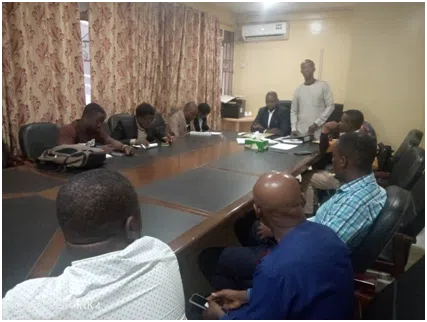
During a ceremony held on Wednesday 20th July, 2022 at the Produce Monitoring Board Conference Room in Freetown, the Produce Monitoring Board (PMB), with aid from the National Public Procurement Authority (NPPA), opened bidding documents for the procurement of one new Land Cruiser vehicle for the use of the Executive Chairman of that institution or entity, Dr. James Vibbi.

According to one of the Directors of PMB, Didan Sankoh, the entity, through the Procurement Officer, Franklyn Chukuma Davies, went through the procurement procedures and worked with the National Public Procurement Authority and the Ministry of Transport and Aviation to ensure that due process was followed. Sankoh encouraged all present during the public opening of the bids to be cooperative and assured of the transparency of the process.

In his statement, the Procurement Officer of PMB, Franklyn Chukuma Davies said as part of the procurement procedures, the Produce Monitoring Board issued adverts on the Newspapers inviting bidders for the procurement of one new vehicle.

Reading excerpts published by the New Vision and A-Z Newspapers he said, “The Produce Monitoring Board (PMB) has been allocated funds by the Government of Sierra Leone and is in the process of procuring one (1) new vehicle for a Government official. The PMB now invites sealed bids for the supply using the National Competitive Bidding (NCB) procedures in line with the Public Procurement Act 2016.”

According to Chukuma Davies, after the publications, two bidders bid for the supply but received only one bidding document from Sulaiman Motors and General Services.

He said the process is now in the hands of an evaluation committee which is expected to review the bid and report in three working days.

Chukuma Davies assured all that the process will be administered transparently and that vehicle purchased will be brand new, adding that the process would be transparent and open.

He revealed that the Vehicle is estimated to cost around Eight Hundred Million Leones, and is meant for the Executive Chairman of the Produce Monitoring Board, Dr. James Vibbi, whom he said since he took up office in 2019 has been using his personal vehicle.

He concluded by calling on the representative of NPPA to aid with the opening of the bidding document of Sulaiman Motors and General Services to the Press and all those present.

The Procurement Officer of the National Public Procurement Authority, Mustapha Shaw, said the Public Procurement Act, 2016 makes provision for the continuance in existence of the National Public Procurement Authority to further regulate and harmonize public Procurement processes in the public service.

He said they will aid the process of the opening of the bidding document but will not open the document as it does not fall under their mandate.

Shaw maintained that the bidding document has all the requirements and was verified by all present revealing that the document fulfilled the following requirement which includes: A signed and stamped Bid Form,

a bid security of not less than twenty thousand Leones (Le. 20.000) New Leone from a reputable commercial bank, a valid tax certificate from the National Revenue Authority, a Business Registration Certificate, a NASSIT Clearance Certificate, a Municipal/ Local Council Business Certificate and a signed Integrity Pact.

The Procurement Officer of NPPA ended up saying he is satisfied with the process underscoring how the next process will be evaluation which will be done by the Evaluation Committee.

Chief Executive Officer of Sulaiman Motors and General Services, Sulaiman Sowe, one of the bidders, told Pressmen that he saw the procurement advert in one of the local newspapers and they decided to bid for the procurement of the said vehicle.

He added that so far they are very impressed with the bidding process highlighting how they are expecting transparency in the entire process and that they have done their part by submitting all relevant documentation as per the requirements.


JICA Visits WFP’s Home-Grown School Feeding and Farming Sites in Pujehun District

JICA Visits WFP’s Home-Grown School Feeding and Farming Sites in Pujehun District

By Abubakarr Harding

Two representatives from the Japan International Cooperation Agency (JICA) visited Pujehun district on Monday 18 July 2022 to see the implementation of the pilot Home-Grown School Feeding Programme (HGSF) by World Food Programme in collaboration with the Ministry of Basic and Senior Secondary Education, and the application of the Technical Package for Rice Production (T-PRP) by supported Farmer-Based Organizations (FBOs).  The T-PRP contains techniques in land preparation, variety selection, seedling raising, uprooting, and transplanting, weed and pest management, harvest and post-harvest, fertilizer management, and water management. All the techniques aim to create better environment for the rice plant to grow healthily and to utilize applied fertilizer effectively and efficiently. Whereas the HGSF pilot is aimed at moving away from a traditional school feeding model where the programme depends on imported food to locally produced, procured, and supplied by FBOs and women groups. The introduction of HGSF creates a predictable market opportunity for small-holder farmers. Both initiatives are funded by JICA.

The JICA-WFP joint mission was led by Mr. Yamazaki Hajime, Senior Deputy Director, Planning Division and Mr. Kasuya, in charge of West Africa., along with WFP and staff of the school feeding secretariat and Agriculture. The team visited two schools in Gofor and Zimmi in Makpele chiefdom, and one school in Futa, Pejeh Chiefdom. They also saw inland valley swamps where T-PRP is being implemented in Gofor, Helebu and BlamaNgiya.

They held meetings with the Head Teachers, School Management Committees, students and volunteer cooks on the implementation of the HGSF pilot. This model is currently piloted in 17 schools in Kambia and Pujehun districts. It will be replicated in other schools based on available resources.

“I observed that the school authorities, students, farmers and other stakeholders are very happy with home-grown kind of school feeding, especially with the variety of school menu. Through this programme, I believe the members of the community will be encouraged to diversify their diets,” said Mr. Yamazaki

The team also witnessed first-hand how farmer-based organizations (FBOs) in the various communities visited were applying knowledge gained from the T-PRP technique to increase their rice yields. Improved farming practices as advocated by the T-PRP, and good seeds have helped farmers to sell surplus rice and vegetables to WFP for supply to schools.

“The training we received has helped us to farm better and get improved harvests. Now we sell the surplus produce to the schools, and the children are receiving fresh and nutritious school meals” said Mamie Kemokai in Gofor.

Home-Grown School Feeding is a win-win situation that benefits the various stakeholders (Children, Parents, farmers and the community as a whole, etc.)


President Bio Receives 2021 Annual Report from the Chief Electoral Commissioner

President Julius Maada Bio

By Amin Kef-Ranger

The Chief Electoral Commissioner of the Electoral Commission of Sierra Leone, Mohamed Kenewui Konneh, on the 21st July, 2022 presented the Commission’s Annual Report 2021 to President Julius Maada Bio at State House.

The Annual Report catalogued the achievements and challenges of the Electoral Commission of Sierra Leone as well as plans it intended to roll out.

After receiving the Report, President Bio thanked the Electoral Commission of Sierra Leone both for its commendable efforts in conducting largely violence-free and fair elections at all levels wherever vacancies have occurred.

He pointed out that the parliamentary contests have been competitive maintaining how both parties have won some and lost some adding how one party has graciously accepted its losses and one party maybe not as graciously but said that is the nature of competitive politics.

President Bio said a cursory look at the history of elections in Sierra Leone would highlight elite domination of politics – a mindset where a party uses a toxic blend of divisive rhetoric, misinformation, and unleashes violence – that is orchestrated and controlled by a few key players – on the voting public.

He continued that while some parties have never used that approach some parties have probably significantly intensified its use pointing out how they would rather not present and debate alternative policies and positions and engage citizens in peaceful ways about why their positions and perspectives are better.

“Our position as a Government has been that there is a better way,” he underscored adding how first they believe that a better governance ecosystem is good for the country’s democracy.

Freedom of the Press, he said, is guaranteed in the country’s laws adding how they have removed seditious libel laws and unfettered free speech maintaining that no journalist is in prison for the practice of journalism, how no media house has been attacked or closed down for what they publish or broadcast and that the Independent Media Commission has a clearer mandate.

The President stated that there is greater cooperation between law enforcement and the press saying he is calling for both the responsible practice of journalism on all platforms on one hand and zero tolerance for intimidation and threats by the security forces and the public of media practitioners revealing how Government has supported greater professionalism in journalism and advocated for investments in the media.

He said journalists are working with development partners, international organizations, and national stakeholders to further enhance freedom of expression.

As a consequence, he continued, Sierra Leone has moved up 29 places higher from 75h position to 46th out of 180 countries in global media freedom rankings.

President Bio informed the audience that Government does not interfere with the work of civil society organizations and rights activists who continue to operate freely within the ambits of the law saying they have observed elections freely and generated and discussed post- elections reports freely on all media platforms.

He said secondly, the Electoral Commission of Sierra Leone operates freely and independently and there is also greater access to justice and citizens can now get redress from the courts on petitions and elections-related matters as the courts deem fit stating how a National Commission for Peace and National Cohesion is now up and running.

According to him, there is a greater engagement of traditional and religious leaders in tamping down tensions within and between communities saying Sierra Leone is now the fourth most peaceful country in Africa for a reason.

President Bio said thirdly, his Government has instituted reforms that guarantee the equal exercise of citizenship rights, especially for hitherto marginalized and vulnerable populations.

He said there is an unprecedented Gender Equality and Women’s Empowerment bill in Parliament that guarantees greater participation, representation, and empowerment for women.

“I urge parliamentarians, development partners, and local stakeholders to support the passing of the bill in Parliament,” he said disclosing that Sierra Leone’s progress on the issue of disability rights and participation has been noted in international fora.

He applauded efforts by the Electoral Commission to form External Stakeholder Groups for Gender and for Persons with Disability at the national level stating that he urges the Commission to cascade the formation of the stakeholder groups to the district level.

President Bio said in his response last year to Strategic Pillar 8 of the Commission’s Strategic Plan, he particularly highlighted inclusion, participation, and equity as critical.

“As I stated last year, my Government approaches that pillar from a rights perspective – that every citizen has an equal and inalienable right to fully participate in political life; to fully participate in political debate; to be consulted, to vote, and to be voted for,” he stated adding that gender, sexuality, disability, age, youth, levels of literacy must not be hindrances.

He said they must be fully accounted for in inclusive democratic elections at all levels maintaining that the views and voices of every citizen must matter on how to move the nation forward.

“I urge us all, therefore, – stakeholders, citizens, development partners — to continue working to ensure that the future of elections in Sierra Leone is fully inclusive,” he appealed.

The President said he was briefed on the generous support by the UNDP for the consultative conference that led to the adoption of 103 of 111 recommendations of the Election Observer Missions (EOMs).

According to him, progress on implementing details of the legal and non-legal issues has been mentioned further urging the Electoral Commission to continue to work with other Election Management Bodies and other stakeholders to fully implement those recommendations.

He said his Government remains fully committed to supporting peaceful, free, fair and credible electoral processes adding that dates for the parliamentary and local council elections have been declared at least fifteen months to Election Day.

The President said they have also proposed fixed dates for elections and other such reforms that will enhance the quality of elections and the governance space. He said the Chief Electoral Commissioner has also declared dates for Presidential elections in accordance with his mandate.

He said he is pleased to note that the constitution of the Electoral Commission is in accordance with extant constitutional provisions and he is urging Parliament to ensure that all regions are fully represented on the Electoral Commission.
The President said he also acknowledges the administrative and organizational restructuring within the Electoral Commission and thanked the country’s partners and the Commission for working on further strengthening the capacity of the Electoral Commission’s staff.

He pointed out that efforts to construct offices and warehouses at the district level are commendable and should support transparency, fairness, and timeliness in delivering the results of public elections.

“I also wish to commend the Electoral Commission for preparations made so far regarding the upcoming voter registration exercise from September to October of this year,” he said urging the Electoral Commission to intensify its public sensitization efforts on the processes and procedures of voter registration.

President Bio also stated how his Government also acknowledges decisions and efforts at boundary delimitation in accordance with constitutional provisions.

He said he notes the memorandums concluded with other agencies to facilitate both the voter registration and boundary delimitation process adding how he appreciates the immensity of work and time needed to successfully conclude the processes within the time set by the constitution.

“The Electoral Commission can always count on the support of my Government in achieving the best outcomes for Sierra Leoneans,” he stated adding that his Government will patiently await Parliamentary deliberations and conclusions on proposed electoral law reforms.

He said Parliament is the only competent body that will change existing laws saying he is confident that their work is informed by what is in the best interests of the country – laws that permit inclusive, fair, peaceful, and transparent elections at all levels of the country’s democracy adding that aggrieved persons must also be able to access and receive speedy and fair hearings in a competent court of law.

President Bio said they believe that the country’s partners can provide additional funding and technical assistance, and support in increasing voter education and civic participation of hitherto marginalized groups – especially women and persons with disabilities.

He concluded by highlighting that they have heeded to the recommendations of the EOMs; opened up the democratic ecosystem with progressive rights and other reforms; improved the capacity of the Electoral Commission and strengthened its legal mandate; and, supported equity and inclusiveness both to represent and to make free and fair electoral choices.
President Bio said he , therefore, acknowledges and receives the report with great optimism that we are, as a nation, becoming better at getting democratic elections right.


 

NRA Holds Retreat to Re-Strategize for Future Revenue Generation

NRA

By Amin Kef-Ranger

The Mini Board and Management retreat of the National Revenue Authority (NRA) ended at The Place Resort – Tokeh on the 16th July 2022,

It is apparent that the current Global Economic Events has had an immense impact on the work of the Authority in the last six months but it now seems the NRA has re-strategize its operational approach.

In her opening statement, the Board Chairperson of NRA, Tuma Adama Gento Kamara, stated that just when they thought that the economy was taking off from the ruins of COVID-19, the Ukraine-Russian conflict struck which is posing problems for revenue generation. She said the retreat is therefore a platform to re-strategize, re-think, and fine-tune other critical operational challenges already faced by the institution.

She said due to the war, the hundreds of thousands of families who were already struggling with lower incomes and higher food prices are more than agitated today. Moreover, that the demand for more resources by the Government is increasing and the NRA has to be in pole position to provide those resources.

Commissioner General of NRA, Dr. Samuel S. Jibao, on his part said that the institution has a reputation for reporting positive things but the current challenges require a re-visit of NRA’s strategies to get the best out of 2022.

According to him, in 2019, the institution was on a positive trajectory; 2020 Covid-19 struck and it affected the institution immensely but yet things were relatively on track. 2021 became one of the best years for revenue generation in the country he continued.

The Commissioner General emphasized that 2022 has ushered in a lot of shocks to the economy but as an institution, they cannot continue giving excuses based on Covid-19 and the Ukraine War.

“We need to come out with innovative strategies for the survival of the country and the institution”.  The retreat ended with the review of existing strategies as the NRA looks forward to a productive end of 2022.


Parliament Ends Debate on Public Elections Act 2022

Parliament Ends Debate on Public Elections Act 2022

By Abubakarr Harding

Parliament has on Monday 18th July, 2022 concluded the Second Reading on the Bill entitled “The Public Elections Act, 2022” subject to further considerations.

The Bill seeks to repeal and replace the Public Elections Act, 2012 (Act No.4 of 2012), to provide for supplementary provisions to Section 32 and 33 of the Constitution of Sierra Leone (Act No. 6 of 1991).

In his submission to the debate, Hon. Dr. Mark-Mahmud Kalokoh referred to certain constitutional provisions that he said were contrary to the amendment and added that, if they were consulted, the Bill was not supposed to be before them.

He expressed the view that the document has a lot of inconsistencies. “This document is not properly before us,” he re-echoed. According to him, the provisions brought would not support the amendment for a District Block System. He also went on to say that, it would be unconstitutional to pass the Bill without a Constitutional Instrument.

The MP also denounced request of the 2021 Census result by the Electoral Commission of Sierra Leone and expressed that it is suicidal and unprecedented for the latter to use the document.

He raised a series of concerns and expressed fear, if the Proportional Representation System is forced and went on to raise alarm on the welfare of citizens amidst the hike in fuel price. He also informed that, the Government is not empowering women as claimed and recalled incidences of violence against the latter.

Hon. Bernadette Wuyatta Songa decried the immediate speaker in his debate about the 2021 Census and advanced positivity. The MP informed that the politics of women cannot be told without giving appraisal to the current Government, and went on to reveal to the House how she ascended to power as a woman. She related the Bill to the international benchmark, in light of the 30% quota and explained the opportunities granted to women.

The MP informed that the Bill is going to work in tandem with the Gender Empowerment Bill. The MP heaped praises on the Kailahun District for having 40% women representation in the current Parliament. She described the Bill as a perfect acceleration that would place women in high-profile positions of trust. She insisted that, they were not undermining the Gender Empowerment Bill as portrayed by others, but both documents would be a perfect combination.

Hon. Aaron Aruna Koroma drew the attention of the House to certain clauses in the Bill and the Constitution of Sierra Leone, whilst opposing the mismatch between the former and the latter. He decried the point earlier advanced by certain previous speakers, adding that, there is an alteration between the Bill and the Constitution of Sierra Leone, and went on to say the Bill would not be passed without a two-thirds majority.

According to him, the debates presented by the ruling side were not tenable or justifiable for the Proportional Representation System and went on to recall and referenced evidence. He emphasized that, the Constitutional Amendment in Section 38(A) of the Bill is not enough to bring the PR System. “Section 31 is very clear in the 2012 Elections Act and the Bill contravened it on registration” he categorically stated and went on to denounce the National Civil Registration Authority’s position on the same.

The MP also informed that the women of Sierra Leone need space and decried the Government for maltreating women.

Hon. Sarty Banya said his constituents are in total support of the Bill and the PR System. The MP applauded his colleague Members who discredited the 2021 Census, adding that, his point had validated the PR System. On women empowerment, he told the House that, the Kailahun District already had allotted the required seats to women. He said his people are also happy about the election date. According to him, the concerns raised on the 2023 election date adding is that it falls in the Raining Season and needs to be reviewed.

On the cancellation of votes and violence, he said his Political Party is very peaceful and informed that his District had grossly suffered from illegal cancellation and supported the Bill for legal cancellation.

On the PR System, he said it rests with the President and was only worried about the selection process.

Hon. Musa Shiaka Sama, an Independent Member of Parliament from Pujehun District said he had done wilder consultations with his people and other experts.  The MP informed the House that, there are a lot of goodies in the PR System, but said that he has a concern about independent participants. He questioned that, “if the Parliamentary Election has to be conducted under the PR System for political parties, what about the independent candidates?”

He expressed the view that some political parties MPs are against the PR system, but would not speak their feelings. He insisted that the Bill would not protect the minority.

“As it is now, we are giving more powers to political parties,” he noted and added that they should slate time for sensitization on the Bill, to avoid confusion. He recalled how bad governance plugged the country into war referencing the Truth and Reconciliation Commission (TRC) Report. He appealed for the protection of Independent and minority rights and asked for time to implement the sensitization.

In rounding up the debate, the Leader of the Opposition, Hon. Chernor R.M. Bah said a lot has been said about the Public Elections Bill and reminded the House of what previously transpired in the Well on Section 108 of the Constitution of Sierra Leone. The Leader related his statement to clauses that he said were contradictory and subsequently drew the attention of the Speaker of Parliament to them.  He also informed that a lot was said about certain Sections of the Constitution of Sierra Leone that also contravened clauses in the Bill. He also informed that the NCRA (NIN) number is not proper in the application for registration. The Leader made reference to many sections of the Constitution of Sierra Leone and comparatively analyzed it with some clauses in the Bill and raised a series of concerns that are in contradiction.

He said he would continue to support women, but the Constitution of Sierra Leone, he said, needs an Amendment to support the latter position and they don’t want to go against the law. The Leader informed that, many areas in the Bill need careful amendment and supported that, the Bill is similar to the 2012 Elections Act, but said the essence of the Bill before the House is to repeal it. He used the opportunity to inform the House that, they as opposition had never questioned the integrity of Electoral Commission. “Based on the fact that we have agreed to keep on the dictates of Section 108/9b, I rest my case,” he concluded.

In concluding the debate, Leader of Government Business, Hon. Sahr Matthew Nyuma stated that his debate is predicated on the peace and responsibility of the House and their unanimity on the recent passage of Constitutional Amendments. According to him, the Bill is set to prevent elections from violence and be conducted peacefully.

Speaking on the Bill, he reiterated that they are a listening Government and went on to reference provisions in the Bill that predicate on change and progress of the State.  The Leader used the opportunity to reference the European Union report on previous election recommendations, which aligned with most of the proposals in the Bill. According to him, they would work in tandem with the EU recommendations during the Committee Stage of the Bill.

He denounced public bashings on Members of Parliament and advanced some positive outputs in light of their mandates.

He appealed to the people to accept good recommendations in light of the progress and development of the State regarding the election process.

He assured that, MPs will not fight on matters that would enhance the unity and peace of this nation and decried people and institutions that want to set them apart. He recalled that institutions and people attended a conference organized by donor partners and put recommendations surrounding Electoral System which is predominant to the amendment, citing the PR System in same direction.

He underscored the legal framework and went on to recall their discussions on boundary delimitation and population. He referenced Section 38/3 and 38A of the Constitution of Sierra Leone in respect of boundary delimitation and other related matters.

He assured the House that certain clauses that are contentious in the Bill would be removed during the Committee stage. He also clarified that, the NCRA (NIN) number would not be mandatory for registration. The Leader also clarified the issues surrounding women and advanced the necessity of the policy on Women’s Empowerment in tandem with the President’s Speech on sectoral development.

He insisted that they needed radical reforms for a progressive nation to promote women’s rights. “This is a righteous course,” he stated and went on to say the Bill would empower more women through affirmative action.

He further reassured the House to have a compromise on the fixed election dates and other related matters that were good.

He reiterated that, the Bill is relative to a reform that would improve on election process and peace of the State. He expressed thanks and appreciation to the President of Sierra Leone, the Speaker of Parliament, the Members of Parliament, and the Attorney General and Minister of Justice.

The Attorney General and Minister of Justice, Mohamed Lamin Tarawally commended Member of Parliament for extensive debates.

He informed that, the Bill would make Sierra Leone unique from its counterpart in the Sub-Region. He made a series of clarifications on concerns made by debaters. “There is nothing in this Bill that would scare anyone of us,” he reiterated and went on to say, the Bill before the House is for Sierra Leone and went on highlighting the importance to the State and the people.

SLAJ Disciplinary Committee Ends Hearings in Western Area District

SLAJ Disciplinary Committee Ends Hearings in Western Area District

By Abubakarr Harding

The Sierra Leone Association of Journalists (SLAJ) Disciplinary Committee has ended its regional hearings across the country with the last meeting held with media monitors in the Western Area Districts (Urban and Rural) on the 28th of June 2022 at SLAJ Headquarters on Campbell Street in Freetown.

The meeting was chaired by Claudia Anthony, the Chairperson of the SLAJ DC and six monitors were present during the meeting.

Each monitor was accorded the opportunity to give updates about their work, clearly distinguishing the observation made for print media journalists from that of electronic media.

The media monitors from the Western Urban Area in Freetown confirmed that breaches of the media code of practice are more predominant among print journalists, which indicates that the print media should step up in their observance of the code.

The engagement brought to the fore several challenges the journalists claim they are facing, including lack of remuneration, dependency on adverts and journalists adopting unprofessional means to pay themselves. The monitors recommend continuous training of journalists, especially in the provincial areas.

The monitors also reported that journalists do a lot of stories and discussion programs on corruption which is commendable. They further said some journalists complain about the non-payment of meager salaries and NASSIT contributions by their employers.

Some monitors commended journalists working in community radio stations for doing programs to hold the Government accountable. However, he revealed that there is some amount of tension that continues to boil between the radio stations and the public because of how they perceive the radio stations to stand politically.

Meanwhile, the monitors in the Western Region recommended periodic training to upgrade their own skills and strengthen their capacity to do their jobs as monitors. They also suggested that SLAJ could use its MoU with the security sector to solicit training of journalists in the area of reporting petty crimes. This is in response to issues of impersonation by journalists in the Eastern and Southern regions.

In the Northern Region of the country, the DC met with monitors at the SLBC Hall in Makeni on 16th June 2022, during the SLAJ Triennial General Meeting. The engagement was chaired by Claudia Anthony and ten monitors attended.

Reports received focused on, among other things, what is referred to as perceived [political] polarization on the part of both the media practitioners and the public. The monitors also reported that there is a lack of trust in the relationship between the listening public and journalists and their media houses.

Other challenges identified include a lack of logistics to effectively monitor media programs and activities in the region and the need for a form of identification for SLAJ monitors in order to effectively perform their tasks.

The monitors further reported that some clients have made it clear that they will not approach certain media outlets because of their perceived political leanings. They went on to suggest that there already exists some level of tension between the media and sections of the public ahead of the 2023 public elections.

In the South and Eastern Regions of the country the meetings were held on June 2nd and 3rd 2022, respectively, and attended by a cross-section of the National SLAJ Executive, members of the SLAJ Disciplinary Committee, and media monitors from various districts across both regions.

Speaking about their work the monitors stated that the attitude of journalists toward their profession is poor; indicating that there is always one issue or the other between and among colleagues to the point that there is growing division among them.

Another challenge they highlighted is the lack of equipment, especially digital recorders, which they said makes it difficult for journalists to get factual information for radio. The monitors accused journalists of putting themselves in the story rather than just reporting and that calls for continuous training and overall capacity building.

Media monitors in Kenema noted that the district has one of the most complex environments when it comes to media practice.

“There are about 11 radio stations and we have lots of issues. We are aware that some radio stations are perceived to be in support of certain politicians and political parties and this affects the job of journalists,” said James Jamil Fatorma, a monitor in Kenema town.

He went on to report that there are a lot of instances where journalists have been engaged in unprofessional conduct, especially radio presenters.

The monitors appealed to SLAJ to help in the conduct of more training for reporters and monitors, particularly as the 2023 elections approach.

Victoria Bernard, the Regional Chairperson of SLAJ East, said if the DC wants to succeed they must make sure that all radio stations get program schedules and outline the motive of each program.

“The DC should engage IMC to emphasize on welfare issues of journalists that includes payment of salaries. If IMC does not act tough in this regard we will not succeed in this our work, because most of the people doing programs are volunteers and if someone gets up at 5:00 am to do a program the person is likely to promote the one who gives him or her fuel or transport money,” she emphasized.

She called on SLAJ to engage IMC and NASSIT, claiming that as things stand the issue of compromise is on the increase.

The DC team encouraged all monitors to engage the public through the radio stations about their role as monitors.

In the Southern Region, the monitors complained that the lack of adequate resources makes it difficult for them to do their work. They informed the committee that radio stations are usually off for days, whilst indicating that in the district there are not many trained journalists who follow the code of ethics.

The chairperson of the DC responded by saying media institutions airing programs late is an in-house problem and not part of the committee’s mandate.

In Bo, a monitor reported that the district still has journalists that impersonate other professions, including police officers, inspectors of schools, health inspectors, etc. and that is a serious issue he said the DC should look into properly.

The DC called on the monitors to reveal the names of the said journalists in camera with the President and Secretary-General, assuring that the disclosure will be kept confidential. Like in the other districts the issue of Identity Cards came up as members suggested it would back up their legitimacy as SLAJ media monitors.

SLAJ Disciplinary Committee Ends Hearings in Western Area District

Chinese Embassy & Labour Ministry Share Information on Review of the Labour Law

Chinese Embassy & Labour Ministry Share Information on Review of the Labour Law

By Abubakarr Harding

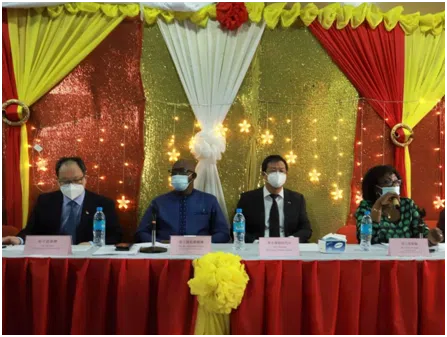
The Chinese Embassy in Sierra Leone and the Ministry of Labour and Social Security (MLSS), on the 14th July, 2022, jointly held an information-sharing session of Labour Law Review at China House in Freetown.

Alpha Osman Timbo, the Minister of Labour and Social Security, the Permanent Secretary of MLSS- Ms. Fatmata Mustapha, Chargé d’affaires of the Chinese Embassy- Li Xiaoyong, Economic and Commercial Counsellor- Du Zijun, representatives from Labour Congress and Employer’s Federation, officials from the Sierra Leone Government and representatives from Chinese enterprises attended the event.

Li Xiaoyong expressed his gratitude to H.E. President Maada Bio and the Sierra Leonean Government for supporting the Chinese business in Sierra Leone. He said that over the past 51 years, China and Sierra Leone have been cooperating well in the fields of trade and investment, agriculture, mining, fishery, education among others. As the biggest investor in Sierra Leone, the Chinese enterprises have not only added revenue for the Sierra Leonean Government but also brought a lot of jobs for the local people. China will continue to work with Sierra Leone to build a stronger China-Africa community of shared future under the Belt and Road Initiative (BRI) and the Forum on China-Africa Cooperation (FOCAC).

Hon. Minister Timbo said that H.E. President Maada Bio and the Sierra Leonean Government attach great importance to the protection of the interests of the Chinese investors and the legitimate rights of the employees. He appreciated the efforts the Chinese enterprises made in complying with labour laws and regulations. He said that by this information sharing of labour laws, the MLSS hopes that both the employers and the employees would understand more about the laws and regulations and the MLSS would continue to work with the Chinese businesses to ensure that a win-win result would be achieved.

Du Zijun said that the Chinese enterprises are operating well in the infrastructure, mining, fishery and forestry sectors and have promoted the development of the local economy. He stressed that the purpose of the Information Sharing of Labour Law Review was to provide a platform of dialogue between the Chinese enterprises and the Sierra Leonean Government. He urged and believed that the Chinese businesses would understand more about the local regulations and create a more harmonious environment for their employees.

The officials of the MLSS briefed and interacted with the participants on the labour law review process and some of the highlights of the new terms.


World Business Outlook Rates Rokel Commercial Bank as “Most Trusted Commercial Bank”

By Abubakarr Harding

Rokel Commercial Bank has been declared as the Most Trusted Commercial Bank in Sierra Leone for 2022 by the Singapore based World Business Outlook.

Rokel Commercial Bank was awarded alongside over 150 financial institutions in Africa, Asia and the Middle East. The awards are done every year targeting business and financial institutions that have exhibited leadership and mastery to achieve success in the financial industries of their respective countries.

Winners are selected through a research and data collection process by a highly qualified editorial team drawn from across the respective regions participating in the process. After a careful review of nominations, winners are announced on the integrity of their applications and current accomplishments.

Receiving the award, Head of Corporate Affairs, Millicent Cole said the bank remains committed in repositioning itself as a leader in the country’s financial sector. She added that the phenomenal transformation taking place at the bank has been due to the efforts of a forward-looking management over the last four years. “The bank has performed exceptionally well over the years… It had installed a new banking software which has placed it on a competitive edge locally and internationally,” she maintained.

The Rokel Commercial Bank, as a leading proponent of financial inclusion had embarked on a massive expansion drive, opening new branches and outlets in Bonthe, Tongo, Fourah Bay College, Kissy, Wilberforce, Juba, Wilkinson Road etc. In the last four years, it has recorded enviable profit and growth indices.  A Small and Medium Enterprise (SME) development scheme launched last year is changing the lives of motorcycle riders in Bo District and traders in Freetown.

For the first time in over three decades, the bank paid over Le6 Billion as dividend to its Prudential Shareholder, the Government of Sierra Leone last year. With an incredible, corporate social responsibility profile, the Rokel Commercial Bank has clearly risen from the ashes from a loss making to profit making financial entity recording positive retained earnings.


First Lady Acknowledges Amb Anthony Navo’s for Making Reality TV Show a Smashing Success  

Housemates Salone Season 3

By Amin Kef-Ranger

Housemates Salone Season 3 with the slogan “Di Game Get Yagba, If You Nor Able Na for Pull Hand” came to an end on the 17th July,  2022 after a successful eight (8) memorable weeks of  “Yagba”,  romance, comedy and fun among other thrilling episodes that got viewers glued to their TV Sets, whipping up gossips and heated discussions in social gatherings. The Reality Television Show was all about entertainment, fun, competition, games and exposure crowned with big wins.

Next to follow will be Housemates Salone Season 4 and it will come in 2023. According to the Chief Executive Officer of the African Young Voices (AYV), Ambassador Anthony Navo Jrn the Season 4 Winner will take home a mouth-watering grand prize of $ 50,000 which is equivalent to Le 500,000,000 (Five Hundred Million Old Leones) and (Five hundred Thousand New Leones). The show, it must be reiterated, will return for its Fourth Season in 2023 with a double of this year’s grand prize.

It must be noted that at the outset of the just concluded Housemates Salone Season 3 , the Reality TV Show featured 22 young men and women, in total, living together for two months, with no connection to the outside world. The show was viewed live on AYV TV, online social media streaming, YouTube and DsTV 24 hours a day, seven days a week. As it progressed, the Housemates, as couples performed various tasks assigned to them by the unseen Chief or Madam and were voted for by members of the public. The cumulative scores garnered from the performance of assigned tasks and from public voting were then used, as part of the assessment tools or yardsticks used to get the ultimate winner.

Emerging as the ultimate winner was Julianna Conteh aka ‘Julie Tombo’ who bagged a whooping sum of Le250M and a ticket to embark on a round trip to Dubai. She was congratulated by the First Lady, Madam Fatima Bio.

In her statement, the First Lady, Dr. Fatima Maada Bio, said, “It is good to have a dream, but it takes a special person to act on the dream and make it come true, which is a special gift and Ambassador Junior Navo is one of those special people in this country.”

She acknowledged his relentless efforts in making one of the biggest Reality TV Shows a smashing success. “I will continue to support your vision because your vision is one that will make our country a better place.”

Dr. Fatima Maada Bio continued by urging young people in the country to keep believing in themselves and to know that they are capable of making a positive impact that will bring about positive change.

She noted that the narrative of Sierra Leone has changed as a result of the Show and the country’s beauty has been positively projected beyond the borders of Sierra Leone, encouraging every Sierra Leonean.

On his part, the Chief Executive Officer of the Africa Young Voices (AYV) Media EmpireAmbassador Anthony Navo used the opportunity to announce the grand prize for the Fourth Season of Housemates Salone. He thanked all the participants for their zest and those who contributed in one way or the other to make the show very successful. He extended special thanks to the First Lady for honouring the invitation to grace the occasion.

It could be recalled that Housemates Salone Season 1 took place in February 2019 and ended on April 14. Kenchine Palmer emerged as the grand prize winner, taking home 100 million Leones. The runner-up position went to Monica Yeanie Ghaliwa, who took home Le50 million.

Housemates Salone Season 2 was won by Housemate Sarah Conteh Robert who grabbed the star prize of Le250 million and a two-week round trip to Dubai.

Sarah, the first-ever female to win the TV show, beat 7 other housemates at the final, which was held on December 13, 2020.

This year’s season attracted a large number of young people from all over Africa and beyond to participate in the competition.

If some of the Housemates were appearing sexy by the kind of dresses they wear then that should not have come as any big surprise simply because they were expected to display nudity. Again, if sometimes they were talking harshly then it was because they were to intermittently use strong language and acting funnily was because they were expected to be humorous.

In a bid to manifest those qualities was what really will made the Reality TV Show very interesting to watch providing some form of relief for viewers and serving as a therapy to reduce stresses.

Housemates Salone Season 3, will for a very long period of time, etched on the minds of many as one of the biggest events of the year.

It was a kind of refinery where the competitors went through life overhauling experiences to an extent that life after Housemates Salone is now completely different for them.

Housemates Salone Season 3