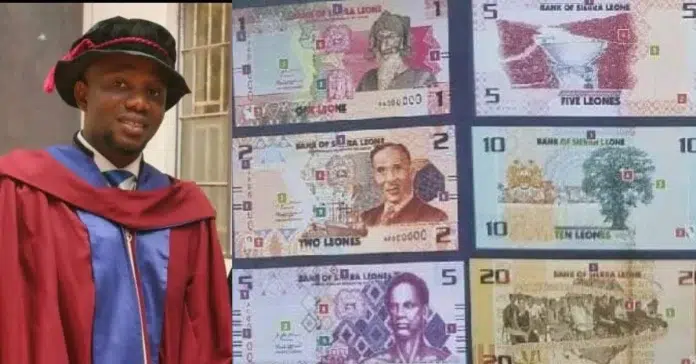
Dr. Ezekiel K. Duramany-Lakkoh, who is the Dean, Faculty of Management Sciences at the Institute of Public Administration and Management, University of Sierra Leone has expressed his view on the re-denomination of the Leone which is slated to take place on the 1st July 2022.
According to him, the problem is not redenomination, but how it is implemented. Proponents of currency recalibration techniques have argued that if implemented properly by introducing further counter-inflationary and monetary policies, redenomination will lead to a new exchange rate which will create creditworthiness in the economy and make Sierra Leone looks stronger in international capital markets.
“I have spent some time reading through the literature on redenomination and I find the article by Lianto and Suryaputra (2012) very interesting,” he pointed out.
He continued that while the currency of Sierra Leone like many other countries within the sub-region and beyond remains volatile against hard international currencies like the United States Dollar, the British Pounds, and the Euro, amidst the COVID-19, the country’s Central Bank has resorted to recalibrate the Leone, in a way that will reduce the volume and transactions cost, while maintaining the same value.
Dr. Ezekiel K. Duramany-Lakkoh pointed out that such a strategy will also attempt to address inflation, which might in turn address the balance of trade, budget deficit, and public debt maintenance costs.
He furthered that the practice of re-denominate the country’s currency would definitely be confusing in an economy like Sierra Leone, but other countries including Ghana, Russia, Hungary, Zimbabwe, Greece, Germany, Yugoslavia, China, Nicaragua, Congo, Bolivia, Peru, Angola, Turkey, Georgia, Ukraine, Venezuela, Taiwan, Ecuador, Indonesia, Austria, Argentina, Poland, Romania, and very recently in Belarus have redenominated their currencies, with some economic costs, and positive outcomes.
The Dean said interestingly, the discussion around social media and the Press at large have still not discussed how redenomination would be useful to the overall economic performance and how the issues of reduced currency burden will quantitatively ease and manages transaction in the economy.
He maintained that like quantitative easing techniques employed by developed economies, where interest rates are adjusted even to zero to address capital market structures, and hard currencies are introduced to buy off toxic assets, currency redenomination has its own impact on the balance of trade, budget deficits, public debts maintenance costs, and hyperinflation. There will never be an economic recovery without cost, especially in the short or medium term.
“Actors within the national economic, political and social landscape should also understand that redenomination of the currency will not out-rightly solve our economic situation, which I believe will only be solved by an expanded private sector, ready and willing to innovate human resource, with the ability to take risk within the framework of a strong business legal structures,” he said.
According to him, a perfect economy will only come with the right mindset, a disciplined private sector, combined with an innovative human resource that will be able to transact with very little political Government intervention.
“This should be an understanding requirement of the average elite, regardless of our fields of study,” he underscored adding that the world economy is at a crossroads and most countries are technically in recession.
He highlighted that economic jurisdictions are exploring avenues to adjust inflationary pressure at least to keep employment and a basic standard of living during the COVID-19. For the very first time, the world saw a negative oil price in 2020 and a bigger recession than in 2007.
“Therefore, multinational corporations, companies, SMEs, commercial outlets, and even households should be spending more time planning on how to absorb the operational shock and make the best use of the options available, while Government should pay serious attention to the phased rollout of its redenomination strategy, especially on pre-redenomination speculation transactions,” he recommended.
He added that there is no outright answer to an economic crisis in the short term and any measure taken by any Government to make adjustments will have its short-term implications.
“However, those who are keeping their hard currencies will bring them out to the Banks,” he expressed optimism stating that now is the time to know where the monies are hidden.





Special Commentary As SLAJ AGM Ends In Makeni… Let’s Examine the Media’s Role in Ensuring Democratic Governance
By Ranger
For better or for worse, real political life is expressed in the media – newspaper columns, radio stations, and TV studios than in Parliamentary assemblies or during partisan activism.
This idea, which stresses that one cannot talk about democracy without highlighting the necessity for a free, trustworthy, responsible, and credible media, is held by many who subscribe to democratic ideals.
It is also true that democracy, aside from Freedom of the Press, regular organization of free and transparent elections, separation of powers, a Parliament that controls Government action, a fair Judicial system, or a Government that fulfills its promises to the people, also requires other commitments to grow.
In fact, 21st-century democracy also implies incorruptibility of the Government and the greater responsibility to resist all temptations to abuse power.
It signifies transparency and accountability in a manner that enables citizens to know what Government wants to do on their behalf, and how they want to do it, plus access to public information and administrative documents.
In this light, in ensuring good governance, the power and influence of the media lie in its ability to give information and provide an easy means of communication easily across time and space by reaching a lot of people with credible news, views, and information.
Because of this, the influence of media has become so powerful today because it can easily influence people positively or negatively.
In helping to ensure good governance, the media gives political parties the tools to reach large numbers of people and inform them on key issues ranging from policies to elections. Thus, the media can be seen as an enabler for democracy by helping to create better-educated voters which would lead to a more legitimate Government.
Furthermore, in ensuring good governance, advances in communication, largely through the internet, have improved community access to information.
Therefore the media plays an important role in society as a source of information, but also as a “watchdog” or scrutinizer.
With the country having a largely youthful population, the media importantly can also affect youth’s thinking, attire, attitude, and so on by providing them with the right information, education, and entertainment. Media development plays a role in democracy and effective democratic discourse through supporting free and independent media. Alongside these functions of the media should go media development which involves capacity building for institutions or individuals related to Freedom of Expression, pluralism, and diversity of media as well as transparency of media ownership.
It must be reiterated that the most important function of the media is to disseminate news to the masses concerning vital occurrences or important information. That way, the media can play a very positive role in shaping the moral, ethical and spiritual outlook of society?
This positive role of media can increase the media space, highlight political engagement, and develop awareness in the public because through that we can share information with the help of mass communication.
The media can also bring out hidden talents, as well as bring out public opinion about certain events and current issues.
On the other hand, the negative effects of mass media on society can lead people towards negative attitudes including violence, racism, tribalism, and political chauvinism which can be a threat to social unity, harmony, and peace.
For example, political thugs can be incited and get carried away from the rumors spread on the internet.