
Home Blog Page 881

Public Transportation… The People Say Give Bio & ‘New Direction’ 15% Score

By Amin Kef Sesay

With due respect to the Minister of Transport and his desk bound pot-bellied bureaucrats and technocrats in his Ministry, the long suffering of tens of thousands of low paid and unemployed commuters in the sprawling Western Area that now stretches from Waterloo in the East to Adonkia in the West have called on him to forgo his $70,000 air-con official vehicle and join the people at, for example, Waterloo to seek transport to and from work in the morning and evening for just one day – preferably Monday or Friday – to feel the extreme discomfort and unnecessary expenses the people undergo every day accessing transport.

The Minister, about a year ago, assured the people that the Government is in the process of securing 200 buses to help address the acute urban transportation problem in the country. Many people ask comically if the ship bringing the buses to Water Quay has lost its way on the high seas.

The reason why the people view the Minister of Transport and his bureaucrats disdainfully is that particularly with fuel prices sure to continue going up as global demand surges after COVID-19 is because transport fares would be minimized if the country has an effective, efficient, affordable public transportation system.

Take for example somebody who lives in Waterloo and has to come to work five days a week in the West End of the city. He/she pays Le2, 000 from Waterloo to Jui.

From Jui to Lumley he or she pays Le5, 500. How much is that, one way to work? Add the same amount for return fare. How much in total does that person pay for transport for a day and for five working days? Now let us imagine that that person is on the minimum monthly wage of Le600, 000…

Thus, what the people say they want to sink into the ears of the Minister of Transport and his and his pot-bellied desk-bound bureaucrats and technocrats is that if the Government is truly serious about reducing poverty, one of the major starting points is how to control transport fares which affect all other prices in the country.

The Government can only do so effectively when it has its own fleet of buses and road haulage vehicles to transport passengers and goods into and from the provinces.

Transport carries an important social and environmental load, which cannot be neglected. When transport systems are efficient, they provide economic and social opportunities and benefits that result in positive multiplier effects such as better accessibility to markets, employment and additional investments.

Thus, in designing and implementing a pro-poor friendly public transportation policy, what should be in front of the minds of the servants at the Ministry of Transport is that public transportation provides people with mobility and access to employment, community resources, medical care and recreational opportunities, on the understanding that over 90 percent of the people do not own a car and must rely on public transportation.  Public transportation provides a basic mobility service to these persons and to all others without access to a car.

Areas with good public transit systems are economically thriving communities and offer location advantages to businesses and individuals choosing to work or live in them.  The incorporation of public transportation options and considerations into broader economic and land use planning can help the new communities to expand business opportunities, reduce sprawling and create a sense of community through transit-oriented development.

By creating a locus for public activities, such development contributes to a sense of community and can enhance neighborhood safety and security.

Also, in times of emergency, public transportation is critical to safe and efficient evacuation for treatment.

With the world concerned about the harmful effects of pollution, public transportation also helps to reduce road congestion and travel times, air pollution and energy and oil consumption, all of which benefit both drivers and commuters alike.

Pastor Mambu Warns on the Closure of Place of Worship

By Amin Kef Sesay

One of the most popular Men of God in the country, Pastor Francis Mambu, the Founder and General Overseer of the Faith Healing Bible Church has reacted to the pronouncement made by President Julius Maada Bio, during his 1st July 2021 broadcast to the nation that all places of worship, particularly Churches and Mosques, must close for a period of one month as one of the precautionary measures to forestall the spread of the coronavirus.

In an audio recording, that went viral on the 7th July 2021, Pastor Mambu drew the attention of President Bio to the fact that the decision taken to close places of worship is out of context and untimely.

He underscored that if, as a nation, we must win the fight against COVID-19 then we need to put God first going forward to appeal for places of worship to be opened in order to enable people to pray and worship God.

Pastor Mambu asked all those that are close to President Bio to remind him that during the Ebola epidemic it was prayer that delivered the country and silence the epidemic.

He reiterated that the COVID-19 battle could only be won through prayers.

The Man of God ended by saying that if the Government does not listen to such a warning all sponsors and donors assisting in the fight against COVID-19 will become disillusioned and it will reach a time that the smartness and wisdom the Government is displaying will fail them.

“God must be at the top of every situation and we must put God first,” he additionally admonished.

Over Allegation of Unlawful Possession of Arms & Ammunitions… CSOs Demand Expeditious Investigation of Hon. Saidu Conteh & 3 Others

Honorable Emmanuel Saidu Conteh of Constituency 129

By Amin Kef Sesay

A group of Civil Society Organizations known as the Consortium for Good Governance, Human Rights and Democracy (CGHRD), in a Press Release issued on the 8th July 2021 and titled, “Concerns Over Allegations Of Unlawful Possession of Firearms” and signed by Marcus Bangura as National Coordinator, Morlai Conteh – Secretary General and Thomas Moore Conteh as Spokesman stated that it is closely following  an investigation on allegation of unlawful possession of firearms involving Honorable Emmanuel Saidu Conteh of Constituency 129 of the main opposition – All People’s Congress (APC) and three others.

The consortium furthered that in view of the above it notes that the aforementioned firearms were allegedly found in a vehicle at the Queen Elizabeth Quay believed to have been imported under the name of Hon. Saidu Conteh, that the said vehicle was opened and searched at the Quay in the absence of the Honorable.

It continued that the Police alleged that seven pistols were found in the said vehicle, that the Honorable is one of the most vibrant and vivacious Members of Parliament that have been critical on issues in the Well of Parliament as an opposition Parliamentarian, that Hon. Conteh and three others were arrested and detained at the Criminal Investigation Department (CID) headquarters, since Friday 2nd July, 2021.

According to the group of CSOs, the issue has generated serious public interest and there is no gainsaying that professionalism is greatly needed to ascertain the veracity of the investigation.

It stated that members of the consortium therefore looks forward to the authorities to expedite the investigation and employ an independent, impartial, non-political, free, fair and credible process for the general good of all, devoid of any suspicion and distrust by the general public in the investigation process.

The Consortium for Good Governance, Human Rights, and Democracy is said to be a vivacious and conscientious public space entity of likeminded organizations within the rubric of Civil Society in Sierra Leone.  Thus, CGHRD is committed to the promotion of democratic good governance, human rights, rule of law, social Justice, socio-economic justice, national security, cohesion and socio-economic development in a bid to ensure a transparent and accountable society.

It could be recalled that an Opposition Member of Parliament for Constituency 129, Hon. Saidu Conteh was recently arrested and detained at the Criminal Investigation Department (CID) together with three others on allegation of importation of arms and ammunitions into Sierra Leone.

During a Press Conference convened by the Sierra Leone Police Force on the 6th July 2021 journalists were informed that the Honourable and three others were arrested following the search of a vehicle at the Queen Elizabeth Quay II, allegedly imported into the country under his name, during which time  One Hundred bullets, Seven Pistols and Twelve Magazines were discovered.

Honourable Saidu Conteh, in a social media post, stated: “I am presently detained at the CID for questioning about an alleged importation of ammunitions in the country. As a man of high repute who has built a strong image for myself I do not know anything about the said discovered arms and ammunition and can never involve myself in anything of such nature”.

From what this medium learnt, constituents of Constituency 129, in the Western Area which the detained Member of Parliament is representing are calling for Parliament to intervene in the said issue.

However, it appears that Parliament is currently very diplomatic about the issue probably because it does not want to be seen overstepping its boundaries.

“We have not been getting any clear update and nobody is talking to us about the detention of our MP. We don’t know who we are to talk to as it seems nobody wants to talk about this issue,” one of the Constituents lamented.

As presently details are somehow sketchy various conspiracy theories have emerged on the issue. Some have stated that the issue might not

be unconnected to one of the clandestine plans by the main opposition to destabilise the peace and stability of the country.

On the other hand, some are maintaining that the allegation made against the Lawmaker could be politically-machinated or trumped-up especially when the MP had been vociferous in Parliament on a number of thorny issues.

Kingho Embarks on Massive COVID-19 Sensitization Drives in Operational Communities

By Abdul Malik Bangura

Kingho Mining Company, operating at the New Tonkolili Iron Ore Mines and Kingho Railway and Port Company in Pepel, the twin subsidiary companies of Kingho Investment Company have embarked on massive sensitization of the third wave of COVID-19 Pandemic in their various operational communities.

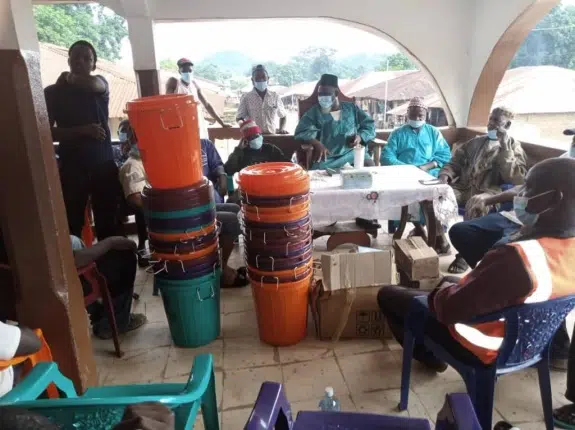
The sensitization drives were done together with the donation of veronica buckets, soaps and facemasks to residents of the operational communities of the two companies.

In Pepel Community, where Kingho Railway and Port Company Limited operates the Pepel Shipping Port and the 192 Kilometer railway leading from the Tonkolili mines to the port, the team distributed tens of veronica rubbers, tens of dozens of soap and hundreds facemask to key areas around the 8 chiefdoms it covers.

Whilst the distribution of these materials was done in Pepel Community, youths and stakeholders highly commended and appreciated the support from the company and promised to use them judiciously.

The Regent Paramount Chief of Kamasondo Chiefdom, Pa Komrabai Lawyer Kabia, thanked the company very well for such a support and said that they have instituted the mandatory use of facemasks in public meetings and gatherings. He said they have also erected and re-enforced the checkpoint at the entrance of Pepel Town saying they are thanking the company for the support given to them by providing them with tarpaulin to build the hut.

Furthermore, in Tonkolili District where the sister company of Kingho Mining Company Limited operates in Sambaia, Dansogoia and Simiria Chiefdoms, the company, whilst sensitizing the people of the mining operational communities as part of its social mobilization efforts on  “Corona Fet Nar we Fet,” donated the same consignment of soap, veronica buckets and facemasks.

In Sambaia Chiefdom, Bendugu Town precisely, Paramount Chief Hon. Alhaji Musa Bamba Foray Kulio Jalloh 111 whilst receiving the donation expressed his appreciation and gratitude to Kingho Mining Company for providing them with the much needed items to help in the fight against this deadly disease.

Meanwhile, the sensitization and donation exercises by the companies came exactly days after the President of the Republic of Sierra Leone, His Excellency Dr. Julius Maada Bio pronounced a number of new nationwide measures, including a curfew that came into force on Monday 5th July 2021 from 11PM to 5AM to stem the increasing number of cases of COVID-19 in the country.

Musa Kargbo Sentenced to Death by Hanging for Murder

By Theresa Kef Sesay

Hon. Justice Unisa Kamara (J), Resident High Court Judge in Makeni,  who is presiding over cases in the ongoing High Court Criminal Session in Magburuka Town, Northern Sierra Leone has on the 7th July 2021 sentenced a 24-year-old Musa Kargbo, popularly known as SOJA, to death by hanging for committing murder.

A twelve-member Jury unanimously returned a guilty verdict against the convict in respect of a one count indictment of murder Contrary to Law.

According to the particulars of offence, the accused Musa Kargbo on the 9th December 2019, at Rongola Village, Yoni Mamilla Chiefdom, Tonkolili District in the Northern Province of the Republic of Sierra Leone murdered Momoh Kamara.

In his address to the jurors shortly before they retired to consider their verdict, Hon. Justice Unisa Kamara noted that in all Criminal trials in Sierra Leone, the burden of proving the guilt of the accused person beyond reasonable doubt rests solely upon the prosecution.

He went on to note that the prosecution must prove among other things that the accused person was of a sound memory and of the age of discretion, that the killing was done with malice aforethought either expressed or implied, that the victim was a reasonable creature in being and under the protection of the State at the material time.

Referring to the jurors as judges of facts, Justice Kamara urged them to decide the case according to the evidence adduced before the court without sympathy for or against either the prosecution or the accused or the victim of the crime.

“If based upon your consideration of the evidence, you are firmly convinced that the accused person is guilty of the crime charged, you must find him guilty. If on the other hand you think there’s a real possibility that he’s not guilty, you must give him the benefit of the doubt and find him not guilty,” Hon. Justice Kamara stated.

The 2nd prosecution witness Dr. John Fallah Yillia said he examined and performed post-mortem examination on the deceased at the Magburaka Government Hospital while the 3rd prosecution witness told the court that the accused and one Marios stabbed the deceased outside a dancehall.

Following the close of the Prosecution’s case by State Counsel A.Y. Mansaray, the accused said he relied on his statement to the Police.

In his plea in mitigation, Lawyer from Legal Aid Board-Ibrahim Samba, told the Court that the convict (Musa Kargbo) is a first time offender and that the Court should temper justice with mercy.

The convict in his allocutus also pleaded for mercy.

Delivering his sentence after the unanimous guilty verdict, Justice Unisa Kamara sentenced Musa Kargbo to death by hanging.

The cases, which range from murder, manslaughter, sexual penetration, larceny, wounding with intent among others are part of the June Criminal Sessions holding in Tonkolili District with a total of 22 cases.

The High Court Criminal sessions are being funded by the Judiciary with funds from the Government of Sierra Leone and aims at taking justice closer to the people.

EU Project Management Unit Admonishes Falaba District Council to Uphold Timely Reporting

By Amin Kef Sesay

Sulley Mintiegmah, Human Development expert for the Project Management Unit, has cautioned the Falaba District Council to ensure inclusion, timely reporting, transparency and accountability of the EU grant project.

Mintiegmah was speaking during the kick-off and grant management training for stakeholders of the Falaba District Council in Mongo Bendugu, the district headquarter town of Falaba.

The training, according to PMU, is to ensure prudent management of the EU grant for the district. The European Union under the Support to Civil Society and Local Authorities Project gave a grant of 25 million euro for development in Sierra Leone. Six districts namely Kambia, Bombali, Kenema, Pujehun, Falaba and Karene are beneficiaries of the over 200 billion Leones grant to take up certain infrastructural, capacity building and agricultural project in the different Councils.

In his statement, the Chairman of the Falaba District Council, Ibrahim Sorie Sesay said the grant will cover the improvement of the capacity of the Council and its staff including fighting against COVID-19, introducing sustainable infrastructural and agricultural projects like the provision of barb wires to settle the dispute between cattle herders and farmers in terms of interference by cattle, provision of market stalls and also the improvement of feeder roads among others. He ended up by thanking PMU for their continued support from the start of the process to the awarding of the grant. He also revealed that the district has received 30% of the grant that is currently in the Council’s account.

The Finance and Operations expert for the Project Management Unit, Lameeck Siage also encouraged stakeholders of the district to take advantage of the EU grant and position themselves for more support, adding that they should ensure to follow the procurement processes of the country and EU standards.

While giving an overview, the Human Development Expert for the PMU, Sulley Mintiegmah, noted that they expect the district to take note. “In this project we expect transparency and accountability, ownership, inclusion and an effective and timely reporting will help in the success of the project.”

The same will be done in Karene district which will be followed by the official launching of the project in both districts respectively.

Time to Make Energy Poverty History: Cheap Renewables Offer the Key to Universal Electricity Access in Africa

By Frans Timmermans and Fatih Birol

Across the globe, nearly 800 million people live without any access to electricity – about 600 million of them in Sub-Saharan Africa. In a world of deepening inequalities between the haves and have-nots, this is a glaring injustice. With cheap renewables and green investments following the pandemic, we can make energy poverty history within the next decade.

Universal energy access by 2030 is possible, but we need to start making great strides, and soon. The International Energy Agency and the European Commission therefore invite other partners to join  in putting energy access at the centre of cooperation with Africa.

Lack of electricity inhibits those aspects of daily life that many of us take for granted. Electricity powers our economies: we need it in schools, offices, and hospitals, where it now refrigerates life-saving vaccines. We need to expand electricity access on an industrial scale to enable families in Sub-Saharan Africa to aspire to the same standard of living as families in other parts of the world.

Technological progress and an unprecedented drop in the cost of renewables can now deliver the cheapest electricity humanity has ever seen. In the past two decades, the massive global expansion of electricity access was mainly driven by coal plants. But it no longer makes sense to invest in coal.

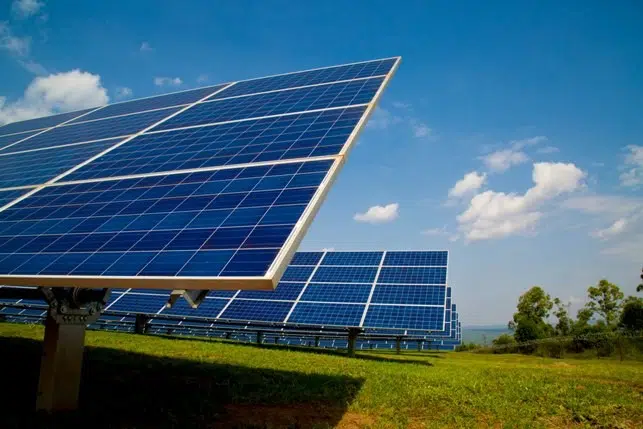
Africa is the world’s premium location to harness solar energy and is already demonstrating that a cleaner path is possible. Between 2014 and 2019, 20 million people a year in Africa got access to electricity for the first time, with much of the growing demand met by increasingly competitive solar and hydropower installations. Harnessing these abundant energy sources on the African continent can help develop local jobs and avoid expensive import bills.

Unfortunately, despite technological progress, the world is not on track to deliver on our global commitment to universal energy access by 2030. The Covid-19 crisis has caused significant setbacks. Without action, this can develop into a lasting negative trend. Last year, the number of people in sub-Saharan Africa without access to electricity grew – for the first time in eight years.

Restrictions due to the pandemic have held back work to connect homes, businesses, schools and hospitals, and the global economic downturn has imposed severe constraints on African countries’ budgets. This has significantly limited the scope for African governments to fund clean energy investments and resulted in millions of people being pushed back into extreme poverty, where they can no longer afford basic electricity services.

Barriers to deploying solar and other renewable technologies in Africa include the initial costs of installing them. Solar and wind power plants have the advantage of free energy supplies – the sun and wind – once they’re up and running. But in developing economies, the upfront costs of setting up mini-grids or standalone home solar systems, especially in rural communities, are enormous given the financial resources of those communities.

In addition, companies trying to set up new renewable projects are not always able to guarantee stable revenues from the get-go and face difficulties attracting investors. In general, businesses across developing economies are plagued by far higher borrowing costs than their counterparts in advanced economies, adding an extra hurdle to any renewable project. These difficulties are now exacerbated by the economic damage from the Covid-19 pandemic, which is lasting much longer in many developing economies in Africa and beyond.

The good news is that there are solutions available to address these challenges. They include innovative pay-as-you-go business models to spread out the upfront costs, improved policy and regulatory frameworks to enable more projects to advance, and greater efforts by international and regional organisations to support the development of the sector and bring down the financing costs of renewables projects.

All governments and relevant international organisations must urgently renew commitment to end energy poverty by 2030, including at the upcoming UN High Level Dialogue on Energy. And we must back that commitment up with stronger action.

The European Union and the International Energy Agency are partnering to make clean energy access an integral part of international efforts to reach net-zero emissions. This is how we can tackle uneven energy access without locking in any more harmful fossil fuel emissions. The IEA as well as the European Commission, through its Green Energy Initiative, are putting clean energy access at the heart of our collaboration with African governments.

We will work to increase the number of people, businesses and industries in Africa who have access to affordable, modern, and sustainable energy services. In 2021, the European Commission’s Green Energy Initiative is entering a new phase. Once in place, grants, technical assistance, and other financial instruments will support investments in renewable energy generation and promote energy efficiency across Africa.

In the next seven years, 30% of the European Union’s budget for international cooperation will go towards tackling climate change. But public funding alone is not enough. Private sector investments will be key and many European companies are ready to step in. But if we are to succeed in making energy poverty history in Africa, we need the whole world to work in concert: a global end to funding overseas coal power, accelerated cooperation on expanding clean electricity in Africa, as well as scaled-up financial support from advanced economies.

Let’s be clear – clean energy access goes beyond climate action. Renewables are good business and an affordable way to produce electricity. Investing in clean energy is a full-fledged strategy for economic development. We therefore count on other leading economies and organisations to take concrete steps with us to make energy poverty history within the next decade.

Environment Ministry & Shout Climate Change Give Prestigious Award to EU Ambassador

By Amin Kef Sesay

The EU Ambassador to Sierra Leone, Tom Vens, was the proud recipient of a meritorious awarded him by the Ministry of Environment and Shout Climate Change in honour of him as an Environmental Champion.

The award recognizes Ambassador Vens and also the European Union’s tremendous contributions towards managing important aspects of Sierra Leone’s environment, including the support in managing two of Sierra Leone’s transboundary national parks with neighbouring Guinea and Liberia.

Sierra Leone is among the three most vulnerable countries to experience the adverse effects of climate change. In recent years, the country has been struck with many environmental challenges.

Presenting the award to Ambassador Vens, the Minister of Environment Prof. Foday M. Jaward on behalf of President Bio’s Government said, “We appreciate you as EU Ambassador to Sierra Leone and for all the outstanding initiatives and interventions you continue to support in the environment sector, particularly in tackling environmental and climate change issues in the country.”

Minister Jaward pointed out that the issues of environmental degradation and climate change are serious challenges the country continues to experience, but recognized that the strong collaboration between the Government and EU could help to surmount those challenges.

He said President Bio remains very passionate about the environment which is an important pillar to achieving the Sustainable Development Goals (SDGs), hence the creation of the first-ever Ministry of Environment, to focus specifically on developing and implementing policy actions for environmental protection.

Founder and CEO of Shout Climate Change Africa, Finnex J. Asibor, who was part of the delegation, congratulated the Ambassador for successfully completing his tenure of office in the country, referring to him as an environmental hero and a strong ally to the global cause. “We love you, and will miss you!”

Ambassador Vens expressed appreciation particularly to all the delegation’s staff for the hard work that led to the recognition, noting that environmental issues remain at the heart of what the EU does globally, and also in Sierra Leone.

He said the EU development policies put strong priority on environment and climate change issues across the world because they are the most contentious issues that humanity has to deal with as a global community, due to the existential threat it poses to humanity.

He expressed optimism that with effective collaboration and strong partnership in the policy environment more could be achieved to mitigate the impacts of the scourge not only in Sierra Leone but across the world and pledged the EU’s unwavering support to the sector.

As a strategic development partner, the EU continues to support initiatives that strengthen the country’s environmental resilience by working with the Government of Sierra Leone, communities and partners in the sector for inclusive and sustainable environmental management.

In early June this year, the EU signed a 2.9 million Euro grant for the management of the Outamba Kilimi National Park – a transboundary forest landscape linking Guinea and Sierra Leone to preserve the country’s flora and fauna and conserve her natural resources.


The EU was also very instrumental in supporting the establishment of the Gola Rainforest National Park in 2011 – a park that now assures a new income stream to Sierra Leone from the sale of carbon credits. This is in addition to several other environmentally sensitive initiatives including restoration and conservation of wetlands and mangroves in Yawri Bay and the Sierra Leone River Estuary. These actions are critical in supporting livelihoods sustainably, in local communities.

The EU’s development partnership with Sierra Leone has increasingly focused on programmes that contribute to sustainable economic diversification, among others through actions that support access to sustainable and clean energy, resilient food systems and the protection of ecosystems and biodiversity.

Consortium of NGOs Proposes Separate Budget for Police Family Support Unit

By Edward Vamboi

A dialogue meeting was held on the 6th July 2021 at the Police Headquarters in Freetown during which a consortium of Non- Governmental Organizations (NGOs), including the Center for Accountability and Rule of Law (CARL), Tro`caire, Caritas and Rainbo Initiative, proposed to the Inspector General of Police (IGP), Dr. Ambrose Michael Sovula, and his Deputy, Madam Elizabeth A Turay,  for the Force to have a separate budget for the Family Support Unit (FSU) under the yearly Police budget.

Addressing the Consortium, the Inspector General, Dr Ambrose Michael Sovula informed that the Sierra Leone Police (SLP) budget is tied to their activities such as investigations, operations, administrations and equipments for all units, adding that if he had been asked, he would have loved the Government to allow them, probably, to explain in more detail about their budget strategy for a better understanding of the Ministry of Finance.

The Government, he said, wish to do more for the Police but is facing constraints due to the little availability of resources.

“As a consortium that believes and wants to see more budget for the FSU, we should start the campaign at the pinnacle, using the Top-bottom approach,” Dr Sovula promised.

FSU, he maintained, deals with matters of rape, sexual penetration and gender based violence.

The IGP further made reference to the supply of rice and fuel to the Sierra Leone Police, commodities, he affirmed, are now being provided by the Government even though procurement for same falls under the Police budget.

He said the SLP is not averse to a budget line for the FSU but noted that FSU has nexus with other units like the CID when it comes to investigations into certain matters.

Dr. Sovula, therefore, assured to discuss the proposal with the Police Budget Officer for onward discussion with the Ministry of Finance.

In her contribution, the Deputy Inspector General of Police, Madam Elizabeth A. Turay, commended the consortium for demonstrating interest in the FSU of the SLP.

The Unit, she said, is a baby of the IGP whom she disclosed was very passionate about combating SGBV.

The SLP, she went on, has been doing a lot in terms of capacity building for FSU officers.

Earlier, the Executive Director of Centre for Accountability and Rule of Law (CARL), Ibrahim Tommy, stated that the consortium over the years has been working with the FSU for justice and accountability.

The purpose of their visit, he said, is to register their campaign in pushing for a budget line for the FSU in the Police budget, disclosing that their campaign was for two reasons, first of which is to put pressure on the Ministry of Finance or the Financial Secretary to release the amount set for FSU to enable the Unit meet its task in the fight against SGBV, and secondly, to know the amount received and spent by the Unit for proper accountability.

Other speakers included Sudie Augustina Sellu from Tro`caire, Eliza G.O.C Sillah from Caritas Freetown and Princess Elliot from Rainbo Initiative.

NaCOVERC & Inter-Religious Council Sign Communique to Combat Third Wave of COVID-19

By Amin Kef Sesay

Out of a commitment to deepen cooperation towards arresting the third Wave of COVID-19, NaCOVERC and the Inter Religious Council, in a  Communique dated 7th July, 2021, signed by Archbishop Dr. Edward Tamba Charles as President of the Inter-Religious Council and Hon. Sheku F. Bangura, as Chairman of  NaCOVERC, have stated that whereas  Sierra Leone is currently witnessing a third wave of COVID-19 Pandemic, defined by rising case-loads, increased positivity, hospitalization and deaths; the two institutions recognize the imperative of public health and safety, and appreciate the immense contribution of the inter-faith community towards addressing the first and second waves of the pandemic in Sierra Leone.

They continued that, further mindful of the broadcast of His Excellency President Julius Maada Bio on July 1st 2021, announcing a range of interventions to suppress the current wave of infections in the country, and urging national ownership of the fight and compliance at all levels and acknowledging the role of the Inter Religious Council in community engagement and promoting behavior change, it was resolved to consult with and fully engage the Inter-Religious Council on matters touching and concerning the inter-faith community in the fight against COVID-19 in Sierra Leone.

The Communique further pointed out that the Inter-Religious Council appreciates the advice of the scientific community in formulating appropriate public health policies and advisories to tackle the current wave of the pandemic, and pledges its full faith and commitment to be collaborating with NaCOVERC at all material times of the COVID-19 Response.

It additionally stated that both sides have agreed to strengthen the framework of cooperation, including setting up a communication and mobilization hub focusing on vaccine roll-out, COVID-19 compliance generally, and addressing misinformation and disinformation.

According to what was stated both sides wish to convey thanks and appreciation to His Excellency the President Dr. Julius Maada Bio, development partners and the inter faith community for the tremendous patience and understanding showed in these difficult times and urged sustained compliance to ensure that the country bend the curve of the third wave and resume normal religious and other activities.