Home Blog Page 882

During MOU Signing… One Family People Donates Vocational Skills Training Equipment to National School for the Deaf

By Foday Moriba Conteh

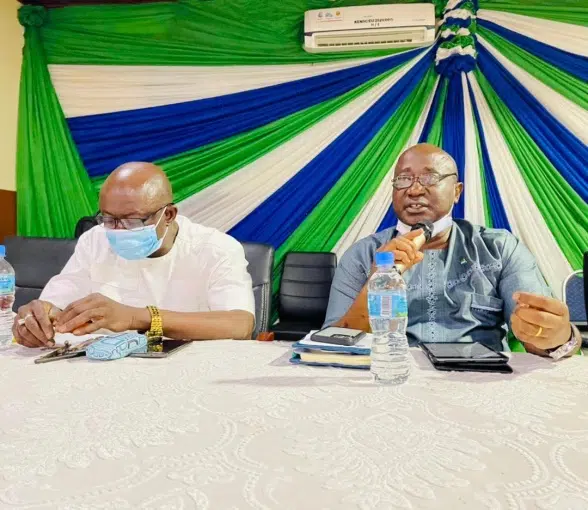
In a bid to support children living with disabilities, especially those suffering from speech and hearing impairment in the country, the One Family People organization, with support from Liliane Funds, has on Thursday 8th July, 2021 signed a Memorandum of Understanding with the National School for the Deaf which was followed by the donation of Vocational Skills Training equipment worth millions of Leones to the National School for the Deaf. The signing and handing over ceremony took place at the National School for the Deaf on Wilkinson Road in Freetown.

In his address, the Programme Manager of One Family People, Samuel P.O.V Macaulay expressed appreciation to the Board Members and the Staff of the National School for the Deaf for their tireless efforts in making the signing of the MOU a success describing such as a move in the right direction in addressing issues faced by those affected children.

He added that their organization is a disability focused entity that has been working assiduously to create a conducive environment for persons living with disability across the country which includes children who have speech and hearing impairment adding that as an organization they noticed that such children have been left out in society.

The Programme Manager pointed out that despite the efforts made by the National School for the Deaf to gain widespread recognition and acceptance, however, the issue of discrimination is still tired around children who suffer from speech and hearing impairment in the country of which he said although they are disable they should not be discriminated against but rather to be seen as useful children in society.

He maintained that as an organization they realized that among all the various forms of disabilities, people with speech and hearing impairment are one of the most vulnerable in society, stating that it is in that regard that they decided to join hands with the National School for the Deaf in order to guarantee a brighter future for those kids.

Samuel P.O.V Macaulay noted that as an organization they noticed that the transition period of children living with disabilities from Primary to Secondary school is fraught with constraints of which he said that inasmuch as they advocate for inclusive education they are also advocating for children living with disabilities further underscoring the need to put emphasis on technical and vocational education.

Head Teacher of the National School for the Deaf, Winifred Kamara-Cole (Mrs) expressed appreciation to the One Family People for both the signing of the MOU and the donation of the Vocational Skills Training equipment to the National School for the Deaf.

She called on all to stop the discrimination against speech and hearing impaired children stating that rather society should see them as very important children in and help in creating the enabling environment for them.

She assured all that the donated items will be used for the intended purposes in order to empower the children.

On her part, Chairperson of the Board for the National School for the Deaf, Josephine Kargbo, applauded the One Family People for the kind gesture which she described as very important towards the empowerment of these children.

She revealed that the National School for the Blind is in dire need of a vocational training center which will host these children after completing their primary school, adding that for most of the children after completing their primary school that is the end of their educational pursuit  as it is only a few that normally proceed to secondary school.

Josephine Kargbo maintained that with the vocational training center such will enable these children to learn skills which will help them greatly by making them self-reliant of which she said the donated Vocational Skills Training equipment are not only important but came in timely.

On behalf of the Board she assured the One Family People that they will closely work with them in order to fulfill what is imbedded in the MOU.

The event was climaxed by the official signing of the MOU and the handing over of the Vocational Skills Training equipment by the Executive Director of One Family People Samuel Edward to the Chairperson of the Board for the National School for the Deaf, Josephine Kargbo.

NP-SL Ltd Continues to Deliver Value for Money

By Amin Kef Sesay

It is strongly incontestable that the leading petroleum marketing company in the country, the National Petroleum- Sierra Leone Limited, is well known to stand tall within the realm of enhancing customer care by making it a key objective in its modus operandi. This is indisputable when thorough cognizance is taken of how Management is very keen in optimizing customer satisfaction in its service delivery on different fronts.

Members of staff of the company are very mindful of the fact that it is the customer that comes first and therefore needs the utmost attention always ensuring that transactions are conducted under a congenial atmosphere that result into a win-win situation. For this brilliant and managerial initiative the company has been making positive headways positioning to stand tall among other business entities in this part of the world.

With a capable and result-oriented ‘Team NP’, working collaboratively and assiduously, where even the cleaner is regarded as highly relevant there is bound to be positive outcomes and the company has mastered this by ensuring that synergy is enhanced.
One admirable quality that NP-SL Ltd possesses is working tirelessly and effectively using its contacts with oil producing countries in order to ensure that there is timely purchase and delivery of petroleum products to avoid shortages.

It goes without saying that fuel, for example, could be a political commodity in the sense that fluctuation in its price would make a Government likeable or unpopular. When the price goes up then people blame the Government for that but if it goes down it is kudos for the political administration.

Its timely importation of petroleum products has earned NP high commendations from various quarters simply because it helps to cushion unrest and other forms of disadvantageous effects one of which is increase in transport fares, increase in the prices of certain commodities. The pro-activeness of the company invariably has a direct impact on poverty reduction in variable ways.

Some who may not be aware of the fact that NP-SL Ltd is wholly owned by Sierra Leoneans vis-à-vis the visibility of the company and how it is remarkably striving could find it hard to believe that it a truly indigenous company.
However, that remains the plain truth when it is learnt that it was Sierra Leonean 35 workers formerly working for British Petroleum (BP) who pulled together their end of service benefits to purchase shares which were used to establish NP, which today is a success story of an indigenous company, having branches in various parts of the country and in other four West African countries namely Liberia, Guinea, Ivory Coast and The Gambia. The company’s operations right across the spectrum is contributing towards revenue generation and job creation for many.

With gas as one its marketable products it was thought wise to be producing gas cookers, popularly known as NP Gas, which could be access at their different filling stations. According to investigation conducted NP Gas is cooking-friendly, safe and long lasting. It is going at an affordable price and many are going for it.

When reference is made to Local Content, which by law is a Policy, then NP-SL Ltd stands tall within that realm as nearly all its members of staff are Sierra Leoneans thereby making use of local talents everywhere they are operating. The Local Content Policy is indeed an engine of growth and NP is making full use of it.
Without any iota of doubt NP-SL Ltd continues to deliver value for money.

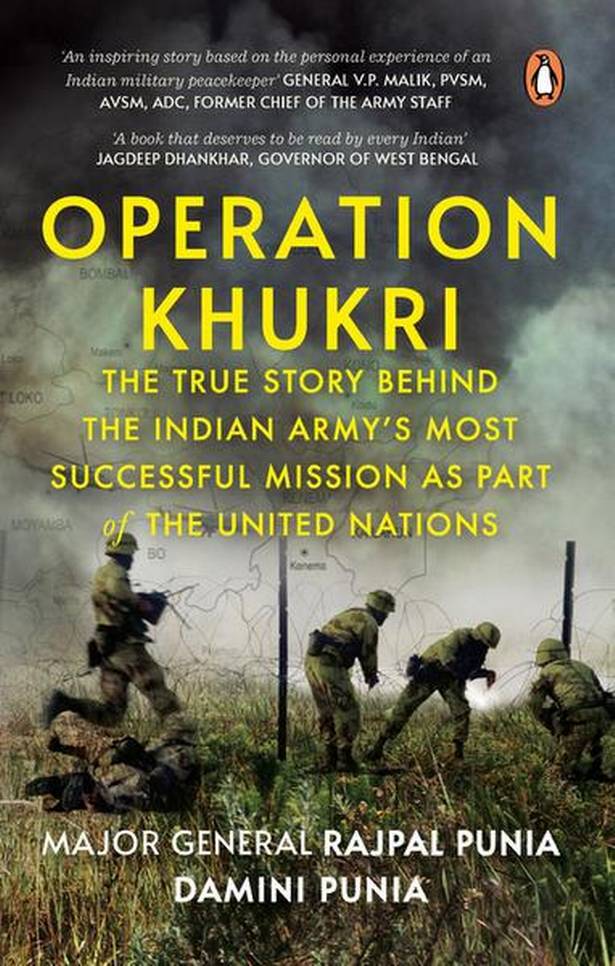
New book ‘Operation Khukri’ Tells Untold Story of Indian Army’s Brave Mission in Sierra Leone

By Penguin Random House India (PRHI)

“Operation Khukri: The untold story of Indian Army’s Bravest Peacekeeping Mission Abroad”, published by Penguin Random House India (PRHI), is the story of the Indian Army’s successful rescue mission of over 200 India peacekeepers who were sent to Sierra Leone in year 2000 by the United Nations to help the Government there in tackling Revolutionary United Front (RUF), a rebel group. July 13 marks the 21st anniversary of the Operation.

Some of the little-known details of ‘Operation Khukri’ — the Indian Army’s peacekeeping mission in the jungles of Africa — will be told in a first-hand account by author Major General Rajpal Punia, slated to be released on July 15.  The book is co-written by Major General Punia and his daughter Damini Punia.

Punia, who was then the Commanding Officer of the 58th Gorkha Rifles, orchestrated the operation, survived the ambush of the RUF in a prolonged jungle warfare twice, and returned with all 233 soldiers.

“Operation Khukri is a story of survival, courage and immense love for the motherland. The book Operation Khukri is symbolic of my duty towards the soldiers who I led into battle in a far-off land against an unknown enemy,” Punia, who was decorated with the Yudh Seva Medal in 2002.

“It will give you an insight into how a soldier’s life unfolds, how children long for their fathers, how 233 soldiers faced death without food for close to three months and ultimately chose to die fighting than of hunger,” he added.

In 2000, Sierra Leone, in West Africa, ravaged by years of civil war saw an intervention by the UN, and the two companies of the Indian Army were deployed in Kailahun as part of a UN peacekeeping mission.

Soon, the peaceful mission turned into a war-like stand-off between Punia’s company and the RUF rebels in Kailahun, with the Indian peacekeepers cordoned off for 75 days without supplies.

“The only way home, they were told by the RUF, was by laying down their weapons,” reads the book.

According to Damini, the book is indeed a restructuring of Punia’s memories and an “attempt to highlight the courage and valour of every soldier donning the olive-green uniform in India”.

“It is truly unfortunate that people are not aware of an operation that transpired a year after the Kargil War, an operation where soldiers chose death over cowardice, dignity over two meals and honour over freedom,” she writes in the introduction.

The book, a maiden attempt by the father-daughter duo as authors, is dedicated to Havildar Krishan Kumar, Sena Medal (posthumous), the only gallant warrior India lost in the operation.

The Trials and Tribulations of Lome – The Role of Ambassador Omrie Golley In The Lome Peace Talks – Episode 8 (Part 2)

By Noellie Marionette-Chambertin

The countdown to the commencement of the Lome Peace Talks started in mid-March 1999 with the arrival in Lome, capital city of the Republic of Togo of the initial RUF Delegation comprising Ambassador Omrie Golley and erstwhile senior military adviser of the RUF, Ibrahim Balde.

Ambassador Golley had been introduced to Balde in Monrovia, Liberia, in early March 1999. Balde accompanied Golley to the RUF meeting in Buedu, eastern Sierra Leone, referred to in the last episode. Balde had assisted in advancing the peace process emerging during this period, and had accompanied Golley during his meetings with sub regional leaders, prior to their arrival in Lome Togo, for the intra RUF consultations, and later the substantive Lome Peace Talks.

Ambassador Golley remembers his interaction with Balde during this time:

‘Balde was soft spoken, a gentleman with an almost encyclopedic knowledge of most of the leaders of the sub-region at that time, most of whom also knew him personally. He looked forward to seeing Sierra Leone free from conflict’.

Upon arrival in Lome, Ambassador Golley proceeded to a meeting with former President of Togo, the Late Gnassingbe Eyadema, who had agreed to mediate and host peace talks between the Government of Sierra Leone and the RUF.

Following this meeting, Ambassador Golley proceeded to Burkina Faso with Balde, where he briefed erstwhile President Blaise Campaore on the arrangements being concluded for discussions in Lome between RUF officials, as well as on the pending peace talks between the Government of Sierra Leone and the RUF.

Ambassador Golley also undertook visits to Ghana and Ivory Coast, returning to Lome on the 17th April 1999, on the eve of the arrival of the RUF Leader, Corporal Foday Sankoh.

On the 18th April 1999, Foday Sankoh arrived in Lome, for the commencement of discussions with his commanders, as well as to lead the RUF delegation into peace talks.

For Ambassador Golley, who had not seen the RUF Leader since their initial meeting in Yamassoukro, Republic of Ivory Coast three years earlier in 1996, this was a defining moment in the quest for a process that he fervently hoped, would lead to a lasting peace in his motherland.

Ambassador Golley was, however, under no illusion, that whilst the release of Sankoh offered a great opportunity for peace to return, the impending discussions and meetings ahead between the Tejan Kabbah Government and the RUF, would be difficult for both sides in the coming weeks.

Ambassador Golley’s initial meeting with Sankoh on his arrival in Lome was pleasant enough. Sankoh thanked Golley for all he had done to advocate for his release to attend the talks, and went on to inform of his time in detention in both Nigeria and Sierra Leone. Sankoh also spoke of conversations that he had had with President Tejan Kabbah, and indicated that if Kabbah was serious for peace, then it could be attainable.

For Ambassador Golley however, that encounter left him slightly troubled.

Ambassador Golley states: –

“Whilst it was pleasing to see Sankoh in person and seemingly in good health, I couldn’t but notice a change in his overall behaviour, since our last meeting in the Republic of Ivory Coast. I found Sankoh more aggressive generally, convinced of his own divine destiny, scathing of individuals within the Government, and more surprisingly, of military commanders and officials from his own Movement, that he had not even seen in recent times.”

Sankoh also appeared concerned about his own place within the movement he created, wondering whether his senior commanders would still accept his authority and command.

This general attitude and behaviour of Foday Sankoh created a pervasive atmosphere for the entire duration of the peace talks.

Meanwhile the delegation of RUF officials chosen for the intra RUF discussions arrived in Lome and the meetings began. In addition the final delegation to lead the RUF into talks with the Government was chosen, and on the 26th May 1999, the Lome Peace Talks commenced with much fanfare, after the arrival of the delegation representing the Government of Sierra Leone, and headed by their erstwhile Attorney-General and Minister of Justice, Solomon Berewa.

The Lome Peace Talks began with cordiality and informality emanating from both sides, but soon became bogged down on the issue of the legal position of the RUF Leader Foday Sankoh, given that Sankoh was still facing treason charges in Freetown, with the Government of Tejan Kabbah insisting that Sankoh continue with legal proceedings upon the conclusion of the peace talks that were already underway.

For Ambassador Golley, the position of the Government of Sierra Leone on this particular issue was untenable. He believed that it was particularly important, not only for the success of the peace talks, but also for prospect of lasting peace, that the RUF leader was free to lead his Movement into deliberations with the Government at that  time.

As Golley stated in a BBC ‘Focus on Africa’ interview on the 27th May 1999:

‘You cannot expect the man (Sankoh ) to negotiate with his jailers while he is shackled and chained.’

This thorny issue of the legal position of the RUF Leader nearly led to the complete breakdown of the talks. Additionally senior commanders of the RUF remaining in Sierra Leone while talks were being held, were threatening to commence military offensives generally, and not complying with any directives from their Leader regarding cessation of hostilities.

This matter was resolved, with a subsequent statement by the Government Delegation, in a briefing paper they subsequently prepared and released, intimating that President Kabbah was prepared to release Sankoh as the price for lasting peace in Sierra Leone.

The second thorny issue which both sides to the talks had to deal with, revolved around the inclusion of the RUF into the political and social landscape in Sierra Leone generally, with the transformation of the RUF into a political party, and more particularly, regarding the inclusion of RUF members into a future Government after the peace talks had concluded.

Ambassador Golley remained very closely involved with the direction and progress of the Lome talks during this period.  The Leader of the Movement, Foday Sankoh, had decided against leading the RUF into peace negotiations, with the Chairman of the War Council of the RUF, the late SYB Rogers, leading the delegation at the talks.

As Legal Representative and Spokesman however, Ambassador Golley, as a member of the negotiating team, had to face the brunt of conveying the position of the RUF to the international media when necessary, but more importantly, was expected to advise on aspects of law and international practice when called upon.

Golley also had to interact on a daily basis with RUF Leader Foday Sankoh, who was feared by his own commanders and his entourage, with a mercurial psychotic temperament. This made the whole peace process even more difficult, and at times debilitating.

Ambassador Golley found the whole experience at Lome at times overwhelming. He remembers the experience:

‘Both delegations were lodged by the Togolese authorities, in the same hotel in Lome, the Deux Fevrier, within close proximity to each other.

In addition to both delegations, the hotel also housed during this period, delegations from the United Nations, ECOWAS, the OAU, together with Government delegations from the US, UK, Libya, and other countries.

My room was allocated just next door to the Suite of the RUF Leader, which did not help my desire for privacy on occasion. There were a constant stream of people clamoring to see Sankoh, many of whom would come round to my room to engage me initially.  At times I was even used as a barometer, by people enquiring about the mood of Sankoh, prior to seeing him’.

Ambassador Golley also remembers his interactions with Sankoh :

‘Foday Sankoh was a complicated man with a   multiplicity of emotions.  Privately he was deeply insecure, with an overwhelming distrust of people around him. He eschewed intellectuals and educated people, but at the same recognized the importance of their role within the Movement.

Sankoh had decided earlier on in the process, not to be directly involved with the peace meetings. That did not however stop him from convening meetings with the RUF delegates every evening whilst talks progressed, to enquire into every facet of the discussions previously held, and also directing the delegates as to negotiating positions to be used, the next day. ‘

Ambassador Golley also remembers the relationship between Sankoh and the Government of Sierra Leone during this period in Lome:

‘Foday Sankoh spoke to Tejan Kabbah directly on the phone on many occasions for the duration of our sojourn in Lome. His relationship with members of the Government of Sierra Leone Delegation also appeared quite cordial. ‘

Meanwhile at the Peace Talks proper, negotiations were difficult, often tortuous, at times hostile, and difficult for both sides. The issue of the inclusion of the RUF into governance was, understandably, a very difficult and protracted issue for the Kabbah Government to accept and agree to.

Although this matter had been aired in briefing and position papers by both sides to the talks prior to the Lome meeting, in reality, it was very difficult to accept on the peace table.

The issue of an Amnesty for those directly involved in the war was another difficult issue, and the difficulties encountered in discussing and reaching an agreement on this matter, can be seen with the subsequent amendments at the conclusion of the peace talks, of the earlier provisions agreed upon, and the subsequent clarifications on the position of the United Nations, regarding the Amnesty provisions, during the signing of the Accord proper in July 1999.

For Ambassador Omrie Golley however, the convening of the Lome talks, offered his country a real opportunity for a cessation of hostilities and the chance of lasting peace. He fervently believed that whatever the outcome of the Lome talks, that excellent opportunities existed for a genuine and lasting peace. To that extent, as the talks progressed Golley started thinking of his own exit from the peace talks.

He decided to do this in stages. The first step was occasioned by him departing from the Hotel Deux Fevrier, where the RUF and Sierra Leone delegations were being housed, and moving to another hotel, a few kilometres away. He also arranged for members of his family to join him there.

This development irked the RUF Leader, who wanted Ambassador Golley to remain at the hotel, where the rest of his delegations were residing. Golley however wanted more privacy, and in any event, felt that the time was fast approaching,  for a quiet exit from the peace talks that he had worked hard to convene.

The second issue, related to the question of his name being included in the list of officials  from the RUF, who were to join the Government of Tejan Kabbah, after the  signing of the Lome Peace Accord, as part of its provisions. In fact Ambassador Golley was informed by the RUF Leader that he ( Sankoh ) wanted Golley to be included in the RUF list of proposed Cabinet  to be submitted. This happened on two occasions.

However for Golley, joining the Tejan Kabbah Government as an RUF Cabinet Minister, was not something he was prepared to accept or join. For him, the most important prize was a lasting and sustainable peace in his motherland, after Lome.

After weeks of deliberations, a Peace Accord was agreed upon and signed in July 1999.

Ambassador Golley however, one of the driving forces behind the convening of the meeting at Lome, and one of the main architects of the peace process generally, did not attend the signing ceremony. For him, his mission, up to this point in time, had been accomplished.

Ambassador Golley left Lome quietly a fortnight before the signing ceremony, and proceeded to Europe, again to his law practice and his family.


*Note*

For further enquiries on our episodes, please contact the writer:

Noellie Marionette-Chambertin

Phone number: +447535506716

Email: noelliechambertin@mail.com
 

Mines Ministry Pays Over Le1B ADF to 5 Rutile Mining Communities

By Amin Kef Sesay

One Billion Four Hundred and Seven Million, Four Hundred Thousand and Seventy Leones (Le. 1, 407, 400, 070.00) Agricultural Development Fund (ADF), provided by Sierra Rutile Limited, was disbursed for the 2021 period by the Ministry of Mines and Mineral Resources (MMMR) on Friday 2nd July 2021to affected mining communities in Imperi, Lower & Upper Banta, Jong, and Bagruwa Chiefdoms in Bonthe and Moyamba Districts.

Out of the one billion four hundred and seven million, four hundred thousand and seventy Leones (Le. 1, 407, 400, 070.00) Agricultural Development Fund (ADF) for the 2021 period, Imperi Chiefdom received Le. 498,304,526.00, Lower Banta received Le. 304,011,477.00, Upper Banta received Le. 323,604,053.00, Jong received Le. 140,740,007.00 and the Bagruwa Chiefdom equally received Le. 140,740,007.00.

The District Officer of Bonthe, who doubles as the Chairman of the programme organized at the SRL Social Hall, Alpha M. Sowa said that ADF is part of SRL’s commitment to uphold the development and to promote the livelihood of affected mining communities in the Bonthe and Moyamba Districts. He opined that SRL has contributed to the development of the communities and making them peaceful.

On behalf of the Chief Executive Officer (CEO) of SRL, Rob Hattingh, the Chief Operating Officer (COO) of SRL, Grant intimated that they have been contributing to the ADF for over ten years, adding that the fund is designed to support agricultural development in affected mining communities.

He assured of their continuous support to cushion the economic burden and development of mining communities.

In his keynote address on behalf of the Minister of Mines and Mineral Resources, Musa Timothy Kabba, the Deputy Secretary (DS) of the MMMR, Emmanuel Sandi, commended Sierra Rutile Limited (SRL) as one of the most compliant mining companies in the Sierra Leone’s mining industry, adding that the SRL has maintained its operations in Sierra Leone even in the height of the COVID-19 Pandemic.

He said that SRL is continuously supporting the ADF to give affected mining communities alternative livelihood and to sustain ongoing community development projects, also opining that SRL would do more for affected mining communities as they maximize profit in their operations. Sandi lauded beneficiaries of the ADF for their peaceful operations with SRL, expressing appreciation to learn that the previous ADF was well utilized.

He explained the variances of the diverse amounts disbursed to every chiefdom, adding that the total disbursement per chiefdom is determined by the surface land utilized for mining activities undertaking by SRL in every chiefdom.

He informed that the MMMR would later visit these SRL affected mining communities to oversee whether the ADF is further disbursed by community leaders to the actual beneficiaries.  He advised community members including youths to always forward their concerns to the appropriate authorities regarding the operations of any mining company in their communities, underscoring that development would not progress in any conflict society.  He promised to forward to his boss (s) the various concerns raised by community stakeholders during the process of disbursing the ADF.

One of the recipients of the ADF, Paramount Chief of Upper Banta Chiefdom, Moyamba District, P.C Tommy M. Jombla commended the MMMR and the SRL for answering the calls of affected mining communities. He said, “Today is better than Yesterday.” He underscored that young people used to protest yesterday before their calls are heard, adding that within a year mining communities have received timely disbursement of surface rent, CDC, and ADF among others. He added that SRL had supported and empowered women with free loan interest in affected mining communities, and provided scholarships to young people.

The programme attracted other representatives from the National Mineral Agency (NMA), Chiefdom Stakeholders, Civil Society Organizations, the Media and Councillors to name a few.

Crime Rate Could Be Combated through Application of Various Strategies

His Excellency President Dr Julius Maada Bio

By Amin Kef Sesay

Just one of those interesting facts of life this commentator came across the other day whilst browsing on the internet. The Netherlands’ crime rate is so low that 23 prisons have been closed since 2004 because there aren’t enough offenders to occupy them.

Whereas, prison population in Sierra Leone has grown so exponentially over the past two decades since the war ended that the main correctional center in Freetown that was built to house less than 400 inmates now houses almost 2, 000.

The cause of increased crime in the country is not hard to find. Sierra Leone continues to grapple with poverty, rising inflation, and high unemployment rates especially among the youth, who possess limited job prospects. Reasonably, more than 50% of Sierra Leoneans live below the national poverty line, with most making less than $2 per day. Economic desperation therefore has fuelled increases in crime.

Reducing the crime rate in the country depends on the workings of an effective criminal justice system which comprises of a series of Government agencies and institutions. Goals include the rehabilitation of offenders, preventing other crimes and moral support for victims.

The primary institutions of the criminal justice system are the Police, Prosecution and Defense Lawyers, the courts and prisons. An effective justice system protects the rights of all citizens against infringement of the law by others, including powerful parties and Governments.

In a democracy, individual judges and the justice system as a whole should be impartial and independent of all external pressures. In which regard, the so-called “Force for Good” seeks to improve its response to escalating crime but it remains hindered by the lack of resources.

However, the lack of well-paid, properly trained officers with established ethical, moral and professional attitudes towards their work of preventing, detecting and prosecuting crime comes under heavy censure from the public the Force serves.

At the Police Stations, paying for paper and pen to have reports taken; paying for transport to invite suspects all go a long way to compromise the impartial dispensation of justice. Police response to reports of suspected crime from the public is often slow and unreliable. It is not an uncommon practice for victims of crime to pay for or provide transportation for Police Officers to accompany them to the local station in order to file a report.

What many people advocate for is increased partnership between crime infested communities and the Police. Under Community Policing, preventing crime means working together with communities, learning about their problems and designing unique solutions to those problems.

Unlike previous policies, what sociologists recommend is a more integrated and developmental approach to prevention that attempts to confront the underlying causes of crime and violence. Traditional approaches to safety and security use ‘tough on crime’ tactics that make little to no impact on safety because they fail to address the underlying causes of crime and violence.

Recognising the limitations of these traditional approaches should prompt policy-makers to look more broadly at the underlying factors influencing crime and violence in our societies. Several priority areas are pointed at: Strengthening the entire criminal justice system, Professionalising the police service, Strict controls on the use of firearms and defining clearly the rules of engagement, Increasing the rehabilitation of prisoners and reducing recidivism as well as Increasing community participation in crime prevention and detection

The aim is to establish a framework for an accountable, professional, competent, and highly skilled Police service that adheres to human rights principles. In this regard, traditional approaches of ‘declaring a war on crime’ and having ‘zero tolerance’ for persons in conflict with the law, often ignore human rights, do not deter crime, and most importantly, do not make people feel ‘safe’.

Victims must be encouraged to report incidents of crime to the Police, and obstacles that interfere with a person’s access to critical law enforcement services need to be eradicated in order to effectively curb future incidents of crime and violence from occurring. Furthermore, building an active citizenry is an essential part of creating long-term sustainable delivery of Police services in communities.

MoPED Starts Consultative Engagements in the Provinces on Construction of Ultra-Markets

By Theresa Kef Sesay

A week-long consultative engagement with key beneficiaries for the construction of ultra-modern markets for trading in Bombali, Kenema and Bo Districts respectively has been commenced by the Ministry of Planning and Economic Development at the Kenema District Council Hall on the 5th July 2021.

This medium learnt that the markets would cater for critical amenities such as water and sanitation facilities, storage facilities, parking spaces for vehicles, tricycles and motorcycles, a police post, offices for the Driver’s Union, Trader’s Union and the Road Safety Authority within the structure to ensure its full use by the targeted beneficiaries.

Chairman of the Kenema District Council, Mohamed O’Level Sesay, in his opening remarks, expressed  his appreciation to the New Direction Government for the initiative; noting that the process of engaging the people during the initial stages of the project was a step in the right direction.

He said the implementation of the project would address street trading, which has over the years increased rapidly in most towns and cities in the country, particularly Kenema District.

Paramount Chief Mohamed Dhaffie Benya V, in his statement, said the project is a timely opportunity for the Kenema people to benefit from, especially the traders. He said, as Chiefs, they would ensure a suitable location for the construction of the market would be provided as soon as possible.

The Traders Union Secretary, Alpha Lamin, expressed his delight at the construction of the market, saying that the project is a demonstration of the Government’s efforts to improving the welfare of its citizens, particularly the traders. He called on the authorities to also identify the demarcation of the categories of items sold in the market for ease of use.

Alpha Bangura, Director of Public Investment Management Directorate (MoPED), in his presentation, noted that the proposed market would be constructed in communities where access to good roads and means of transportation of goods to big cities pose some challenge. Mr. Bangura said the process would ensure that community stakeholders were involved in the entire process from the conception to the implementation phase.

He called on Kenema authorities to work with all stakeholders involved to achieve the desired goal.

Deputy Minister of Works and Public Assets, Philip Tetema Tondoneh, said Government is committed to change the livelihood of the people, especially the traders in Kenema. He noted that the “PAOPA Government” of President Bio would continue to do all it could to alleviate poverty in the country, which demonstrated the President’s vision of achieving Human Capital Development.

In his address, the Deputy Minister of Planning and Economic Development, Rev. Dr. Jonathan Titus-Williams said one of the greatest concerns of the New Direction Government of His Excellency Rtd Brig. Dr. Julius Maada Bio is to provide infrastructure for its citizens, which has culminated into the need to provide modern markets infrastructure for the people of the country.

Dr. Titus-Williams said this move by Government is to begin the transformation process of improving the condition of traders in the country and to minimize street trading. He said that the plan charts a clear path towards 2023 enroute to the goal of achieving middle-income status by 2030 through inclusive growth that is sustainable and leaving no one behind.

The Team would continue the engagements in Bo District today before heading to Bombali District to continue the schedule of activities of conducting site visits to obtain data for the development of the project proposal for funding.

SLFA Sets the Record Straight on List of Leone Stars Beneficiaries

Thomas Daddy Brima President of SLFA

By Edward Vamboi

The Media Department of the Sierra Leone Football Association (SLFA) in a Press Release dated 5th July , 2021 and signed by Ibrahim Kamara as Head of Media and Marketing (SLFA), Thomas Daddy Brima as President of SLFA and Chris Kamara as General Secretary, categorically stated that the attention of the Sierra Leone Football Association has been drawn to a certain list of Leone Stars players apparently written on a fake SLFA letterhead in which the writer suggests the mode of sharing the money from His Excellency Brigadier (Rtd) Julius Maada Bio’s promise which is clearly contrary to the pronouncement made by the President, which states that each player in the squad against Benin is entitled to One Hundred Million Leones (Le 100,000,000).

According to the Media Department, in view of the above, the Sierra Leone Football Association would like to state that the said document has been criminally drafted on a fake SLFA letterhead with no signature of any official of the federation.

It further stated that the SLFA is in full compliance with His Excellency the President’s pronouncement and are fully committed to ensuring that such pronouncement is upheld and implemented accordingly.

Also mentioned was that the list officially presented by the SLFA to the National Sports Authority contains, among other names, the names of Musa Noah Kamara (Musa Tombo) and Saidu Mansaray (Malian).

The Media Department highlighted how SLFA would like to kindly ask the general public, especially Leone Stars players, to discountenance the document mentioned as investigations are currently ongoing to bring out whoever that is behind such deceptive and criminal act of impersonation.
It concluded by informing members of the public to please feel free to contact the SLFA Head of Media and Marketing on the following contact details for any further clarifications; +232 34 706503 slfamediadept@gmail.com

LEGAL LINK Appeals to President Bio to Lift Suspension on Congregational Worship

By Amin Kef Sesay

In an Open Letter written by the Executive Director of LEGAL LINK, Rashid Dumbuya Esq, dated 5th July 2021 and addressed to His Excellency, The President of the Republic of Sierra Leone, Retired Brigadier Julius Maada Bio, for and on behalf of the LEGAL TEAM, an appeal was made to the President for the lifting up of the suspension on Congregational worship in churches, mosques and other religious places in Sierra Leone.

The Executive Director stated that they have seen and heard the President’s broadcast to the nation of Sierra Leone dated 1st July 2021 introducing a plethora of measures to effectively address the third wave of the Coronavirus (Delta variant) in the country.

He continued that as an organization that defends the rights of religious communities and vulnerable groups in Sierra Leone, they sincerely commend the leadership the President has shown thus far and also acknowledge the good work that NaCOVERC has done and is still doing regarding the fight against the Coronavirus in the country.

“Without any iota of doubt, your timely interventions and guidance have fundamentally helped in saving lives and livelihoods during this challenging period in the world’s history,” he commended adding that be that as it may, however, LEGAL LINK will raise 5 cogent and convincing reasons as to why the President should consider the lifting up of the suspension on Congregational worship and prayers within religious institutions in the country.

He pointed out that firstly though the President’s intentions are quite understandable and are premised on saving lives, they at LEGAL LINK are however concerned particularly with the measure of suspending congregational worship in churches, mosques and other religious places for a month in the country.

The Executive Director stated that is so because such a measure might have the proclivity of not only producing hardship for the religious community but also deprives the nation of a sustained spiritual response in the fight against the noisome pestilence called COVID-19 in the shores of the country.

He stated how without any gainsaying the COVID-19 virus is a pestilence that needs to be dealt with not only through scientific and physical means but much more by a united spiritual response.

“This is the case because, like the Bible records in Psalms 91 from verse 3 to 7, our ultimate protection from such noisome pestilence can only be ensured by God Himself,” he justified his stance.

Rashid Dumbuya furthered that suspension therefore of Congregational worship and activities will gravely undermine the realization of the above spiritual objective; which, he said, the President knows is highly recommended at this time especially where powerful nations and medical experts across the world have been humbled by the virus and are seemed to be running out of ink and ideas regarding medical solutions to dealing with the coronavirus pandemic.

He said secondly they make bold to say that religious institutions have been the most compliant of all when it comes to adherence to the COVID-19 guidelines issued by NACOVERC to prevent and/ or curtail the spread of the virus in the country.

“Without any doubt, there is outright disregard for many of NaCOVERC’s COVID-19 measures in other places and institutions including Government offices when compared to places of worship,” he argued.

He said as a matter of fact, in a last documentary survey conducted by LEGAL LINK to assess the impact of COVID- 19 on the religious community in Freetown, Sierra Leone, they found out that there is over 90% compliance rate within religious institutions with regards the core COVID-19 measures introduced by NaCOVERC for the safe return to Congregational worship in Sierra Leone.

The erudite lawyer maintained that since they are the only institution with such a comprehensive report and credible data, they shall attach a copy of that report for the President’s perusal and informed decision.

He said thirdly it would certainly not be just, fair and equitable in the given circumstances to suspend Congregational worship and prayers within religious institutions while allowing schools, market centres, clubs and restaurants to freely operate in the country without much hindrance.

“It is uncontroverted and undisputable that unlike religious institutions and places of worship where order and control can be easily achieved, market centres, clubs and learning institutions have proven to be the most difficult of places to regulate and enforce COVID-19 measures as a result of the huge crowd and social interactions that usually occur in such places as well as the length of time spent therein,” he substantiated his position.

He argued that to now allow for such uncontrolled places to continue operations while restricting controlled places such as religious institutions from holding congregational prayers is not only paradoxical and unfair but will certainly sap off the energies, potentials and collective efforts of the religious community in the fight against COVID-19 in the country.

The LEGAL LINK Executive Director said more importantly and with the greatest of respect, the decision to suspend congregational worship and prayers is not driven by data, science or empirical evidence.

He further argues that there is no data, scientific evidence or empirical studies undertaken either by NaCOVERC or any other related body to show that religious institutions and places of worship have recorded huge number of infections, deaths or hospitalizations or have become the epi-centre for transmissions or have been outrightly cavalier in the coronavirus fight in the country.

Rashid said ,on the contrary,  in the findings of their documentary survey report assessing the impact of COVID- 19 on the religious community in Sierra Leone, it was revealed that no religious institution in the country has ever recorded a single coronavirus outbreak or crisis situation since the return to Congregational worship in July 2020.

“This report finding is quite instructive indeed,” he asserted adding how with such positive and compelling available data indicating the response from the religious community regarding the COVID-19 measures, it stands to reason that some careful efforts had truly being made by religious institutions in terms of adherence to the COVID-19 guidelines.

He said it would therefore be scientifically incorrect for the President to now suspend the activities of those religious institutions at a time when they had shown enormous compliance to the COVID-19 fight.

He stated that finally was the absence of an open, inclusive, systematic, engaging and comprehensive consultative process with heads of the diverse religious bodies in Sierra Leone before such measure is being rolled out.

The Executive Director concluded by saying it is no gainsaying to state that many of the religious denominational heads in the country have expressed concerns and misgivings over the non-notification, non- engagement and non- consultative approach by the Government before stringent COVID-19 measures are often rolled out against religious institutions.

He said that is certainly an issue that is worth noting by His Excellency due to the fact that religious clergymen  are God’s representatives here on earth and must always be treated with awe and reverence and a deep sense of cosmic responsibility and moral rectitude.

“An emergency summit with all religious organizational heads before the suspension would have perhaps saved the current backlash being experienced,” he recommended.

The Lawyer appealed to the President to bear in mind that Sierra Leone is not only a religious nation but religion happens to be a core and sacred fundamental human right guaranteed under Section 24 of the 1991 Constitution.

He said the sanctity of its enjoyment therefore must always be preserved and guaranteed in the State as it forms the soul and way of life of the people.

The Executive Director stated that from the above points raised, it stands to reason that a reversal of the suspension of congregational worship, prayers and gatherings by the President would not only be expedient at this time but will further inject into the nation a spiritual focus which is fundamentally crucial in dealing with the coronavirus scourge going forward.

“By way of mitigation however, we recommend that NaCOVERC carries out robust and effective monitoring of its earlier COVID -19 measures introduced for the safe operations of religious institutions in the country in a bid to ensure adequate compliance of same,” they recommended saying where religious institutions default, LEGAL LINK calls on the enforcement of punitive sanctions by NACOVERC against them.

He stated how it is vital to end by echoing loudly to all and sundry that the religious community of Sierra Leone serves as the largest constituency in the nation’s body politic and also provides the most formidable platform that may be crucial for the advancement of socio- economic, religious and political objectives within the State.

“Hurting such a constituency therefore will not only be counterproductive in the short term but will definitely have far and wide reaching implications in the long run,” he admonished kindly appealing to the good heart and conscience of the President for a reversal of the suspension within the shortest possible time.

He once more thanked the President for his outstanding leadership in the COVID-19 fight and especially for encouraging people to take the vaccine rather than making it mandatory as was stated in the President’s public address to the nation which he said shows the President’s outright respect for the right to health of the citizens and their right to make informed decisions regarding same.


After Several intimidation and Harassment, Benrina Kanu. cried out for Activist Intervention

Benrina Kanu.jpg
Benrina Kanu

By Karifa Kello Thoronka

Forced marriage is an abuse of human rights, it occurs within diverse cultures, traditions, and religions in Sierra Leone with or without the approval of the individual. This press engage in an exclusive interview with one Benrina Kanu. a resident of Hasting, Eastern part of Freetown.

During the interview, Benrina share her story of domestic violence highlighting the often hidden struggles faced by many women in her community. ‘Life was not easy for me, I was going through verbal, physical and emotional abuse from one Afred Brima’ she said with tears in her eyes. Benrina Kanu. continue by narrating that since when she was a teenager, she was forced to marry Alfred as tradition demand.

At the age of 12 years, I thought it was fun so I did not reach out to anyone about it’ she said. In her quest to pursue her education and to flee from his constant beating, rape, and torture Benrina Kanu. was offered a scholarship to pursue her secondary and tertiary education in the capital city. Despite the distance between the two Alfred Brima keeps sending threats to Benrina while she pursues her education regarding marriage, this plus the previous abuse and torture that she endured in her formative years as a teenager negatively impacted her mentally, emotionally, and academically.

After graduating in 2012 with a division three (3) from the University of Sierra Leone, her past encounter did not deter her from pursuing her dreams and aspirations, she was later employed by the government of Sierra Leone under the Ministry of Fisheries and Marine Resources in 2014. Five years later she was offered a 2 years scholarship by the Fulbright Program to pursue her postgraduate degree in the United States of America. Few weeks after she returned from her postgraduate studies, Alfred Brima attacked her and beat her severely on the premises where she traveled with another man out of the country. He further sent thugs to her home, which was vandalized, some of her personal effects carted away and documents destroyed.

In order to keep the media aware of the incident, Secret Societies and Women’s Access to Justice a local organization in Sierra Leone sent letter to all media houses to focus on the issue, since the Government is seeing it as a no go area because of tradition. The organization conducted one on one interviews with the victim and it is convinced that there is a need for legal intervention from concerned organizations. Until press time, there is a constant pattern of harassment and abuse from Alfred Brima, if left unchecked might lead to a fatal outcome for the young promising woman. One Fatmata Sesay a close Neighbor to Benrina noted that the physical and emotional abuse at the hands of Alfred gives them a clear picture of the pain and torture she has endured since childhood.

Fatmata ended by calling on policy makers, and media houses to increase awareness and make support services accessible for survivors of domestic violence. Gender-based violence is a serious issue that affects people from all works of life.