Home Blog Page 888

COVID-19 Vaccine Related Death Investigated by Health Ministry

By Foday Moriba Conteh

According to the Ministry of Health and Sanitation in a Press Release issued on the 24th June 2021 and titled: Suspected COVID-19 Vaccine Related Death under Investigation, it was stated that the Ministry has received information of the sudden death of a 50-year-old female healthcare worker attached to PCM Hospital on the Tuesday June 22, 2021.

The female healthcare worker (name withheld to maintain confidentiality), the Ministry said, had received her first dose of COVID-19 vaccine on Monday 21 June.

The Ministry of Health and Sanitation said it  takes any potential side effect of the vaccine seriously and is conducting, in collaboration with NaCOVERC, further investigations to determine whether that incident is related to the administered COVID-19 vaccine and will inform the public as further information becomes available,

It was mentioned that the deceased was a known chronic asthmatic on medication who had been experiencing asthmatic attacks especially on exposure cold weather which were usually relieved by medication at home (Inhalers).

According to the Ministry on the 21st June, 2021 the healthcare worker felt normal and without any coercion or persuasion voluntarily received her first dose of COVID-19 vaccine at exactly 8:57 am and worked throughout the day with no reported concerns.

It continued that on the 22nd June, 2021the healthcare worker went through her normal work routine without reporting any health-related concerns.

In the evening she returned home and ate dinner and during dinner, at about 5:30 PM, she reported chest heaviness, pain and cough and as usual, she was given her inhaler but the condition worsened.

The family then decided to take her to hospital but she died at 6:30 PM before reaching the hospital. The Ministry of Health and Sanitation stated how it has systematically investigated all incidents suspected to relate to the administration of the COVID-19 vaccine.

Based on what the Ministry said available data shows that the vaccines are safe and effective further disclosing that since the introduction of the vaccine in Sierra Leone in March 15, over 105,000 doses of COVID-19 vaccines have been administered across the country, with no incident associated with its administration.

The Ministry said it is encouraging the public to report any potential serious side-effect by calling 09 91 17 117 or 117 and in case of serious sickness or emergency to, as always, seek medical assistance immediately.

Bar Association Engages Lands Minister on Land Related Issues

By Foday Moriba Conteh

In a very important meeting between members of the Sierra Leone Bar Association (SLBA) and the Minister of Lands and Country Planning diverse issues were discussed including the current non-signing of survey plans, the unacceptably long delays in inspection of lands by officials before issuing building permits and the right of the Krios to purchase and own land in the provinces.

According to a report by the SLBA, the Association’s engagement with the Minister is as a result of growing public outcry and investigations conducted by the Land Complaints Committee (LCC).

Speaking during a meeting held in his office at Youyi Building in Freetown, the President of the Sierra Leone Bar Association, Michaela Swallow questioned the delay in lifting the moratorium on the signing of survey plans and bottlenecks in submission of returns to the office of the Administrator and Registrar-General. She appealed to the Minister to correct those anomalies.

Turad Senesie ,the Minister of Lands and Country Planning, said that there was a moratorium on the acquisition and disposition of land in the country but that it has been lifted, noting that the Ministry recommenced the signing of survey plans some four weeks ago.

The Minister further stated that his office has designed new criteria to get a survey plan signed. These criteria, he said, may be stringent but are appropriate to deal with the problems the Ministry had faced. The newly designed Standard Operating Procedures (SOPs), the Minister stated, cannot be circumvented.

“The chain starts from the front desk and ends at the front desk,” he pointed out adding that it is now a policy that a “licensed surveyor who signs a survey plan takes full responsibility of any error and/or problem arising therefrom”.

According to Turad Senesie, documents are now signed within 14 days after submission, if they meet the criteria set out by the Ministry. He went on to say that in an event a document is refused, the rejected document is boldly marked ‘rejected’ and is sent to the enquiry desk for further verification.

Turad Senesie assured that the Land Complaints Committee is now fully functional, and that the Committee is setup to look into land disputes.

“The Committee is at the verge of completing investigations into land disputes under my predecessor and the findings and recommendations will soon be submitted to cabinet for Government’s position statement,” he said.

The Minister acknowledged delays in the submission of returns to the Registry at Roxy Building  and promised to act, noting that his office will shorten the turnaround time for the inspection of lands leading to the issuing of building permits.

“I am of the view that records that predate my assumption of office need to be cross-checked in order to avoid multiple signing and the reoccurrence of the problems being curbed right now,” the Minister said.

The Director of Surveys and Lands, he said, is mandated to verify such documents before the Returns are sent out.

Responding to the question of the rights of the Krios to buy and own land in the provinces, Minister Turad Senesie told the SLBA that his Ministry now has two legislations in process for enactment into law; the Land Commission Bill and the Land Right Bill currently being discussed.

The passing of those Bills into law will adequately resolve the age-old problem of the rights of the Krios to freehold in the provinces.

MMCET to Commence Training Architecture Draftsmen and Urban Town Planners

By Esther Wright

Director of IDEAS Partnership Sierra Leone Limited .Architect Abel Onomake, on the 24th June 2021 informed the staff, administration and students of the Milton Margai College of Education and Technology (MMCET) polytechnic that construction and infrastructure are the foundation of any country and disclosed plans to form a joint venture with the college to train students in technical/vocational education which he described as “an unchartered terrain.”

He made that statement during a public lecture organized by the college administration at the Great Hall of the Goderich campus in Freetown where he also informed that this August they would start training students as Architecture Draftsmen and Urban Town Planners at certificate level for a start to sanitize the industry in the country lamenting that the city is poorly planned, that it is better late than never as provision would be made for mature students who have worked in the industry for years to be trained reiterating that those on the job would be retrained hands on deck.

He furthered that the training of students in the sector would help reduce the pressure on Government for employment as well as better help to plan the country stressing that discussions on the training have been going on with the college administration for the past six months.

Architect Abel Onomake recalled his discussions with the Principal of the college, Dr. Philip Kanu, about plans to design a course in architecture and other technical/vocational courses that would empower and prepare students for self-employment upon graduation underscoring that students would be sent for practical trainings in various companies and workshops, assured that those who excel would be employed, enlightened about the differences between engineering and construction that are closely linked with architecture and quantity surveying adding that the architect designs and passes it over to the quantity surveyor who then hands it over to the engineer and contractor who interprets and implements the plan.

According to Architect Abel Onomake, there are only 25 professional and registered architects and seven professional and registered quantity surveyors in Sierra Leone that is a big gap while there are 15 million engineers in the world of 7.5 billion people and disclosed plans to train and award students of the college certificates and degrees in Building Engineering, Quantity Surveying, Carpentry, Bricklaying, Electrical Installation and other technical and vocational skills that are in demand in the job market.

Architect Abel Onomake said after the civil war in Sierra Leone, he discovered that the key players in the sector were absent which he described as a “huge shortage”, that Sierra Leone does not produce Quantity Surveyors and Town Planners and assured that his firm has the manpower and expertise to train students.

He also urged engineering students to take up the challenge and close the gap of 2,675 engineers that are needed, articulating that according to the International Labor Organization (ILO), every registered engineer needs 5 technicians to work with underscoring that the engineer recognizes the problem and designs the solution while the technician does or implement the actual work.

The guest speaker continued that the various technical/vocational courses would commence in August this year with intensive practical work underlining that technical/vocational training is the backbone of any country and assured that the courses would be streamlined to meet the requirements of students in various levels like certificate, diploma and degree reiterating that each skill would be certified.

He further revealed that they would collaborate with owners of workshops where students would do their practical work under strict daily supervision, informed that the entry requirements for the courses are four (4) passes in the West Africa Senior Examination Certificate in English Language and Mathematics in not more than two sittings to train students in courses like survey plan, design, building permit and how to prepare a building site for construction.

The Principal of MMCET, Dr. Philip John Kanu, encouraged the students to strictly abide by the prevention measures of the COVID-19 pandemic that is real and ravaging the world adding that he would not like to see any of his students contracting the virus or getting sick and urged them to be disciplined students of the college that would make him proud.

He also commended the college administration and lecturers for their dedication and commitment to duty.

Government Bags $50 Million Grant from World Bank

By Amin Kef Sesay

The World Bank Board of Executive Directors has on the 25th June, 2021  approved a $50 million grant from the International Development Association (IDA) for the Resilient Urban Sierra Leone Project.

The project will improve integrated urban management, service delivery, and disaster risk management in the Western Area and selected district capitals across the country. It will help address the needs of the capital Freetown as the economic engine of Sierra Leone, while catering to the unique opportunities and challenges in the district capitals: Bo, Makeni, Kenema, Koidu, Port Loko and Bonthe.

The project will also support an integrated spatial approach to the multi-sectoral urban development challenges facing the country, including integrated urban planning, own-source revenue enhancement, infrastructure upgrading, solid waste management, and disaster preparedness and management, with the aim to support and advance liveable, well-planned, financially sustainable and productive urban centers.

It complements a range of Government programs, World Bank projects, and development partners’ support to leverage maximum impact for the people of Sierra Leone.

“The lack of defined urban policies on land use and management of public investments continue to hamper sound urban management, particularly in district capitals,” said Gayle Martin, World Bank Country Manager for Sierra Leone. “This project offers a major opportunity to ensure well managed urbanization that supports growth, investment and community aspirations,” she disclosed.

Furthermore, given Sierra Leone’s vulnerability to climate-related shocks, the project supports the country’s disaster risk management capacity, contributing to sustainability and resilience. Sierra Leone’s urban population has almost doubled in the past five decades, with over 40 percent of the population now living in urban areas.

The country is highly exposed to a range of natural hazards with recurrent flooding and landslides posing the greatest risks, thus disrupting economic and social functions, and imposing high public and private costs for rehabilitation.

This disaster and flood risk is further compounded by extremely limited solid waste management capacity, which has not kept pace with urbanization, especially in Freetown, hampering the city’s liveability. Presently, only 25 percent of the city’s waste is transported to its overflowing dump sites, while the remaining (more than 300 tons per day) is buried, burned, or dumped in waterways or drains. Waste clogs the already insufficient storm water drainage system, exacerbating flood risks and the prevalence of vector-borne diseases.

The project will enhance the overall solid waste management system, including the construction of a new landfill in Freetown and sustainable solutions in selected district capitals to operate and maintain their waste management systems and keep ahead of their projected population growth. “The project aims to build basic foundations to help city councils guide resilient urban development.

Over the longer-term, it aims to strengthen cities’ institutional and financial capacity and develop the appropriate integrated urban planning tools and service delivery infrastructure to enable the country to fully capture urbanization dividends,” said Tiguist Fisseha, World Bank Senior Disaster Risk Management Specialist and project Task Team Leader.

The total cost of the project is $56.73 million, of which $50 million is financed by the World Bank and $6.73 million from the Global Environment Facility.

Outgoing World Bank Country Manager Receives Warm Farewell from Government

By Amin Kef Sesay

The outgoing World Bank Country Manager, Dr. Gayle Martin, was given a warm virtual farewell by the Government of Sierra Leone through the Ministry of Finance on the 24th June 2021. Her tenure as, Country Manager, comes to an end this June 2021.

Dr. Gayle Martin was appointed as Country Manager in 2018 as a replacement to Pamenda Bra and since then she has collaborated with the Bio-led New Direction Government in many ways to increase budget supports, improve project portfolio and the overall increase in resource mobilization.

In a short but significant virtual ceremony, speaker after speaker from the Chief Minister, Minister of Finance to Health, Education, Energy, and NaCSA expressed gratitude to Dr. Martin for the dedication, commitment, passion, and professionalism she demonstrated in their many encounters in meetings, negotiations, and project development.

Former Minister of Finance, now Chief Minister Jacob Jusu Saffa in a video documentary in honour of Dr. Martin, said it was during her tenure, Sierra Leone was able to attract the highest amount of concessional resources including the unprecedented $100m budget support in 2020.

Dennis K. Vandi, the Minister of Finance, in his statement, stated that the outgoing Country Manager was very instrumental in the disbursement of $40 Million each in 2018 and 2019 as budget support. He continued that in 2020, with Dr. Gayle Martin’s support during the COVID outbreak, the World Bank disbursed a total amount of $100 million as budget support under the Productivity and Transparency Support Credit a record amount since the World Bank’s intervention in Sierra Leone.

In the area of projects, the Minister stated that since 2018 to date Sierra Leone project portfolio has been doing well with over $470 million projects across different sectors and that all projects are doing well.

The World Bank Country Director for Sierra Leone, who is based in Ghana, Pierre Frank Laporte, in his statement, described Gayle as one of the best Country Managers he has worked with, stating Gayle’s tenure was successful because she put her heart into the work and issues about Sierra Leone. He thanked the Government of President Bio for providing the space for constructive dialogue and reform and commit to more cooperation with the incoming Country Manager.

In her response, Dr. Gayle Martin thanked the Government of Sierra Leone for their commitment to reforming and rebranding Sierra Leone and also for creating the platform and atmosphere to accomplish all that she was able to accomplish in the past three years. She also attributed the gains made in her tenure to the fact that she fell in love with Sierra Leone the day she comes into the country.

“I succeeded because I fell in love with this country,” she added.

As she moves to the headquarters in Washington D.C, the Minister of Basic and Senior Secondary Education, Dr. David Sengeh, implored her to serve as an ambassador of Sierra Leone at the Bank, whiles Financial Secretary Sahr L. Jusu wished her all the best in her new capacity and Deputy Minister of Finance 1 Dr. Patricia Laverley thanked her for their discussions on issues of women in finance and empowerment.

Dr. Gayle Martin will be replaced by Dr. Abdu Muwonge who has also committed to sustain the good work of Gayle Martin and promised to work closely with his colleagues here to maintain the achievements that the country is making.

Tourism Ministry Trains Women on Entrepreneurship Skills & Business Model

By Foday Moriba Conteh

With support from the United Nations Development Programme (UNDP), the Ministry of Tourism and Cultural Affairs has on the 25th June 2021 trained women in the Lumley and Aberdeen communities on women empowerment and business model skills for touristic and coastal areas at the Family Kingdom Resort, Aberdeen in Freetown.

It could be recalled that the Ministry, with support from UNDP, trained women in Bonthe Island, Mattru Jong, Tobanda, Sulima, Kabala and Kamakwie on women empowerment and business model (entrepreneurship skills)

The Minister of Tourism and Cultural Affairs, Dr. Memunatu Pratt, speaking to participants, thanked UNDP and the Sierra Leone Government for giving support to such an important training to women in Sierra Leone.

She added that the training is geared towards bringing women together and train them to be entrepreneurs in the tourism sector and to be self-dependent also noting that women are key to development in any country, hence they are empowering them to showcase the Tourism sector of Sierra Leone.

The Tourism Minister added that with the support of UNDP, they were able to train 400 women in coastal areas and that the total number of beneficiaries from the training is 800.

She revealed that they have submitted a proposal to the World Bank to source funds to support women in Tourism furthering that, as a Ministry they want such training to be a project wherein every year they will reach a certain number of women and train them on business model skills and at the end, they will have trade fares and exhibitions where every woman will come and showcase her skills.

Dr Pratt expressed determination and commitment to supporting women in the country through business model skills training and other developmental aspects. She pleaded to the women to help protect climate change by not cutting trees and mining sand from the beaches, noting that such will destroy the touristic nature of the beaches and forests.

The Lead Trainer, Isata Kaifa, challenged the women to follow the footsteps of women in Kamakwie and other parts of the country that have gone through successful training.

She said once the women are trained, they will be able to use those skills to be self-reliant and add value to themselves. She thanked the Minister and UNDP for providing such an important training for women which she said will prevent them from taking to the streets.

Chinese Health Attaché Debunks Baseless Media Reports

By Amin Kef Sesay

 In a statement by the Health Attaché of the Chinese Embassy in Sierra Leone, Zhou Shuisen, on what was termed as the Baseless Reports about Chinese COVID-19 Vaccine it was highlighted that the attention of the Embassy had been drawn to reports published by the Newstime Africa and the Standard Times Newspaper on the 24th and 25th June, 2021 respectively titled: Hard Working Midwife Dies in Sierra Leone after Taking Chinese-Manufactured COVID-19 Vaccine and How Nurse Eleanor Died After COVID-19 Vaccine.

 According to the Health Attaché ,those  two reports wantonly drew a hasty conclusion before getting scientifically proven evidence, linking the unfortunate passing away of a midwife in Sierra Leone with the administration of Chinese manufactured COVID-19 vaccine stating how they made provocative statements at the efficacy of the Chinese vaccine saying such is totally misleading and unacceptable.

The diplomat furthered that it is widely recognized that there is no vaccine in the world that is 100% effective and safe maintaining how some people may have varying level of adverse reactions after vaccine administration adding that  any person, following the standard process of vaccination, is notified before the administration of  the vaccine.

It was stated that up to now, over 1 billion doses of Chinese vaccines have been administered in and out of China with no single reported death case directly associated with the Chinese vaccine.

Zhou stated that the incidence of severe reactions is 0.07 out of 100,000 doses, which means the Chinese vaccine is very safe adding that the WHO has also listed the Sinopharm COVID-19 vaccine for emergency use.

The Chinese Health Attaché pointed out that the press release issued by the Ministry of Health and Sanitation of the Republic of Sierra Leone on June 24, 2021 stated clearly that the deceased had chronic disease and no relationship has been established between the death and the vaccination so far.

“Irresponsible speculation and accusation against the Chinese vaccine is both unethical and vicious,” Zhou affirmed.

The diplomat revealed that the above mentioned reports claimed that there were calls for the Government of Sierra Leone to stop administering the vaccine to its nationals and that there were criticism against the Government’s irresponsible behaviour of not securing vaccines from reputable sources in the West to protect its people from such anomalies maintaining how the real intention is to tarnish the image of  the Chinese vaccine and undermine the relevant cooperation between China and Africa.

Zhou said faced with the COVID-19 pandemic, Africa is in dire need of vaccines revealing how China is the first major country to respond swiftly to the request of African countries and has donated several rounds of vaccine to Africa stating how China will continue to do its best to help Africa in the fight against the pandemic.

The diplomat informed that in the communication with the Embassy, Philip Neville, Managing Editor of the Standard Times newspaper, has regretted that its report had lost its credibility following the press release issued by the Ministry of Health and Sanitation concluding that he believes that rumours stop at the wise.

Determination of Petroleum Pump Price is Beyond Government’s Control

By Amin Kef Sesay

It must be stated with all amount of certainty that Sierra Leone is not an oil producing country which means it is a net importer of all petroleum products consumed by the populace. Marketing of petroleum products, which include petrol, diesel, gas, kerosene etc, are done by privately owned companies and Government only plays a regulatory role through the Petroleum Regulatory Agency (PRA) to ensure that these oil marketing entities perform according to the rules in order for sanity to prevail within the sector.

In this kind of set up, Government does not determine the price of petroleum products because external forces that impact the price cannot be controlled by Government. What we have witnessed over the years is that the best that the Government could do is to provide subsidies which in itself are not sustainable as it depends on the amount of revenue that the Government could mobilize as against other competing development programmes that need funding.

As a nation, it has been established that Sierra Leone consumes in excess of 1.1 million litres of petroleum products per day but interestingly the country can only store 40% of what is used per day.

Since this country is a net importer of petroleum products, having an inadequate storage facility with only one jetty what this means is that there is frequent replenishment which is done every two weeks.

To compound this precarious situation vis-à-vis the importance of petroleum products to human existence the frequent replenishment has prompted certain unscrupulous individuals to seize that opportunity to hoard petroleum products or speculate against the availability of petroleum products most times leading to panic buying with black marketers having field days by inflating pump prices.

It must be underscored at this juncture that Sierra Leone does not determine its oil or pump prices. The prices of petroleum products are determined by a combination of the international Oil reference price (PLATTS) and the foreign exchange rate.

In other words, the pump price of petroleum products, including petrol, diesel, kerosene etc. in the country, is efficiently determined by a +/-5% trigger mechanism of the landed cost, that is the cost of landing the shipped petroleum products in the country and that is mostly driven by the combined effect of the International Oil Reference Price (Platts) and available as well as accessible Foreign Exchange

However, the country’s pricing regime is well structured, transparent and reviewed monthly. From what  this medium gathered, pump prices of petroleum products  changed six (6) times since 2018 and out of those, it was reduced three (3) times during that period.

It is good to note that in spite of the hike in global prices, the Government of Sierra Leone has kept the pump price of petrol and diesel unchanged at Le8, 500 per litre which comparatively is far lower than per litre prices in the entire West African sub-region. In other words, the country’s fuel prices are the lowest in the sub-region. The matrix below clearly shows this on a comparative basis of sub-regional fuel prices converted in Le/Litre as at 31st May, 2021 taking into consideration: Sierra Leone, Guinea, Liberia, Ivory Coast, Ghana and The Gambia:

Petrol– Sierra Leone Le 8,500.00, Guinea: Le 9,450.00, Liberia: Le 7,879.33, Ivory Coast: Le 11,728.05, Ghana: Le 11,240.11, The Gambia Le 11,453.17.

For Diesel the comparison is as follows: Sierra Leone: Le 8,500.00, Guinea: Le 9,450.00, Liberia: Le 9, 192.49, Ivory Coast Le 11, 728.05, Ghana: Le 11, 172.45, The Gambia: Le10, 904.09.

In terms of Kerosene the comparison is as such: Sierra Leone: Le 8, 500.00, Guinea -, Liberia: Le13, 279.25, Ivory Coast Le10, 583.85, Ghana: Le9, 076.84, The Gambia: Le 8,573.04.

The Exchange Rate source is the Bank of Sierra Leone as at June, 3rd 2021. What this tells us is that at the moment we have the cheapest fuel pump price within the West African sub-region.

This medium was further made to understand that between May and December 2020, although there were oil price increases all over the sub-region and in the world, the Government did not allow the high costs to be passed on to the poor consumers. At first Government suspended the automatic pricing adjustment mechanism since May 2020 to date.

The Government intervened by injecting about Le66bn during that period and Le17.43bn in January 2021 to support the pump price stabilization. Again, since May 2020 to June 2021 Government has subsidized about Le132.11bn.

In as much as there has been a rise in the price of crude oil on the world market as it is the case at this material time, the rate and manner in which the Government of Sierra Leone will continue to sustain leveraging subsidy on petroleum products could largely depend on how much Government will continue to mobilize additional revenue over a specific period of time.

As a matter of fact it is worthy of note that the intervention of the Government, as had been stated in terms of subsidies, was dictated by the wild prevalence of COVID-19 in order to lessen economic hardship brought about by the spread of the virus.

The apprehension now is whether the mentioned stance of Government will be maintained amidst competing funding for the implementation of various development programmes.

What for now is certain is the undiluted truism that conditions on the world market are not favourable in terms of seeing a downward trend in the prices of petroleum products and it is something that is bound to affect developing nations like Sierra Leone negatively leaving most people, who are oblivious of the market realities on the ground, blaming Government whenever there is an increase in pump price though the latter does not import and market petroleum products.


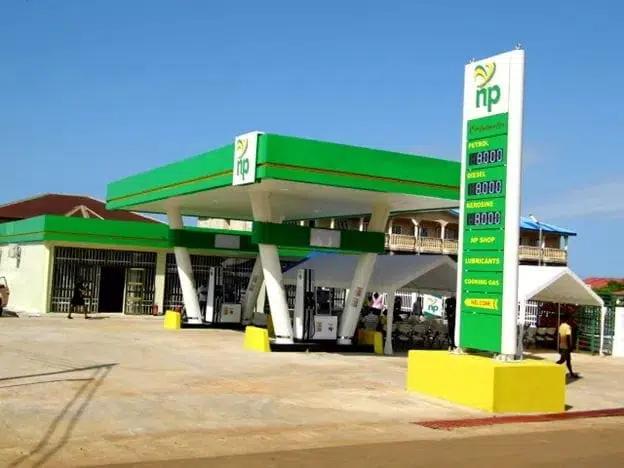
NP-SL Ltd Continues to be 1st in terms of Enhancing Customer Care

By Amin Kef Sesay

The National Petroleum Sierra Leone Limited (NP-SL Ltd), it has been confirmed, is a successful enterprise that is hugely contributing to the socio-economic development of this nation.

This assertion could be justified when cognizance is taken of the company’s serious deepening of the country’s Local Content Policy as vividly evident in giving exceptional preference to employing indigenes contrary to bringing in foreign expatriates to execute certain tasks. This laid down policy that is strictly implemented has created room for the employment of Sierra Leoneans who have the requisite qualifications and skills giving them the opportunity to take care of personal responsibilities.

This admirable quality that NP-SL Ltd has been exhibiting throughout the years by the proper implementation of the country’s Local Content Policy is geared towards giving preferential treatment to indigenes or making use of local ingredients, in the form of human and material resources, instead of depending on those that are acquired through importation.

The company has deepened the laid down policy of giving preferential employment consideration to indigenes instead of relying on expatriates.  As long as Sierra Leoneans have the requisite qualifications and skills they are first considered for various vacant positions in the company. The greatest advantage is that the policy has made it possible for indigenes to be gainfully employed and live improved standards of living.

“I cannot find words to express how delighted I am as I can proudly say that NP-SL has changed my life completely since the company employed me,” one of the workers at NP Cotton Tree joyfully intimated The Calabash when this medium went out on a fact finding mission.

“As far as I have assessed in this country it is only NP-SL Ltd that has such a pragmatic policy of maintaining a policy that gives job preferential treatments to Sierra Leoneans and I have great respect for the indigenous company,” Raymond Cole, a Social Commentator eulogized.

With the introduction of NP Smart Card, which has gone viral, the Card can be credited with money and the amount of money utilized to buy fuel is debited after every transaction. With the use of NP Smart Card, customers are saved the hassle of having to always move with physical cash in their possession in order to purchase fuel and indeed there are times when one may not have time to rush to the bank to make withdrawals. Customers, who are holders and users of NP Smart Card, are at the vantage position to properly budget, through the amount that is contained in the card to buy fuel, during a considerable period of time, say a week or a month. Indeed, NP Smart Card has become trending.

In order to ensure that their customers derive value for money, it was thought prudent on the part of Shareholders and Management to make use of state of the art and highly modernized calibrated pumping machines which were installed at the company’s different Filling Stations capable of pumping the exact quantity of fuel, be it petrol or diesel, that a particular customer requested for.

This fine move by the company has helped instilled confidence among customers that they are really dealing with a very transparent business entity and getting what they are paying for. This singular business strategy has got many glued to a petroleum company that is considered to be marketing the best of petroleum products which include petrol, diesel, gas and high grade lubricants, one of which is the most sought out Castrol oil, said to be very good for the proper functioning of engines.

The company also markets NP Gas which is a cooking device that is manufactured in different cylinder sizes and sold at the company’s Filling Stations across the country. It can be easily refilled with gas, is said to be non-hazardous to the health of individuals and easy to operate. Its performance has been rated high and many are indeed going for it.

One yardstick that could be used to assess the potency and vibrancy of a company is how well it is entrenched or established. With regards NP-SL Ltd, one can actually see that the company, over the years, has grown by leaps and bounds as seen in its opening of branches in neighbouring Guinea, Liberia, Ivory Coast and The Gambia. All these NP branches, within the sub-region, are functioning very efficiently and contributing immensely towards the socio-economic development of those host countries. Through their operations, the company is paying taxes to the various Governments and indirectly boosting the revenue bases of those countries to roll out different development programs.

From all that have been said so far, it could be argued with all amount of certainty that NP-SL Ltd is indeed a highly successful and very competitive petroleum company that continues to stand tall within the business landscape of this country. And from the look of things it is poised to reach higher heights.

Should Government Subsidize Or Not Subsidize Fuel?

Sierra Leone president Julius Maada Bio attends a press conference after a meeting with Ivorian President on May 4, 2018 at the presidentaial palace in Abidjan. / AFP PHOTO / Sia KAMBOU

By Amin Kef Sesay

There are many reasons why Governments around the world grant subsidies. In developing countries, many Governments adopt price controls for basic consumer goods. They try to counter the shortfall in the availability of such goods with direct subsidies to producers of these commodities.

In Egypt, Iran, Mexico, and other developing countries the prices of staple items such as bread, sugar, and cooking oil have been under Government control.

As a specific example, Venezuela kept the price of gasoline very low and well below the world price. However, one consequence of artificially cheap gasoline in Venezuela was the smuggling of gasoline from that country to Colombia, a neighboring State where gasoline is not subsidized.

One disadvantage of a subsidy policy is that while it is designed to help the poor, everyone including the rich, who do not need the subsidy, benefits from it.

Basically, subsidies are provided by the Government to specific industries with the aim of keeping the prices of products and services low for people to be able to afford them and to encourage production and consumption.

A subsidy is a direct or indirect payment to individuals or firms, usually in the form of a cash payment from the Government or a targeted tax cut. In economic theory, subsidies can be used to offset market failures and externalities in order to achieve greater economic efficiency.

Government subsidies are financial grants extended by the Government to private institutions or other public entities, in order to stimulate economic activity or promote activities that are in the public good.

For instance, the Free Quality Education program is a subsidy provided by the Government and it aids the social development and uplift of the poor and the socially depressed classes by making such education easily accessible to them.

Subsidies, which are financed from either tax or non-tax revenue, or result in a deficit, have some disadvantages that include:

  • Product Shortages. When the Government subsidizes a particular product, it causes the price to go down and consumption to go up
  • Difficult to Measure Success
  • Inefficient Transfer to Recipients
  • Higher Taxes

A cut in subsidies puts the Government in a dilemma because if the Government reduces subsidies it will affect the poor class, traders, and the common person. If it does not do so, the rich class also benefits and puts enormous strain on the limited Government resources.

In short, any subsidy that benefits women, the poor and the marginalized is good; their growth propels national growth. … Similarly, subsidies or loans given for secondary agriculture initiatives reduce the burden on primary agriculture activities. This and previous Governments have given lavish subsidies in the form of machinery, seeds, animal stocks, pesticides, milling machines, stores, cash, etc., to small and medium scale farms in the aim of increasing food productivity and reducing food insecurity and help whittle down disguised unemployment in the agric-sector.