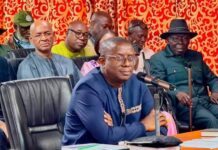


The Sierra Leone People’s Party (SLPP) has reaffirmed its strong commitment to electoral integrity, constitutional governance and inclusive political dialogue, following the outcomes of the recent Joint Assessment Mission conducted by International Moral Guarantors in Sierra Leone.
In a detailed Press Statement issued on April 21, 2026 and signed by its National Secretary General, Paran Umar Tarawally, the ruling party expressed appreciation to key international partners, including ECOWAS, UNOWAS and the Commonwealth, for their continued support towards peace, stability and democratic consolidation in the country.
The party paid special tribute to former Gambian Vice President, Fatoumata Jallow-Tambajang, for her leadership role in guiding the process from its inception, noting that her efforts have been instrumental in sustaining dialogue and fostering cooperation among stakeholders.
Reaffirming its position as the governing party, the SLPP underscored President Julius Maada Bio’s commitment to implementing both the Agreement for National Unity and the recommendations outlined in the Tripartite Committee Report. The party noted that such commitment was further demonstrated during the recent engagement between the President and the International Moral Guarantors.
Central to the SLPP’s position is a strong defense of the independence of the Electoral Commission for Sierra Leone (ECSL). Referencing Section 32(11) of the Constitution, the party stressed that the Commission must operate free from external direction or control, warning against any attempt by Parliament to exercise oversight over constitutionally independent institutions.
“The Electoral Commission shall not be subject to the direction or control of any person or authority,” the statement emphasized, adding that such independence is critical to maintaining public confidence in the electoral process.
The SLPP further argued that just as Parliament does not oversee institutions such as the Judiciary, the Anti-Corruption Commission and the Audit Service Sierra Leone, it should equally refrain from exercising administrative oversight over the ECSL.
On electoral reforms, the party welcomed the expansion of the Tripartite Steering Committee to include other political parties and Civil Society Organizations, describing the move as a step towards ensuring broader representation and inclusivity in the reform process.
The party also reiterated its support for proportional representation, aligning with its longstanding policy stance, while commending international partners for upholding parliamentary procedures in relation to the Constitution of Sierra Leone (Amendment) Bill 2025.
Addressing national cohesion issues, the SLPP reaffirmed its commitment to working collaboratively with all political actors, including the opposition All People’s Congress (APC), particularly in areas such as the ongoing Population and Housing Census and broader governance processes.
While welcoming the APC’s decision to end its boycott, the ruling party urged the opposition to adopt more constructive and mature approaches to national issues. It cautioned that persistent boycotts and threats could undermine constitutional provisions, particularly Section 35(1), which outlines the responsibilities of political parties in shaping the political will of the people.
The SLPP also took a firm stance against hate speech and incitement, reiterating its zero-tolerance policy on inflammatory rhetoric, which it said poses a threat to national unity and democratic stability.
Commending both Government and opposition delegations, as well as development partners and the Independent Commission for Peace and National Cohesion, the party acknowledged their collective efforts in resolving operational challenges within the Tripartite process.
However, the SLPP expressed dissatisfaction with aspects of a recent Press Statement issued by the APC National Secretariat, describing portions of it as unhelpful and unnecessary. The party warned that such rhetoric could erode trust and weaken the spirit of cooperation among political actors.
Despite those concerns, the SLPP maintained that it remains fully committed to engaging all stakeholders in advancing electoral reforms, strengthening democratic institutions and promoting sustainable peace in Sierra Leone.
The statement comes at a critical time in the country’s political landscape, as efforts continue to consolidate democratic gains and build consensus around key governance reforms.