

By Amin Kef (Ranger)
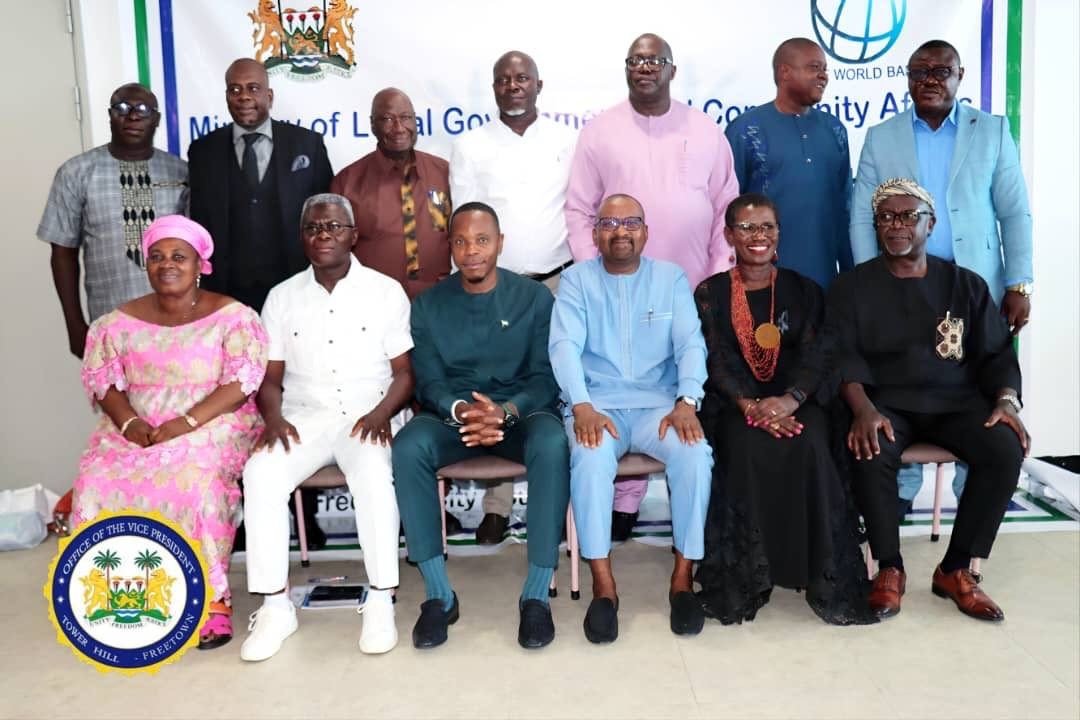
The Vice President of Sierra Leone, Dr. Mohamed Juldeh Jalloh, has underscored the urgent need to transition the country’s decentralization agenda from policy formulation to tangible, measurable results, as he chaired a high-level meeting of the Inter-Ministerial Committee (IMC) on Decentralization.
Delivering a keynote address on Thursday, May 7, 2026, Dr. Jalloh emphasized that decentralization remains one of the most critical governance reforms in Sierra Leone, directly influencing how government institutions function and how citizens access essential services across the country.
Addressing a gathering of Ministers, Deputy Ministers, Local Council officials, and senior government stakeholders, the Vice President noted that despite years of policy commitments and strategic frameworks, implementation has lagged behind expectations. He pointed to persistent challenges such as weak institutional coordination, gaps between policy and practice, and inconsistencies in service delivery across various districts.
“We have made commitments. We have developed policies. But we have not consistently translated those into results on the ground. That is the reality,” Dr. Jalloh stated, setting the tone for a renewed push toward accountability and performance.
To bridge this gap, he announced the establishment of the IMC Secretariat within the Office of the Vice President, describing it as a strategic intervention designed to ensure that decisions taken at the committee level are effectively implemented, monitored, and completed. According to him, the Secretariat will serve as the central coordinating hub, bringing coherence to what has historically been a fragmented system.
Dr. Jalloh stressed that the time for incremental progress has passed, declaring that decentralization must now be pursued as a results-driven, government-led reform process. He warned that the continuation of fragmented approaches, delays in implementation, and weak accountability structures would undermine national development efforts.
“This is no longer business as usual,” he said. “We must move with discipline, clarity, and a strong commitment to delivery.”
He further explained that the IMC will undergo a functional transformation, shifting from a platform for routine updates to a decision-making body focused on alignment, coordination, and accountability across government institutions. The newly established Secretariat will act as the “delivery engine,” ensuring that all agreed actions are tracked and executed within defined timelines.
Outlining the government’s reform priorities, Dr. Jalloh identified institutional coordination as a central pillar. He announced plans to introduce regular Vice Presidential-led coordination meetings, establish a technical working group chaired by senior government officials, and enhance alignment among ministries and agencies to ensure a unified approach to decentralization.
The Vice President also highlighted the need for urgent reforms within the Local Government Service Commission (LGSC), describing human resource management as one of the most significant bottlenecks affecting service delivery at the local level. He noted that without an efficient system for recruitment, deployment, and performance management, local councils would continue to struggle in fulfilling their mandates.
Proposed reforms, he said, would focus on strengthening the Commission’s mandate, building its institutional capacity, developing a more robust legal framework, and introducing structured oversight mechanisms to enhance performance and accountability.
On fiscal decentralization, Dr. Jalloh emphasized that resources must follow functions, stressing the importance of aligning financial allocations with devolved responsibilities. He disclosed that government would prioritize clarifying and unbundling devolved functions, strengthening fiscal transfer systems, and aligning these efforts with the ongoing review of the Local Government Act.
In addition, the Vice President announced plans to re-establish Regional Coordinating Committees, which he said are critical for ensuring that decentralization is not confined to central government but effectively implemented at the regional level. These committees will help identify challenges in real time and provide a feedback mechanism to inform national decision-making.
To strengthen monitoring and accountability, Dr. Jalloh revealed that the IMC Secretariat will introduce an Action Tracker system. This tool will be used to monitor decisions, assign responsibilities, track timelines, and identify bottlenecks, ensuring that progress is both visible and measurable.
Taking the reform process beyond policy rooms in Freetown, the Vice President also announced plans to embark on a series of regional consultations in Kenema, Bo, Makeni, and Port Loko. He emphasized that these engagements will provide an opportunity to interact directly with Paramount Chiefs, local councils, and frontline service providers to better understand the practical challenges facing decentralization efforts.
“Too often, we sit in Freetown and design solutions without fully confronting the realities on the ground,” he noted. “This time, we will engage directly with those implementing these policies.”
He added that the consultations will involve key central government officials, including Deputy Ministers and sector leaders, to ensure that issues raised are addressed promptly and that decisions are followed through effectively.
Dr. Jalloh reaffirmed that decentralization is fundamental to Sierra Leone’s long-term stability and development, noting that bringing governance closer to the people enhances service delivery, strengthens accountability, and builds public trust in state institutions.
He concluded his address by urging all stakeholders to prioritize implementation, coordination, and accountability, emphasizing that citizens will ultimately judge government performance based on real improvements in their daily lives.
“Our citizens will not measure us by what we say here today, but by what they experience tomorrow,” he said. “Let us move from policy to performance and deliver results that truly impact lives.”
The renewed push for decentralization reforms signals a critical phase in Sierra Leone’s governance agenda, as government intensifies efforts to ensure that policies translate into meaningful change across communities nationwide.