
By Amin Kef (Ranger)
Sierra Leone’s journey toward industrial growth and economic self-reliance has gained fresh momentum with the commissioning of a modern flour milling facility in Cline Town, Freetown; an investment that not only signals progress but embodies a powerful story of determination and transformation led by businessman Alhaji Amadu Juldeh Sowe.
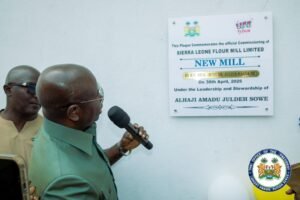
The facility, operated by Sierra Leone Flour Mill and owned by Alhaji Amadu Juldeh Sowe, was officially commissioned by Julius Maada Bio on Thursday, April 30, 2026. While the event marked a significant milestone in the country’s industrialization drive, the spotlight firmly rested on Alhaji Amadu Juldeh Sowe, whose personal journey from a modest local baker to a major industrial player has captured national attention.
President Bio described the investment as a strong endorsement of Sierra Leone’s private sector potential, emphasizing its alignment with the Government’s agenda to boost local production, reduce import dependency and strengthen food security. He noted that the expansion of domestic flour production would not only stabilize supply but also position the country competitively within the sub-regional market.
“This project reflects resilience, renewal and a bold step toward economic sovereignty,” the President stated, highlighting the importance of converting local and imported raw materials into finished goods within Sierra Leone.
For Alhaji Amadu Juldeh Sowe, however, the commissioning represented far more than an economic milestone; it was the culmination of a deeply personal journey rooted in struggle, perseverance and vision.
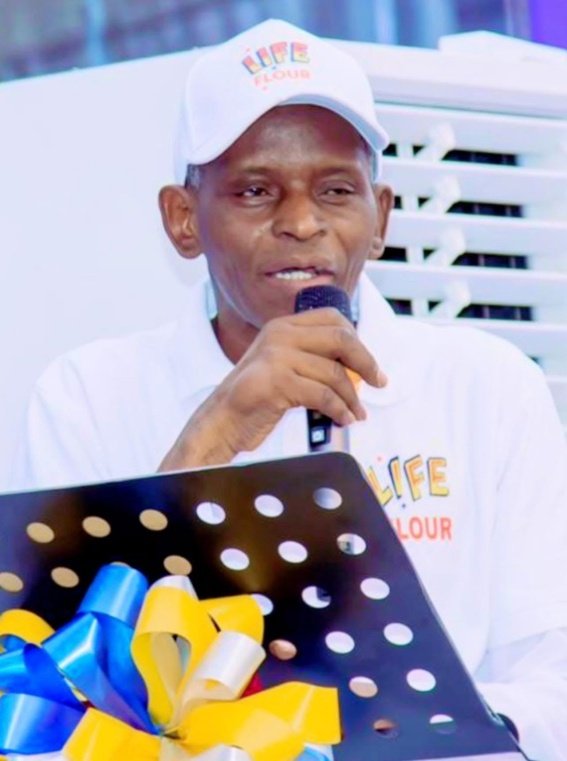
Speaking at the ceremony, Alhaji Amadu Juldeh Sowe recounted his early days as a young boy assisting his father in a small bakery business. At the time, the family relied on purchasing flour from the very factory he now owns. He vividly recalled standing outside the factory gates with his father, waiting to collect bags of flour, as they were not permitted access into the premises.
Years later, that same boy, who had left school to support his family’s livelihood, has risen to become Chairman and Chief Executive Officer of the facility, now overseeing its operations and expansion.
His story, widely described as inspirational, underscores the transformative power of entrepreneurship and local ownership in shaping Sierra Leone’s economic future.
“When I started, we were only trying to survive. Today, we are building something that contributes to national development,” Alhaji Amadu Juldeh Sowe said, expressing gratitude for the support received from Government policies and financial institutions.
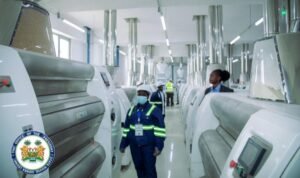
The facility itself mirrors that transformation. When Alhaji Amadu Juldeh Sowe acquired the mill in 2015, it had been dormant for nearly a decade, raising skepticism about its viability in a market dominated by imported flour. Through sustained investment, strategic planning and policy support, including tax incentives and waivers on wheat imports, the once-abandoned plant has been revived into a high-capacity industrial hub.
Management disclosed that production capacity has now increased significantly, rising to approximately 600 metric tonnes per day, a major leap expected to lower flour prices, improve supply stability and expand exports to neighboring countries such as Liberia and Guinea.
Beyond production figures, the project is already generating tangible economic benefits. Employment opportunities are expanding, supply chains are strengthening and locally branded flour products are gaining competitiveness in both domestic and regional markets.
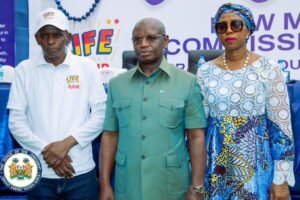
The commissioning ceremony drew a high-profile audience, including senior Government officials, Members of Parliament, development partners and regional delegates; an indication of the project’s broader economic and political significance.
Among them was World Bank Country Manager, Abdu Muwonge, who described the investment as a strong example of effective collaboration between Government, development partners and the private sector. He noted that the initiative aligns with national agricultural and food security priorities, particularly the Feed Salone Strategy aimed at boosting local production and reducing reliance on imports.
Alhaji Amadu Juldeh Sowe acknowledged the critical role played by such partnerships, noting that access to financing and technical support had been instrumental in transforming the facility into a viable and competitive enterprise.
He also commended the Government’s efforts in creating an enabling business environment, citing policy reforms, infrastructure support and concessions as key drivers behind the project’s success.
President Bio, in his remarks, reflected on the historical significance of flour production in Sierra Leone, recalling the establishment of the original Freetown Flour Mill in 1968 by Seaboard West Africa Limited. Once a symbol of industrial ambition, the facility had played a central role in supplying bakeries nationwide before falling into decline.
Its revival under Alhaji Amadu Juldeh Sowe’s leadership, the President noted, represents not just the restoration of lost capacity but the emergence of a new era of indigenous ownership and industrial confidence.
“This is about reclaiming our productive strength and ensuring that Sierra Leoneans take the lead in building their own economy,” he said.
Observers say the symbolism of the moment cannot be overstated. What was once a place of exclusion for a young boy has now become a platform of leadership and opportunity under his stewardship.
Standing at the facility, many were struck by the powerful narrative it represents; a shift from dependence to self-reliance, from limitation to possibility.
Sierra Leone’s ongoing push for industrialization finds strong inspiration in the journey of Alhaji Amadu Juldeh Sowe, whose success story highlights what is possible when local enterprise is backed by sound policy and strategic investment.
The story of Alhaji Amadu Juldeh Sowe is not just about personal success; it is a reflection of a broader national aspiration; to build an economy driven by its own people, powered by resilience and sustained through innovation.
With the gates of opportunity now firmly open, the message is clear: Sierra Leone’s industrial future may well be shaped by those who once stood outside looking in but who now hold the keys to transformation.