

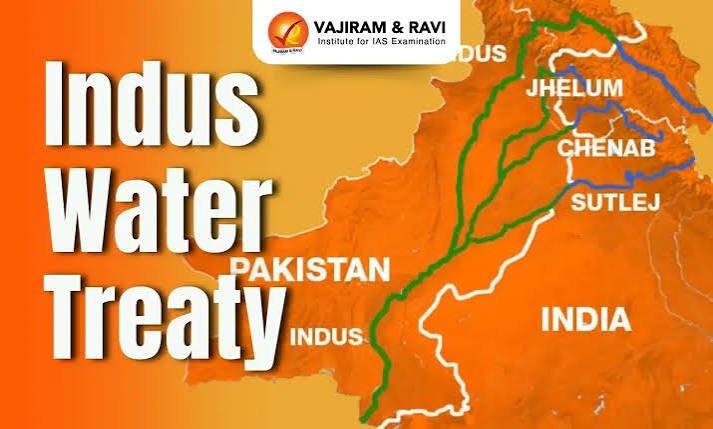
The decision to place the Indus Waters Treaty (IWT) in abeyance marks the end of India’s restraint in the face of multiple grave provocations by Pakistan. Signed in 1960 and celebrated internationally as a rare example of sustained cooperation between two adversarial neighbours, the Treaty survived wars, political upheavals, military crises, and prolonged diplomatic hostility only on account of India’s benign and good-neighbourly approach. Agreements of such consequence depend on reciprocity, trust, good faith, and a genuine commitment to cooperation. Over the past six decades, these foundational principles were steadily eroded by Pakistan’s persistent obstructionism, politicisation of technical matters, and repeated weaponisation of Treaty mechanisms to frustrate legitimate development in the Union Territory of Jammu and Kashmir. To cap it all, Pakistan relentlessly pursued a diabolical policy of exporting terror, completely demolishing the very foundation of goodwill, friendship and good faith on which the Treaty stood.
While India consistently bore the burden of making the treaty work, Pakistan cultivated a false narrative of victimhood, portraying every legitimate Indian proposal as a threat to its survival. India repeatedly adhered to the demands of the Treaty in full letter and spirit, often extending accommodations beyond its formal obligations. Pakistan, by contrast, frequently approached the Treaty not as an instrument of cooperation and mutual benefit but as a political lever to impede India’s lawful rights on the Western rivers.
Pakistan’s pattern of obstruction emerged almost immediately after the Treaty came into force. The first information supplied by India under the Treaty for a new hydroelectric Plant was transmitted in March 1962, scarcely a year after ratification. The project was minuscule: a 200 KW run-of-river small plant, utilizing only 25 cusecs of water, with no consumptive use and no retention even for a second. It was intended to provide electricity to a remote tribal population located hundreds of kilometres upstream of the international border. Yet Pakistan objected. A second project of similar size, for which information was supplied in December 1963, was again challenged on flimsy grounds. These objections dragged on until September 1971, when the Indian Commissioner for Indus Waters urged closure of the matter without prejudice to either side’s position. It had taken eight years to negotiate the Treaty itself, and nearly as long to deal with objections over a modest 200 KW project. Such episodes exposed an entrenched pattern: procedural resistance divorced from substantive merit.
Pakistan’s self-serving and dishonest invocation of the Treaty became even more apparent during periods of conflict. In November 1965, after large-scale conflict had broken out, Pakistan alleged that it had not received supplies in the Central Bari Doab channels. India responded that Pakistan had failed to submit the necessary requests as required under the Treaty. Moreover, regulation from the Ferozepur Headworks had been rendered physically impossible due to shelling and firing from the Pakistani side, during which irrigation personnel were killed or seriously injured. No regulation was possible even for Indian canals under those conditions. Despite continued unprovoked firing after the ceasefire, India stated that Pakistan’s estimated shares had been released into the Sutlej and passed onward.
A revealing episode occurred in June 1973, when Pakistan, by virtue of its illegal occupation of parts of Jammu and Kashmir and acting as the upper riparian on a local stream – blocked water supplies to the Poonch power channel for several days. The disruption affected both power generation and irrigation in the region. This was a direct and serious violation of the Treaty. India lodged a protest and sought immediate restoration of flows. Pakistan’s eventual response in March 1975 trivialised the matter, claiming the disruption resulted from a “natural change of course” of the stream. India showed restraint and chose not to precipitate the matter, preferring to preserve the broader framework of cooperation. That restraint, however, was rarely reciprocated.
Disputes surrounding India’s major hydroelectric projects repeat the same story. The Salal Hydroelectric Project became contentious because Pakistan raised specious objections in July 1970 though the project design was fully in conformity with the Treaty. In an extraordinary gesture of accommodation, India agreed to major design modifications not required by the Treaty, including reducing Pondage to zero and plugging low-level outlets. These concessions ultimately had severe consequences. The dam lost its sediment flushing capability, and within a few years much of its designed storage capacity (approximately 284 MCM) was heavily silted, significantly diminishing long-term efficiency. Even during the initial filling of the Salal reservoir, Pakistan had demanded that India provide equivalent water from the Eastern Rivers to compensate for water impounded in Salal’s dead storage, an extraordinary demand wholly outside Treaty provisions. India nevertheless accommodated this demand as well.
Another striking example of India’s magnanimity was the suspension of the Tulbul Navigation Project in Kashmir valley. India halted work in 1987, in the face of Pakistani objections, hoping for an amicable resolution. The project remains in limbo even today. In Pakistani commentary the project was transformed into a symbol of alleged Indian designs to store water on Jhelum River and regulate releases into Pakistan. Privately, Pakistani officials acknowledged that the project could also benefit Pakistan through improved lean-season flows. Publicly, however, the issue was prolonged for decades, with Pakistan continuing to delay meaningful settlement. What might have been a mutually beneficial cooperative undertaking was converted into another theatre of manufactured distrust.
The same pattern was repeated in the Baglihar Hydroelectric Project. Information on the project was first supplied by India in 1992. Prolonged discussions followed, at the level of the Permanent Indus Commission, government channels, and secretary-level talks. India repeatedly engaged in bilateral dialogue and even offered design adjustments to address Pakistani concerns. Yet sections of Pakistan’s media simultaneously propagated alarmist claims that Baglihar would turn Pakistan into a desert. Ultimately, Pakistan escalated the matter to a Neutral Expert appointed under the Treaty framework. The verdict substantially upheld India’s position, affirming that the project conformed to Treaty provisions, subject only to limited technical modifications. The fake narrative of existential harm to Pakistan collapsed under impartial scrutiny.
The Kishanganga Project also followed a similar trajectory. Information was supplied in 1994. During the planning stages in 1989, India sought data from Pakistan in order to account for downstream agricultural and hydroelectric uses. Pakistan claimed that all waters were already fully committed to Neelum-Jhelum link hydel project. It also cited an exaggerated figure of 133,209 hectares of irrigated area, a figure that it was unable to substantiate either in Commission or before the Court of Arbitration. Even when India was allowed a special tour of inspection of the Neelum-Jhelum Project site, after much delay in 2008, Pakistan’s claim about the project having being under construction since 1988 was shown to be a white lie. Furthermore, India pursued extensive bilateral engagement before agreeing to third-party arbitration. The Kishanganga Court of Arbitration ultimately upheld India’s right to divert waters from the Kishanganga/Neelum to the Jhelum river for power generation. Yet even after this adjudication, Pakistan continued to raise objections on the project design and sustain uncertainty. Once more, the reality diverged sharply from political rhetoric.
Thus, since the very execution of the Treaty, virtually every Indian hydropower project on the Western rivers irrespective of its size or design was objected to by Pakistan. Pakistan’s objections have sought to restrict design of Indian hydroelectric projects to the technological standards of the 1960s, despite the fact that the Treaty itself allows consideration of sound engineering practices.
Even today, Pakistan continues to persist with its obstructionist challenge to Kishanganga and Ratle projects. It has made matters worse by pursuing parallel proceedings before two different dispute resolution mechanism (Neutral Expert and a Court of Arbitration) – something that was in clear breach of the Treaty.
Pakistan’s actions have destroyed the spirit of cooperation envisioned in the Preamble to the Treaty. The result has been the increasing realisation in India, especially in the Union Territory of Jammu and Kashmir that the weaponisation of the Treaty by Pakistan represents a major impediment towards development of water resources in the region. For years, questions have been raised about the Treaty’s sustainability given Pakistan’s recalcitrance and the evolving needs and changing ground realities of the region.
Beyond procedural disagreements lies a broader context of hostility that cannot be ignored. Persistent cross-border terrorism, including attacks targeting civilians, infrastructure, and development projects in Jammu and Kashmir, has deeply poisoned the atmosphere necessary for cooperative treaty implementation. Even projects concerning the use of water of Indus system of Rivers such as Tulbul Navigation project etc. have not been spared in terror attacks. India has been at the receiving end of Pakistan’s policy of exporting and sponsoring terror for decades, and Pakistan shows no sign of being prepared to change its ways. Agreements of such strategic significance require a minimum threshold of trust. It is impossible to expect enduring cooperation in one domain while sponsoring destabilisation in another.
Another vital facet of this matter is Pakistan’s mismanagement of water. While Pakistan complains about the alleged threat to its water security by India’s actions, the reality is quite the opposite. Indeed, Pakistan’s own internal acknowledgements have exposed the hollowness of its accusations against India. For instance, in 2010, Pakistan’s then Foreign Minister Mr. Shah Mahmood Qureshi publicly challenged the claim that India was responsible for Pakistan’s water shortages. He stated that Pakistan received approximately 104 million acre-feet (MAF) of water annually but utilized only around 70 MAF, leaving roughly 34 MAF lost through mismanagement. In a strikingly candid admission, he asked:
“Where is the 34 million acre feet of water going? Is India stealing that water from you? No, it is not. Please do not fool yourselves… We are mismanaging that water.”
He further criticised the tendency within Pakistan to “exaggerate” disputes and “pass the buck,” urging attention to domestic inefficiencies such as poor irrigation systems, leakages, and waste.
This admission goes to the heart of the matter. Pakistan’s water apprehensions are an outcome not of any Indian projects but of Pakistan’s own structural and institutional failings: inadequate storage capacity, chronic canal seepage, inefficient cropping patterns, low irrigation efficiencies, weak maintenance and inter-provincial disputes. These internal challenges cannot be remedied through misconceived recourse to anti-India rhetoric.
Here are some facts from Pakistan’s own national water policy document of 2018. Pakistan’s water management system exhibits critical inefficiencies that lead to substantial waste of available resources. Out of about 140 MAF of water received by Pakistan from Indus system of rivers, only 104.0 million acre-feet (MAF) of water can be diverted annually through the canal system, and of that only 58.3 MAF actually reaches the farm gate. This means that nearly 46.7 MAF is lost during conveyance.[1] In essence, about half of the canal water drawn from the Indus River system fails to reach the agricultural fields it is intended to irrigate. The stark and alarming reality also is that on an average 35 MAF of water simply drains into the Arabian sea from Pakistan, without being utilized. The total quantum of water lost is much more than double of India’s share under the Treaty, and is lost purely on account of Pakistan’s inefficiencies and failure.
For more than six decades, sections of Pakistan’s political and media establishment repeatedly projected the narrative that India’s upstream hydroelectric projects were designed to “steal water,” regulate the Jhelum and Chenab, trigger droughts or floods, destroy Punjab’s agriculture, and ultimately “turn Pakistan into a desert.” This rhetoric resurfaced with nearly every Indian project—from Salal and Tulbul to Baglihar, Kishanganga, and Ratle transforming routine technical disagreements into supposed existential threats. Yet after projects such as Salal, Baglihar, and Kishanganga became operational, none of the catastrophic outcomes, so confidently predicted, ever materialised. Pakistan did not dry up, its rivers did not disappear and its agriculture did not collapse because of these projects.
Instead, the recurring alarm over Indian dams increasingly revealed itself for what it was: not hydrological reality, but a political strategy. It served to internationalise bilateral disputes, generate diplomatic pressure on India, and delay legitimate development projects fully permissible under the Treaty framework. Treaty mechanisms intended for cooperation were repeatedly and cynically exploited as instruments of obstruction. Moreover, by choosing subterfuge over sincerity and using terrorism as an instrument of State policy, Pakistan has destroyed and thrown overboard the very goodwill and friendship upon which the Treaty was founded.
India’s decision to place the Indus Waters Treaty in abeyance can only be understood in this backdrop, as reflecting the culmination of Pakistan’s sustained non-cooperation, serial bad faith, systematic misuse of the Treaty and launch of cross-border terror attacks.
A lesson stands out clearly from this saga: international agreements and treaties endure not by merely being signed, but by being respected by all parties. The longevity of such arrangements depends not on legal principles and texts, but on mutual respect, reciprocal responsibility, and genuine commitment to fundamental tenets of peaceful coexistence. Pakistan’s rejection of these cardinal norms has brought the present situation to pass. It has only itself to blame.
[1] Pakistan National Water Policy 2018