
Home Blog Page 1081

“A Third of Fish Stocks are Overfished…” -FAO warns

A fishermen holds a recent catch at the port near Elmina Castle, Ghana, where fish consumption accounts for more than half of the population's intake of animal protein

By Amin Kef Sesay

More than a third of the fish stocks around the world are being overfished and the problem is particularly acute in developing countries, the United Nations Food and Agriculture Organization (FAO) said in a report on Monday.

The FAO said in a biennial report that tackling the issue would require several measures including stronger political will and improved monitoring, as fish stocks in areas with less-developed management were in poor shape.

“While developed countries are improving the way they manage their fisheries, developing countries face a worsening situation,” the FAO said.

In 2017, 34.2 percent of the fish stocks from the world’s marine fisheries were classified as overfished, a “continuous increasing trend” since 1974, when that figure stood at just 10 percent.

Overfishing depletes stocks at a rate that the species cannot replenish and so leads to lower fish populations and reduced future production.

The FAO said less intense management was common in many developing nations, and was fuelled partly by limited management and governance capacities.

“We notice that sustainability is particularly difficult in places where hunger, poverty and conflict exist, but there is no alternative to sustainable solutions,” the agency said.

Worldwide per capita fish consumption set a new record of 20.5kg per year in 2018, and has risen by an average rate of 3.1 percent since 1961, outpacing consumption of all other animal proteins.

Fish consumption accounts for a sixth of the global population’s intake of animal proteins, and more than half in countries such as Bangladesh, Cambodia, the Gambia, Ghana, Indonesia, Sierra Leone and Sri Lanka.

The FAO projected global per capita consumption would climb to 21.5kg by 2030, a slowdown in the average annual growth rate to 0.4 percent, with a decline expected in Africa.

“The main reason for this decline is the growth of Africa’s population outpacing the growth in supply. Increasing domestic production and higher fish imports will not be sufficient to meet the region’s growing demand,” the FAO said.

The report is based on information gathered before the COVID-19 outbreak, which has led to a decline in global fishing activity as a result of restrictions and labour shortages due to the health emergency, the FAO said.

Sustaining Inclusive Peace is on the Frontlines of Climate Change

As countries reel from the devastating social and economic impacts of the COVID-19 pandemic, gender inequality is shaping the experience of crisis, as well as prospects for resilience and recovery.

A new report – Gender, Climate & Security: Sustaining Inclusive Peace on the Frontlines of Climate Change – by the UN Environment Programme (UNEP), UN Women, the UN Development Programme (UNDP), and the UN Department of Political and Peacebuilding Affairs (UNDPPA) reveals the close links between gender, climate, and security, and shows that women on the frontlines of climate action are playing a vital role in conflict prevention and sustainable, inclusive peace.

Communities affected by conflict and climate change face a double crisis. The pandemic further compounds the impacts of climate change on food security, livelihoods, social cohesion, and security. This can undermine development gains, escalate violence and also disrupt fragile peace processes.

Women and girls are facing disproportionate economic burdens due to different types of marginalization; gendered expectations can lead men and women to resort to violence when traditional livelihoods fail; and important socio-economic shifts can result from changes to patterns of migration.

“Unequal access to land tenure, financial resources, and decision-making power can create economic stress for entire households in times of crisis, leaving women disproportionately exposed to climate-related security risk,” said UNEP’s Executive Director, Inger Andersen. “The climate crisis stretches well beyond just climate, and tackling it effectively requires responses that address the links between gender, climate and security – we must ensure no one is left behind.”

Research supporting the report shows that in Chad, gender-based violence and structural inequality limit the capacity of communities to adapt to climate shocks. In Sudan, the growing scarcity of fertile land caused by extended droughts and rainfall fluctuation is marked by increases in local conflict between farmers and nomadic groups.

Many people – mostly men – have migrated away from local villages in search of alternative livelihoods in large agricultural schemes or in nearby mines, leaving women with greater economic burdens. Other examples highlight climate-related security risks for women in urban areas, especially within informal settlements. Research from Pakistan and Sierra Leone suggest that water shortages, heat waves, and extreme weather events can create new risks of gender-based violence and deepen pervasive inequalities.

The report makes clear the urgent need for gender-responsive action to tackle these linked crises. Interventions around natural resources, the environment and climate change, for example, provide significant opportunities for women’s political and economic leadership, and strengthen their contributions to peace. Sustainable natural resource programming also offers opportunities to mitigate sexual and gender-based violence in conflict. Recognizing that peace and security, human rights, and development are interdependent is vital to forge a better future, the report argues.

“Gender inequality, climate vulnerability, and state fragility are strongly interlinked –we know, for example, that countries with higher values in one of these areas tend to score higher in the other two”, said UNDP Administrator Achim Steiner. “At the same time, aid targeting initiatives that empower women and promote gender equality remains very low. The concrete examples of these types of initiatives in action showcased in this report can help spur further research and inspire more opportunities to reinforce the roles of women in peacebuilding, which is fundamental to help us achieve the Sustainable Development Goals.”

“Strengthening the role of women in the management of natural resources also creates opportunities for them to act as peacebuilders and manage conflicts in non-violent manners,” adds Oscar Fernández-Taranco, Assistant Secretary-General for Peacebuilding Support.

Gender considerations should also be fully reflected in emerging policy and programming on climate-related security risks –not only to strengthen awareness and understanding of particular vulnerabilities, but also to highlight opportunities for leadership and inclusion of women and marginalized groups in decision-making processes.

More investment for gender equality and women’s empowerment is required in fragile states, including implications on human mobility, and especially in sectors related to natural resources, where it is particularly low.

“Building back better with a gender lens means ensuring our post-COVID economies tackle the fundamental inequalities in society and end violence against women,” said UN Women Executive Director, Phumzile Mlambo-Ngcuka. “Women are a powerful force to rebuild societies more securely, from providing food and shelter, to generating vital income and leading sustainable change.”

Preservation of the Environment is Paramount

By Amin Kef Sesay

If we don’t protect nature – it will retaliate and deprive us of her grace and beauty.

The fresh air we breathe and the clean water we drink comes from nature. Nature is the bread basket for communities all over the world. It has been a source for finding cures to some of the world’s most complex diseases. Yet we fail to acknowledge its importance. As a result of our damaging activities, there exists a massive imbalance in our ecosystems. The world will become inhabitable if we continue to degrade our environment at such an alarming rate.

World Environment Day is celebrated on 5th June every year to raise awareness about global warming and wildlife crimes. Tacugama Chimpanzee Sanctuary supports community-based conservation projects to protect the environment and its wildlife primarily through outreach, alternative livelihood and reforestation initiatives.

Communities are encouraged to establish tree nurseries with the objective of planting native tree and fruit species that are beneficial to both animals and humans. For instance, Tacugama is currently working with five communities in Moyamba District to finish connecting fragmented patches of forest along a 3km stretch thus establishing Sierra Leone’s first wildlife corridor.

With the help of the communities, Tacugama has planted over 60,000 trees to establish the corridor and encourage human/wildlife co-existence. Moreover, Tacugama has supported seven communities along the Western Area Peninsula National Park (WAPNP) to establish tree nurseries. The communities are using recycled water sachets to nurse tree seedlings which will then be planted in close proximity to the respective communities. As a result, they’re practicing proper waste management while committing themselves to forest protection and habitat restoration projects.

Deforestation is one of the factors contributing to climate change in Sierra Leone. Entire patches of forests are cleared by land grabbers who often have no knowledge of their actions on the environment and wildlife. Due to deforestation, Sierra Leone can no longer boast of 70% of forest coverage. Nevertheless, we can still accomplish a great deal by simply engaging communities and planting trees.

Schools should also endeavor to set aside spaces for nursing seedlings to fuel reforestation exercises within and outside their school premises. This would instill a sense of commitment in caring for the environment as they are our future leaders. Some of our essential natural resources, such as clean water, are also threatened due to deforestation in urban areas and rural communities.

Trees have important water catchment formation and protection functions. The deep root systems of trees stabilize the banks of catchments, protecting against erosion while also providing habitat for wildlife. Deforestation and the ensuing disappearance of water catchments will not only threaten food security, but will further restrict the movements of animals. Over 200 zoonotic diseases (ranging from Ebola to COVID-19) are as a result of increased exposure to wildlife. Transmission occurs when an animal infected with bacteria, viruses, parasites and fungi comes into contact with humans. This trend is predicted to rise in the future if we neglect and or tamper with nature.

Over one million species are said to be in danger across the world. Many species are on the verge of extinction and climate change continues to increase its devastating impact on the environment. If we fail to make the right changes – there are undoubtedly threats to the environment that could jeopardize our very own existence. Pollution and disease outbreaks will put humans and wildlife at risk of disappearing from the face of the earth. It is our responsibility to protect animals living in the wild and maintain healthy forests. Sierra Leone’s National Animal – the chimpanzee maintains a healthy forest through seed disposal and bees through pollination which is important because it leads to the production of fruits we can eat and seeds that will create more plants.

We need to change the way we conduct ourselves, otherwise we won’t have a future.

Bonthe Island to Benefit from First Desalination Plant by SAWACO

By Theresa Kef Sesay

Management of Sierra Leone Water Company (SALWACO), headed by  Joseph Munda Sandi together with the Minister of Finance, Jacob Jusu Saffa and the Director General of the Sierra Leone Roads Authority, Mr. Amara Kanneh  on Saturday 6th June, 2020 conducted a symbolic signing of contract for the reconstruction and construction of Bonthe water supply project.

In his statement, the Managing Director of SALWACO stated that Bonthe Island will get a desalination pipe borne water supply.

Joseph Munda Sandi said water is in the agenda of His Excellency, noting that two weeks ago in Parliament, the  President made a statement on the provision of the Bonthe water project and finally the contract has been signed.

Sandi continued that SALWACO is responsible to providing water in every part of the country except Freetown. He therefore called on the residents of Bonthe municipality to appreciate the Minister of Finance for his passion he has for water.

He said the project has two components: the desalination component which is turning of salt water into fresh and safe drinking water and the other component is the reconstruction of the dilapidated degremont facility. Also, there will be an office space and accommodation for SALWACO operations.

He added, IPCS will do the construction of the office space and accommodations and GIS Construction will be in charge of pipe networking in the city. Sewa and Guangjin Company, a  joint venture, will construct the desalination and reconstruction of the new Treatment Plant.

“This project will create job opportunities for the youths around the Municipality and I hope that in the next couple of weeks the President will do turning of sod in the Bonthe municipality,” he stated.

In his keynote address, the Minister of Finance, Jacob Jusu Saffa said the money for the reconstruction and construction of the Bonthe water supply project is in the bank waiting for the conclusion of SALWACO papers work.

As a development expert, the Minister of Finance stated that the provision of safe drinking water in every part of Sierra Leone has a direct link to education and good health. Hence, investing now in water will reduce future cost in managing health crisis such as cholera and other water borne diseases.

He added that water is a core component to Human capital Development further stating that : “This project is a full funded Government project with a total cost of 121.8 billions Leones and it is going to be one of the fastest projects to be implemented.

In response to the call of the President for collaboration between agencies, the Director General of SLRA, Amara Kanneh said when different MDAs collaborate, it yields positive outcomes and reduce cost on Government expenditures.

He stated that SLRA and SALWACO will work collaboratively in developing the Bonthe municipality. “I’m happy to be part of the signing of the project in Bonthe, this shows how committed the two agencies are working hard to complement the agenda of the New Direction,” he stated.

The Deputy Speaker of Parliament, Hon. Sengehpoh Thomas, in his statement applauded both SALWACO and the Minister of Finance for a job well done, adding that the current Government is a “talk and do” Government.

He therefore called on the stakeholders and youths of Bonthe municipality to own the project and support the contractors.

In his conclusion, the Deputy Speaker of Parliament said after forty-five years of no pipe borne water, the Bonthe Municipality has something to celebrate… His Excellency, Julius Maada Bio and the New Direction.

New Direction Government Prioritizes Youth Empowerment

By Amin Kef Sesay

Youth empowerment formed part of President Bio’s 2018 campaign message and upon the assumption of power, it has always been the ultimate desire of President Bio to transform the youths of Sierra Leone and to make them readily available and productive for every national service.

He is desirous of tapping into the inner reservoir of the talents of Sierra Leonean youths and translate them into tangibles -by building institutions, creating job opportunities and putting them on firm ground of self -realization, actualization and reliance.

Some excerpts of the President’s statements on youth empowerment in the recent State Opening Address:

“Mr Speaker, Honourable Members, my Government sees young people as key drivers of development. We regard Youths as “partners today and leaders of tomorrow.” Government has therefore increased the participation of young people in decision-making processes and leadership roles. To that end, my Government has established 190 Chiefdom and 16 district councils nationwide”

“Government has developed capacity and entrepreneurial skills with a skills development project and a skills development fund component, a graduate internship programme, youth demonstration farms, youth business groups, and the setting up of a youth entrepreneurship and employment project”

The following are to the credit of the President on youth empowerment in just two years of his Presidency.

As a believer in the competence and the promotion of youths, the President has appointed lots of young people  as Ministers and Deputies, Executive Directors and Deputies, Chairmen, Commissioners etc. across the country without recourse to ethnicity, region, party affiliation etc.

The President firmly believes that once the existing generation and even the generation yet to be born have the requisite qualifications and competence, must be given prominent positions and be allowed to fully participate in national governance, not when they are almost in their retirements. And almost all the appointed young people are doing well on their respective appointments, even the youth minister is a young man from an ethno-regional background different from the President.

In making the youths invulnerable to poverty and unemployment, the President, through the Ministry of Higher and Technical Education have established Technical and Vocational institutions in Kenema, Bo, Kailahun etc. empowering the youths in different fields. They are taught different trades as to become readily employed and can even become employers themselves. As mentioned in his last State Opening Address, the President has secured funds to construct Technical Vocational Institutes in Makeni, Mattru Jong, Karene, Port Loko etc. This is more empowerment for the youths.

In addressing the unemployment especially among the youths in the country and diversifying the economy through agriculture, the Ministry of Youth Affairs has established youth farms in Kono, Kenema,  Masalia (Port Loko)Koinadugu, Tonkolili and plans are firmly on course to do similar in Bo, Moyamba, Bonth  etc. Those farms are going to be engaged in the production and cultivation of different products, ranging from rice, cassava, potato etc. This will certainly and tremendously reduce the importation of rice and help easily achieve food security in the country.

Over 560 youths, illiterate and semi- illiterate are currently engaged in Car Wash Centers nationwide established by Youth Affairs Ministry. Those youths are currently working, taking care of their family members, paying taxes and developing their social security.

Over 3000 youths are currently benefiting from the Youth Entrepreneurship Programmes across the country being implemented by Youth Ministry. As an innovative leader, the President has clearly understood that entrepreneurship is currently catapulting lot of countries to higher orbit of economic development, in that regard, he has decided to invest in Sierra Leonean youths to be competing with Lebanese, Indians, Nigerians etc. in the importation of essential commodities in the country. The project calls for the formation of Youth Cooperatives and the training of Youth Entrepreneurs in business basics.

In relation to fish farming, about 1,750 youths will be employed in Seven Districts through the Youth in Fisheries Project. More than 20 youths  will be employed in every location in about 70 sites  within all the seven districts where the boats will be stationed. The Districts include: Bonth, Pujehun, Moyamba, Kambia, Port Loko and Western Rural and Urban.

Youths of all kinds, disables, non- disables, women etc. are also benefiting from the Social Safety Project being implemented by NACSA across the country. This is improving the livelihoods of many youths, some are even establishing businesses.

The President wants to develop Sierra Leonean youths not only for the existing generation but for the succeeding ones as well. He wants to empower the youths to a degree that they will never be a permanent and available instruments in the hands of self-serving politicians but enlightened, responsible and productive people who can always take this country forward.

ECOWAS Youth Council SL Romances with Speaker of ECOWAS Parliament

By Foday Moriba Conteh

As they continue their strides to create an enabling environment for young people in the country, the ECOWAS Youth Council Sierra Leone Chapter has on Sunday 7th June, 2020 met with the newly elected Speaker of the Economic Community of West African States (ECOWAS) Parliament, Hon Sidie Mohamed Tunis, at the Ministry of Youth Affairs Conference Hall, Stadium Hostel, in Freetown.

In his opening address, the President of the ECOWAS Youth Council Sierra Leone Chapter, Amb Sheku Foryoh described the gathering as an August meeting which, he said, will help to change the narrative about young people in the country.

He added that they decided to invite the newly elected Speaker of the ECOWAS Parliament, Hon Sidie Mohamed Tunis, to brief him on the successful activities the Council has undertaken in the fight against the coronavirus in the country.

He further disclosed that they are more than committed in soliciting support for young people in the country, adding that the ECOWAS Youth Council Sierra Leone Chapter was established three months ago but that they have made a lot of progress towards the development of young people and the country as a whole.

He expressed gratitude to the Speaker of the ECOWAS Parliament for honouring their invitation and for his good leadership in rolling out programs geared towards youth empowerment and development.

He also used the opportunity to introduce the ECOWAS Youth Council Sierra Leone Chapter Executive and encouraged them to work in the best interest of young people.

Vice President of the ECOWAS Youth Council, Hannah Kargbo, revealed that the Council is a youth-led organization that has a membership that cuts across various countries that are part of the ECOWAS. She also expressed appreciation to the Speaker of ECOWAS Parliament.

Disclosing their contributions towards the fight against the COVID-19 in the country she disclosed that in a bid to complement the efforts of the Government to reach out to communities with preventive messages against the coronavirus, the ECOWAS Youth Council Sierra Leone Chapter on Friday 11th April 2020 concluded a 2 day outreach sensitization on the causes and prevention of the Corona Virus Disease (COVID-19) at Gbalamuya, a border community closer to Guinea in the Kambia District in line with their “Beyond Borders Sensitization Tour”.

She also pleaded to the Speaker of ECOWAS Parliament to give them opportunities to fully participate in all ECOWAS activities across the region in order to equip them so that they will give back to society.

On his part, the Speaker of the ECOWAS Parliament, Hon Sidie Mohamed Tunis, commended His Excellency President Julius Maada Bio for his commitment towards the development of young people in the country.

He also applauded the Council for the tremendous work they have been doing towards the development of young people disclosing how he has been following the work of the Council towards national development.

He said that the potentials that  young people have  so far displayed and their readiness in the Council to complement the efforts of the ECOWAS Commission and the Government of Sierra Leone are laudable adding that under his leadership as ECOWAS Speaker he will ensure that he works with the Council in order to achieve their goals.

He further disclosed that young people have pivotal roles to play towards the development of any nation, and that the productivity of any country lies in the hands of the youth. It against such a backdrop,he said, that the ECOWAS VISION of 2020 is targeting young people and see how they can move from Communities of States to Communities of People.

He assured them that the ECOWAS Youth Council will have the recognition and support of the Ministry of Youth Affairs and other Government agencies which will make their work easy.

Repeal of Criminal Libel Law Backed by Information Minister

Minister of Information and Communications, Mohamed Swarray

By Bampia James Bundu

It was observed and from spontaneous reactions that news making the rounds in different circles that the Public Order (Amendment) Act tabled in Parliament for deliberation and approval five months ago had been withdrawn, dropped like a thunderbolt and sent shock waves across Sierra Leone.

Initially, the rationale behind the withdrawal remained unclear not until it was clarified by the Ministry of Information and Communications. It did not come as a surprise that the Ministry lost no time in reaffirming Government’s commitment to repealing the draconian law.

The Minister of Information and Communications, Mohamed Rahman Swaray, has injected fresh enthusiasm into his untiring effort in actualizing President Bio’s vision for a free and pluralistic media in Sierra Leone.

Repeal of the criminal libel law has not been done by successive Governments despite making firm commitments in that direction.

President Bio reaffirmed his commitment to expunging the draconian law from our law books upon assumption of office.

Since his appointment as Information Minister, Mohamed Rahman Swarray, has worked assiduously with partners and the law office to ensure that the libel law is struck off completely from our law books.

The New Direction Government has already received global acclamation for taking tangible steps to fulfil its electoral promise for a free press.

The Amendment Act has been successfully drafted and tabled in Parliament since last year.

It was however unfortunate that the Bill was never discussed until the legal instrument supporting its stay in Parliament expired as a result of time lapse.

However, the Sierra Leone Association of Journalists (SLAJ), under the leadership of Ahmed Sahid Nasralla, resisted the urge to jump into conclusion that the Government was not serious about repealing the law, chiefly because the SLAJ leadership knows how passionate the Minister of Information is with regards repealing the criminal libel law.

As someone who does not disappoint, Minister Swaray is already making frantic efforts to ensure that the Bill returns to Parliament and gets deliberated on and passed into law.

The Minister sees the repeal process as his baby and one of his would-be legacies as a Minister and loyal soldier to the President.

He is therefore poised to do everything legally possible to ensure that the law books are rid off the criminal libel law.

How refreshing it is to have a Minister and President who are so passionate about doing the right thing especially when it comes to press freedom.


“Declare all Criminal Libel Cases Nolle Proseque…” -Emmanuel Saffa Abdulai Appeals

Emmanuel Saffa Abdulai Esq

By Amin Kef Sesay

Emmanuel Saffa Abdulai Esq., who is the Director of Society for Democratic Initiative (SDI), has called on the Attorney General to declare Nolle Proseque on cases relating to criminal Libel.

According to him such will serve as an interim measure as the repeal process has taken another turn. The long term campaigner for the repeal of the criminal Libel law made that appeal recently.

He furthered that the repeal process has been a protracted process adding how the recent withdrawal of the Bill from Parliament is a continuous embarrassment to President Julius Maada Bio.

It has been noted by many media practitioners that the manner in which the Bill was withdrawn shows lack of coordination with the Executive and a deliberate attempt to stall the process. Princess Gibson, SLAJ Public Relations Officer, however stated that they are determined to see the end of the obnoxious law that is deterring media development.


Freetown Terminal Responds Swiftly to Fire Incident at Dan Street

By Amin Kef Sesay

It was indeed a very sad day for residents of four houses along Dan Street, in the East End of Freetown, when an inferno gutted their houses at around 2:00 a.m on Sunday the 7th June 2020.

According to other residents in the area the Freetown Terminal was the first to arrive at the scene with their fire engine and they were later supported by the National Fire Force which put an end to the fire that left many homeless at 21, 23 and 25 Dan Street with a total of four houses razed to the ground (two at 21 Dan Street).

An eye witness who wants to remain anonymous explained that the fire incident gutted three board-houses which were burnt to the ground and a two-storey building with the top floor completely burnt.

Gassimu S. Fofanah, Head of Communications at the Freetown Terminal said this is not the first time the company has helped in rescuing communities in the East End of Freetown.

He mentioned that the fire engine has done same for the Grassfield Community in 2017, Shell Community in 2018, Effort-Lane in 2019 and more. “We believe we are part of the communities we operate. Whatever affects them affects us, so we will always stand by them,” he maintained.

Kamanda Bongay, Head of Sierra Leone Fire Force said their report shows that the places were set ablaze by someone and that the accused has been handed over to the Police for further investigation.


Indian Community Empowers C19 Dignity Project

By Amin Kef Sesay

On Friday, June 5, 2020 the Indian Community in Sierra Leone has donated medical supplies, food items and sanitation materials to the C19 Dignity Project Sierra Leone.
The donation was made in support of the Project which provides aid to COVID-19 frontline health care workers across different treatment and isolation centers in Sierra Leone.

Speaking at the donation, Rajesh Hemnani, Coordinator for the Indian Community started by complementing the efforts of Vickie Remoe the Founder of the Project furthering how they saw the good work of the Project on social media which they assessed as very unique and therefore they decided to help her Project, so she can make further donations to the Treatment and Isolation Centers that need help.

“She is trying to help Treatment Centers that don’t have the basic medical supplies and hygiene items needed to fight the disease and without those items people won’t get medication. We made these donations directly to the C19 Dignity Project because they receive direct requests from the Treatment Centers which means they know exactly what each facility needs,” said Rajesh Hemnani, Coordinator for the Indian community stated.
Receiving the donation, Remoe expressed her appreciation to the Indian Community for the donations saying it is a way to support frontline health workers and victims and also reduce the costs in purchasing items needed.

She added that the Project, which started in May 2020, has so far raised Le 500 million (USD 50 thousand) and has sent supplies to over 8 Treatment and Isolation Centers across Sierra Leone.

“When we receive these donations we also try to make supplies to hospitals that have sent in their requests of items they need that will serve them for the coming weeks or months to speed up treatment,” Vickie Remoe, Founder of C19 Dignity Project Sierra Leone also disclosed.

The items donated included, 250ml Kavita handwash (120 pieces), 250ml Kavita sanitizer (120 pieces), 200 liters hand wash device (2 pieces), 120 liters dustbin (4 pieces), Nutribom food (36 cartons), Garbage bag (100 pieces), Glucometer (12 packs), Glucometer Test Strips (12 packs), Lancets (12 packs), and other medical items.

C19 Dignity Project Sierra Leone is a citizen-led project that coordinates resources to provide the urgent basic needs of Treatment and Isolation Centers. So far the project has raised cash of over USD 50 thousand (Le 500 million), which they have used to provide basic medical supplies to over 8 health care facilities in the country (Connaught Hospital, Jui Hospital, 34 Military Hospital, Port Loko Government Hospital, Fourah Bay College Community Treatment Center, Correctional Service Treatment Center, Bo & Kenema Government Hospitals).

President Bio’s 5 Million Trees Project Has Questions

By Amin Kef Sesay

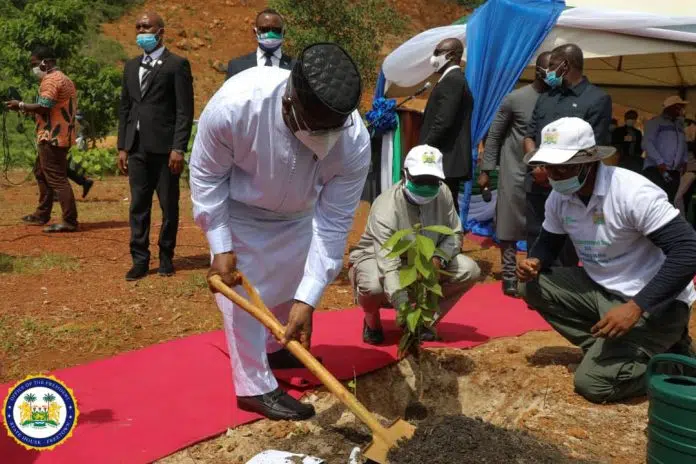
Probably, more than any other physical development initiative by President Bio and the New Direction Government, the most far-reaching is that of the five million countrywide tree planting initiative that he announced last week.

Globally, reforestation is an important environmental issue of growing concern. International programs like the United Nations Initiative for Reducing Emissions from Deforestation and Forest Degradation (UN-REDD) are key for implementing global programs for reducing deforestation, emissions through reforestation and afforestation projects which brings with them huge financial gains.

As such, certainly, President Bio’s 5 million trees project is ambitious as it is laudable. However, before looking at the beneficial relationship between tree planting (otherwise known as reforestation) and the environment, there are some unanswered questions about implementation of the project.

  1. Within which institutional framework is it going to be implemented?
  2. Which type of trees would be planted?
  3. How many trees will be planted by district, chiefdom?
  4. Who are the people who will lead the process in the different districts and chiefdoms?
  5. What would be the role of Councils and Paramount Chiefs in the implementation?
  6. Who and who will be employed as workers, volunteers, etc?
  7. Most importantly where will the nurseries be located and what would be the logistic requirements of the entire project?
  8. Last but not the least, what is the budget for the project?

There are other questions agro-forestry experts would like to throw in concerning the requirements for rolling out what definitely is an extensive project of this nation countrywide.

Environmentally, we all know that reforestation helps the environment to stay healthy. Gases like carbon dioxide and methane are major contributors to the changing climates. Planting new trees can help to reduce the amount of CO2 in the air. Reforestation is an effective mitigation strategy to fight global warming. In addition to benefiting the climate, reforestation helps protect important species of animals. Reforestation helps to rebuild habitats and degradation which are the leading threats to the health of a species.

Deforestation, which is frightening in this country (75% of the primary forest cover is gone) damages soil and habitats through erosion. Reforestation can help to restore what the erosion has damaged. In addition, regional watersheds that have been damaged by deforestation can be brought back to health through reforestation. Regional watersheds are an important resource for human development.

Reforestation can also help humans to address world hunger issues and deal with water usage and availability. Restoring forests has many benefits on the chemical, social and biological levels of an entire ecosystem. Reforestation can also help to supply jobs for those who lack skills to be employed in other industries. Therefore, it benefits not only the environment, but the economy as well.

Thus, overall, planting trees supports recovery of ravaged landscapes, improves water quality, mitigates climate change, and so much more. By planting 5 million trees, we are investing in healthy forests for today and for future generations.

We at The Calabash as such commend President Bio for thinking of a green future for beloved Mama Salone. We all can join in by each planting fruit trees in our backyards.