The West African Police Information System (WAPIS) has convened at a well-attended VIP gathering government officers including the Minister of Internal Affairs, Inspector General Police, Deputy Head of Mission European Union in Sierra Leone, Deputy National Security Coordinator and representatives from INTERPOL, Fixed Solution etc to hand over items relevant for police information.
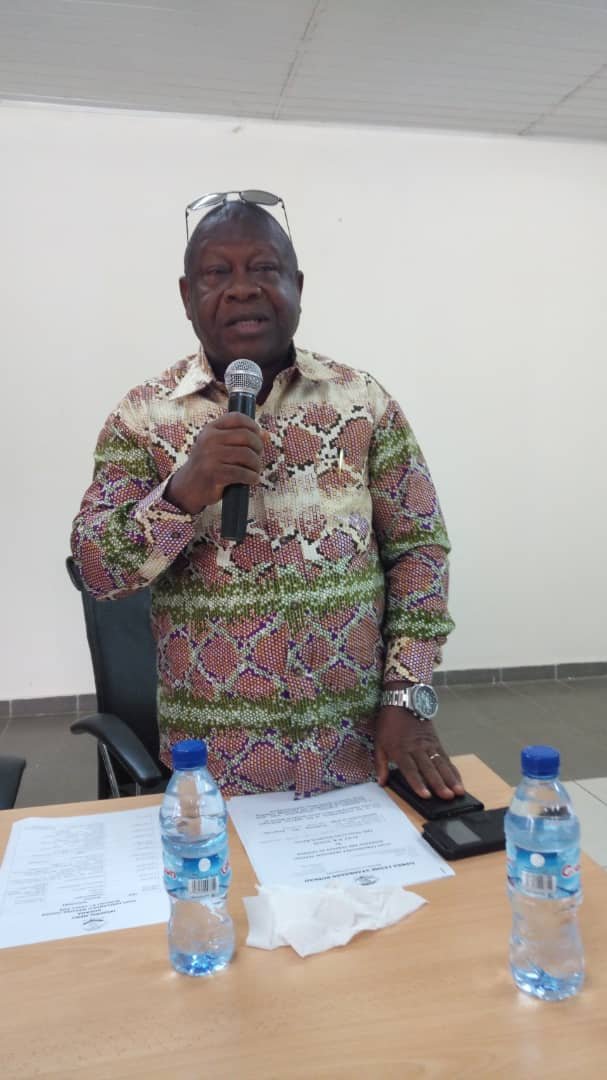
The event which convened on Friday 1st November 2019 at the Police Headquarters in Freetown saw the handing over of quantity of Information Technology Equipment worth over 56,125 Euros equivalent to $ 62,613.89 to the SLP. “This equipment are very timely and necessary in the fight against Transnational Organized Crime such as terrorism, money laundering and other related Cyber offences”, stated Dr. Yansanneh, who is on secondment from the SLP to WAPIS.
He further stated that the equipment will help to strengthen the SLP’s database in terms of data collection, storage and processing, and wholeheartedly expressed thanks and appreciation to the European Union for providing the funds and supporting the project. He also requested for legislation Data Processing.
Hon. Edward Suluku said the government of Sierra Leone will continue to support the WAPIS project and expressed appreciation to the European Union, INTERPOL and WAPIS for the donation. The minister appealed for concerted efforts to eliminate the fear of crime and to neutralize the threat of terrorism in Sierra Leone.
Dr. Richard Moigbeh is the Inspector General Police and was very pleased with the support, coordination and collaboration from the European Union, INTERPOL and WAPIS to the WAPIS Office in Sierra Leone. On behalf of the SLP Council, the IGP said it was a very unique opportunity to integrate cyber services in the fight against crime at the national, regional and international level. He also thanked the European Union for talking and doing.
The representative of the European Union Madam Jamila indicated that the EU was always ready to support and collaborate with WAPIS and emphasized that there was need for the sustainability of the project. Other speakers including the Deputy National Security Coordinator and the Director of Crime Services also made meaningful contributions. The ceremony was chaired by the Director of Community Affairs, AIG Kalia Edward Sesay.
In Sierra Leone, the long-awaited inquiry into the assets of former President Koroma and other senior public officials in his APC Government, will commence sitting on Monday, 11 November 2019. The inquiry will look into the financial affairs of former president Ernest Bai Koroma, former vice president Victor Bockarie Foh, former ministers, heads of departments and parastatals.
Since 2007 when former president Ernest Bai Koroma and his government took office, after winning presidential and general elections, and then went on to serve two terms before he and his government were voted out in March 2018, there have been serious allegations of rampant corruption and amassing of unexplained wealth that need to be looked into, once and for all to set the record straight and hold them to account fairly.
Many in Sierra Leone believe that former president Koroma was one of the richest presidents on the African continent, alleged to have illegally accumulated hundreds of millions of dollars, stashed away in off-shore accounts and in real estate in Europe.
There are allegations also that the former president owns dozens of real estate properties across the country, especially in Freetown and Makeni – his hometown.
Other former senior government ministers are also alleged to have misappropriated hundreds of millions of dollars from the State. These allegations will be investigated by the Commission of Inquiry set up last year by president Julius Maada Bio, to look into the running of the country by the former president and his ministers.
Sierra Leone is ranked as one of the poorest nations in the world, despite having massive reserves of natural resources and minerals. Average daily income per person in Sierra Leone is less than $1.50, while daily cost of living per household is more than $10.
Over 60% of the adult population are unemployed, with an average life expectancy of less than 50 years. It is estimated that the country loses about $500 million in corruption every year, causing widespread poverty, destitution, illiteracy and poor health among the majority of the population.
A Government Transition Team Committee report published by the Bio-led government last year, said it had found evidence of corruption on a grand scale, estimated at over $2 billion, most of which related to improper public procurement processes, abuse of office, misappropriation of funds, and theft of public property.
What the Commission of Inquiry will seek to do – with the help of the Anti-Corruption Commission is to sift through all the evidence collected by the Transition Team Committee, to match against all allegations of corruption by former government officials.
The Commission will also look into the annual asset declaration forms of former senior government officials, their Bank Account transactions during the period they were in office, in order to identify any mismatch between personal income, expenditure and asset portfolio of each official being investigated.
One thing is certain about this Commission of Inquiry, it may not be liked by the former government officials, but it has set new standards of accountability and probity, for past and present government officials as well as those in the future.
There must be an end to impunity in Sierra Leone. President Bio has started the ball rolling. The Commission of Inquiry into the activities of former government ministers and head of State is enshrined in the country’s laws, and can only be stopped through an Act of Parliament.
The people of Sierra Leone are waiting to hear the truth about corruption in the country, under the presidency of former president Ernest Bai Koroma. Are the allegations of billions of dollars stashed away by the former president and his ministers a myth, or is the nation going to be shocked by what the Commission will find?
This is the statement published by the Commission of Inquiry Secretariat
Through the International Organisation for Migration, the Freetown City Council has benefited 20 tricycles, 2 motorbikes to help the Council manage waste in the city and achieve its target of having 60% of solid and liquid waste safely collected and disposed of by 2022.
IOM, as part of its efforts to reduce irregular migration by boosting youth entrepreneurship, supported Council’s efforts to improve waste collection & create jobs in Freetown by providing tricycles, safety gear, and business training for 200 youth. IOM also provided two motorbikes for monitoring the use of the tricycles.
The youth, who make up 20 youth groups, will collect waste from residents right across the city, especially in hard to reach areas and low income communities! Freetown City Council is determined to improve sanitation in Freetown and more tricycles are set to be handed over to young people in the near future for them to start their own waste collection businesses. We kindly ask our residents to make use of their services. Residents can get their contact information, and that of other waste service providers in Freetown, by using findmeinfreetown.com or by calling 030 064 811 or 075 434014.
The chairperson of Tonkolili District Council, Madam Yabom Sesay has appealed to stakeholders to monitor the running of public buses given to schools in Tonkolili District.
Following the distribution of buses to the district, she has registered deep appreciation to the government over the buses which she acknowledged their importance to the children in easing the transportation challenges in the district and most especially within the township of Magburaka (the headquarter town) and Mathora village which hosts the Government Junior and Senior Secondary School for.
Such facilities will help address the problems faced by the Mathora and other school girls within the district to school and home conveniently. There are challenges though and these were said to be the first amongst is the bad conditions of the road network especially the one for Mathora. The self-help project that is recently launched by the people of Rowalla Village who teamed up with Tonkolili District Council and youths on the road couldn’t help enough. As a result, the government was still being called by her administration to support the efforts of the council to make the road.
Fuel shortage too became another imperil for her administration to pull over from the challenges she faces. The buses are reported short of fuel most times and this was becoming a problem to manage as they use 35-40 litres per day and this is not commensurable to the proceeds collected from pupils per day.
Last but not the least is paying drivers plying with the buses”. Each of the four drivers of the vehicles takes a home pay of Le,1,000,000 monthly and the money raised was not enough to offset their payments, lamented the Council chairman. As a result, she has appealed to the government to support the initiative by giving government fuel chits to the buses.
Head CSR Orange Sierra Leone addressing kids at Services Secondary School Juba over the weekend
By Fatmata Jengbe
It was the turn of Services Secondary School on Juba, West of Freetown when on Friday 1st November, Orange Sierra Leone donated one hundred menstrual hygiene packs to the school as part of their ongoing camping to introduce reproductive health services and education into the schools. The donation is consistent with the clarion call by President Bio to lure private sector support to his Free, Quality Education scheme in 2018. The company pledged a total USD 1.5 million material support to the scheme through five projects in menstrual hygiene packs for school girls, super coders, solar packs and building of laboratories and educational support to teachers.
Orange Sierra Leone Head of Corporate Social Responsibility Desmond Spaine headed the team and entreated all the school authorities to support the girls during their menstrual periods. He expressed concerned that they at Orange were aware that Girls are facing increasing challenges to stay in schools while they are undergoing their menstruation.
Abibatu Kamara of Girl Child Network Sierra Lone gave a short talk to the schools girls during the presentation of the reusable packs. In her talk, she encouraged them to open-up the discussions around menstrual hygiene to their teachers, parents and all other people who could support them during this period.
The issue of menstruation should no longer be a taboo and many girls have encountered problems as a result of the secrecy that has surrounded the process.
Authorities at Services Secondary School Juba lauded Orange Sierra Leone as usual for supporting the school and the girls by extension in menstrual hygiene packs and Education.They recounted that, they have been spending towards procuring disposable pads for girls who undergo their menstruation while in school. The climax of the ceremony was the handing over of the 100 menstrual hygiene packs to the schools authorities by Orange Sierra Leone.
Elizabeth Grace Kanu delivering the vote of thanks on behalf of the SchoolAbibatu kamara of Girl Child Network Sierra Leone delivering a short talk on menstraul hygiene to pupils of Services Secondary School
Executive Director of West Africa Youth Network, Mohamed Kanneh
By Foday Moriba Conteh
Africa Youth Day has been celebrated in Sierra Leone on the theme: Combating Injustice, Marginalization and Corruption in the educational sector, at British Council Freetown. The African Youth Day is a day set aside every year to promote and increase recognition of youths as key agents for social change, economic growth and sustainable development African.
The Day was championed in Sierra Leone by young people in Sierra Leone led by the West Africa Youth Network (WAYN), a youth led organization in partnership with Patriotic Advocacy Network (PAN) on Saturday 2nd November, 2019. They joined several other countries in celebrating the Day.
Executive Director of West Africa Youth Network Mohamed Kanneh expressed warmest appreciation on behalf of the Board of Directors to young people who join them in celebrating Africa Youth Day. Mr. Kanneh stated that the theme was timely as corruption was taking a centre stage issue in Sierra Leone as a major factor affecting the educational system of the country.
He advised young people to serve as catalysts for change and must reject corruption and be prepared to expose malpractices. Since 2001 the West Africa Youth Network has operated in three African countries including Sierra Leone, Guinea and Liberia. The WAYN provides young people an opportunity to champion different issues affecting their lives.
James Fortune joined Mr. Kanneh is calling young people to eradicate corruption in the educational system because it has affected the development of the country. He said the Africa Youth should now be partners in development and not condoning and indulging in crime or to be used by politicians wrongly.
Youth in Sierra Leone faced huge challenges in the areas of education, employment, health, and governance and their desire to effect change in society has not be appreciated because of lack of seriousness; but such days as the Africa Youth Day inspires them to do so.
Celebrating this day thus makes sense in the fight against corruption. Since established, the WAYN said they have succeeded in establishing sound and active school chapters in various schools now serving as ambassadors in the fight against corruption.
This year’s celebration focused on three major areas education, empowerment and engagement. The event also looked at contributions made by young people and their energy and optimism to reinforce the efforts towards the achievement of sustainable development.
Sierra Leone’s leading importer and marketer of high quality petroleum products, the National Petroleum Company Limited, NP (SL-Ltd) is now rolling out initiatives that will give the general public what they do desire.
The company’s General Manager Kobi Walker and Board of Directors have looked at best options give effective service delivery to the people. Customer Care has been strengthened and today we are hearing about plans for better enhancing this priority so that customers would come to appreciate the company more.
Reports from its most recent Blackhall Road Filing Stations said that customers in the East End of Freetown now enjoy good customer service. Times un-numbered, Kobi Walker has reiterated that the company is here to serve their customers well by giving them best services.
Looking from the current modern calibrated pumping machines installed in all its locations, there is ease of doing business as customers no more queue to get refilled. They are friendly and pump attendants are trained in KYC (Know Your Customer).
Its significance in real terms borders on functional continuity of those institutions as they will be assured of supplies of petroleum products in as much as they keep honoring their obligations.
In this country today, for one to see a successful business entity that is owned mainly by Sierra Leoneans and having a maximum number of indigenes as members of staff is like trying to find a lost needle on the beach, although there are some that could be identified..
For NP-SL Ltd this has been a big achievement as the company is strongly adhering to the country’s Local Content Policy. Making use of local brains has been identified as one of the conduits through which developing countries like Sierra Leone could attain economic empowerment. Correspondingly, if there is a continuation of the colonial mentality that it is only by importing foreign ideas and skills that we will get there then such could be a very sad mistake.
By providing job opportunities for hitherto jobless Sierra Leoneans, NP-SL Ltd continues to help in alleviating poverty by putting monies into pockets which could be utilized to take care of responsibilities.
For those who have not tried NP Gas for the first time it is now time to give it a try. Designed in sizable varying cylinders and sold at various NP Filling Stations, this cooking device has been rated as one of the best that is on offer for sale. NP Gas is safe, user friendly and portable. Trying it will spur you to recommend it to others.
NP Smart Card is now in vogue and is one of the latest technological devices used to purchase petroleum products. Using it has attendant advantages as evident in procuring fuel at any time of the day even during times when monies could not be accessed from banks. It is secured, easy to use and very quick. It is now trending.
To crystallize proposed projects into tangible realities on the ground, Government needs the required financial resources to effectively do so and one sure way is from collection of taxes which is the mandate of the National Revenue Authority (NRA). NP- Sierra Leone is one of the big time tax payers in the country and it is very compliant in that direction.
From all indications, it is crystal clear that NP-SL Ltd is here to stay in order to give the best and contribute tremendously to the socio-economic development of the country. Indeed the company is passionate and committed towards attaining those objectives.
The Leader of Government Business in Parliament, Hon. Sidi Mohamed Tunis has demonstrated true leadership qualities by lobbying the Main Opposition APC Party to support the amendment of the Anti-Corruption Act of 2008 in order to specify categories of public officers affected by the declaration requirement under Subsection (1) of Section 119 which applies to penalties for offences under the Act and other related matters.
Presenting the Bill in Parliament, the Deputy Attorney General and Minister of Justice Umaru Napoleon Koroma informed MPs about the importance of the Bill which he said is aimed at curbing corruption. He added that the new law will increase penalties for offences under the Act, strengthen protection of those who assist the Commission, provide the Commission with alternatives to prosecution, widening the scope of corruption that includes an accused person offering, soliciting, obtaining or receiving bribes in addition to giving and accepting an advantage.
The new amendment will also reduce the year-long requirement that people who cease to be public officers would have to file declarations in respect of their assets and the Commissioner would be empowered to specify categories of public officers for the purpose of declaration by Statutory Instrument published in a Gazette.
It also provides for administrative sanctions for public officers who fail to submit their Assets Declaration Forms or knowingly register false, inaccurate or misleading information in the form; and to vest in the Commissioner, powers to direct that contracts may not be proceeded with. He praised MPs for agreeing that corruption in Sierra Leone must be treated with all the seriousness it deserves.
Acting Leader of the Main Opposition Party in Parliament, APC Hon. Ibrahim Ben Kargbo assured Parliament of his party’s continued support in the fight against corruption. He underscored how corruption was taking the country backwards. Therefore he called on the MPs to collectively support and amending the Bill so that it will come to pass.
Leader of Government Business Hon. Sidie Mohamed Tunis said for the first time Sierra Leone is being recognized as a “responsible State” that is championing the fight against corruption. He told MPs that the fight against corruption must never be discriminatory as it is supposed to be a clean fight which the President himself and other institutions have pledged to fight and win.
“We know corruption will fight back, but as a responsible government we will ensure we endure the fight to stop it,” he expressed optimism. Hon. Tunis concluded that the Bill should be amended to make it painful for those who are involved in corrupt practices.
The term corruption comes from the Latin verb ‘to break’, rumpere – which implies that something is badly broken. This might be a moral or ethical code or more often an administrative rule or law. The person who breaks it derives some recognition or benefit for him/herself, family, tribe, party, or some other relevant group.
After independence, most African countries drifted from a bureaucratic administration that emphasized good governance to one that emphasized the sovereignty of politics. This resulted in the emergence of a politicized bureaucracy which began to engage in centralized economic decision-making and patrimonialism.
The new states were not only autocracies rather political and economic monopolies now lacking in accountability, transparency and the rule of law. Thus, the post-independence bureaucracy that emerged in most African countries contributed to institutional instability, the politicization of the State and patrimonial economic management and incentives, whereby clientelism replaced moral and political legitimacy and political and personal loyalty and obedience were rewarded more than merited.
This was the genesis of corruption in Africa. The unethical politicization of the bureaucracy allowed for the entrenchment of the use of personal aggrandizement and patronage as a means of exercising authority and influence. The politicians and the bureaucrats forged a dependent patron/client relationship through which administrative decision-making occurred. This process, inevitably led to a cooperative and institutionalized abuse of public office for private and personal gain. Corruption can now be defined against that foregoing background.
Corruption is seen, first and foremost, as the utilization of official positions or titles for personal or private gain, either on an individual or collective basis, at the expense of the public good, in violation of established rules and ethical considerations, and through the direct or indirect participation of one or more public officials whether they be politicians or bureaucrats.
In a simplistic sense, corruption may be seen as partisanship that challenges statesmanship. It is an act or acts undertaken with the deliberate intent of deriving or extracting personal and/or private rewards against the interests of the State.
The development of resource rich countries like Sierra Leone were seriously held back in the decade after independence in 1961 by bad State governance, poor public sector financial management and the most cancerous disease of them all – corruption.
Corruption reached cancerous proportions in the 1980s when systems collapsed, the economy faltered, jobs disappeared, inflation set in followed by its attendant youth frustrations and hopelessness about a better future among the population. Presidents Ahmed Tejan Kabbah and Ernest Bai Koroma tried between 1996 and 2018 to put the disease under control, with mixed results; yet corruption continued to affect the nation’s future.
Corruption reflects the general climate of unethical leadership and bad governance found throughout most of the continent. The pandemic of corruption in Africa, and it’s extremely negative impact on socioeconomic development and the fight against poverty in the region, became matters of global concern; with the World Bank, USA, UK and other Western development partners focusing their attention on the root causes and consequences, as well as on action to control this cancer in society.
At the 1996 joint annual meeting of the World Bank and International Monetary Fund (IMF), had former World Bank President James Wolfensohn declaring that: ‘Let’s not mince words, we need to deal with the cancer of corruption. In country after country, it is the people who are demanding action on this issue’. Mr. Wolfensohn also made similar statements in his 1997 address to the Board of Governors where he said: ‘We have seen how corruption flourishes in the dark, how it prevents growth and social equity, and how it creates the basis for social and political instability’.
Similarly and quite surprisingly, the United Nations General Assembly issued a resolution, on 16 December 1996, aiming at promoting social responsibility and ethics. The ‘UN Declaration Against Corruption and Bribery in International Commercial Transactions’ emphasized the need to ‘promote social responsibility and appropriate standards of ethics on the part of private and public corporations, including transnational corporations, and individuals …’. It further stated that fighting and controlling corruption are also necessary to ‘enhance fairness and competitiveness in international commercial transactions’.
In the ACC’s fight against corruption, it is crucial that we the people talk openly about how our everyday lives are permeated by behaviors and values which are unethical and contribute to the entrenchment of norms perpetrated by corrupt politicians and bureaucrats.
Such concern is a good thing, for until we the people decide to react forcefully against the stench of corruption to which we are currently subjected, it will remain a societal norm poisoning civil society and splitting it into rent-seeking elites and helpless spectators.
At a banquet organised by National Social Security and Insurance Trust (NASSIT) on Friday 25th October, 2019, Managing Director of National Petroleum Company Sierra Leone and Chairman for Sierra Leone Employers Federation, Kobi Walker, praised two indigenous companies for their effective performances.
Speaking to distinguished personalities during the banquet, he said that he was particularly exultant witnessing the inaugural employers’ banquet organised by NASSIT. The objective, he disclosed, was to interface and engage the employers on pertinent issues regarding the obligations of both parties. Being strong partners with NASSIT, Sierra Leone Labour Congress (representing employees), etc Mr. Walker said the initiative comes in the wake of the recently ended Customer Week.
During the occasion, the “My NASSIT Companion” was also launched and this was disclosed will aid and guide employers in discharging their sacred obligations as enshrined in the NASSIT Act No. 5 of 2001. He also informed the guests about plans for a joint NASSIT and Employers Federation engagement which is designed to create awareness and to brief employers and employees on their various obligations as propagated in the NASSIT Act No. 5 of 2001 in the near future.
The “My NASSIT Companion” was circulated to members and it encouraged employers to use their Human Resource Departments to embolden their employees to update their records when necessary with NASSIT, i.e. addition to family members, death, next of kin etc
“Our Federation will also engage NASSIT personnel to develop a channel of communication dialogue between NASSIT and Employers nationwide whereby issues can be proactively discussed and resolved to avoid penalties which include legal proceedings,” he stated.
He therefore notified the employers that NASSIT was like a regulatory body that deals with matters of non-compliance and adherences to the NASSIT Act No. 5 of 2001. In addition, he said the proposed engagement will speak for receipt of Members’ Statements from NASSIT which he promised to address and resolve in advance of their retirement.
Plans to address the situation of members retirement will also be addressed to resolve the issues relating to their former employers’ contributions, pensions etc. “As employers we are all aware that our biggest and best assets are our revered and venerated employees, it is therefore incumbent on us to ensure we pay the various contributions for our staff to afford them the opportunity of a decent pension when they retire even though some of them may not be tired,” he notified his colleagues.
As a result, Mr Walker assured members of the Federation that there will be effective collaboration with them as outlined and this will enable the pensioners or their next of kin to promptly receive their benefits including pensions which will serve as a testimony of the high quality, value added services offered by NASSIT, amidst applause.