The City is honored to host Mr Michael Boulware Moore, CEO of the International African American Museum (IAAM) and his team as Freetown and Charleston share multiple links dating back to the Trans-Atlantic Slave Trade. Bunce Island in Sierra Leone was the site where Sierra Leonean captives’ feet touched African soil for the last time and Gadsden Wharf in Charleston was the site where over 90% of those captives’ feet touched American soil for the first time.
Mr. Moore has traced his personal ancestry to Sierra Leone through DNA testing and so his visit also has tremendous personal significance.
The Freetown City Council, together with other major stakeholders in tourism, will collaborate with the Charleston City Council and IAAM to harness the benefits of the historical and cultural ties between the two cities, creating a bridge for those whose ancestors left Bunce Island hundreds of years ago, to return home.
As Freetown and Charleston develop our city twinning relationship, this initiative supports the Mayor’s efforts to drive job creation in Freetown through tourism.
Chairman and Leader – Dr. Prince Alex HardingJimmy Batilo Songa
Disaster awaits the ruling Sierra Leone People’s Party (SLPP), if President Bio does not tackle the growing instability caused by the Prince Harding and Batilo Songa leadership war. The ruling SLPP is confronted with a lot of challenges that are now shaking the fundamental unity of the party, and potentially poised to destroy its credibility and undo all that President Bio is achieving for the country.
All this while, I have kept sealed lips but now is the time to speak truth to power, so that peaceful and lasting solutions are promptly brought to the altar to end this insanity.
The SLPP came to power in March 2018, after winning one of the most fiercely contested and controversial elections in the county since independence. Its Presidential candidate Julius Maada Bio was pilloried and scorned during the elections campaign, yet sailed through to occupy the most sacred seat of the land – the Presidency. That was almost a year ago.
Eleven months on, all is not well in the SLPP and getting worse as an internecine war for the leadership of the party – between the National Organising Secretary Jimmy Batilo Songa and the Chairman and Leader – Dr. Prince Alex Harding (now bitter enemies) is poised to destabilise the party.
The SLPP is currently facing two main challenges: Inter-party division and Governance. Inter-party division
Whilst in opposition, the deep rooted internal conflict besieged and bedevilled the effective management of the party as a united political party waiting to take over governance.
It all started after the August 1, 2011 National Delegates Conference held at the Miatta Conference Center, Freetown. Despite the fact that all 19 flagbearer aspirants pledged their support to the winner, the hatred for Rtd. Brigadier Julius Maada Bio intensified beyond comprehension.
Since then, instability has become an inseparable companion of the SLPP and not a day passes without new threat of political tribulation.
The SLPP is not even a year old in governance and the youths are now on each other’s throat for the Chairman and Leadership position.
I totally condemn the chaos that took place last Saturday 16 February 2019 at the party’s headquarters in Freetown that led to the cancellation of the party’s National Executive Council meeting.
If prompt action by the President is not enforced, there is likelihood that the power struggle between Jimmy Batilo Songa and Prince Alex Harding could destabilise the country. This threat is real and immediate, because one cannot divorce party politics from national governance. Batilo and the SLPP party youths
National Organising Secretary – Batilo, is making inroads in his appeal to the hearts and minds of the SLPP stalwarts and the grassroot youths because the current Chairman and Leader – Prince Harding, has practically abandoned the party Secretariat and by extension his duties.
Batilo is well known to have successfully served as Chairman of the SLPP for the UK/Ireland branch for two terms, before coming home to help President Bio win the elections. But he is not a radical political strategist like Prince Harding.
The political tension Batilo is fuelling is wrong and his supporters are in a rush to drive Prince Harding away from the party – especially its leadership.
After last Saturday’s commotion at the party’s office in Freetown, Batilo did not issue a statement condemning what took place, but rather went on to demand that, “Prince Harding must go.”
I will not dwell on the ugly occurrences among youth groups supporting Batilo and how they chased away those believed to be supporting Prince Harding.
Batilo is not happy about his perceived role of Prince Harding, which he believes is undermining his authority and hijacking the functions of the National Women’s Leader and her Deputy.
The difference between Batilo and Prince Harding is that the latter is desperate to give a meaning to the lives of the SLPP grassroots members. He is out there making sure that the SLPP youths are employed. Prince Harding and NATCOM
Prince Harding is a seasoned politician who promised victory for his party at the 2018 elections; and he strategically fulfilled that promised. He lost the SLPP National Secretary General position to JJ Saffa, who had left his job at the World Bank in 2005 to become an active politician.
He later became the Deputy Chairman and went on to launch an internal revolution in the party aimed at deposing former chairman and leader – Chief Somano Kapen.
It is alleged that Prince Harding brought unknown persons from elsewhere to guard him and secure the party’s headquarters yesterday, instead of allowing the party’s youths to do so. He caused the unfortunate incident yesterday by not communicating with Batilo to execute his own duties ahead of the NEC meeting.
Prince Harding has a very quintessential role in the effective functioning of the party, but he is no longer playing that role. He has alienated himself from the youths and some executive members who supported him against Dr. Morie Manyeh – the current Mines Minister.
Prince Harding’s insistence on becoming the Board Chairman of NATCOM was a wrong and untimely decision. Since his appointment he has become difficult to reach by the party’s youths who are struggling to gain employment.
This is the sad reality. He is responsible for the current declining state of the SLPP. Governance and the SLPP
SLPP is not only a political party but an institution, according to Dr. Peter Tucker in his book, ‘History and Philosophy of the SLPP’. The institutional aspect is a challenge. What must be accepted is that without SLPP there is no ‘New Direction’.
SLPP is the vehicle used for the effective leadership Sierra Leoneans are enjoying today. President Bio should know that all is not well in his party and that the youths are deeply unhappy.
Life is difficult for the majority of SLPP youths. Some are being mocked because those who are to seek their interest have become a complete disappointment.
Dr. Abass Bundu, current Speaker of the House of Parliament once said, “we shall make the administration of the SLPP no longer a one-man show, it is a collective leadership.”
Amidst the high unemployment rate and battered economy inherited by the New Direction administration, the SLPP youths are now suffering the brunt of that inheritance. This trend must change. Time for effective action is now
Those who are to provide the jobs are closing their doors and the party’s leadership is not helping the situation. Where is the SLPP National Secretary General, Napoleon Koroma?
Napoleon and Prince Harding are two highly important personalities in the SLPP and their absence is opening a huge gap.
Mr. President, the SLPP youths sacrificed their lives for you to succeed at the 2018 elections, and it is time to put some smile on their faces. Act now before you allow the rivalry for Chairman and Leader position to fragment the party and deepen the injury in the hearts of our youths.
President Bio is still struggling to get the right team, but just like he bulldozed the APC, he should stoutly bulldoze those detractors in the SLPP who are undermining the peace and stability of the party and the nation in general. Hope President Bio is listening.
Our president should not continue to give deafening ears to a problem that will affect the smooth running of the state. He must summon an immediate meeting as Fountain of Honour because the SLPP youths made him what he is today.
President Bio must now be ready to take tough decisions against anything that will undermine his New Direction government and undo all that he has achieved for the country. I therefore urge president Bio to act tough to save the credibility and image of the SLPP party.
The Tony Elumelu Foundation, the leading African-funded and founded philanthropy committed to empowering African entrepreneurs, has announced its last call for applications into its prestigious 2019 Entrepreneurship Programme. The application portal launched on the 1st of January 2019 to close on the 1st of March, 2019.
Selected beneficiaries will join 4,470 current alumni and will receive $5,000 seed capital, access to mentors, bespoke training and numerous opportunities to impact policies at the local and global level.
Open to African entrepreneurs from the 54 African countries, the Entrepreneurship Programme accepts business ideas as well as existing businesses with less than 3 years of experience in all sectors of the economy. It has been commended as one of the few accelerator-type programmes that encourage viable businesses at idea stage that can demonstrate potential to scale, generate revenue and create employment opportunities.
A 10-year, $100 million commitment to identify, train, mentor and fund 10,000 African entrepreneurs, the Programme’s objective is to generate at least 1,000,000 new jobs and create at least $10 billion in new business revenue across Africa.
Some of the success stories from the Tony Elumelu Foundation Entrepreneurship Programme include Mama Moni, founded by Nkem Okocha, a fintech social enterprise that provides loans to women in rural communities in Nigeria; founded by Martin Ruga, Desserts Anyone, a chocolate processing enterprise in Kenya was built from scratch and with the infusion of the capital from the Tony Elumelu Foundation Entrepreneurship Programme, the business now serves over two tonnes of chocolate to over 50,000 consumers; founded by Abiodun Adereni, Help Mum, a Nigerian based enterprise that provides low-cost birth kits to prevent child and maternal mortality recently won the first ever Google Nigeria Impact Challenge and has attracted additional capital investments; iMed Tech, founded by Nneile Nkholise, innovates in the med- tech space in South Africa by using technology to create breast prostheses for women with breast cancer; in Egypt, Ahmed Abbas founded Sun City that provides mobile solar pumps for small farmers. Additionally, six of Tony Elumelu Foundation entrepreneurs were recognised on the Forbes 30 under 30 list, among many other achievements, some have been appointed on the boards of global companies, government and developmental institutions, influencing policies at various levels.
The Programme is inspired by Tony Elumelu’s economic philosophy of Africapitalism and his vision to institutionalise luck and democratise opportunity for a new generation of African entrepreneurs. Applications will be judged based on criteria including feasibility, scalability and potential for growth of the product/service; market opportunity for the idea/business; financial understanding, leadership potential and entrepreneurial skills.
Applicants can apply on TEFConnect – www.tefconnect.com – the largest digital networking platform for African entrepreneurs.
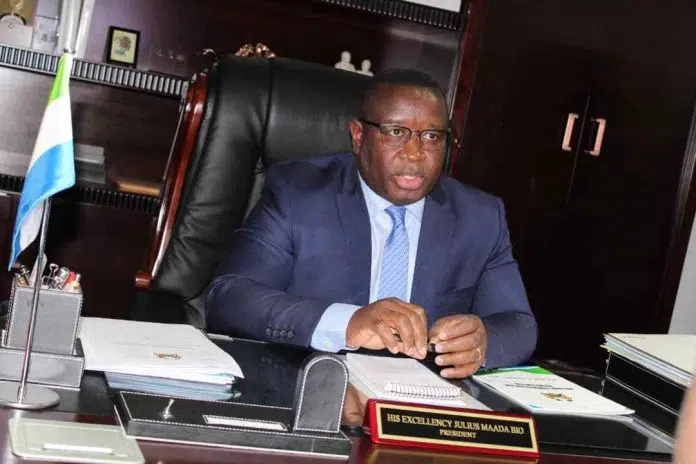
Myohaung Officers’ Mess, Wilberforce, Freetown 18 February 2019 His Excellency President Julius Maada Bio and Commander-in-Chief of The Republic of Sierra Leone Armed Forces, RSLAF, has announced new measures meant to improve conditions of service of the serving and ex-servicemen in the country.
“As I have said, your service and sacrifice are unique; your dedication and loyalty, exemplary. It therefore gives me great pleasure to announce a number of immediate interventions to improve the conditions of service of all serving and retired men of the RSLAF who honourably served and are serving their nation.
“Terms and Conditions of Service (TACOS) – Starting this year, members of the RSLAF will benefit from the enhanced salary pay, which has also been rolled out to all public sector service workers. Henceforth, your annual leave allowances will be normalised to reflect your gross pay. This is in recognition of the unique nature of your service to this nation,” he said.
President Bio further stated that under the New Direction, the previous amount paid to the RSLAF as ‘Monthly Running Costs’ (MRC) and ‘Rations Cash Allowances’ (RCA) had been reviewed, adding that his Government had concluded that the previous amounts paid to soldiers were insufficient to support their welfare and other needs.
“Furthermore, in support of your well-being, I have also authorised the recommendation that the MRC of the Joint Medical Unit (JMU) be increased by 100%. This increased budget allocation to the Joint Medical Unit will facilitate the maintenance of hospital equipment, and other undertake infrastructural improvements in support of your welfare.
“Furthermore, the provision of adequate housing facilities for all service personnel and their families is still a strong priority of my government. This plan will incorporate the rebuilding of Wilberforce Barracks. I also encourage the military leadership to take strong action in evicting illegal occupants off military property as a matter of urgency. Once this is complete, we would review the stabilised situation and plan in a purposeful way how to cater for adequate housing,” he added.
The Commander-in-Chief also announced that the Defence Council had approved the transformation of the RSLAF into a Tri-Service organisation with a separate but unified Army, Navy, and Air Force that would be implemented as part of the government’s long-term strategic goal to commence within the next five years.
“Alongside this, we also plan to develop and properly resource the RSLAF’s specialist units such as the Armed Forces Agricultural Units (AFAU), Engineer Regiment (Engr Regt), Electrical and Mechanical Engineers (EME), the Armed Forces Technical and Education College (AFTEC), the Joint Medical Unit (JMU), and the Tailoring Unit. This will help each of the specialist units to develop their capacities in order to support food security, skills and human capital development, construction, and to generate revenue for the military. These specialist units will also be particularly strengthened and capacitated to contribute towards disaster and emergency relief interventions,” he said.
He thanked the UK government, through the International Security and Advisory Team (ISAT), adding that he had already sanctioned the special female recruitment drive into the force. He also acknowledged the invaluable interventions of the Government of the People’s Republic of China and, in particular, for providing a grant of 50 million Chinese Yuan equivalent of 7.3 Million United States Dollars.
“My aim is for our women to constitute 25% of the Army in line with best practices all over the world. This recruitment drive begins to close the gender gap and opens up possibilities for women to serve their country as proud and distinguished members of our armed forces,” he said, adding that based on recommendations by their commanders and endorsed by their Chief of Defence Staff, he had confirmed a number of promotions that recognised meritorious and outstanding service.
“Distinguished ladies and gentlemen, I have had the distinguished honour to serve in the Republic of Sierra Leone Armed Forces. I feel, know, and recognise the stresses and hardships of military service. I am delighted to be here today both as our country’s democratically-elected President and as a man who proudly served in our Republic of Sierra Leone Armed Forces,” he said.
Lawyer Ady Macauley, who happens to be one of the Defense Counsels in the ongoing Commissions of Inquiry, has on the commencement of hearings taken a jurisdictional objection to the Commission on the basis that the rules of practice as provided for in Section 150 of the 1991 Constitution of Sierra Leone had not been followed. Interestingly though, Justice Biobele Georgewill with alacrity correct him on the procedure he was supposed to use before the Commission.
Representing the former Chief Executive Officer of the National Ebola Response Centre, Palo Conteh and Madina S. Rahman, erstwhile Deputy Minister of Health,Ady Macauley informed Commissioner Justice Biobele Georgewill from Nigeria that his clients would not subject themselves to the jurisdiction of the Commission.
He submitted that one of the persons of interest, Alfred Palo Conteh was a party to an action filed in the Supreme Court of Sierra Leone in which one of the issues was to determine whether or not the Commissions of Inquiry would continue with the proceedings without complying with Section 150 of the Constitution of Sierra Leone.
Lawyer Macauley further invoked Section 124 (2) of the 1991 Constitution of Sierra Leone which says “Where any question relating to any matter or question as is referred to in subsection 1 arises in proceedings in any court, other than the Supreme Court, that court shall stay the proceeding and refer the question of law involved to the Supreme Court for determination; and the court in which the question arose shall dispose of the case in accordance with the decision of the Supreme Court.
He submitted that his clients were very much respectful to the inquiry and ready to subject themselves to its jurisdiction, but could not because the Instruments that established the COI did not comply with Section 150 of the 1991 Constitution of Sierra Leone.
When quizzed as to which rules or procedures he was relying on in taking a jurisdictional objection, he responded that there were no rules as the Rules of Court Committee, as provided for in Section 150 of the Constitution was not followed.
But Justice Biobele Georgewill noted that since lawyer Macaulay did not put forward any rules during his submission, until they go to the Supreme Court and set it aside, they must be bound to the rules set aside by the Commission until the Supreme Court says otherwise.
Whilst replying to the question as to why he did not file papers before taking the objection, lawyer Macauley responded that his clients were only informed of their appearance before the COI on Saturday night, through radio and social media, which, he said prevented him not to file the necessary papers.
At that juncture, the Commissioner urged O.V Robin Mason, who represented the state, to make sure all persons of interest are given fair trial by serving on them the necessary papers that will enable them prepare their case.
Responding to Macaulay’s submission, lawyer Mason admitted that he did not served any papers relating to the issues that were raised by lawyer Macaulay.
He argued that the rule of natural justice demands that a tribunal cannot determine issues that are relative to itself and that the authority and jurisdiction of the Commission has been established and confirmed by parliament.
Judge Biobele in the end advised both parties to ‘keep their gun powder dry’ as a time would come when those needs would arise.
But Lawyer Macaulay pleaded to hand in his case next Thursday to the Commission, which Judge Biobele accepted.
The judge also admonished both the prosecution and the defense lawyers to make a written submission in the interest of progress.
However, on the 14th February 2019 Commissioner Biobele gave a ruling on the matter stating that the Commission of Inquiry is legal and all persons of interest invited to testify should appear before the Commission.
Mr. Timothy Kabba, the Director of the Petroleum Regulatory Agency, Mr. Timothy Kabba on Wednesday 13th February 2019 informed staff and students of the Milton Margai College of Education and Technology (MMCET) at the Great Hall of the Goderich campus that oil and gas would soon be discovered in Sierra Leone and that Government would attract the best companies to start the mining of oil and gas in the country observing that diamonds have not benefited the country.
He made the disclosure at the Student’s Forum that was attended by hundreds of students, lecturers and staff during which he articulated that the college has been part of the history of education in Sierra Leone affirming that Government prioritizes education, the reason for the introduction of the free quality education by the Government of President Julius Maada Bio.
He also underscored that education is a basic right that makes people competitive, that today most educated people cannot articulate issues or solve complex scientific theories and contrasted between formal English and traditional education, described Sir Milton Margai after whom the college was named as the father of independence and one of the great sons of the country.
According to Mr. Timothy Kabba, it is only education that can emancipate people, that the products of Milton Margai can compete anywhere in the world reiterated that government is sincerely determined to improve the educational system in the country and recalled the civil war, Ebola outbreak and mudslide that disrupted the educational system underlining that President Julius Maada Bio has established a strong platform to implement the free quality education that would be monitored and reviewed for effective implementation.
The Director of the Petroleum Regulatory Agency went on to reveal that through education, Government would strengthen the country’s human resource capital and underscored the need for girls to stay in school disclosing that Government has increased budgetary allocation to education from 12%-21%, a clear manifestation of Government’s commitment to the sector in addition to the support from donors like UNICEF and the World Bank among others.
He further urged all to rise up to the challenge of acquiring quality education adding that students pursuing science subjects and engineering are entitled to automatic scholarship, that education must be effective and is the upward vehicle that impacts society citing South Korea that focused its resources on human capital development resulting to 98% literacy rate and is one of the biggest economies.
He recalled that the Petroleum Regulatory Agency sponsored the introduction of a Bachelor in Education degree in Petroleum Engineering and started the construction of the Science Library at the Goderich campus that was later abandoned by the erstwhile Government intimating that funds were provided for the construction of the building, provision of equipment, chemicals, furniture and other items that was never done causing the building to become derelict and stressed that this is not politics but defending the future of the young generation.
Mr. Timothy Kabba also guaranteed that the Agency would solicit funding from donors for the neglected Science Laboratory to be completed and furnished with equipment and chemicals enlightening that most the polytechnics in the country would be upgraded to universities to accommodate the large number of new intakes and that the facilities at Milton Margai would be extended.
He went on to state that Milton Margai College is one of the best in the country that has been transformed in recent times since the appointment of Dr. Philip Kanu as Acting Principal which he stressed is not a mistake; that Dr. Philip Kanu is one of the finest leaders and acknowledged that there must be cordiality between students, lectures and administrative staff for effective learning.
Mr. Timothy Kabba also described Dr. Philip Kanu as a replica of President Julius Maada Bio due to his sincere determination to transform the college into a university as well as improve on its infrastructure and academic performance highlighting that there is light at the end of the tunnel as government is committed to support education and gave an update of the oil and gas sector in the country.
In his brief statement, Dr. Philip Kanu said he welcomes frank discussions from students about developments in the college since his appointment, that his administration is transparent and accountable underlining that with resilience one can overcome challenges.
The question and answer session climaxed the well-attended event.
His Excellency President Julius Maada Bio has presented the 20th Report of the Committee of Ten Heads of State and Government (C-10) at the Plenary of the 32nd Ordinary Session of the Assembly of Heads of State and Government of the African Union (AU). He highlighted series of actions being taken by the Committee since the AU meeting in Nouakchott last year.
During the presentation, the President also stated that the content of the report represents an extensive outreach by the committee members to Interest Groups and individual Member States to support Africa’s demands for the reform of the Security Council.
As the Chair of C-10, President Bio also used the opportunity to inform his colleagues about the Ministerial Meeting of Foreign Ministers of C-10 countries organised in Freetown in December last year.
He stated that: “In this regard, I am pleased to report that the Foreign Ministers of the Committee met in Freetown Sierra Leone, from 14 to 15 December last year to develop (a) a roadmap for advancing the Common African Position, (b) an Aide Memoire for engagement with the Permanent Members of the United Nations Security Council – P-5, and, (c) a strategy to engage with other Interest Groups and regional groupings.”
President Bio also warned that: “The recognition and legitimacy of the African demand to take its rightful place in global governance is achievable only if we continue to work together in articulating our aspirations and goals as a continent. We must continue to resist the temptation and efforts by other Member States and Interest Groups to divide and distract Africa from its Common Position. African countries must collectively continue to defend, promote, and advocate the Common African Position.”
In their various responses, the President of Kenya, H.E Uhruhu Kenyatta, President of South Africa, H.E Matamela Cyril Ramaphosa, Prime Minister of Ethiopia, Abiy Ahmed Ali, President of Mauritania, Mohamed Ould Abdel Aziz, President of Uganda, H.E Yoweri Museveni and the Chairman of African Union and President of Egypt, H.E Abdel Fattah El Sisi praised President Julius Maada Bio for his excellent leadership of the committee of Ten Heads of State and Government. The various Heads of State and Government committed themselves to the Common African Position and assured of their support to President Julius Maada Bio to deliver on the mandate of the C-10.
Earlier, President Bio also held a separate meeting with members of the C-10 wherein he advised committee members to focus on ensuring that Africa is properly represented at the United Nations and not to be distracted by the question of which particular country would represent Africa in the Security Council and for the non-permanent seats. The Coordinator of C-10 was responding to concerns from members of the Committee on what should be the mode of the distribution of seats among the African countries once the request of the C-10 had been granted through the United Nations Reform process.
In its tireless efforts to fight corruption in every nook and cranny within the country, the Anti -Corruption Commission (ACC) has once more secured conviction against four individuals in Kenema, Eastern Sierra Leone.
It was revealed that the High Court of Sierra Leone, Holden in Kenema, presided over by the Honorable Justice Ivan Sesay, on Tuesday 12th February, 2019, convicted four former public officers for various corruption offences.
The four persons were Abubakarr Sidique Turay, former Accountant, Kenema City Council; Edward Kargbo, former Expenditure Clerk, Kenema City Council; Moses Koroma (alias ‘MO Jah’), former Transport Officer, Kenema City Council; and Mathew Amara Sesay, former Social Worker, Ministry of Social Welfare, Gender and Children’s Affairs, Kenema Office.
All these public officials were convicted on Twenty-One (21) Counts of Abuse of Office, and Misappropriation of Public Funds, contrary to Sections 36 and 42 respectively, of the Anti-Corruption Act, 2008.
Between 22nd of July, 2011, and February, 2012, the four convicted persons misappropriated public funds amounting to Twenty-Seven Million, Five Hundred and Nineteen Thousand Leones (Le 27,519.000/00); being monies meant for the operations of the Kenema City Council.
Justice Sesay sentenced all four persons to three years imprisonment to run concurrently; or pay a fine of Thirty Million Leones (Le 30,000.000/00) on each of the twenty one (21) counts. He further ordered that all four convicted persons are to make full payments of the fines as a condition for their release from detention.
Meanwhile, the learned Judge acquitted Lamin Lumeh Mansaray, Regional Librarian Sierra Leone Library Board,Kenema, who was also standing trial in the same matter.
The ACC was represented by Nigel B. Davies and Adrian B.C. Samuels.
It was further revealed that the Commission wishes to reassure the public of its commitment to ensuring that public funds are protected, and, where necessary, recovered. The Commission said for further enquiries, please contact Margaret Murray, the Public Relations Officer on +232-25-428-081.
An adoption of a resolution was done by the Parliament of Sierra Leone on Thursday 14th February 2019 after a debate on women, peace, and security that was laid on the Table of the House on Thursday 7th February, this year.
Presenting the Resolution prior to adoption by the House, the President of the Parliamentary Female Caucus, Hon. Veronica K. Sesay recognized UNDP’s global project on “The Role of Parliaments as Partners in Women, Peace, and Security”, with minimal funding from the Government of Norway. As such, she continued that UNDP’s commitment is to work with four legislatures, including the Sierra Leone Parliament which is the only one chosen from Africa, to progress their national identified priorities that are geared towards supporting women, peace, and security in their home countries. The four countries identified for this pilot project are Jordan, Kyrgyzstan, Sierra Leone and Sri Lanka.
Hon. Veronica K. Sesay also said that the Women, Peace, and Security Agenda was formally initiated and adopted by a UN Security Council Resolution 1325 and was endorsed on the 31st of October, 2000. Since then, Resolution 1325 had been affirmed through subsequent ones, aimed at calling attention to the unique needs of women in conflict-affected situations, such as a variety of interventions to protect women and girls affected by conflict and to ensure their inclusion in peace building processes that affect them, promotion of women’s participation in decision-making, peace processes, political, judicial, elections, post-conflict peace building and efforts to prevent violence and extremism.
Highlighting the four main pillars under Resolution 1325, Hon. Veronica K. Sesay said they include participation of women at all levels of decision-making, protection of women and girls from sexual and gender-based violence, prevention of violence against women, and relief and recovery measures to address international crises through a gender lens.
In adopting the Resolution, MPs have committed to do some of the following by using parliamentary processes and advocacy to promote law reforms in support of gender equality and women’s peace and security, push for the amendment of Section 27 (4d & e) of the 1991 Constitution which allows for discrimination against women, fast track the adoption of amendments to the Child Rights Act of 2007 to make it consistent to the Registration of Customary Marriage and Divorce Act of 2009, and to debate and enact a Bill on affirmative action for Parliament among others.
MPs who spoke to the motion acclaimed and referred to the Resolution as non-controversial and that it is geared towards protecting women, children and girls from all forms of gender based violence, cognizant of efforts that had been made by Government to combat such acts against women and girls in Sierra Leone in light of inheritance, control, and decision-making processes.
They have also called on Government to promote issues relating to women such as the speedy conclusion of cases pending determination in court, recruitment and promotion of women in employment, provision to get forensic evidence against perpetrators of rape, and huge budgetary allocation with stringent supervision on issues relating to the prevention, participation, and protection of women and girls in Sierra Leone.
On Monday, February 11, 2019 the Executive Director of the Sierra Leone Legal Aid Board, Ms. Fatmata Claire Carlton-Hanciles presented a paper on ‘Increasing Access to Justice for women in Remote Communities through Primary Legal Aid Services’ at a two day regional workshop on improving access to justice for women in West Africa, with a focus on Sierra Leone, Liberia and Senegal.
The workshop which took place in Dakar, Senegal on February 11-12, 2019 was organized by the United Nations Office on Drugs and Crime (UNODC) and UN Women, in collaboration with the Office of the United Nations High Commissioner for Human Rights (OHCHR).
The workshop is meant to review and discuss the findings and recommendations of the assessment of the legal aid systems of Sierra Leone, Liberia and Senegal which was carried out by UNODC and UN Women in the second quarter of 2018. It is also meant to prepare a plan identifying national priorities and concrete steps that may be needed to align laws, policies and other practical measures for reform on legal aid with international standards and norms on legal aid and gender equality.
Ms. Carlton-Hanciles’s paper on Sierra Leone touched on the Legislative and policy reforms relating to women and children’s rights which she noted have been slow. She stated that the country has very old and outdated laws dating back to the 1900s when the country was under colonial rule by the British which need to be reviewed.
She added that Sierra Leone is a patriarchal society and that its culture is skewed against women. ‘The land tenure system is very problematic in the sense that women cannot own land in some parts of the country due to customary laws which are unwritten and uncodified,’ she said, adding that ‘Women cannot become chiefs in some parts of the country or inherit property. Also, Female Genital Mutilation (FGM) is still widely practiced.’
Speaking on legal aid service delivery, Ms. Carlton-Hanciles said with few lawyers outside the capital Freetown, the deployment of paralegals upcountry to provide primary legal aid services through mediation, legal empowerment, referrals and provision of information to enhance access to justice has been a huge success in expanding access to justice for women who are among the most disadvantaged in accessing the justice system.
She stated that paralegals work in all the districts in the country to monitor the delivery of the justice system to ensure their modus operandi is consistent with the law and rights are respected. In addition, she stated that they provide advice and legal assistance to those using the Local Courts, Informal Courts, Correctional Centers, Police Cells, Magistrates and High Courts.
She also spoke about establishment of satellite office called Community Advisory Bureaus and the training of partners to cater for the justice needs of members of their communities. She singled out the training of 44 members of the Western Area Council of Tribal Headmen as Paralegals in March 2017 which is meant to empower tribal heads on how to operate informal courts and their powers in terms of matters they can hear and determine and refer those outside their remit, mediation skills and assistance that could be provided to their tribe’s men and women accessing the formal justice system.
Other members of the Sierra Leone Team to the workshop comprised Ms. Olive Gooding of the Ministry of Justice, Ms. Ishmail Mammy of the Sierra Leone Bar Association, Ms. Juliet Anderson of the Civil Society Movement Sierra Leone and Ms. Baindu Massaquoi of UN Women.