At the United Nations International Day of Education on Wednesday January 24th, in New York, Minister of Information and Civic Education, Chernor Bah, eloquently narrated Sierra Leone’s educational journey, beginning with the system the colonial masters handed over to us, the decadence that set in afterwards, the disruption caused by the war and the restoration of hope by current President Julius Maada Bio.
The confident Minister Bah held the august audience spellbound with his narrative of his country’s educational history, harping on the theme for the event: “Learning for Lasting Peace”. He dilated on the impact of the war on education, highlighting the disruption it brought into the education of many Sierra Leonean children, leaving a less than 20% literate population and its attendant consequences like inequality, unemployment and underemployment. The mercurial Chernor Bah shed light on an education system that was too pedagogical, making no room for critical debate and clamping down on dissent.
The Minister spoke on how those challenges in our system pushed them into advocacy to address the imbalances in our society and to find lasting solutions to them. He said they presented a strong case for inclusive education as a way of laying the foundation for just society. Chernor Bah succinctly drew the link between the factors that threatened Sierra Leone’s peace two decades ago and those currently affecting the entire world, such as increased inequality with education under threat, especially for girls.
After narrating the challenging stories, the Minister expressed optimism for the future, harping on President Bio’s bold decision to put education at the center of his governance. He told the audience that Sierra Leone now has a President who has allocated 22% of national budget to education, introduced free education from pre-primary to secondary school, the STEM programs and radical inclusion. All the barriers to education, he said, have been removed by the Government of President Julius Maada Bio, which he said is the ray of hope for the country.
Minister Bah committed to working with UNESCO to implement and institutionalize the UNESCO recommendations on Education for Peace, Human Rights and Sustainable Development.
The Minister spoke proudly of how Sierra Leone has risen from the ashes of destruction to now sit as a non-permanent member of the United Nations Security Council, showcasing its experiences of transformation from conflict to education-fueled development to the world.
He concluded by appealing to his audience for collaboration and interconnectedness in achieving the goals set already and asking that a leaf be borrowed from Sierra Leone’s journey as a shining example for all to emulate.
NP-Sierra Leone Limited (NP-SL Ltd) stands as a prominent importing and marketing business entity, renowned for its proactive approach in providing top-tier petroleum solutions to meet the nation’s energy needs. Offering a comprehensive range of quality petroleum products, including petrol, diesel, gas, and lubricants – featuring the highly sought-after Castrol lubricant oil – NP-SL Ltd has positioned itself as a cornerstone in ensuring energy security for the country.
At the core of NP-SL Ltd’s operations is a commitment to transparency and customer satisfaction. The company’s dedication to delivering reliable and high-quality products has earned it a reputation for excellence among its valued customers, which include individuals, government and non-government entities, as well as private institutions or businesses. With an efficient and customer-centric approach, NP-SL Ltd has managed to build strong relationships with its clientele.
The company’s extensive workforce and network of distributors play a crucial role in bringing its diverse range of petroleum products to the market. This strategic approach not only drives the company’s growth but also aligns with the national development agenda.
Gone are the days when consumers would voice concerns about unfair practices at fuel stations. Thanks to NP-SL Ltd’s forward-thinking initiatives, such as the implementation of modern calibrated pumping machines at its stations, customers now receive accurate quantities of fuel and fair pricing. This commitment to precision and honesty has led NP-SL Ltd to earn the coveted accolade of “1st For Customer Care.”
A recent countrywide survey, conducted to gauge public opinion on NP-SL Ltd’s operations, unveiled a positive sentiment among a large percentage of its customers. The company’s Management was applauded for its effective service delivery and dedication to customer satisfaction. Prominent social commentator Mohamed Bai Sesay noted that NP-SL Ltd has set an exemplary standard for customer care in the nation’s business landscape.
Experts in development economics emphasize the importance of nurturing Local Content for sustainable economic growth. Abdulai Braima, a seasoned economist, lauded NP-SL Ltd’s policy of exclusively employing Sierra Leoneans as a commendable step towards empowering the local workforce and enhancing living standards. He noted that this approach aligns with the ethos of utilizing domestic resources for production and self-sufficiency.
NP Gas, a cooking device offered by NP-SL Ltd, has gained popularity for its efficiency and eco-friendliness. Customers expressed satisfaction with the performance of NP Gas devices, which come in various sizes and are available at affordable prices through the company’s Filling Stations. Businesswoman Memunatu Forna attested to the popularity of NP Gas, noting its swift adoption due to its ease of use and ready availability of refills.
The NP Smart Card has become a trendsetter in convenient purchasing of petroleum products. Users highlighted its usefulness in streamlining transactions, eliminating the need for cash payments. This innovation has notably eased the process of buying fuel, with engineer Musa Kalokoh praising its effectiveness.
As NP-SL Ltd expands its presence into neighboring countries such as Guinea, Liberia, Ivory Coast, and The Gambia, its remarkable growth journey is undeniable. The company’s thriving operations across these branches underscore its resilience and commitment to regional energy needs.
It can be safely affirmed that NP-SL Ltd is not only a successful business entity but also a beacon of socio-economic contribution to the nation.
With its unwavering focus on customer satisfaction, transparent operations, and dedication to local empowerment, NP-SL Ltd sets an inspiring example for others to follow in Sierra Leone’s journey toward progress.
It is an undisputed fact that the Biometric National Identity Cards are indeed the pathway for citizens and non-citizens to actually have access to individual security and access to certain facilities or opportunities. Equipped with advanced features, these Biometric ID Cards have now become crucial for citizens and non-citizens alike as they are embedded with chips that biometric data that will greatly enhance the streamlining of identity verification and ultimately provide access to Government facilities and thereby make possible remote Know-Your-Customer (KYC) checks within the financial sector.
As it has been mandated that the use of National Identification Numbers (NIN) is should be mandatory for pupils in public examination classes, such underscores the Biometric ID Cards growing significance in education. Obtaining the National ID Card is a straightforward process for residents aged 12 and above, while non-citizens can apply for the Non-National ID Cards.
Furthermore, it has ensured that the Biometric Identity Cards are Securitized and Multi-purpose with an advanced ID Verification System. Of importance also is that the cards are mandated for use at checkpoints nationwide, ensuring secure transactions and offering convenience to cardholders.
Against such a backdrop, it is but vital for Sierra Leoneans to prioritize obtaining their Biometric ID Cards as their roles in personal security, participation in national development and access to essential services cannot be over emphasized. As a citizen obtaining the ID Card is a statutory obligation and the unique National Identification Number (NIN) contains pivotal security elements.
To facilitate the application process, specific NCRA Offices and designated centers have been established across Sierra Leone.
It must be underscored that the designated centers and NCRA offices, strategically located throughout the country, offer accessibility for citizens to secure their Biometric National ID cards. Worthy of note also is that the NCRA has introduced corporate services for organizations, further promoting accessibility and efficiency.
Designated centers and six specific offices have been opened throughout the country in locations that are easily-accessible, as part of efforts to facilitate the ID registration process. The centres are:
1. NCRA Headquarters: 2 Walpole Street, Freetown.
2. NCRA Office: 23B Off Kingharman Road, Freetown.
3. NCRA Office: Kennedy Street, Freetown.
4. NCRA Branch Office: 230 Lumley Road, Freetown (By the Round About).
5. NCRA Office: Waterloo along the Freetown High Way (Opposite the Police Station).
6. NCRA Offices: Regional Headquarter Towns of Bo, Kenema, Makeni, and Port Loko.
To improve accessibility, the NCRA has introduced specialized corporate services designed for organizations and institutions. For detailed information on these services, interested parties can reach out to the following contact numbers: +232-33-433-333, +232-30-500-000, +232-60-000, +232-78-221-812, or via email at idverification@ncra.gov.
It is essential to acknowledge that fulfilling this civil responsibility is crucial for citizens.
The National Consumer Protection Commission (NCPC) of Sierra Leone on Tuesday 23rd January, 2024 organized a workshop to discuss the implementation of the ECOWAS Regional Competition framework. Held at the New City Council Conference Hall, 3rd Floor in Freetown, the event brought together key stakeholders and featured discussions on the importance of competition laws, consumer protection and collaboration between national and regional bodies.
In his opening remarks, Lawrence Bassie, the Chief Executive Officer of NCPC, outlined the mission and vision of the Commission. He emphasized the necessity for a competition law in Sierra Leone, underscoring the importance of shielding consumers from unfair market practices. He discussed the pivotal role the NCPC plays in monitoring the consumer market, educating consumers about their rights, and investigating non-compliance with consumer protection laws.
Despite acknowledging challenges such as budget constraints, he regarded them as opportunities for growth. He expressed gratitude towards the Ministry of Trade and Industry and ECOWAS for their support, particularly highlighting the signing of a grant agreement between ECOWAS and Sierra Leone to develop a competition framework and law as a significant milestone.
He urged the Minister to engage with the Ministry of Finance to secure the necessary funds for the Commission to effectively carry out its responsibilities.
In his statement, Aruna Musa, the ECOWAS representative, focused on the collaborative efforts to develop competition and consumer protection in Sierra Leone within the ECOWAS framework. He expressed gratitude to participants and emphasized the significance of promoting fair trade within the ECOWAS region. Aruna highlighted the intention to support Sierra Leone in taking ownership of the regional framework and working towards domestic implementation.
He underscored the importance of cooperation between national and regional stakeholders and the need for capacity building to strengthen the competitive environment in West Africa.
The ECOWAS representative emphasized commitment to supporting Sierra Leone in establishing a national competition authority, contributing to the broader regional integration process within ECOWAS.
Simeon Kofi, a representative of the ECOWAS Regional Competition Authority (ERCA), stressed in his presentation the importance of competition in promoting economic prosperity, innovation, and trade development.
He highlighted the 2008 framework aimed at promoting, maintaining, and encouraging competition in the region while prohibiting anti-competitive practices and protecting consumer welfare.
Deputy Minister of Trade and Industry, Fatmata Wurie, in her address, highlighted the pervasive nature of competition in life and its necessity for growth. She sees the workshop as a crucial step in tackling monopoly and promoting fair trade and investments in Sierra Leone.
She attributed exorbitant prices and exploitation of consumers to monopolistic practices and expressed optimism that the Competition Act would benefit all citizens.
She emphasized the Government’s commitment to ensuring fair trade and healthy competition, applauding the role of the National Consumer Protection Commission in implementing this vital policy. She called for open and meaningful discussions to achieve the shared goal of realizing a competitive and consumer-focused Sierra Leone.
In conclusion, the Deputy Minister officially declared the workshop open, expressing hope for fruitful deliberations and a positive outcome. She highlighted the potential for the competition law to bring about significant changes in the market, benefiting both consumers and businesses.
The workshop is seen as a crucial milestone in advancing Sierra Leone’s economic development through fair trade and healthy competition.
The National Revenue Authority (NRA), in a recent press release dated January 22, 2024, announced the imminent launch of the Mandatory Digital Excise Tax Stamps Program for all stakeholders in the excisable goods industry.
This initiative, set to go live on February 1, 2024, will impact manufacturers, importers, distributors, and retailers of excisable goods, including tobacco, wine, spirituous beverages, and beer products.
The introduction of the Excise Tax Stamp Program, initiated in October 2023, is a strategic government policy aimed at enhancing the efficient collection of revenues to support national development programs. Furthermore, the program seeks to protect citizens from harmful and counterfeit goods, deter smuggling activities, and create a level playing field for compliant importers and manufacturers of excisable products.
To facilitate registration and compliance with the excise stamp usage, the government will finance the procurement of the stamps for the first three months (90 days) following the system’s go-live.
During the initial period, importers and manufacturers of excisable products will receive the stamps at no cost. However, after the grace period, the excise stamp will be subject to published fees before issuance to manufacturers or importers.
For importers, the affixing of stamps is an integral part of the customs process. They will be required to attach the stamps either during production at the foreign manufacturer’s facility or before goods are released by customs for public sale. Importers utilizing warehousing facilities must adhere to the standard customs clearance process, ensuring their facilities are suitable for affixing the stamps.
The government emphasizes its commitment to providing training and technical support to taxpayers on the system. Importantly, all importers and manufacturers of excisable products are urged to register for the system and apply for stamps through the Product Tracing Systems (PTS).
In conclusion, the implementation of the Mandatory Digital Excise Tax Stamps Program represents a pivotal step towards enhancing revenue collection, ensuring consumer safety, and fostering fair competition within the excisable goods industry.
Stakeholders are therefore encouraged to proactively engage with the system to ensure a seamless transition and compliance with the new regulations.
Despite providing crucial environmental services, especially as the sole source of clean water from the Guma Valley dam, the Western Area Peninsula National Park (WAPNP) is facing severe threats from human activities. Land grabbing, charcoal burning, quarrying, and marijuana cultivation, exacerbated by weak law enforcement and corruption, pose significant risks to the park’s ecological balance. These threats extend beyond the park, impacting Freetown’s water supply and escalating the potential for disasters like landslides and floods.
Given these challenges, it is imperative to closely monitor WAPNP’s forest coverage to guide effective protection measures.
Reports highlight a notable surge in forest fires, particularly along WAPNP’s boundary, compounding the already precarious situation. Since 2023, 420 hectares of forest have been lost, increasing the likelihood of water shortages, floods and landslides.
Yvonne Forsen, Country Director of the World Food Programme, stressed the urgency, stating, “Time is soon running out to act to preserve the health of the forest and to avert a water crisis and other disasters in and around Freetown.”
The primary objective of the analysis conducted was to offer current data on forest cover in WAPNP from April 2023 to mid-January 2024. Given the National Park’s vital role in protecting Freetown’s water supply and preventing disasters, the findings underscore the gravity of the situation.
The analysis identified that the substantial loss of forest cover, approximately 225 hectares, was primarily due to uncontrolled human-induced forest fires and land clearing, followed by agricultural and urban expansion. New quarries were pinpointed, accompanied by the development of new roads, contributing further to deforestation as land grabbers and charcoal producers encroach upon the park.
The results show that most forest loss occurred along the park’s boundary. However, of utmost concern, forest loss was also identified deep inside the park, with the potential for these areas to expand.
The report, released by the World Food Programme on January 23, 2024, issues a call for immediate action. Preserving the Western Area Peninsula National Park is not only crucial for biodiversity but also paramount for ensuring Freetown’s water supply and mitigating the risk of disasters such as devastating landslides. Strengthened law enforcement, anti-corruption measures, and sustainable land use practices are imperative to address the root causes of these threats.
Sierra Leone embarked on its national Constitutional Review Process nearly eighteen years ago, aiming to address governance and human rights challenges. While commendable progress has been achieved, the process remains incomplete, leaving citizens eager for a new constitution. Acknowledging concerns, the Bio-led administration issued a Whitepaper accepting numerous recommendations from the Justice Cowan Report. However, the absence of a Constitutional Bill and citizens’ limited awareness of the process status raised questions.
To deliberate on the progress, identify gaps, and propose recommendations for a citizen-centered and expeditious constitutional review, the Centre for Accountability and Rule of Law Sierra Leone, (CARL-SL), with funding from the Open Society Foundation, has concluded a one-day national conference on Wednesday, 25th January, 2024. The conference brought together key stakeholders, including Government officials, civil society leaders, women-led groups, and development partners. The event took place at the Buxton Memorial Hall on Charles Street in Freetown.
Ibrahim Tommy, the Executive Director of the Centre for Accountability and Rule of Law, Sierra Leone, highlighted the protracted nature of the constitutional review process, beginning in 2006 with the Peter Tucker Constitutional Review Committee. Despite completing its report in 2013, the Government’s response was delayed. The current Constitutional Review Committee, established in 2013, reviewed the Tucker report, presenting findings and recommendations in 2018. The Government accepted and rejected certain recommendations in a White Paper, emphasizing the prolonged duration of the process.
Tommy outlined the purpose of the conference, expressing the expectation of an update from a Government representative, notably the Office of the Attorney General, Minister of Justice. Despite the absence of such representation, Tommy noted productive outcomes, including reflections on the government white paper. He emphasized that constitution-making should prioritize public interests and highlighted the need for a participatory and inclusive approach.
The Executive Director called for an expedited process, the integration of new ideas, and government engagement with civil society. He recommended the disclosure of a timeline for concluding the process and urged sincere engagement with civil society to address concerns. Tommy emphasized the collective responsibility to enhance the constitution, advocating for transparency and unity among civil society organizations.
Expressing disappointment in the delayed new constitution, Tommy urged the government to adopt an open-minded approach, welcoming diverse perspectives until the constitution is finalized through parliamentary approval and a referendum.
In her statement, Bintu Kamara, the program coordinator of the 50/50 Group, emphasized the importance of ensuring a gender-inclusive approach to the ongoing constitutional reform in Sierra Leone.
Kamara expressed gratitude for the positive steps taken to update the constitution and the issuance of a Whitepaper aligning with Justice Cowan Report recommendations, but however, highlighted the need for clarity on the progress of the constitutional reform, emphasizing its significance in reflecting citizens’ needs and concerns.
As a women-centered organization, 50/50 Group stressed the fundamental role of constitutional reform in achieving a transformative agenda for women, girls, and the country’s development. Kamara recalled the Women’s Solidarity Response and Recommendations to the Constitutional Review Committee’s Abridged Draft Report in 2016, outlining the collective aspirations of women for a revised constitution.
The 50/50 Group identified several gender dimensions requiring attention during constitutional reform. Kamara highlighted the problematic recognition of customary law, which lacks uniform rules and often perpetuates patriarchal norms, particularly in areas like land tenure, marriage, divorce, and inheritance.
A notable concern raised was Section 27 (4)(d-e) of the Constitution, which provides exemptions to anti-discrimination provisions, hindering due process and equal protection. The group called for the removal and replacement of that section.
The Program Coordinator of 50/50 Group advocated for an equity-focused constitutional approach, considering the existing barriers faced by women due to cultural norms. Positive discrimination or affirmative action, especially in areas of education, political participation, health, and economic empowerment, was proposed by the 50/50 Group.
She concluded her statement with a call for women’s active participation in constitutional discussions, asserting the constitution’s importance as a shared rulebook co-owned by all citizens, reaffirming 50/50 Group’s commitment to the constitutional reform process, and emphasizing the significance of inclusive and transparent dialogue.
Alfred Paul Juwah Esq, the Secretary General of the Sierra Leone Bar Association, emphasized the paramount nature of the constitution as the highest law in the country, stating that the Sierra Leone Bar Association serves as a moral guarantor of the constitution, calling attention to instances where Government actions may be perceived as violating constitutional principles.
Juwah highlighted the dual role of the Association, not only scrutinizing potential constitutional infringements but also commending and reminding the Government to adhere to constitutional provisions. The Sierra Leone Bar Association acknowledged the commendable progress made in the ongoing review of the 1991 constitution, a process initiated in 2006.
Expressing optimism for the adoption of a new constitution, Juwah raised concerns about persistent constitutional challenges and controversial cases associated with the existing 1991 constitution. He stressed the need for the ongoing constitutional review to address these challenges comprehensively.
The Sierra Leone Bar Association’s position underscores the importance of considering past constitutional controversies during the current review process. The Secretary General urged the Government to take a proactive approach to ensure that the new constitution is free from contentious issues that might necessitate immediate amendments shortly after its adoption.
Other speakers including the Chairman Education Committee at the Sierra Leone Labour Congress, Alieu Fofanah, PRO Driver’s Union, Mohamed Kaindoneh, President Traders Union, Haja Marie Bob Kandeh, the National Publicity Secretary of the All People’s Congress (APC), Sidi Yayah Tunis also made statements during the conference, followed by presentation:
The conference provided a platform for constructive dialogue and reiterated the importance of a constitution that reflects the collective will, safeguarding citizens’ rights for future generations.
In a recent development, the Court of the University of Sierra Leone (USL), the institution’s highest administrative decision-making body, has reaffirmed its decision made on the 16th January 2024. The decision involved the approval and ratification of a Pro Vice-Chancellor for the University of Sierra Leone in compliance with Sections 8 and 9 of the Universities Act, 2021.
The University Court, during an “Extra-Ordinary meeting” on the 16th January 2024, officially approved and ratified Prof. Mohamed Samai, the Deputy Vice-Chancellor of the College of Medicine and Allied Health Sciences (COMAHS), as the Pro Vice-Chancellor. In addition, an “Emergency Extra-Ordinary meeting” held on Wednesday, 24th January 2024, saw the Court reiterating and upholding its earlier decision.
The Court, as part of its decision, endorsed the existing procedure of rotating the position of Pro Vice-Chancellor among the constituent colleges: Fourah Bay College, the College of Medicine and Allied Sciences, and the Institute of Public Administration and Management.
It’s essential to note that the Court clarified that it does not recognize Prof. Joseph Aruna Lawrence Kamara as the “Acting Vice-Chancellor and Principal” of USL.
The approval and ratification of Prof. Mohamed Samai as Pro Vice-Chancellor align with Section 9(1) of the Universities Act, 2021. Prof. Samai, who has been performing the duties of the Pro Vice-Chancellor since November 2022, is considered the Acting Vice-Chancellor and Principal of USL in accordance with Section 8(5) of the Universities Act, 2021.
Both meetings of the University of Sierra Leone Court were conducted in the Committee Room of the “University House” at Fourah Bay College Campus, Mount Aureol, Freetown. The decision underscores the commitment of the University to follow due process and governance principles in its administrative appointments.
In the Southern Moyamba District, along the shores of Sierra Leone, Plantain Island finds itself caught in the throes of an environmental crisis. Once a haunting slave pen, an island of natural beauty, is now grappling with the ruthless impacts of climate change.
Over the centuries, Plantain Island stood embellished with lush greenery and thriving rainforests. However, the early 2000s marked a turning point as the island began to lose its original attraction, with locals turning victims to the hands of climate change induced by human activities. The relentless forces of deforestation, sand mining, and unplanned constructions by inhabitants, irreversibly altered the landscape, leaving over 4000 locals, reliant on fishing for their livelihoods, to bear the unbearable consequences of this environmental upheaval.
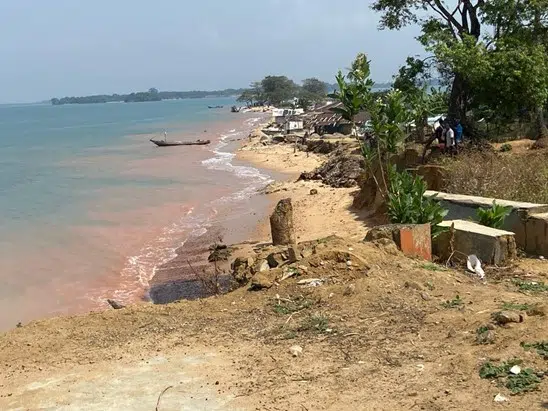
As years pass by, the island, once a steadfast exhibition against the tides, succumbs to relentless erosion, gradually surrendering its territory to the encroaching waters. Plantain Island, now a shadow of its former self, staggers on the brink of disappearance.
Close to the heart of this ecological tragedy, lies Shenge, the headquarter town of the Kargboro Chiefdom in Moyamba District. Here, the Supreme Islamic Council Primary School, the sole educational institution on Plantain Island built in 1986, stands as a testament to the pervasive impact of climate change. Positioned over 100 meters from the sea, the once resilient school has lost one of its classrooms to the relentless rise of the ocean, and fear now shrouds the community.
The erroded lanscape at the school environment
A Potential Danger for Kids in the School
Osman A.B Kamara, the Head Teacher of the primary school, laments the erosion eating deep into the school environs, making parents hesitant to send their children to school in utter fear of imminent danger. As I cautiously approach the collapsed classroom for a photograph, villagers vehemently warned against treading on the deadly terrain.
Among the disheartened diaspora is Algali A Bangura, whose family roots intertwine with the island’s soil. Forced to abandon his home in 2007 as the waters claimed his family’s land and sprawling plantations, Algali now gazes back at the submerged remnants of his past. Coconut stems, orange stems, once flourishing plantations, now stand as silent witnesses to the relentless march of the sea.
Rising Temperatures and Changing Rainfall Patterns:
Sierra Leone has experienced a noticeable increase in average temperatures, with a rise of approximately 1.2°C over the last century. Changes in rainfall patterns have been stark, with altered distribution and intensity leading to a rise in extreme weather events.
The warming trend contributes to an increased frequency of droughts and erratic rainfall, posing a significant threat to agriculture, the backbone of Sierra Leone’s economy.
Sea-Level rise and coastal erosion
Sierra Leone is ranked as the third most disaster-prone country globally, facing recurrent challenges from rising sea levels. The country has witnessed a consistent rise in sea levels at a rate of approximately 4.5 millimeters per year, contributing to coastal erosion.
The effect is glaringly evident on Plantain Island, where over 4000 residents face the imminent loss of their homes and livelihoods due to encroaching waters.
Extreme Weather Events and Flooding:
Part of the island almost eroded
Sierra Leone experiences an increasing frequency of extreme weather events, including heavy rainfall and flooding.
In 2017, the devastating mudslide in Freetown claimed over a thousand lives, exposing the vulnerability of communities to climate-induced disasters.
The 2017 mudslide remains a haunting reminder of the lethal synergy between climate change and extreme weather events, leading to tragic loss of life and property.
While statistics underscore the gravity of the situation, Sierra Leone is not merely a victim of climate change but an active participant in seeking solutions. The government has initiated several measures to adapt to the evolving climate, including the implementation of sustainable practices, encouraging sustainable land use, afforestation, and responsible resource management.
There is more need for community awareness and resilience building through empowering communities to understand and adapt to climate-related challenges and engaging with global partners for support, technology transfer, and capacity building
Mangrove Harvesting for Fish Smoking: A Double-Edged Sword in Coastal climate Battle
Harvested Mangroves Ready for Use
As I moved around the depleted Island, I came across bunches of harvested mangroves prepared for fish smoking. The harvesting of mangroves for fish smoking at Plantain Island and other coastal communities emerges as a common practice. While this activity is integral to the local economy, providing livelihoods and sustenance, it also unleashes a series of environmental consequences that echo far beyond the immediate shores.
The reliance on mangrove wood for fish smoking carries profound implications for Sierra Leone’s coastal climate dynamics. Harvesting mangroves for smoking releases stored carbon back into the atmosphere, contributing to the greenhouse effect and climate change.
Mangroves which serve as natural barriers against erosion and storm surges are constantly being harvested around the shores of Plantain Island and their removal exposes the Island to increased vulnerability, especially in the face of rising sea levels attributed to climate change.
The indiscriminate cutting of mangroves disrupts these ecosystems, leads to biodiversity loss and affecting the subtle balance of coastal ecosystems.
IOM, EPA Intervention: Renew Hope for the Islanders
IOM and EPA team having a meeting with residents of the island
Amidst the community’s depletion, a glimmer of hope arrives in the form of the International Organization for Migration and the Environment Protection Agency (EPA). A team, including the Deputy Minister of Environment and the Head of Country Office for the International Organization for Migration (IOM), descends upon the island to assess the environmental hazard.
IOM has joined forces with the Environment Protection Agency and the Ministry of Environment to officially visit Plantain Island to see and gather firsthand information from locals on the impact of climate change in their community.
IOM Development Fund has allotted a substantial USD 300,000 funding in order to scientifically understand what is going on, on two targets islands- Plantain and Yelibuya Islands on a two year pilot project which aims to mitigate the already depleted islands.
Christos Christodoulides, Head of Office IOM Sierra Leone said the Project which is to scientifically understand the impacts of climate change on the two fishing island has an intensive research component to understand the root causes of what is happening on the two islands and provide solutions to the affected people.
He said the nexus between migration and climate change is very important which was why the IOM came in. He said there is already internal migration taking place as good numbers of people have moved from Plantain Island to mainland Shenge.
“IOM is particularly proud because this is our first migration climate change project in Sierra Leone and I am really touched by the stories of the islanders. We have seen and felt the impact of climate change on the island and truly we admire the resilience of the people of this fishing island,” he averred.
Sheku Mark Kanneh, Executive Director at the Environmental Protection Agency, expresses gratitude for the resilience of Plantain Island’s people amid the deadly challenges of climate change. The EPA, he says is deeply concerned about the escalating crisis and is collaborating with the IOM to secure funding for the mitigation of this environmental catastrophe, striving to save the island from disappearing.
Pauline Macharia, Head of Programs at IOM Sierra Leone, recounts the organization’s earlier visit in May 2023, underscoring their commitment to understanding and addressing the impacts of climate change on the island.
Alessia Castel Franco, IOM Development Fund Administrator, unveils a USD 300,000 pilot phase project for Plantain Island, urging patience as the organization implements over 200 projects worldwide.
Deputy Minister of Environment Hon. Mima YM Sobba-Stephens voices the government’s commitment to mitigating the aftermath of climate change. Encouraging frank discussions, she urges the community to explain the problems they face, while also advocating for practices that protect the environment.
Testaments of the Islanders:
Algali A Bangura, who was forced to leave his home since 2007 is explaining his experience to the officials of IOM and EPA
Amidst tales of hopelessness, Adama Sesay, a resident since 1984, describes the island’s steady submergence and the rising waters dividing the village. She pleads with authorities to intervene and mitigate the situation, proposing measures such as banking the island.
Charles Barlay emphasizes the island’s staggering loss – over 50% of its land claimed by the sea, leaving more than 200 houses submerged. Locals, including Ben Caulker and Abubakar Sesay, echo similar stories, soliciting all possible means to save their beloved island from impending doom.
The encroaching waters eating deep into the land
In the face of adversity, Plantain Island stands as a heartbreaking symbol, indicating for collective action to stave off the looming catastrophe and reclaim its once-vibrant legacy from the clutches of climate change.
Accra, Ghana. 17 January, 2024 – QNET’s insightful YouTube video showcasing the impact of its financial literacy programme, Fingreen, has been honoured with three prestigious gold award at the 2023 MarCom Awards. Titled “FinGreen: Seeding Financial Literacy for a Brighter Future,” the video shines a light on QNET’s FinGreen initiative, a peer-to-peer educational program designed to improve financial understanding in underprivileged communities.
The video opens with a striking statistic: only one in three adults worldwide possess financial literacy. It then elaborates on how FinGreen contributes to the United Nations’ Sustainable Development Goals by addressing inequality and promoting decent work and economic growth opportunities.
“FinGreen is tailored for women and youth in emerging economies, “says Malou Caluza, CEO of QNET. “Historically, women have had limited access to financial services compared to men. Although mobile banking and payment platforms have recently improved accessibility, many still lack the essential knowledge for making informed financial decisions.”
Ms. Abass Bushira, a young woman leading an agricultural venture testified: “The FinGreen training felt like it was designed with me in mind. The curriculum covered topics such as budgeting, investment strategies, debt management, banking, financial planning and others.”
Launched initially in Turkey and Nigeria in 2022, and expanded to Ghana in 2023, FinGreen primarily targets women and youth in developing regions. The FinGreen programme partners with local experts to assess and identify underserved communities that could most benefit from greater education and inclusion. In Ghana, more than one thousand young people and women were trained in the cities of Accra and Ho.
According to Michael Andoh, a student of Accra Technical University, “I have learnt how to achieve personal financial discipline and how to carefully prepare a simple budget for my personal expenses.”
Caluza believes the MarCom award underscores the video’s success in communicating FinGreen’s mission of individual empowerment for community upliftment.
The MarCom Awards is a premier international creative competition.FinGreen: Seeding Financial Literacy for a Brighter Future was one of 6,500 entries from more than 47 countries submitted this year. The video clinched a gold trophy for outstanding achievement.
Encouraged by FinGreen’s success in Nigeria, Ghana, and Turkey with more than 3200 people empowered, QNET will soon expand the programme to Morocco. Readers can view the winning video here or learn more about FinGreen here.
####
About QNET
QNET is a prominent lifestyle and wellness company that uses a direct selling business model to offer a wide selection of exclusive products that enable individuals to embrace a healthier, more balanced life. Established in 1998, QNET marks 25 years of making an impact around the world through its product offerings and e-commerce-powered business model, in 2023.
QNET proudly holds memberships in the Direct Selling Association in several countries, the Hong Kong Health Food Association, the Health Supplements Industry Association of Singapore, and more. QNET is also active in several global sports sponsorships including in its role as the official direct selling partner of the Manchester City Football Club and the Confederation of African Football (CAF), underscoring its commitment to excellence and global reach.
To learn more about QNET and its mission of RYTHM – Raise Yourself To Help Mankind, please visit www.qnet.net.