
Home Blog Page 541

President Bio Expresses Delight Over IMF Assessment & Disbursement of USD$20.7 Million

President Bio has disclosed at the Presidential Lodge on the 5th June,2023  that he is impressed with the outcomes of the latest reviews by the International Monetary Fund (IMF) citing the disbursement of USD$20.7 million, after the visit of the team, as a vote of confidence in Government’s economic management measures.

“The economic management measures my Government put in place early in my administration in 2018 won the confidence of the International Monetary Fund and reinstated Sierra Leone in the Extended Credit Facility programme that made available USD$172.1 million to our nation. On Monday, June 05, 2023, I was pleased with the news of the approval by the Executive Board for the immediate disbursement of US$20.7 million.

“This is yet another vote of confidence in the measures we continue to put in place to manage the economy in this uncertain global economic environment. This facility will enable us to quickly work towards reducing inflation, mobilize revenue to allow for necessary spending consistent with debt sustainability, safeguard financial stability and maintain external resilience to shock.

“My SLPP administration has been transparent and forthright with public spending, thereby increasing mutual trust between our Government and multilateral agencies. We, therefore, thank the Executive Board of IMF and the entire management for their confidence in my SLPP administration. Our focus is to continue to pursue structural reforms, which are essential to reducing vulnerabilities to corruption and fostering private sector development.”

President Bio, who is certain of a first-round victory in the 24 June 2023 elections, also assured that his Government would continue its efforts at improving the business climate and strengthening the governance of key institutions, adding that he is committed to supporting public accountability framework, the anti-corruption efforts and respect for the rule of law.

The Fund stated in a press release on Monday 5 June 2023 that the programme was aimed at reducing inflation, so that the Government could mobilize revenue to allow for necessary spending consistent with debt sustainability, safeguard financial stability, and maintain external resilience to shock.

“The economic recovery from successive external shocks was interrupted last year amid high energy and food prices in the context of Russia’s war in Ukraine, reduced household purchasing power and lower than expected mining output. The soaring cost of living contributed to rising levels of food insecurity.”

The release also confirmed that Sierra Leone’s “Foreign exchange reserves remain adequate but have declined, and rebuilding reserve buffers will be a priority going forward…Macroeconomic conditions are expected to stabilize on the back of the planned adjustment, but the outlook remains challenging. Growth is expected to decelerate to 2.7 percent in 2023 from 3.6 percent in 2022, before recovering to 4.7 percent in 2024.

“Inflation is projected to gradually decline to single digits over the medium term amid the policy stance while foreign exchange reserves would stabilize, assuming robust concessional financing”.
USL Collaborates with the Broad Institutes to Train Postgraduate Medical Students

An intensive one-week training for postgraduate students at the College of Medicine and Allied Health Sciences (COMAHS) is expected to be rolled out by the University of Sierra Leone in collaboration with the Board Institutes – Harvard University and the Massachusetts Institute of Technology (MIT).

Addressing  students and tutors at the start of the training at the Galliness Paradise in Bo, Deputy Vice Chancellor (DVC) of COMAHS, Prof. Mohamed Samai who deputized for the Vice Chancellor and Principal (VC&P) of the USL, Brig. Gen. Prof Foday Sahr said he is delighted to have collaborated with the Broad Institutes to support the University’s medical school and by extension, the health sector in the country.

Prof Samai noted that the University of Sierra Leone is looking beyond the training of students for academic purposes to include support for the Ministry of Health and by extension, the country’s health sector. He said the training, which is the second phase is the precursor to the full-blown Masters and PhD programmes in the medical and related fields that would start immediately, which he said would run for two years and a minimum of three years respectively.

The Course Coordinator, Haja Dr. Isata Wurie, Dean of the Faculty of the Medical Laboratory Sciences and Diagnostics at COMAHS said the background to the training should be traced to 2022 when the University of Sierra Leone in line with the national agenda decided to improve on the capacity of faculty staff members.

She pointed out that through the sustained efforts of the VC&P of USL and the DVC of COMAHS, postgraduate courses were instituted in Epidemiology, Laboratory Medicine and Pharmacy for Masters, MPhil and PhD students.

Associate Professor Wurie noted that after the approval of the course, some 11 PhD and 15 Masters Students have started their courses through collaborative efforts between USL and the Broad Institutes, adding that the training is part of the USL’s long-term strategy to prepare masters and PhD students in public health and other medical-related disciplines.

On her part, the Project Manager at the Broad Institutes, Dr. Marietou Faye Paye pointed out that they are happy to have the opportunity to collaborate with the University of Sierra Leone through the teaching of courses to Masters and PhD students. She said they are passionate about supporting education in the country, especially in the public health field, adding that they are happy to secure the opportunity to collaborate with the University. She pointed out that part of the project package is to teach Masters and PhD students on general public health topics, epidemiology, understanding how research design works and how to implement them.

In terms of the next steps, the Project Director expressed hope for the continuation of the collaboration and to develop the medical workforce in the country.

Dr. Faye Paye noted that as part of their strategic outcome, they are not just focusing on research but also on the detection of pathogens to support public health and to also connect people and  the different levels of Government so that they can easily detect outbreaks of epidemic and to respond. She furthered that they are focusing on empowering the people in terms of building the workforce and connecting the different leadership so as to take their own actions rather than depending on outsiders to respond to their public health emergencies.

The tutors for this intensive one-week training in Bo, the second of such engagements in the country comprises staff from Harvard University who are teaching gratis through a memorandum of understanding among USL, Harvard University and the Massachusetts Institute of Technology in addition to a team of local staff at COMAHS, including Dr. Donald Grant, Dr. Momoh Gbetuwa and with Haja Associate Prof. Isata Wurie as the Course Coordinator.

It is important to note that other strategic partners are onboard this postgraduate academic and professional enterprise including but not limited to the West African Health Organization.


IMF to Disburse US$20.8 Million to Government of Sierra Leone

The Executive Board of the International Monetary Fund has on the  5th June, 2023 approved the Economic Performance Programme of the Government of Sierra Leone which will trigger immediate disbursement of about US$20.8 million. This disclosure was made by the Ministry of Finance. in collaboration with the Bank of Sierra Leone and the National Revenue Authority  under the Extended Credit Facility Programme.

It is worth noting that the global economy is currently facing challenges occasioned by unprecedented overlapping multiple crises severely impacting all countries’ economic fabric. These crises have manifested into high inflation, depreciation of currencies, deteriorating external accounts, high-interest rates and rising debt levels and vulnerabilities.

The crisis has also worsened food and energy insecurity. Therefore, the approval of Sierra Leone’s economic programme by the International Monetary Fund amidst the overlapping multiple crises is a strong recognition and vote of confidence in the Government’s commitment to restoring macroeconomic stability, long-term debt sustainability, and enhancing transparency and accountability in public funds.

During the Executive Board meeting, and in view of the global multiple crises, Government was pleased with the statement of  Bo Li, Deputy Managing Director and Acting Chair, as follows.

“Sierra Leone continues to face significant economic challenges, amplified by multiple shocks, including Russia’s war in Ukraine. However, the Government’s commitment to bolster tax revenues represents important steps towards tightening the fiscal stance while creating space for priority social spending”.

The IMF’s approval of the economic programme will pave the way for other international financial institutions to scale up their support towards financing the Government’s priority programmes, including Human Capital Development.

As a result, the Ministry of Finance, the Bank of Sierra Leone and the National Revenue Authority are pleased to inform the general public that the Government is at an advanced stage in negotiating with the World Bank to disburse 65 million United States dollars in budget support in 2023.

Similarly, the approval will lay the basis for the ongoing negotiations with the European Union for the restoration of budget support of about 100 million Euros for a period of four years, effective 2023.

It is also important to note that a sound economic programme with the IMF, among others, will provide comfort for the negotiation of the US Millennium Challenge Corporation (MCC) Compact and signature by the end of 2023.

Therefore, Government reiterates its commitment to implementing agreed reforms with Development Partners, including but not limited to prudent fiscal consolidation, exchange rate and monetary policy management that will lower inflation and stabilize the exchange rate and boost international reserves aimed at promoting macroeconomic and financial stability thereby laying the foundation for inclusive green and sustainable growth.


Gento’s Manifesto Plans Prove Detractors Wrong of a Clueless Ambition

By Amin Kef (Ranger)

At the launch of his manifesto titled: “Freetown for We All”, aspiring Mayor of Freetown under the SLPP ticket, Mohamed Gento Kamara, made it abundantly clear that his manifesto entails five commitments should he be elected Mayor. These are: Water for we all; Clean city for we all; Jobs for we all; Public spaces and services for we all and Freetown for we all.

Undoubtedly, the name Mohamed Gento Kamara is a household name in Sierra Leone. His name rings a bell wherever you go in Freetown and Sierra Leone in general. He is slated to become the next Mayor of Freetown if voted for come June 24, 2023.

It is no gainsaying the fact that over the last two decades or more, Freetown (the capital city of Sierra Leone) which should be the beacon of cleanliness, progress, discipline, infrastructural beauty and champion of utility services, has not maintained such posture due to the fact that, individuals tasked with keeping Freetown as the befitting capital city of Sierra Leone, have failed woefully in all aspects.

However, it pays no one to begin to apportion blame on anyone or on any Government. Suffice to say, the mistake has been done throughout all these years by putting the wrong persons in the wrong place to serve as Mayor of Freetown. In fact, it is a wonder to many people how it happens that wrong people are more than often appointed or elected to serve in positions they know nothing about.

Thankfully however, Sierra Leoneans are now cognizant of the fact that this country needs people to serve in positions of trust who are qualified and know much about the position or job they are being elected or required to perform. This is good for the progress of this country, the capital city Freetown in particular.

It is against this background that political pundits and social commentators are urging the people of Freetown to make a wise decision by voting Mohamed Gento Kamara, not only because he is a philanthropist who has helped all and sundry, but mostly because he has the requisite knowledge, experience and moral attitude to develop Freetown and transform it into a 21st Century capital city which all Sierra Leoneans can be proud of.

It could be recalled that while speaking on national television a few weeks ago, he did say that when he is voted Mayor of Freetown Municipality, he will be committed to fixing this city so that it works for all of us. His focus will be on providing clean water, sanitation services, job creation, and public spaces – including dignified health centers, marketplaces and recreational facilities for all.

With Gento Kamara as Mayor of Freetown, Freetonians are assured of enhanced access to public services in a manner which appreciates the self-worth of all citizens as he will purposefully include those who have traditionally been marginalized and forgotten by society.

It is generally believed that by cleaning up the mess, instilling order, and creating employment opportunities throughout the city, this will enable everyone to rise and live in dignity, from East End to Aberdeen, from the Kekeh riders to the market sellers to the footballers to the fishermen to the tailors to the artists to the business executives.

Hopefully, with such a critical infrastructure and socio-economic framework in place, we can all begin to enjoy what Freetown has to offer– a vibrant culture and beautiful city, where all citizens can pursue their dreams.

However, we are mindful of the fact that, this can only be done with an inclusive, accessible and accountable Local Government, which is responsive to the needs of all people no matter their heritage or status.

It is the hope and wish of all Freetonians that unlike the past administration, the next leadership of the city must respect and collaborate with chiefs, traditional and religious leaders and local community leaders, so that no one is left behind.

And this is where Mohamed Gento Kamara comes in!

In his manifesto, Gento Kamara promises that as Head of the Freetown City Council, he will work with all stakeholders to ensure that Freetown becomes a city known for its cleanliness while promoting recycling of waste, especially single-use plastics, for other uses such as making pavement blocks. As Mayor, he also intends to progressively eliminate the use of plastics which otherwise clog the drainage systems and litter the beaches and other public spaces. He also plans to build public toilets for use by traders, tourists, and anyone in town; and to re-introduce cleaning days with proper incentives and coordination in order to cultivate habits of cleanliness and communal pride in our neighborhoods.

More importantly, he promises that as Mayor, his staff will reflect the faces and languages and religions of this city. He adds that he will be inclusive so that all feel at home and can access Local Government services in a comfortable environment. He adds that the groups which have been traditionally marginalized and underrepresented – women, youth, those with disability, ethnic minorities – will be purposefully prioritized when making decisions on hiring and project implementation.

Listening to Mohamed Gento Kamara reading his manifesto, political pundits and social commentators are of the opinion that Sierra Leoneans are now more inclined to vote for him come June 24 because his plans and policies, added to his career and experience in urban development qualify him for the position of Mayor.

It is now up to the people of Freetown to decide whether they want someone with exquisite knowledge and experience to fix the problems of Freetown or whether they want a novice who knows nothing about urban development.

ACC New ‘Integrity House’ Head Office Officially Commissioned in Freetown

By Amin Kef (Ranger)

The Anti-Corruption Commission’s (ACC’s) new ultra-modern Headquarters building, named Integrity House, has been officially opened by President Julius Maada Bio on the 5th June, 2023 at Tower Hill in Freetown.

In his remarks, President Bio started by reminding the gathering that corruption is an existential threat to the image, integrity, and wholesomeness of the State, adding that it had the potential to undermine business, public service delivery, public trust and cohesion, which were critical for national development.

“We must therefore prevent and curb the flagrant abuse of public office for personal gain and fight corruption in the private sector. That is why I have not wavered in my support for and commitment to the resolute national fight against corruption.

“Let me, therefore, congratulate and thank the Commissioner, Francis Ben Kaifala, the Deputy Commissioner, Augustine Ngobie, the Board, and the dedicated team that have demonstrated assiduous dedication to achieving the objectives I set in my New Direction manifesto.

“International ratings and corruption perception indexes over the last five years of my leadership have been very favourable. Using objective international datasets, the Millennium Corporation Challenge rates Sierra Leone as passing the hard ‘control of corruption’ indicator year on year with consistently high marks.

“On the Transparency International Global Corruption Perception Index, Sierra Leone has moved 19 places upward since 2018 and scored 34 points — above the Sub-Saharan average of 33.

“I am informed that the most recent Afro-Barometer Survey Report 2022, Round 9, indicates a significant improvement, with data showing elevated levels of trust in the robust posture of Sierra Leone’s Anti-Corruption Commission and the function of Integrity Management Committees located within Ministries, Departments, and Agencies.

“But we can do more, and we continue to do more. As a Government, we have been very mindful of waste and accountability. This sets us apart from our predecessors who could have been better and done better,” he concluded.

It is evident that the favourable and unprecedented local and international indexes and rankings the country has made in the last five years are clear demonstrations of the Government’s commitment to the national anti-corruption campaign. “Despite the financial difficulties in the World, my Government continued its support to the construction of the ACC building,” the President underscored.

The Commissioner of ACC, Francis Ben Kaifala Esq. disclosed how the construction of  Integrity House was entirely funded by the Government of Sierra Leone, and therefore thanked the President and Government of Sierra Leone for the enormous financial and moral support to the Commission in the last five years.

“Your Excellency, we would not have made all these achievements without the strong and exceptional Presidential and Political Will and Support we have had from you and your Government,” the ACC Commissioner noted.

Chairman of the ceremony, the Commissioner of the National Action for Social Action (NaCSA), Dr. Sao-Kpato Hannah Isata Max-Kyne, lauded the ACC for its efforts in the fight against corruption and the Government for the continued unwavering support in addressing the problems of corruption in the public sector.

Deputy Commissioner, ACC, Augustine Foday-Ngobie in his welcome statement congratulated the people of Sierra Leone for the hard work displayed in the fight against corruption, which has resulted in the construction of the building. He further thanked the President and his Government for their support to the fight against corruption at all times.

The new ultra-modern building is situated on Tower Hill, Freetown, in front of the House of Parliament and by the Ministry of Foreign Affairs and International Cooperation.

Sierra Leone Elected as a Non-Permanent Member of the United Nations Security Council

By Amin Kef (Ranger)

On 6 June 2023, the General Assembly elected five non-permanent members to the Security Council for a two-year term, beginning on 1 January 2024. The five non-permanent members are  Algeria, Guyana, Republic of Korea, Sierra Leone and Slovenia, now considered as the newly elected #UNSC members for 2024-2025.

It will go down the annals of history as the small West African country that succeeded in its bid to fill a vacant position in the non-permanent member category of the 15-Member Security Council.

In May 2022, Sierra Leone launched its bid for the UNSC seat to lobby regional powers for support but Nigeria, which had expressed interest in the seat, dropped out with the mediation of the West African bloc, ECOWAS.

With the passage of time, Sierra Leone later received the African Union’s endorsement at its 39th Ordinary Session of Heads of State and Algeria’s earlier at its 37th session.

Significantly , it must be underscored that Sierra Leone  served in the UNSC once, from 1970 to 1971, since it joined the UN in 1961.

The United Nations Security Council, one of six organs of the UN, has the most significant task of maintaining international peace and security.

Only five countries – China, France, Russia, the United Kingdom and the United States – have permanent status in the Council and are collectively known as the P5 with  each wielding the power to veto a resolution.

The remaining 10 members are elected to serve on a rotational two-year, non-consecutive term without veto power and  the seats in the non-permanent category are allocated per region. Africa has three, which Kenya, Ghana and Gabon were occupying.

In the election that was conducted yesterday, 6th June,2023 , however, only the two seats occupied by Ghana and Gabon were up for replacement.

Other countries elected on the same day were Belarus, Guyana, the Republic of Korea and Slovenia.

Sierra Leone is now among the countries representing Africa on the UN’s most powerful organ.

Sierra Leone currently chairs the African Union’s Committee of Ten (C-10), which is charged with negotiating the continent’s position on the reform of the UNSC. Other committee members are Kenya, Equatorial Guinea, Republic of the Congo, Namibia, Zambia, Libya, Algeria, Senegal and Uganda.

Africa wants to have two permanent representatives in the Security Council and an additional two seats as non-permanent representatives, as enshrined in the Ezulwini Consensus and Sirte Declaration, also called the African Common Position.

The 10 non-permanent members are elected by the General Assembly, which comprises all 193 UN Member States, and in line with geographical distribution by region.

Voting was conducted by secret ballot and candidates must receive a two-thirds majority, or 128 votes, even if they run uncontested.

Overall, 192 countries voted to fill three Council seats allocated to the Africa and Asia-Pacific Groups, and one each for Eastern Europe and Latin America and the Caribbean.

Slovenia beat Belarus in the race for Eastern Europe, receiving 153 votes versus 38, while Algeria, Guyana, Sierra Leone and the Republic of Korea ran unopposed.

The five newly elected countries will join Ecuador, Japan, Malta, Mozambique and Switzerland as non-permanent members of the Council.

They will take up seats currently occupied by Albania, Brazil, Gabon, Ghana and the United Arab Emirates when their terms end on 31 December.

In a tweet, President Julius Maada Bio said: “It is with profound honour and a deep sense of fulfillment to convey the news that #SierraLeone, for the first time in 52 years and for only the second time in our nation’s history, has been elected as a Non-Permanent Member of the United Nations Security Council for the term 2024-2025.

Our candidacy was anchored on the theme of “Partnership, Multilateralism and Representative Approach to Sustained Global Peace and Security” and Sierra Leone was elected by an overwhelming majority of the United Nations General Assembly, running as an endorsed candidate of the @_AfricanUnion.

Our return to the @UN Security Council is a generational accomplishment and a testament to my SLPP Government’s transformation of Sierra Leone’s international reputation and standing and our immense foreign policy gains over the past 5 years.

Our presence on the #UNSC represents our unique success as a democratic and peaceful country of resilience and unbounded optimism; one that successfully transitioned from war to peace while working in partnership with the United Nations. A country no longer defined by the stigma of the past. A beacon of hope and fortitude, a place of great belief that the future will be better, more just and more peaceful because of the investments we are making today in an inclusive and sustainable future.

As Sierra Leone accedes to this primary global decision-making organ on peace and security matters at the United Nations, let me, on behalf of every Sierra Leonean, express our profound gratitude to our #African brothers and sisters and their Governments for their unwavering and unconditional demonstration of solidarity. Sierra Leone’s success is #Africa’s success.

I also thank the member States of the @UN for their overwhelming support and trust in the people and Government of Sierra Leone under my leadership.

On this momentous day, I call on every Sierra Leonean to hold their head high, celebrate, and be proud of Sierra Leone’s historic achievement at the heart of the international system.”


Chief Justice Assures of Expeditiously Dealing with Electoral Offences & Petitions

The Chief Justice, His Lordship, Justice Desmond Babatunde Edwards, has on the 4th June,2023 assured the Carter Center Observation Mission to Sierra Leone that the Judiciary is prepared to expeditiously handle election offences and petitions when they come up during the electoral cycle.

“We’re going to handle these elections with the promptness they deserve and I assure you that everybody is ready to do a good and decent job when the time comes,” the Chief Justice assured.

He said as an electoral justice body, the Judiciary has the duty to ensure that justice is not only done at all times but should be “manifestly and undoubtedly” seen to be done.

The Chief Justice went on to state that if there’s any disorder during the process be it in the form of  disruptions or offences committed, the Judiciary has a role to play in keeping the order of society while elections may be ongoing.

Briefing the team about the Judiciary’s preparedness so far, the Honorable Chief Justice said the Judiciary, with support from its partners, has put together a Compendium of all laws that have an incline with elections.

He added that the Judiciary with support from the European Union and the United Nations Development Program through the Judicial and Legal Training Institute (JLTI), organized training for Judges of the Superior Court of Judicature and Registrars with special attention given to how to expeditiously deal with electoral cases and when to order a rerun or to declare an election void.

He went on to state that in the area of communications and outreach, plans are at an advanced stage to roll-out strategic communications messages aimed at bringing the work of the Judiciary during the elections period closer to the people.

He said the Courts are going to be run on a temporary basis to cover the entire electoral cycle as provided for by law.

Field Office Director, Cater Center Observation Mission to Sierra Leone,  Nicholas Jahr said they’re a team of four with each of them deployed already in the four regions to cover every district in the country for the purpose of observing the elections.

He said the courtesy call on the Chief Justice is part of ongoing engagements with key stakeholders such as the Police, the Electoral Commission and now the Judiciary so as to be brought to speed with how the process looks like from the perspective of the Judiciary and how the electoral process is taking shape around the Court.

Nicholas Jahr lauded the reasoning of the Chief Justice and his administration in so far as preparedness for electoral justice is concerned.

He assured that their team will give “international and impartial” perspective to the elections and their processes.

He concluded that he was pleased to know that the Judiciary’s independence has been upheld at all times under the current Chief Justice.

Legal Analyst of Carter Center Observation Mission to Sierra Leone,  Despina Efstathiou said the frank discussion with the Judiciary has added insight to their work relating to electoral justice.


SLAJ Unveils Media Manifesto: “The Media We Want”

By Foday Moriba Conteh

In commemorating the Association’s 52nd birthday anniversary, the Sierra Leone Association of Journalists (SLAJ) in partnership with the International Institute for Democracy and Electoral Assistance (International IDEA), through funds from the European Union, has on Monday 5th June, 2023 launched the media manifesto titled: “The Media We Want”. The launching ceremony which was graced by stakeholders and media practitioners was held at the New Brookfields Hotel on New England Ville in Freetown.

The launch of the Manifesto which comes weeks before the upcoming general elections scheduled for June 24th 2023 presents a comprehensive roadmap of achievable actions and strategies aimed at advancing media freedom, professionalism, viability, gender equality, inclusivity, journalist safety, and media literacy in Sierra Leone.

In his welcome address, the President of the Sierra Leone Association of Journalists (SLAJ), Ahmed Sahid Nasralla, said the fortunes of the media in Sierra Leone actually started with the historic repeal in 2020 of the 55-year-old criminal and seditious libel law in Part 5 of the Public Order Act, 1965 that hindered media freedom in the country for half a century, adding that since the repeal, Sierra Leone subsequently made significant progress in press freedom rankings in the world and in 2020 also, a new IMC Act was passed which has strengthened the Commission’s regulatory powers and provisions to address the perennial problem of conditions of service of journalists.

He pointed out that in 2022, the Government, media stakeholders and partners hosted the first Media Viability and Investment Conference in April and the conference was to promote and call for a viable media ecosystem that works in the public interest with the essential tools to advance democracy, prosperity and stability of which he said that Seven key recommendations came out of that historic conference which are woven into the manifesto.

He noted that despite all of these significant strides, there is a lot more work to be done to realize the actual impact on the media landscape in Sierra Leone and that they want to see these gains reflect in the viability or prosperity of the media; in quality output from the media; and in the welfare of journalists in Sierra Leone, furthering that in essence, this is the goal of the media manifesto with critical aspects which include freedom and independence; empowerment and inclusivity.

The President maintained that the manifesto is therefore aimed at consolidating the significant gains they have made in the last five years and represents their collective vision and aspirations as journalists for the media we want in the next years.

“We want the buy-in of politicians and hope that this document will serve as the framework for all future interventions in the media sector in Sierra Leone. SLAJ and other media stakeholders will continue to work together to follow up on the implementation of this manifesto to ensure that it is actually manifested in the media landscape in Sierra Leone,” he revealed.

He concluded by recognizing the support of and consultations with their various partners in enriching the manifesto: the Media Reform Coordinating Group (MRCG), Faculty of Communication, Media and Information Studies, Fourah Bay College, University of Sierra Leone, Bournemouth University (BU) UK, BBC Media Action Sierra Leone, the Independent Media Commission (IMC), and the Right to Access Information Commission (RAIC); and the consultant, Dr. Francis Sowa, Dr. Isaac Massaquoi, who contributed the original concept of this manifesto and finally, European Union for funding the development of the manifesto through International IDEA.

Giving his chairman opening remarks, the Chairman of the Independent Media Commission, Dr. Victor Massaquoi, emphasized that the media manifesto aligns with a new political logic, promoting media development, freedom, and regulation without unnecessary restrictions.

He acknowledged the significance of this milestone in shaping the media landscape of Sierra Leone.

The European Union Ambassador to Sierra Leone, Amb Manuel Muller, reiterated the EU’s commitment to supporting the media and strengthening its capacity.

He pledged continued assistance in protecting media freedom and pluralism through various initiatives, recognizing the crucial role of the Independent Media Commission (IMC) in regulating the media landscape and upholding ethical and professional standards.

The Ambassador stated that the EU, through International IDEA, will provide equipment and institutional support to enable the IMC to effectively implement its renewed and fortified mandate as outlined in the IMC Act of 2020.

In his presentation of the Media Manifesto, the Consultant of the manifesto, Dr. Francis Sowa said although there have been developments in the media ecosystem in Sierra Leone, a lot has to be done to ensure a free, independent, vibrant and viable media and that based on the consultations with media owners, journalism associations, and other stakeholders, and analysis from the national survey, eight priorities emerged.

He stated that the manifesto presents eight key priorities which include, Promote and Protect Media Freedom; Safety and Security of Journalists  Access to Information; Gender Equality and Women’s Empowerment; Media Professionalism and Capacity Building; Media Sustainability and Viability; Welfare of Journalists; and Media Literacy.

Closing the ceremony was the official launch of the Media Manifesto by the Former President of the Sierra Leone Association of Journalists, Kelvin Lewis which he described as a laudable venture towards the development of the media landscape in the country.

Chinese Medical Team Donates Medical Supplies to Jui Hospital

By Foday Moriba Conteh

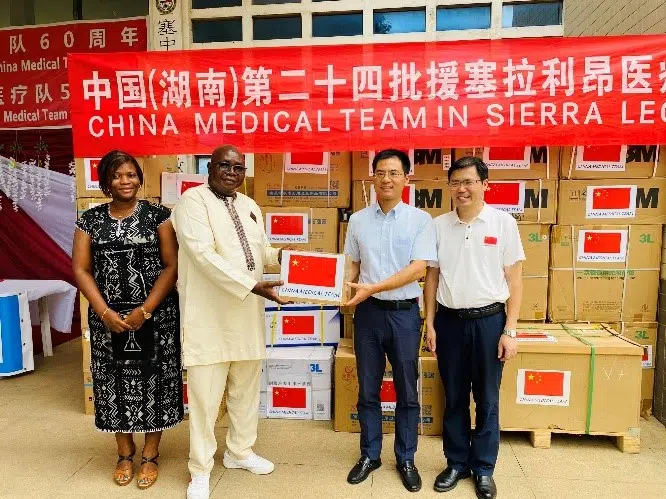
In commemorating the 60th Anniversary of dispatching the first China Medical Team to Africa and  the 50th Anniversary of dispatching the first China Medical Team to Sierra Leone, the Government of the People’s Republic of China, through the 24th Batch of the China Medical Team in Sierra Leone, has on Friday 2nd June, 2023 donated medical supplies to the Sierra Leone-China Friendship Hospital Jui. The handing over ceremony was held at the hospital premises at Jui, Western Rural District.

The Leader of China’s 24th Batch of Medical Team to Sierra Leone, Chen Yongjun, said the medical team arrived in Sierra Leone in the early March of this year, and the first challenge they faced was the detention of medicines and equipment at customs for over 100 days this year.

He said the materials donated include various categories,  pharmaceuticals, consumables, instruments and equipment, etc., with a total amount of nearly 300000 RMB, totaling over 1 Million New Leones and that the medicines cover oral and intravenous medications, including antibiotics, cardiovascular systems, digestive systems, respiratory systems, and nervous systems; Consumables include infusion sets, blood collection needles, disinfectant, gloves, masks and hats, gynecological delivery kits, various puncture kits, and so on; The equipment covers sphygmomanometer, electric aspirator, expectoration machines, sprayer, electrocardiograph, and other basic equipment.

Chen Yongjun pointed out that in addition to material support, according to the Protocol between the Government of the People’s Republic of China and the Government of the Republic of Sierra Leone on dispatching a Medical Team from China to serve in Sierra Leone, their greatest support for hospital is technical support.

He stated that the batch of medical team has sent a total of 21 members, covering multiple disciplines such as internal medicine, external medicine, gynecology, pediatrics, adding that since 1973, China has sent its first medical team to help Sierra Leone and over the past 50 years, it has sent 24 batches of 363 medical team members, treating a large number of local patients and training local medical staff.

“This batch of medical team members had been in Sierra Leone for nearly three months, and all medical work  carried out comprehensively and orderly. The medical team members have over ten or even twenty years of work experience, and we have rich medical experience in our respective professional fields. Most of them come from teaching hospitals of well-known medical schools in China, with rich medical teaching experience. We will further train local doctors and nurses in Sierra Leone,” he revealed.

The Leader noted that there are still some difficulties in the operation and management of the hospital, such as a lack of investment in new instruments and equipment, a shortage of medical supplies, frequent power outage, etc. so they are kindly requesting the Ministry of Health and Sanitation of Sierra Leone and the Chinese Embassy to pay more attention to the development of Sierra Leone-China Friendship Hospital.

The Chinese Ambassador to Sierra Leone, Wang Qing, said that China has always been working closely with Sierra Leone in the health sector  to support the country’s effort in promoting universal health coverage and advancing the country’s health sector in the country.

He said that the Sierra Leone-China Friendship Hospital where both the China Medical Team and the Sierra Leonean doctors are working closely is a clear manifestation of the China and Sierra Leone collaboration achievement.

Wang Qing said that this year marks 50th Anniversary of dispatching the first China Medical Team to Sierra Leone, adding that over these years the China Medical Team has been sending professional Chinese doctors, medicines and medical care to Sierra Leone.

He stated that since 1973 the China Medical Team have treated over 800,000 patients and they have conducted more than 100,000 cases of operations and trained over 5,000 local medical staff.

The Ambassador concluded by stating that the donation of the medical supplies to the Sierra Leone-China Friendship Hospital is part of their effort to support the medical sector in the country.

The Medical Superintendent at the Sierra Leone-China Friendship Hospital, Dr. Sarah Conteh expressed appreciation to the Government  of the People’s Republic of China through the 24th Batch of the China Medical Team in Sierra Leone for donating the medical supplies to the Sierra Leone-China Friendship Hospital.

She described the donation as very important towards the development of the hospital. She said that they are very happy for the working relationship between the local doctors and the Chinese Medical Team.

Dr. Sarah Conteh assured all that the donated medical supplies will be used for their intended purposes in order to improve the medical facilities in the hospital.

China Medical Team Restores the Sight of 105 Years Sierra Leonean Patient  

By Foday Moriba Conteh

The 6th June every year is observed as Chinese National Eye Care Day. The day is designated to dilate on the importance of eye health and promoting eye care awareness among the general public since 1996.

In a bid to observe this year’s Chinese National Eye Care Day on the theme: “Prioritizing Universal Eye Health” which also marked the 28th “Sight Day” in China, Dr. Wang Wanpeng, from the Eye Center of Xiangya Hospital, Central South University, who also doubles as a member of the 24th batch China medical team to Sierra Leone has called on everyone to enhance the awareness of eye care and eye health.

According to Dr. Wang Wanpeng, Sierra Leone which is located in West Africa is a country with strong ultraviolet light and high incidence of eye diseases, mainly cataract and glaucoma, and the age when cataract is contracted is younger than that of many countries.

He ,however, said due to the lack of medical resources, poor health awareness and low income, many patients’ eyesight have been reduced to the level of blindness when they first see a doctor, adding that not long ago, Dr. Wang received a 105-year-old cataract patient.

Dr. Wang Wanpeng maintained that the patient’s cataract condition was serious, and his vision was only hazy and his family members had a strong desire to restore his vision through surgery furthering that when the patient opened his eyes, he saw the long-lost light and immediately shed tears of excitement. He put one arm around his family and the other around Dr. Wang, and shouted happily, “Chinese doctor! Good!”

In addition to daily diagnosis and treatment work, Dr. Wang Wanpeng also shoulders the task of further promoting the Ophthalmic counterpart Cooperation Project between Xiangya Hospital of Central South University of China and Sierra Leone-China Friendship Hospital.

The project will introduce domestic advanced ophthalmic instruments and equipment, carry out more relevant technical diagnosis and treatment and impart knowledge to local doctors, so as to promote the improvement of ophthalmic health care  in Sierra Leone.