

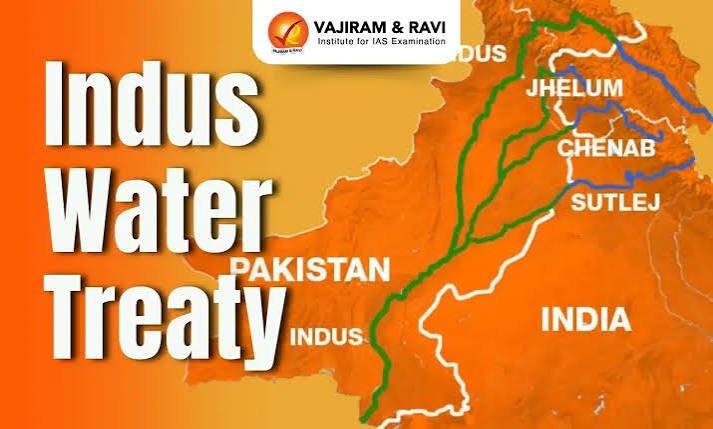
The Indus Waters System
The Indus river is about 1,800 miles long. Its western tributaries (Kabul, Kurram) are more than 700 miles; the eastern tributaries (Jhelum, Chenab, Ravi, Beas, Sutlej) have an aggregate length of more than 2,800 miles. The system drains 450,000 square miles, and is one of the largest in the world. Most of the basin lies in India and Pakistan, influencing the history, culture and ecosystem of the South Asian region.
Brief Background of Negotiations
- 2. The partition of India in August 1947 brought in its wake the Indus waters dispute, eventually requiring negotiations for an agreed solution. The Inter-Dominion Agreement of 4 May 1948 (the Delhi Agreement) was the first regulation of waters between the two countries. While recognizing that a water supply dispute had arisen, the Agreement stated that the ‘proprietary rights’ did not allow West Punjab to claim any share of the East Punjab waters as a right. Pakistan later denounced it on 23 August 1950.
- In early 1951, David Lilienthal, former chairman of the Tennessee Valley Authority, proposed that India and Pakistan jointly develop the Indus Basin system, using the good offices of the World Bank. Subsequently, World Bank President Eugene Black wrote to the two Prime Ministers on 6 September 1951, proposing this. Both accepted. Black proposed a Working Party of Indian, Pakistani, and World Bank engineers. The negotiations witnessed extreme ups and downs and at times verged on collapse, but the World Bank’s resoluteness kept them buoyant until the Treaty was eventually signed in 1960.
The Treaty and its Legal Structures
- The Indus Waters Treaty was signed on 19 September 1960 at Karachi, and entered into force on 12 January 1961, with retroactive effect from the ‘Effective Date’, 1 April 1960. It comprises 79 paragraphs under 12 Articles, supplemented by eight annexures. While the Preamble names only the plenipotentiaries of India and Pakistan, W.A.B. Iliff signed on behalf of the World Bank, which is a party only for purposes specified in Articles V and X and Annexures F, G and H.
- The instrument states that nothing in the Treaty shall be construed as establishing any general principle of law or any precedent, the reference to precedent being designed to forestall arguments based on prescription or servitude. It allocates the Eastern Rivers (Ravi, Beas, Sutlej) to India and the Western Rivers (Indus, Jhelum, Chenab) to Pakistan, subject to specified exceptions.
Objectives
- The objectives of the Treaty, explicitly laid down in the Preamble reads as follows:
“The Government of India and the Government of Pakistan, being equally desirous of attaining the most complete and satisfactory utilization of the waters of the Indus system of rivers and recognizing the need, therefore, of fixing and delimiting, in a spirit of goodwill and friendship, the rights and obligations of each in relation to the other concerning the use of these waters and of making provision for the settlement, in a cooperative spirit, of all such questions as may hereafter arise in regard to the interpretation or application of the provisions agreed upon herein, have resolved to conclude a Treaty in furtherance of these objectives,”
Dispute Settlement Mechanism
- Under the heading “Settlement of Differences and Disputes”, the Treaty entrusts the Permanent Indus Commission, comprised of representatives of both countries, with a role in resolving issues, mainly administrative and consultative.
- Article IX, central to the dispute settlement framework, makes a clearcut distinction between a ‘question’, a ‘difference’ and a ‘dispute’. Any question is first examined by the Commission. If no agreement is reached, a difference is deemed to have arisen, to be dealt with by a Neutral Expert. A dispute is deemed to have arisen only if the difference falls outside Paragraph 2(a) of Article IX, or if the Neutral Expert so informs the Commission.
- Importantly, the Commission has discretion to decide whether any difference be dealt with by a Neutral Expert or be deemed a dispute, such decision reachable only by agreement within the Commission. When a dispute has arisen, the Commission reports to the two Governments; either may invite the other to resolve it by agreement, and mediators may be enlisted. A court of arbitration may be established only by agreement, or on the failure of negotiations or mediation to resolve a dispute.
Pre-requisite for the Establishment of a Court of Arbitration
- The opening language of Annexure G (Court of Arbitration) is critically significant: “If the necessity arises to establish a Court of Arbitration under the provisions of Article IX, the provisions of this Annexure shall apply.” The phrase “If the necessity arises” signifies a stage reached only on fulfillment of certain prerequisites; it is not that any question can be referred to a court of arbitration at the sweet will of either party. A dispute arises only where both Commissioners agree to so deem it, or where the Neutral Expert so informs the Commission, and only thereafter, once negotiation and mediation are exhausted, may the necessity for arbitration arise.
- A striking difference emerges between handling of a ‘difference’ and a ‘dispute’. While either Commissioner may unilaterally take the initiative for a difference to be dealt with by a Neutral Expert, there is no such provision to unilaterally deem any ‘difference’ a ‘dispute’. It has to be the Commission’s decision in agreement of both Commissioners. Consequently, there arises no question of initiating the Court of Arbitration process unilaterally. A bilateral treaty normally provides for mutual determination, the latter being true with the Indus Waters Treaty.
Effect of the Unilateral Initiation of Process, Violation of the Treaty provision and Options with the other Party
- If a dispute has not arisen in accordance with the Treaty, a unilateral decision by either party to initiate the process for the creation of a court of arbitration could amount to violation of the Treaty, hence illegal. The other contracting party would obviously look for remedial options.
13.This would raise the question: If one party violates a vital aspect of a treaty, defeating its very purpose, does it not make its continued performance impossible? Many a times the Vienna Convention on the Law of Treaties, 1969 (“the Convention”) is invoked as the most relevant instrument to answer such a question, as many of the Convention’s articles reflect customary international law. Neither India nor Pakistan is a party to the Convention, and the Indus Waters Treaty predates it.
- 14. However, even if the Convention were to be invoked, it must be read together with its key provision of Article 60, which addresses what happens when a treaty is breached. A “material breach” includes violating any provision that is essential to achieving the treaty’s object or purpose. This establishes a clear legal foundation for India.
- The relevant question then becomes: when Pakistan unilaterally moved to establish a court of arbitration without a dispute having actually arisen as the Treaty requires, bypassing an essential procedural safeguard, does this amount to violating a provision essential to the Treaty’s purpose?
Conclusion
- The Indus Waters Treaty is a unique bilateral instrument concluded as a consequence of partition of India. The Preamble, Articles and Annexures are equally substantive, and together form the Indus Waters Treaty 1960. The dispute settlement mechanism stipulates that all issues are to be resolved by cooperation in a spirit of goodwill and friendship, avoiding third party involvement to the extent possible. If one party drags the other unilaterally before the Court of Arbitration for the resolution of issues that have not arisen to the stage of a ‘dispute’, it goes against the core intent of the Treaty and may amount to a material breach, making the Treaty’s performance impossible. Given that the spirit and objective of the IWT is premised on ‘goodwill and friendship’, it can be argued that Pakistan’s continuous indulgence in cross-border terrorism could be attributed to its failure to perform the obligations on its part under the Treaty. It, therefore, constitutes a material breach, and India is fully entitled under customary international law to hold the Treaty in abeyance.