
By Amin Kef (Ranger)
A high-level international delegation of Moral Guarantors, led by former Gambian Vice President H.E. Fatoumata Jallow Tambajang, has intensified diplomatic engagements with both the Government of Sierra Leone and the opposition All People’s Congress (APC) in a decisive effort to assess progress on the implementation of the Agreement for National Unity (ANU) and address lingering governance concerns threatening the country’s democratic stability.
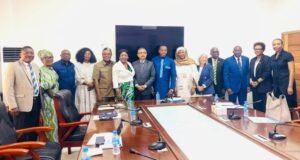
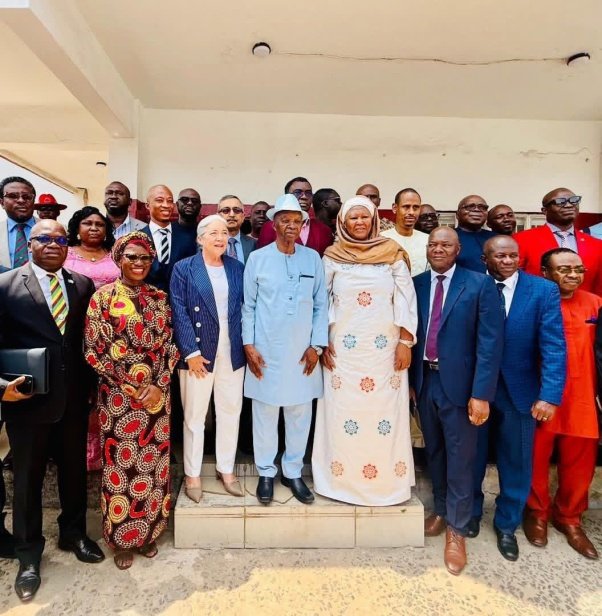
The delegation brought together key regional and international peace actors, including H.E. Barrie Freeman, Deputy Special Representative for West Africa and the Sahel; Tanmaya Lal, Deputy Secretary-General of the Commonwealth Secretariat; the ECOWAS Ambassador to Sierra Leone; United Nations Resident Coordinator Ms. Seraphine Wakana; Reverend Shodanke Johnson, Chairman of the Independent Commission for Peace and National Cohesion and the Executive Secretary, Hawa Samai. Their latest mission is widely seen as a crucial intervention aimed at rebuilding trust and restoring confidence in Sierra Leone’s democratic governance institutions.
A closed-door engagement was held with senior APC leaders at the party’s headquarters in Freetown. The APC delegation was led by Ambassador Foday Yansaneh, alongside National Secretary General Lawyer Lansana Dumbuya, Chief Negotiator Dr. Kaifala Marrah, Minority Leader Hon. Abdul Kargbo, Hon. Chernor Maju Bah (Chericoco), Leonard Balogun Koroma and Mayor of Freetown Yvonne Aki-Sawyerr, whose participation further underscored her growing influence in shaping the party’s governance and reform agenda.
Opening the deliberations, Lawyer Lansana Dumbuya described the current mission as “the last window for credible action,” warning that unless decisive progress is made, the ANU and the Tripartite process risk being remembered as a failed opportunity for national reconciliation. He maintained that the APC returned to governance in good faith following earlier interventions by the Moral Guarantors at Bintumani, despite internal resistance and dissatisfaction among supporters, but argued that such a goodwill has not been matched by meaningful implementation on the Government side.
In his remarks, Ambassador Foday Yansaneh revisited the political stalemate that followed the 2023 elections, which the APC continues to dispute. He explained that the crisis led to the creation of the ANU and the establishment of the Tripartite Committee under Resolution 3 to review the elections and recommend corrective measures. He expressed concern over persistent delays, lack of transparency and what he described as unilateral Government actions that undermine the spirit of the agreement. As a key example, he cited the recent appointment of Edmond Sylvester Alpha as Chief Electoral Commissioner, arguing that the decision contradicts Recommendation 36 of the Tripartite Committee and heightens the need for stronger confidence-building safeguards within Sierra Leone’s democratic architecture.
Ambassador Foday Yansaneh further alleged that the President contravened the 1991 Constitution by failing to consult political parties in the appointment of the Chief Electoral Commissioner. He also raised concerns over politically motivated legal cases, lack of political will and the President’s refusal to directly engage the APC, all of which he said have contributed to the party’s ongoing boycott of governance structures. He additionally referenced the recent sentencing of opposition supporter Zainab Sheriff as another development deepening concerns among party supporters.
Further submissions by Dr. Kaifala Marrah focused on what he described as failures by the Government’s chief negotiator to uphold the “sacred responsibilities of state,” thereby weakening trust in the reform process ahead of the 2028 elections. He pointed to alleged non-compliance by the Electoral Commission, concerns surrounding the civil register and the earlier imposition of Proportional Representation as issues requiring urgent attention.
Leonard Balogun Koroma, Chairman of the APC 2026 Census Committee, also raised concerns over the postponement of the 2025 Census and the implications of relying on 2021 mid-term census data for future constituency boundary reviews. He warned that such uncertainty could further erode public trust if not addressed transparently and inclusively.
Mayor Yvonne Aki-Sawyerr provided an update on the Steering Committee overseeing the Tripartite process, emphasizing the need for measurable accountability and credible progress. Her intervention, particularly on the position of APC-led local councils regarding the governance boycott, reinforced the opposition’s insistence on a trust-based and verifiable resolution before normal governance participation resumes.
Hon. Abdul Kargbo also outlined parliamentary concerns, including the APC’s inability to nominate representatives to international parliamentary bodies and the urgent need to implement Recommendation 20 of the Tripartite report, which calls for the establishment of a dedicated parliamentary oversight committee for electoral management bodies. He further pointed to the APC’s cooperation in the Constitutional Amendment process as evidence of its sustained commitment to dialogue and democratic reform.
Ambassador Foday Yansaneh concluded the APC’s presentation with a position paper reaffirming the party’s commitment to peaceful dialogue and democratic processes, emphasizing that sustainable peace must remain anchored in justice, trust and credible electoral systems.
Responding on behalf of the Moral Guarantors, H.E. Fatoumata Jallow Tambajang expressed appreciation for the APC’s frank and comprehensive presentation. She acknowledged concerns surrounding the non-functionality of the Secretariat and stressed that both the ANU and the Tripartite Committee recommendations remain “moral documents” that carry responsibility and accountability for all parties. She assured the APC that the mission would carefully review submissions from both the opposition and the Government in order to develop a common position aimed at safeguarding peace, political stability and national cohesion.
She further reaffirmed the mission’s determination to address the root causes of the political impasse and urged all sides to continue embracing dialogue, compromise and peaceful democratic engagement as the only sustainable pathway forward.
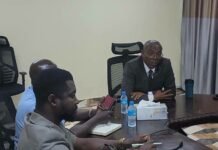
In a separate strategic engagement with the Chief Minister, Dr. David Sengeh and other SLPP representatives, the Moral Guarantors reviewed the status of the ANU and received a comprehensive update on the implementation of the Tripartite Committee Report, developed under Resolution 3 of the agreement.
Government officials outlined measures already undertaken, presented timelines for outstanding commitments and highlighted renewed efforts to strengthen institutional coordination, implementation efficiency and accountability mechanisms. The discussions also focused on practical pathways for enhancing trust among political stakeholders as the country gradually moves toward the 2028 elections.
It was concluded that the APC and the Moral Guarantors will reconvene on Thursday, 16 April 2026, in a smaller setting to begin addressing the most critical issues raised during the initial engagements. This latest round of talks is widely regarded as a crucial opportunity to break the current stalemate, restore confidence in Sierra Leone’s democratic institutions and move the country closer to the full and credible implementation of the Agreement for National Unity.