Home Blog Page 1024

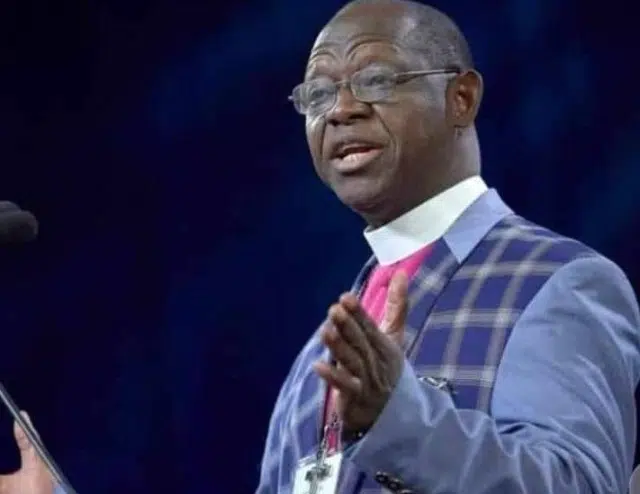
Police Arrests Driver Who killed Bishop Yambasu

Late Bishop John K. Yambasu

By Phileas Jusu

The driver of the SUV that crashed into and killed Sierra Leone Area Late Bishop John K. Yambasu has been arrested and charged with seven counts, including speeding.

Mohamed Allie Saw, who Police said fled the scene of the Aug. 16 accident and had been on the run but was charged in court on September 4, 2020. The charges include driving without due care and attention, speeding, being careless and inconsiderate.

The Toyota Land Cruiser that he was driving was uninsured.  Mohamed Saw, a mechanic, it was learnt, was taking the car owned by Festus Amara to be serviced in a garage across town.

According to Police reports, Saw lost control of the vehicle and it jumped the median and slammed head-on into Bishop Yambasu’s car, killing the 63-year-old religious personality and injuring his driver. Bishop Yambasu was on his way to Yonibana to preach at the funeral of a retired district Superintendent.

“By the time we cleared the traffic and safely packed the vehicles from off the road, the driver had disappeared,” said Mbalu Kabbah, Traffic Commander for the Calaba Town Police.

“We first detained the owner of the vehicle when the driver could not be located. We released him after his blood pressure shot up,” she said, adding that he was let go on the condition that he hand over the driver in two days.

Family members of Amara went in search of Saw and turned him over to the Police,.

Kabbah, who knew Yambasu since her school days, said the owner of the vehicle and his family wanted to meet the Bishop’s family and offer their sympathies, but they were afraid of how they might be received.

Hassan Bangura, an eyewitness at the scene of the accident, said Bishop Yambasu was taken by taxi to Wellington Satellite Hospital. “The door to his backseat was shut and could not open through the normal knob. We had to use implements to chop off the door and get him out,” Bangura said.

Saw was uninjured, according to Police, although the vehicle he was driving was damaged beyond repair. The Bishop’s driver, Abdul T. Kamara, has been discharged from the hospital and is recovering at home.

Bangura and others on the scene secured the Bishop’s belongings and turned them over to two United Methodist pastors who came to the crash site later in the day.

“In the bag, we later found his Bible, a laptop, a prepared message that he was to preach and three (pairs of eye glasses),” Bangura said.

One of the Bishop’s sons returned to the scene recently to thank them, he said.

Yambasu was laid to rest on the campus of United Methodist University in Freetown on Sept. 6. During a Service of Remembrance and Rites of Passage, the Bishop was remembered as a bridge builder and for “being the voice of Jesus when it needed to be heard.”

NRM Declares Commitment to ‘Democratise’ APC

By Foday Moriba Conteh

The National Reformation Movement (NRM) on the 10 September 2020 stated that it has met with the APC leadership over the past one month to try to resolve the constitutional issues which form the centre of interest of their reformation efforts.

It disclosed that on July 1, 2020, the leadership of the NRM met with their party, the All People’s Congress, at the party’s headquarters, where both parties made commitment to the  search for a negotiated settlement. In that meeting, which was summoned by the Facilitator, Dr. Ibrahim Bangura, both parties also made commitment to the observance of a rule that forbids the reporting to the public of information disclosed in the course of the negotiation.

The entity continued that in early July of 2020, a few days after  meeting on July 1, they submitted three copies of their negotiating document to the Facilitator for onward submission to the party’s Chairman, Deputy Leader and Secretary General.

According to them those documents were indeed submitted for a response from the leadership of the party.

The NRM furthered that since that submission of their negotiating demands, the process seems to have resulted in an absolute stalemate.  They lamented that the leadership has resorted to tactics that are not conducive to the resolution of the issues that forced the NRM to go, unavoidably, to court.

“It is as result of that stalemate, the party’s leadership’s violation of rule that forbids public disclosure of information, inter alia, that we have decided to bring the issue to the public,” they stated.

The entity pointed out that on the very day they submitted their negotiating document, the leadership of the party violated the rule that forbids public  disclosure of information, and their negotiating document was leaked to Adebayor, whom they referred to as a gutter commentator and an establishment misinformation propagandist, who discussed some of its contents at length and went on to proclaim, in a ridiculous manner and louder than ever before, that the party’s leadership would not negotiate with the NRM.

It continued that on that same day, the NRM was on the receiving end of a barrage of invectives and imbecility from the gutter commentator.

They said it is becoming increasingly clear to them that the party’s leadership does not have the political will to resolve the matter on the table. The NRM highlighted that quite clearly, the party’s leadership came to the negotiating table with a double agenda adding that while appearing to be interested in a negotiated settlement, prominent party functionaries who said they are acting under the instructions of the party’s leadership secretly engaged the plaintiffs and other actors to get them to stand prepared to withdraw the case from court before the resolution of disputes in the APC, just like they did with the one plaintiff.

The institution continued that the fact is that the faithful plaintiffs within their fold are more than determined to see a logical conclusion of the case.

“The leadership of the NRM, therefore, wishes to inform the manipulators, to whom negotiation means manipulation, that their unconventional negotiating tactics will serve them no useful purpose. The NRM is a disciplined, structured movement, and accordingly, the decision to withdraw the case from court does not lie in the exclusive hands of any plaintiff. To say it is impossible to reach any other agreement in the absence of a response to the negotiating document we submitted in the early July of 2020 is to understate our resolve,” they stated.

The NRM made it known that throwing up of one obstacle after another, the stonewalling towards their negotiating document, the persistent harassing of the plaintiffs and other NRM actors and the evident desire to manipulate them, the double agenda and the ongoing attempt by the their party’s leadership to renew their mandate in the guise of a convention, in violation of the court order and in utter disregard to the negotiations, make the call to negotiate looks like an Orwellian doublespeak and the search for a negotiated settlement all the more complex.

The NRM concluded that while they are still committed to a negotiated settlement, they wish to assure all their comrade reformers, at home and abroad, that their commitment to the creation of conditions that guarantee equal participation and a level platform for all comrades in the APC is unshakable.

They furthered that as the party’s leadership goes about hatching one plan after another to manipulate the process, let them be reminded of the court order and their collective resolve to deliver the knockout jab on the dictatorial construction of their party’s internal politics. The NRM pointed out that they went to court to correct the injustice and inequalities in their party, and these must be addressed BEFORE THEY WITHDRAW THE CASE FROM COURT.

According to the Secretary General of the NRM Osman Bikal Kamara, he extends our appreciation on behalf of the Movement, to the Facilitator, Dr. Ibrahim Bangura, for being very patient and professional in carrying out his task.

The NRM concluded that it remains committed to the democratization of their party’s internal politics.

 J J Saffa Re-Elected as Chairman of WAMZ Convergence Council

Minister of Finance of Sierra Leone, Jacob Jusu Saffa

By Amin Kef Sesay

On September 11, 2020 the 44th Meeting (virtual) of the Convergence Council of WAMZ ended. That meeting was preceded by a meeting of the Technical Committee on 7-8th September and the Committee of Governors on September 10th.

The purpose of the meeting was to discuss and adopt the report of the Committee of Governors of Central Banks of WAMZ member States.

Minister of Finance of Sierra Leone, Jacob Jusu Saffa in his welcome remarks expressed appreciation to WAMZ countries for their commitment to the course of regional integration and attainment of a single currency in West Africa.

He observed that achievements in 2019 were made on the back of a strong focus on fiscal consolidation as the anchor of economic management in recent years. As a result, he stated that Sierra Leone’s performance on the macroeconomic convergence improved significantly.

“Overall, Sierra Leone satisfied three out of the four convergence criteria in 2019 compared to fulfilling only one criterion in the past three years -2016, 2017, and 2018,” he added

The Governor of Central Bank of Nigeria, Dr. Godwin Emefiele thanked the Chairman, Mr. J J Saffa, Minister of Finance, Sierra Leone for the manner he conducted WAMZ meetings during his tenure. He particularly appreciated him for managing the apparent impasse between the French-speaking countries and their English speaking colleagues on the use of the Eco, the single currency by organizing a very successful Authority of Heads of the States of WAMZ and several engagements with the ECOWAS Commission on this matter.

”Sierra Leone has done an excellent job during these difficult times. I am therefore proposing that the Minister continues as Chairman, Convergence Council,” he added.

This nomination was seconded by the Minister of Finance, Ghana, Mr. Ken Ofori-atta, and unanimously adopted by all member states.

In his acceptance speech, Mr. Saffa expressed gratitude to his colleagues for his re-election and extended appreciation to President Bio for the encouragement and staff of the Ministry of Finance for technical support to his chairmanship.

Sierra Leone’s Minister of Finance reaffirms Sierra Leone’s commitment to the monetary union of West African states and I call for a regular meeting of Authority of Head of States to WAMZ to discuss matters arising from Convergence Council meetings.

The meeting adopted all the recommendations of the Committee of Governors including increasing spending on agriculture and promoting the private sector in agricultural development; consolidating and improving on gains in macroeconomic management; scaling up investment in growth-enhancing capital projects for sustained long term economic growth and sustain efforts at containing the spread and socio-economic impact of COVID-19 pandemic on member states’ economies.


Hon. Tawa Conteh Relinquishes Committee Chair Position

Member of Parliament representing Constituency 132, Hon. Ibrahim Tawa Conteh

By Theresa Kef Sesay

Member of Parliament representing Constituency 132, Hon. Ibrahim Tawa Conteh has resigned as Chairman of the Transparency and Accountability Committee effective over what he perceived to be leadership interference in the Committee’s work.

The news came during the summoning of the Ministry of Information and Communications on the 10th September, 2020 to explain the reasons for the unbundling of Sierra Leone Cable Limited.

The summoning had a series of drama even though it started as a simple session before things got heated after the Ministry stated two positions for the unbundling of the Sierra Leone Cable Limited; one which was based on physical sustainability and no growth in the institution whilst the other issue was based on revenue generation which according to them, SALCAB is a burden to Government as it does not generate revenue and does not reach out in other places.

Just after these reasons were stated by the Ministry through a presentation, the Chairman of the Committee, Hon. Ibrahim Tawa Conteh then asked him to explain which of the two documents supersedes the other; the President’s address of 2019 where he praised SALCAB stating that the new Management had made tremendous improvements given the bad state he inherited the company or the reasons put forwarded to cabinet by the Minister for the unbundling.

The question was described by the Information Minister, Mohamed Rado Swaray, as a snare to ambush him adding that he was not in the position to differentiate between the two documents. He maintained that they are going ahead with the unbundling because it is for the benefit of the people of Sierra Leone.

The answer given by the Minister was described by Hon. Tawa and Members of Parliament as an affront and deception of cabinet and contempt of Parliament.

Other members like Hon. Abdul Karim Kamara and Hon. Lahai Marrah said the unbundling of SALCAB at this stage is costly to the people of Sierra Leone and must not go on while Hon. Abdul Kargbo pleaded that SALCAB should be given the chance to defend themselves against the allegations of revenue loss put forward against them for the unbundling.

The session was about to take momentum when the Leader of Government Business came in and stood the Committee down for five minutes to have a meeting with the Chairman and his members but the Chairman said that he will not change the trend of the Committee.

Unfortunately, after the Committee resumed, the Minister was asked to give a concluding remarks which he did vociferously reiterating that he is going ahead as he has a marching order from Cabinet to do so.

Just after the statement, Hon. Ibrahim Tawa Conteh openly resigned as the Chairman of the Transparency and Accountability Committee because he feels Sierra Leone comes first and that the decision is borne out of the fact that he is pressured and getting interference from the leadership in doing his job.

The decision of Hon. Ibrahim Tawa Conteh comes at a time when the Parliament of Sierra is struggling to save its neck from an abattoir of corruption survey of 2019, ranking them as the second most corrupt institution in the country which even an MP from the ruling party confirmed.

NP (SL) is Committed to Marketing of Qualitative Petroleum Products

By Amin Kef Sesay

It has been widely accepted that the premier petroleum marketing company that has gained so much recognition in the country and even beyond for its pro-activeness in its transactions is indisputably the National Petroleum –Sierra Leone Limited (NP-SL Ltd).Many have attested that NP-SL Ltd always leads where other petroleum marketing companies follow.

Without contesting the undiluted fact, this 100% indigenous company has left its footprint on the sands of time as it continues to bag wide commendations for its timeliness in always ensuring that qualitative petroleum products are imported into the country, distributed to its sales points or Filling Stations across the country in order for its esteemed customers to easily gain access to them.

The company has never renege in doing so save only certain situations where, as a result of unforeseen contingencies, most often beyond its control, there has been some delay. However, in such circumstances measures are quickly rolled out to address them and restore normalcy in the supply chain.

It must be noted that for any petroleum marketing company to maintain such a solid and unshakable posture could only be attributed to prudent business management initiatives. Indeed, it could be said with all amount of certainty that the selflessness and dogged determination on the part of the 35 Sierra Leoneans who established the company have greatly influenced most of the policies that were adopted, effectively implemented which saw the transformation of a small business enterprise to a towering entity.

One of those laid down policies is that which places premium on enhancing or maximizing customer care to create a situation where its customers are always made to feel good and satisfied. The company’s Shareholders and Management are also conscious of the fact that by taking customer care to a higher pedestal such could serve as a leeway to attract other individuals to come on board its customer platform.

Indeed, it is in that light that a conscious move was made to make the company’s Filling Stations very attractive and welcoming. Built in state of the art fashion, painted with yellow and green paints, these sales points are very spacious to accommodate fleet of vehicles, are very eye catchy and in some of them there are shopping marts where customers could purchase basic items and even relax to socialize. As of now social gathering in those marts has been put on hold as social distancing has been recommended as one of the preventive measures put in place to avoid the spread of the deadly virus.

To promote transparency and win the trust of its numerous customers as well as match up with international standards, it was decided on the part of the company to invest so much in procuring and installing calibrated pumping machines. These have the capacity to pump the exact quantity of fuel in vehicles and containers to the utmost satisfaction of buyers. “I always feel gratified whenever I do purchase petrol at NP Filling Station because I am always satisfied that I am getting my money’s worth,” Haja Mariatu Williams ,a fashion designer divulged to this medium adding that the Managers of the company are doing a fantastic job ,referencing the orderliness of how business transactions are taking place.

One very striking feature which NP-SL has so far exhibited, to the admiration of many, is its strict adherence to the country’s Local Content Policy. Development Economists have recommended that one viable route to be used to boost a country’s economy is to make effective use of indigenous resources, both material and human, as long as they are available. Enhancing local content has its attendant merits one of which is creating employment opportunities and ensuring that monies paid workers are not remitted overseas.

The National Petroleum-Sierra Leone Limited is one of the few companies in this country that has successfully implemented its internal policy of giving employment preference to Sierra Leoneans. This is indeed very impressive and is helping in major ways to reduce poverty.

If today NP Gas is going at the pace of a jet, in terms of sales, then this is simply because it has been discovered that it is very fast, efficient and environmental friendly for cooking purposes. Besides, it can be refilled without going through the hassle of having to find gas elsewhere as the company markets gas alongside petrol, diesel and other lubricants. They are manufactured in different cylinder sizes and are easily accessible.

“NP Gas is my kitchen partner and I am finding it very cooperative. It is easy to handle and for me it poses no danger. I am therefore recommending it and for anyone to secure it there will be no regrets,” Mariatu Sesay, a housewife living in Makeni sincerely suggested.

What is much talked about today is NP Smart Card. As the name suggests the card is so smart to such an extent that as long as it is loaded with money it can be slotted in the calibrated pumping machine and after demanding the amount of petrol or diesel requested for, it churns out the exact amount plus displaying the price. It is trending, secured and convenient to use.

“NP Smart Card works well and since I have been using it I always procure fuel for my car and generator in record time. Using it, there are many benefits one can derive,” Lawyer Bah underscored.

The company does not joke with rolling out its Corporate Social Responsibility fully aware that it is incumbent on it as a business entity to give back to society. This is all the more reason why it has been complementing the Government’s development interventions. The Shareholders and Management have always stood by the side of Sierra Leoneans in thick and thin always endeavouring to give succour and deepen development.

The good things it had done are so many to catalogue and time plus space could not permit one to narrate all of them. However, the recent one should not go unnoticed and it has to do with availing the Government one Billion Leones to help scale up the fight against the spread of the deadly coronavirus.

“This shows that the company is a responsible business entity,” an official of the Petroleum Regulatory Agency commended.

The company stands tall for having vibrant branches operating in Guinea, Liberia, Ivory Coast and The Gambia where they are operating efficiently, offering jobs and paying taxes to Governments. NP-SL is indeed a force to reckon with and is poised to further make its presence felt and expand its operations.

As Top 50 Housemate To Go Through Voting… 20 Applicants with Highest Votes to Enter the House

By Amin Kef Sesay

The Quarantine Drama has just begun with lots of fun which viewers, according to a random survey, are really enjoying. Audition ended few days ago and out of those who went through the process fifty (50) successful applicants emerged.

At this material stage of the competition the chosen fifty will have to go through a voting process in order to determine the twenty (20) Housemates that will enter the House on the 14 October 2020. Details of when the voting process will take place will be determined and announced for the purpose of the general public.

This show has gained currency within the entertainment industry of the country and it is the much talked programme in town.

Replay of Housemates Salone Season 2 Audition is aired on AYV Television Channel 33. The entire programme will be streamed live online at Africa Young Voices Media Empire Facebook page, AYV ENT, Africell Sierra Leone Facebook page and on website at www.ayvnews.com.

Housemates Salone has in store for the lucky winner the whopping sum of Two Hundred and Fifty Million Leones (Le250M) plus undertaking a round trip to Dubai.

Apart from bagging the Star Prize of Two Hundred and Fifty Million Leones (Le250M), all other participants will be entitled to their daily allowances of Le100, 000 each, whilst they still remain in the House and accumulatively given to them whenever they are evicted.

Interestingly, during a particular stage of the Show, based on the percentage of votes scored by a particular Housemate such will determine if he or she will be evicted from the House. Evictions will continue until the ultimate winner emerges.

The underlying rationale for the organizers to package this entertainment show goes beyond providing mere entertainment to that of Youth Empowerment. With twenty young Housemates, from different backgrounds,” Quarantined” under one roof for up to about two months, they will be taken through certain mental and physical exercises that will impact their personalities and it is certain that after the competition they will never be the same again.

They stand to benefit from being guided to be motivational speakers, to think critically as well as rationally, how to healthily interact, how to solve problems, to set goals, to cook, how to eat and dress for different occasions, to sing, dance, control emotions and stress. They will have the opportunity to learn from what visiting guests from certain corporate institutions will teach them, learn how to play games and a host of other things that are aligned to coping mechanisms as well as development of strong characters.

However, what the judges will be keenly watching for is originality. The Housemates should do things naturally instead of faking certain performances.

Another good thing about the show is that it will put all the Housemates in the spotlight as the Reality TV Show will be viewed by many in and out of the country via AYV Television Channel 34. People will come to know them, the talents that they possess and what they are capable of doing. The show could be a window of opportunity for the Housemates as some people out there could be interested in tapping the talents that they have seen displayed which could end up in changing their fortunes for life. Indeed something has to start somewhere!

Some people may be having reservations as to whether it is apt to stage the show amidst the coronavirus. To allay such a fear, the organizers have put all the necessary modalities in place to ensure that all the Housemates to enter the House are coronavirus free, that precautionary measures are observed and the House is kept safe.

For now Housemates Salone is the most talked about upcoming social event that continues to dominate conversations in social circles and many are looking forward to be viewing an entertaining and educative programme from which a lot could be learnt.

As the expectations are running high, the organizers are methodologically and meticulously putting finishing touches to once again avail viewers a lively, tantalizing and thought-provoking Reality TV Show.

Indeed, you would not want to miss the fun and the drama of the different personalities of young Sierra Leoneans who want to make it to the top.

Parliament Vexed For Been Scrutinized?

Parliament of Sierra Leone

By Amin Kef Sesay

Are reports true that the Parliament of Sierra Leone, the body collectively elected by the people to serve as their ears and eyes as to how the affairs of State are conducted on their behalf, is vexed that civil society and members of public have subjected them to keen scrutiny as to how transparent and accountable they are?

Listening to the people on this very interesting national issue that has lately captured the public imagination for discussion, many people have commented that whoever directed the spotlight on allegations of gross operational improprieties allegedly going on in our honorable House of Parliament must be given a big hug by the entire nation for being brave like the proverbial David to take on the gigantic Goliath.

No double speak on this. Parliament in a Government of the people, by the people and for the people shall at all times be open to inspection, investigation and scrutiny by members of the public and its representatives – civil society, the Press and political parties as to how well they are doing the people’s work of keeping themselves, the Executive and Judicial arms of Government accountable.

In these three parts series, The Calabash looks at what a very distinguished law maker on the ROLE OF PARLIAMENT IN ENSURING TRANSPARENCY AND ACCOUNTABILITY delivered in November 2010 by Hon. Ibrahim Sorie of the All People’s Congress at the Regional Consultation on the Draft Guidelines on Foreign Debt and Human Rights held at the United Nations Conference Centre in Addis Ababa, Ethiopia from 4th – 5th November 2010 organized by the Office of the United Nations High Commissioner for Human Rights and co-sponsored by the United Nations Economic Commission for Africa.

The speech was a very long one, so we will endeavor to quote the parts that relate mainly to this discussion.

According to Hon. Ibrahim Sorie:

“The concept of democracy which my country, Sierra Leone practices in a form of multiparty constituency democracy contains some essential ingredients, including transparency and accountability.

Transparency relates to open access to Government, political and economic activities and decisions.

It enables all stakeholders in a country to see the structure and functions of the Government, its policy intentions and fiscal projections, while accountability entails a State being held responsible by its people for its choices and actions.

In the context of public financial management, accountability is the obligation on the part of the Government to answer for its actions, coupled with its ability to respond to queries from the Parliament.

More specifically, financial accountability is the relationship between the Executive and the Legislature based on the Government’s fiduciary obligation to demonstrate and take responsibility for performance in the light of agreed expectations regarding the management and use of public funds…”

Going further to tell his audience that Sierra Leone, a small country with about six million people, richly endowed with natural resources – plentiful deposits of gold, diamonds, rutile, iron ore, bauxite and other minerals which are yet in their discovery stage such as oil, and in addition having good climate, vast arable land for agriculture, forest and fishery resources, and in terms of human resources, has an impressive history and traditions of education, being the first country in black Africa to have a university, Fourah Bay College, founded in 1827, Hon. Sorie however states that:

“With all the bounty of nature, Sierra Leone is still a poor country and debt ridden, a situation exacerbated by the 11years of rebel war. Corruption and its associated lack of transparency and accountability have contributed to the poor governance regime, which the country experienced mainly before the outbreak of the war in 1991.

That today Sierra Leone is still wallowing in poverty and debt distress is a function of bad governance and corruption, challenges we are still grappling with as a country. (Continued next edition)

Note: Hon. Sorie was the Chairman of the Parliamentary Oversight Committee of the Ministry of Information and Communication, Leader of Sierra Leone’s delegation to the ECOWAS Parliament and also Vice Chair of the Legal and Judicial Affairs Committee of the ECOWAS Parliament during the Ernest Koroma led APC Government.

NPPA Discloses Public Procurement Manual

Ibrahim Brima Swarray, Chief Executive Officer of NPPA

By Amin Kef Sesay

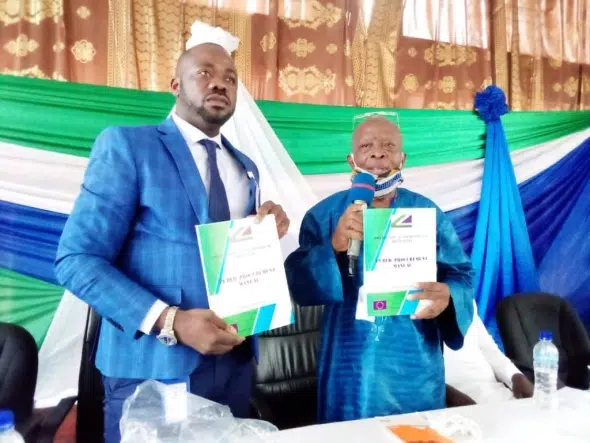
The National Public Procurement Authority (NPPA) on Tuesday 8th September 2020 unveiled the Public Procurement Manual document at the Atlantic Hall of the National Stadium Hostel in Freetown.

The ceremony was well attended by procurement practitioners from different Ministries, Departments and Agencies (MDAs) including their vote controllers.

Addressing procurement practitioners and members of different MDAs, the Chief Executive Officer of NPPA, Ibrahim Brima Swarray, said the Procurement Manual details the standards, policies and procedures which should be strictly followed in the procurement of goods works and services within the public sector.

The Chief Executive  Officer said the Manual also includes a section for guidance on contract administration, asset disposal, and complaints procedures relating to breaches in procurement procedures.

These standards, policies and procedures are designed, according to Mr. Swarray, to guide the procurement and asset disposal processes; provide uniform procedures for the procurement of goods, works and services and for asset disposal; ensure transparency and accountability in all procurement operations; ensure consistency with the guidelines of donors where necessary; improve the efficiency and effectiveness of operations; promote the consistent application of best procurement practices and international standards.

Mr. Swarray revealed that this Manual applies to the procurement operations of all institutions using public funds as defined in subsection (1) of Section 1 of the Public Procurement Act of 2016.

The Chief Executive Officer pointed out that consistent application of the provisions and procedures of the Manual throughout government is essential to achieve improved efficiency, transparency, uniformity of documents and decisions as well as  and reduced costs of procurement for the Government.

He pointed out that the Manual’s intention will be subjected to continuous upgrading by the National Public Procurement Authority (NPPA) to reflect amendments in legislation, changing needs, the commercial environment, and the adoption of new improved procedures and practices.

In his submission, the Centre for Accountability and the Rule of Law (CARL) CEO, Ibrahim Tommy, expressed thanks and appreciation to the Management of NPPA, especially the Chief Executive Officer, Mohamed Brima Swarray, for his relentless effort to ensure procurement procedures and regulations are followed strictly.

“The procurement manual is geared towards the ongoing efforts by the National Public Procurement Authority to close the gaps,” he said.

Ibrahim Tommy pointed out that NPPA, through the hard work of the Chief Executive Officer+, has, over the last two years, seen tremendous progress, especially with the review of the Procurement Act, Procurement Report and now the Procurement Manual.

He said the application of the provisions and procedures of the Manual, throughout government institutions, is essential to achieve improved efficiency, transparency, uniformity of documents and decisions as well as reduced costs of procurement for the Government.

Ibrahim Tommy pointed out that, in spite of unveiling the manual, there is a lot more to be done, and asked all MDAs to comply with the Manual, adding that, over the years, public funds have been lost through procurement irregularities.

NPPA Board Chairman, Mr. Alfred Kandeh, informed that the Procurement Manual is a very good venture, adding that the manual explains step by step examples which MDAs should follow.

He said many times, when people read the Act, it is full of ambiguities, adding that the NPPA manual will ensure procurement practitioners do things correctly.

The Board Chairman revealed that the manual is so important that it is a foundation for University students and admonished all to get into the habit of reading, comprehend and put into practice what is in the manual for transparent and accountable procurement.

The Deputy Commissioner of the Anti-Corruption Commission (ACC), Mr. Augustine Foday-Ngobie, in his submission, informed authorities that the ACC is now partners with the NPPA, adding that the ACC have no doubt in procurement institutions upgrading  their procurement manuals.

According to Mr. Augustine Foday-Ngobie, the unveiled manual is not just a matter of just reading it, it is also a matter of application, adding that Section 48 of the ACC Act frowns at MDAs not observing procurement procedures.

The Deputy Commissioner furthered that for people who are not observing the manual, especially the procedures in the document, are liable to pay the sum of Le50 million or a period of five years imprisonment.

He therefore said the ACC is well pleased with the work of the NPPA Chief Executive, Ibrahim Brima Swarray, and pledged the Commission’s continued collaboration with Mr. Swarray and team.

“Avoid using the past where procurement items are not needed,” Deputy ACC warned.

The Deputy Director of the Procurement Directorate in the Ministry of Finance, Fodie J. Konneh, and Director Budget Advocacy Network all made salient statements as to how government needs to be accountable in handling procurement activities.

According to Fodie J. Kanneh, the work for putting procurement manual has taken ten years, adding that within two years of Mohamed Brima Swarray the work has been done.

He concluded that the entire template, in the manual, gives a breakdown for their daily consumption.

NPPA Sylvester B. Allieu, who chaired the ceremony, said the manual guides the procurement to improve effectiveness and efficiency.

As Unbundling of the Institution Takes Centre Stage…   The True Story About SALCAB Emerges

By Amin Kef Sesay

After running Sierra Leone Cable (SALCAB), an agency that controls the country’s internet gateway, for over a year without realising much returns and the institution was in huge debt, the agency closed down in 2017 with a negative cash flow of Le327M.

SALCAB’s situation became worsened in 2018 with a liability of Le9.7Bn as a result of repayment of loans from banks, vendor payment for spare parts and related items which has resulted into a huge exposure of the institution to debt and the possibility of going into administration if Government does not inject huge capital to salvage the situation.

Looking at the country’s dire economic situation, the Director-General, Ishmael Kebbay in his wisdom and in consultation with the general Board members and Management thought it fit that the only way to keep SALCAB as a  viable and relevant institution to the country is to privatise it  to a third party.

The third party will be charged with the responsibility of network operations and maintenance of the submarine fibre optic network and the landing station including supply chain planning, equipment, spares and capital expenditure as well as related network expansion, upgrade and contingency plan and service delivery.

He went further to say that it would be prudent for the third party to take responsibility of the sales, marketing and new product development component which means the third party will manage service partners for driving sales, account management, billing and collection, marketing and clients experience management with a 24/7 contract centre.

It will also bear responsibilities of  research of new product development, market launch including the creation of ethical business climate in the country that attract more investment.

The said proposals were approved by Board and Management with the request for selective bidding and an Expression Of Interest (EOI) was sent to the National Public Procurement Authority (NPPA) on 27th January, 2020 for vetting.

A response was received from NPPA on 29th January, 2020.

The EOI can be seen on NPPA website:https://www.publicprocurement.gov.sl/index.php/public-notices-2/bid-oppurtunities/sierra-leone-cable-limited-salcab.

NPPA did not grant DG’s request to undertake selective or restrictive method of procurement, but allowed the DG to embark on an open tender.

After EOI Expression had been advertised and an open tender begun by SALCAB, the Minister of Information and Communications, Mohamed Rado Swarray came in to protect the country’s interest.

Mr Swarray ordered that all processes in respect of the privatisation of SALCAB be put on hold to ensure that the correct process was done.

The Minister of Information was highly concerned about entrusting the whole operations of SALCAB to a private entity saying it has the potential to compromise national security.

Growing misconceptions now overshadow SALCAB while on the threshold of privatisation and unbundling accusing the Minister of selling the institution.

At a press conference held at the Ministry of Information and Communications, Mr Swarray made it clear that SALCAB was not for sale.

The Minister however confirmed that SALCAB would be unbundled to ensure operational effectiveness and efficiency.

Suffice it to say the project of unbundling SALCAB never came from the Information Minister.

Owing to widespread misunderstanding and misconceptions about SALCAB’s unbundling, Minister Swarray, last week, appeared before the Parliamentary Committee on Transparency and Accountability where he explained the unbundling process.

The Minister told parliamentarians that the unbundling of SALCAB was in the country’s interest.

When the privatisation idea came up, Minister Swarray however, insisted on upholding the State’s interest by ensuring that Government handles SALCAB’s security aspect while the third party manages the commercial aspect.

The letter dated 19th August, 2019 sought an approval from NPPA so that it could commence the bid process for the transformation of SALCAB into a private entity.

“We are proposing a business model that will allow SALCAB outsource the operations of the sub-marine fiber-optic network to a third party via lease operation model,” the letter reads in part.

It further states that the entity to whom SALCAB will be leased bears the cost of operation, maintenance, administrative, and commercial cost of the landing station while giving SALCAB a fixed revenue for the month.

Sierra Leone, the letter says, will not have any operational cost exposure to the network including related capital expenditure, equipment, spares, service recovery among others.

Should the arrangement go as planned, the third party will absorb the existing SALCAB staff to drive network, sales and marketing.

As SALCAB stands on the Threshold of Unbundling, various sectors of society are less satisfied with the project.

Almost invariably, under the new arrangement, SALCAB will recalibrate its business model towards its open access terrestrial fibre optic network with a mix of a passive network for backhaul transmission and distribution.

It will be solely responsible for backhaul transmission and distribution connecting national cities and towns as well as supporting operators to transport a large amount of data cheaper and faster

It will mainly focus on real fiber network operations at the other end of the spectrum.

In a subsequent correspondence dated 14th January, 2020, Mr Kebbay strengthens the case for SALCAB’s privatisation.

“The Public-Private Partnership model employed for operating SALCAB was a slippery-slope for Government of Sierra Leone. The operators were not meeting their High Operating Expense (OPEX) obligation to operate the facility. They were only sorting after the direct benefit of extracting bandwidth while the facility almost perished,” the letter alleged.

The 14th January application requested NPPA for a ‘No Objection’ to undertake selective or restrictive consultancy services procedures for outsourcing the operations of SALCAB.

In its reply, NPPA did not grant the MD’s request for selective or restrictive method of procurement as the exigency of the service does not meet the requirement stated in Section 41(1) of the Public Procurement Act.

Apart from its failure to meet its OPEX obligation, the correspondence also indicates that the company has not been profitable adding that it is at a breakeven point to sustain its operational expenses.

The cash flow, it says, is very weak to undertake any significant capital expenditure.

Weak revenue collection, high debt exposure of over $6.7M, running of SALCAB as a not-for-profit entity by the previous administration and difficulty of talent acquisition in the public sector were part of the case for privatisation and unbundling of SALCAB.

SALCAB was operated under a Public Private Partnership model from 2011 to 2013 which did not benefit the institution.

Between 2013 and 2014, Government of Sierra Leone through the Ministry of Information and Communications revoked the equity of private individuals and refunded the capital contributed per share of the private partners.

Government took full control of the facility whose landing station it has been operating from 2014 to date.

Despite Government taking the lead to set the stage for the stimulation of the country’s digital economy, it needs to protect her investment by employing the right business model that will pay-off associated liabilities and earn returns on investment.

Incidentally, the current business model does not optimize enough to support Government pay its liabilities.

Document seen by this medium shows that SALCAB is expanding too thin and horizontal through the in-sourcing, operations,  maintenance and commercialisation of the submarine optical and terrestrial networks.

It also shows that SALCAB has not been profitable since its formation and operation under the PPP model up to a point Government took full control of the station facility.


Mary Koroma on the Run for forceful initiation into the Bondo Society

Mary Koroma

By Abdulrahman Karama

Mary Koroma, a resident of No. 2 Cowan Drive Malama Lumley in Freetown left for the residence of her Aunt Madam Fatu Sesay at Pata Bana village in Makeni Town to answer her call for help to take care of her sick mother, who has been ill for a long period of time.

Upon her arrival, and seeing the condition of her mother, she requested from her aunt that her mother be taken to Freetown for better medical attention, but this request was denied on the grounds that the members of the secret society will not let her go because she is the leader of the secret society (sowie) and she was undergoing some traditional medical treatments. After an anxious period of waiting for her recovery, she finally passed away on 1st September 2020.

At her death, Mary koroma was taken together with the remains of her mother to the society shrine for some secret ritual. She noticed that the head of her mother was then cut off in her presence and this was given to her to put in a sacred place in the shrine.

After the burial ceremony, they told her aunt that Mary should replace her mother as the leader of the secret society (Bondo). This message was relayed to her by her aunt, to which she declined, siting that her faith as a Christian prevents her from such satanic practices. One fateful night, when she was waiting to observe her mother’s fortieth day funeral rites, in accordance with the usual practice of religions in the country, a huge group of people came to their house and entered into her room, abducted her and took her to the secret society shrine in the forest for initiation.

They then commenced the initiation ceremony, which involved making cuttings/markings on her body with unsterilized knife. She was forced to drink some concoction said to be society medicine. During the process of initiation, she was tied to a big stick in the middle of the society bush and tortured. This went on for quite some time.

Fortunately, in connivance with her husband, a member of the society (name withheld) managed to escape with her through the bush to a spot where her husband was waiting. They both then left the forest for Guinea around the 10th September 2020.