Home Blog Page 1026

Women’s Right to Heredity Inheritance in Kabala Problematic

By Alusine Rehme Wilson

Apart from ancient beliefs that women are not entitled to family inheritance discriminatory laws, customs, traditions and family bonds are the banes that affect the work of the Family Support Unit, Traditional Leaders, the Judiciary and other groups working to address heredity marginalization against women in Sierra Leone and  Kabala in particular.

This is confirmed by the Truth and Reconciliation Commission (TRC) Recommendation 319 which states that, “Women and girls in Sierra Leone continue to suffer historic structural inequality on account of their gender. Gender inequality is entrenched in all spheres of social, political and economic life by discriminatory laws, customs, traditions and practices.

Paragraph 320 points out that, “the Commission notes that the State has not yet taken the necessary steps to eradicate structural inequality against women that still pervades Sierra Leonean in the areas of marriage, divorce, land rights, inheritance and the administration of estates remain major obstacles to the transformation of women’s lives.”

With support from the Media Reform Coordinating Group-(MRCG) and African Transitional Justice Legislative Fund-(ATJLF), key interviews were conducted targeting marginalized groups specifically focusing on women in Kabala. This was to enable women who have been suffering in silence and who have endured such marginalization to speak out.

It also gave traditional leaders and other stakeholders the opportunity to add their voices on the issue and what should be done to protect and encourage orphan girls, widows and married women to expose perpetrators of heredity violations by reporting cases to traditional leaders in their communities and to the Police.

A decade ago, this less densely populated North-Eastern District Headquarter Town of Koinadugu (Kabala) was the first to recover from the civil war; no wonder it now has an estimated population of over 18,500 inhabitants. These inhabitants are predominantly Muslims with a minute Christian population making it one of the most ethnically diverse cities, and the second largest city in the North-East Region hosting five of the seventeen ethnics groups in Sierra Leone.

Surrounded by Mountains including Wara-Wara Mountain, the largest in the country, Kabala – (The Land of Milk and Honey) North-East  is about 85 miles to Makeni and 200 miles from the country’s capital Freetown. This is the place or region where discrimination against women on heredity is deeply entrenched.

“At my Barry, I do settle disputes on a daily basis but apart from quarrels and civil sermons, marriage and land cases form the bulk of cases I resolve,” 83-year old Section Chief of Gbawuria, Wara-Wara Yagala Chiefdom, Pa. Ferenkai Mansaray, revealed.

“Husbands and male relatives are the main perpetrators of heredity violation matters against women in my section. My sub-chiefs and I have been taking actions such as levying fines, detaining and referring cases to the local court to prevent women in my section from such human rights violation but sadly our work is almost not taken very seriously and it is often made complex as a result of family interventions,” the Section Chief bemoaned.

The Family Support Unit Line Manage in Koinadugu District stationed at the Kabala Police Station covering ten Chiefdoms is Alhassan Foday Kamara; he confirmed that out of the ten-(10) gender discrimination cases reported between2018-2019, six-(6) were heredity restriction issues against women in Kabala.

Alhassan recollected how his department mounted robust investigations and mediations with the intent to charge to court such matters of higher magnitude, but said their effort was frustrated by the complainants themselves who withheld relevant information and showed little or no interests in the matters for fear of breaking family bonds. Five out of the six cases reported were resolved by their family members instead, while one was charged to court.

“This year, we have recorded and at the moment investigating four-(4) cases; two are heredity discrimination against women, the other two relates to divorce,” Alhassan stated.

He believed that much is needed to be done in terms of sensitizing the public and building the much needed structures for the FSU especially in the provinces. He commended the State for the promulgation of three Gender Acts of 2007 which comprise of the Domestic Violence Act, the Devolution of Estate Act and the Registration of Customary Marriage and Divorce Acts of Sierra Leone which in his view is a direct response to the TRC recommendation 342, which calls for “a repeal of all statutory and customary laws that discriminates against women.”

Ya. Amie Mansaray, a 53-year old woman is a victim of heredity discrimination from a family of twelve. She affirmed that women are mostly deprived when it comes to heredity rights in Kabala.

“I am the eldest daughter of twelve children in my family. I have six brothers and five sisters but since my father and mother passed away in 1980 and 1993 respectively, my brothers on several occasions have deprived my sisters and I access to our family house and have reserved plots of land only for themselves at our village in Kamashakay. I have never been consulted to take decisions about the said properties but my brothers will always compel me to send money when there is burial, naming ceremony and marriage contribution in our family.”

“It is heart rendering especially for one of my sisters who is a widow. I wish we could have been educated because our family elders are also backing our brothers over us with the belief that women are entitled to their husband’s property only,” she lamented dejectedly.

Forceful eviction, attempts of illegal divorce, psychological torture and poor documentation of properties remain some of the most pressing heredity problems women in Kabala are facing, and it is but very obvious that the State is obliged to take realistic actions to avert cruelty against women, protect victims and survivors at the same time thoroughly investigate, prosecute and punish perpetrators by way of providing fitting remedy on enhancing Transitional Justice in Sierra Leone.

This, when followed, will bring into reality recommendation 344 of the Truth and Reconciliation Commission which urges that: “Government take steps to immediately implement its obligations under the Convention on the Elimination of All Forms of Discrimination against Women  and to ensure that gender is taken into account in all legislation and Policy.” This is followed by recommendation 345 which states that, ‘’… all aspects of customary law as well as practices which discriminate against women in the realm of inheritance, land ownership, marriage, divorce and the administration of estates be abolished by Parliament.”

Perception Report Nails Parliament as Most Corrupt Institution

By Amin Kef Sesay

Parliament of Sierra Leone has been named as one of the corrupt institutions in the country according to a latest Corruption Perception Report published by the DFID-Funded PFM Consortium in partnership with the Center for Accountability and the Rule of Law in Sierra Leone. The Police and Ministry of Health were also perceived as very corrupt as captured by the perception survey.

According to this 2019 Corruption Perception Report, about 70% of respondents surveyed said that poverty, greed and lack of integrity are the main causes of corruption in Sierra Leone; 80% of citizens said the ACC is the most credible reporting channel for corruption

The report concludes that the Government of Sierra Leone should reduce opportunities for corruption in the public sector, by decreasing points where cash is exchanging hands.

Reacting to the findings of the report and its conclusion that Parliament is one of the most corrupt institutions in the country, a statement was published last week by the Department of Public Relations of the Parliament of Sierra Leone, saying that “Parliament is Not a Corrupt Institution”.

The statement says:

“The Parliament of Sierra Leone objects and takes serious exception that it is the second most corrupt institution in Sierra Leone; following the conclusion of a 2019 Corruption Perception Report released by the DFID-Funded PFM Consortium including Center for Accountability and the Rule of Law (CARL).

“The Parliament of Sierra Leone is the supreme legislative body in Sierra Leone that has the constitutional authority to hold the executive to account.

“The Parliament is accountable and answerable to the people of Sierra Leone in light of Section 5(2a) of the 1991 Constitution of Sierra Leone that places sovereignty in the people from whom through the said constitution power, authority and legitimacy is derived.

“The main objections of Parliament are on the following grounds:

Due to public outcry, Parliament abandons its stance for improved conditions of service; having in mind it is the least paid Parliament in the sub-region.

It stated further that Parliament concedes and listens to the cries of the people in light of the economic reality, even though it has power under the Constitution in Section 74(4) to determine its conditions of service and the power of the purse.

Furthermore, it pointed out that Parliament openly conducts its business both at Committee and the Plenary in the full view of the public; most times it is streamed live on radio, TV and other social media platforms.

Also stated was that  Parliament had organized its Open Day in the full view and attendance of the donor community to promote an open Parliament and increase citizens understanding about the functions and operations of Parliament.

Moreover, it says due to public outcry again, Parliament had expunged a certain section in the then Finance Act that provides for non-accountable imprest for the President, Vice-President and the Speaker of Parliament.

That due to its commitment to the implementation of the Bo Declaration on procedural adherence, Parliament now settles division with voting by standing in the open.

It continued that Parliament spars on radio on allegation of corruption and the matter is being investigated by the ACC.

Finally, that Parliament is also constrained with late disbursement of funds to carry out its oversight obligation. “This is an open, transparent and accountable Parliament to the people of Sierra Leone devoid of corruption.

“In light of the above, Parliament strongly condemns the outcome of the said survey relating to its image and sees it as an affront deliberately fabricated to damage its reputation.

“Parliament now challenges the said consortium to advance its evidence as it deems the outcome of the survey as a solitary figment of imagination to destroy the good image of Parliament.

“The Parliament of Sierra Leone is constitutionally required to make law for the peace, security and good governance of the country; to represent the people and hold the executive to account for the overall development of the country.” This is not the first time that an independent report has found Sierra Leone’s Parliament to be corrupt.

A report published by the Campaign for Human Rights and Development International – Sierra Leone (CHRDI – SL) four years ago, found serious levels of corruption in the country’s Parliament. But CHRDI was similarly condemned by Parliamentarians for its damning report.

Calls for the country’s Anti-Corruption Commission (ACC) to conduct an investigation into the findings of these reports have seemingly fallen on deaf ears.

Consortium of CSOs Calls for the Implementation of Property Tax

By Foday Moriba Conteh

In an open letter written by a Consortium for Good Governance, Human Rights and Democracy (CGHRD), dated 7th September 2020 signed by its Secretary General, Marcus Bangura, addressed to the Minister of Local Government and Rural Development, Tamba Lamina, highlighting the issue bordering on the stalemate between the Ministry of Local Government and Rural Development and the Freetown City Council (FCC) relating to the implementation of the reviewed Property Tax in the Municipality of Freetown, formed the core subject matter.

The organization recalled that over three months ago the Minister of Local Government made a position statement in which he halted the implementation of the reviewed Property Tax in the Municipality of Freetown. It continued that the Minister advanced reasons on the thin line of timeliness and administrative measures to deal with COVID-19 and further asserted that the levied Property Tax is an added burden to the people in the middle of COVID-19.

The letter also stated that as a responsible public space entity, CGHRD has avidly and conscientiously followed the impasse and is ghastly worried about the incessant stalemate which has lingered on for a while and has become a quagmire to the FCC implementation of the Property Tax.

CGHRD says it had hoped that the FCC implementation of the Property Tax will be the main revenue base for the FCC, in addition to the yearly fringe subsidies allocated to local councils in the country.

The organization drew the Minister’s attention to the following for his consideration: that Sierra Leone is a unitary democratic Republic with two spheres of Government, namely, the Central Government and the Local Government.

It maintained that FCC is the Municipal Government of Freetown and the highest political authority in the locality with legislative and executive powers, responsible for the general management of the city. It additionally stated that the main legislation dealing with Local Government administration is the Local Government Act of 2004.

According to them, the Act empowered the FCC to mobilize resources, coordinate and harmonize the execution of programs and projects initiated, drawn up, maintain and execute plans for the development of basic infrastructure and provide works and services in the locality among others and the Minister performs supervisory role; as provided in Part 5 and the entirety of Section 20 of the Act.

CGHRD stated that the FCC is empowered to levy and impose Property Tax on the assessed annual value of assessed buildings at a single rate as reflected on the present property rate reassessment. It is therefore mandatory for property owners to pay Property Tax as provided in Part 8 and the entirety of Section 69 of the Local Government Act of 2004,

It highlighted that the FCC reviewed system of Property Tax which the Minister had halted in Freetown has been adopted and implemented by a local authority upcountry for many years before FCC introduced it in Freetown. It is ongoing with local authorities in the provincial districts, it affirmed, at the disadvantage of FCC under the Minister’s watch as political head of the Ministry.

The consortium stated that irrefutably the Minister’s action to halt the implementation of the Property Tax led to a pointless stalemate between the Ministry and the FCC.

“Your action has stripped the FCC from sourcing her own resources. Property tax, if collected has the proclivity to stimulate exponential economic growth for the FCC to affix the structural transformation of Freetown, provide basic services looked-for by the people of Freetown and ease the too much dependence on Government subsidies,” it asserted.

It says CGHRD is not oblivious of the proposed guidelines which the Ministry is working on and the unconventional reasons the Minister advanced to halt the collection of the property tax vis-à-vis COVID19 and its encumbrances, timeliness and administrative measures. The organization said without prejudice they do respect the Minister’s excuses but holistically ruminate them as not suitable to rebuff the implementation of Property Tax.

CGHRD referred to such excuses as disingenuous and not in tune with best practice. It again drew the attention of the Minister on the following tangible reasons in respect of the implementation of the Property tax so as to enable the FCC to raise its own revenue and ensure the smooth administration of the Council.

It stated that the FCC, like other Councils is underfunded and constrained by limited revenue to provide the necessary services looked-for by the people of Freetown and to ensure the effective and efficient functioning and provision of basic services, such as waste management, flood mitigation, urban planning and tackling environmental degradation among others.

The organization maintained that subventions or subsidies to local councils, which are constitutionally charged on the Central Government for effective and efficient operations most times delay and sometimes not fully paid as allocated and budgeted.

This explains, it argued, why it is imperative for the FCC and other local councils to be offered options to stimulate resources for sustainable economic growth and curb the burden of unnecessary delays in the implementation of their projects and activities due to the Central Government challenges to pay subsidies.

The organization, citing a case in point, referenced the FCC and ‘‘Three Years Transform Freetown Plan ‘‘which detailed 19 concrete targets across 11 sectors in Freetown but could not be achieved due to limited resources.

It says the reviewed property rate is mandatory and due to the hardship caused by COVID- 19, FCC has considerately made a concessional reduction of payment from 15% to 5%. And as it stands, some law abiding property owners have already paid into the Council’s account as a show of good citizenship.

The consortium maintained that the IMF – African Department and other State partners like the World Bank is in full support of the Mayor’s plan on property rate reform and disagrees with the deferment of the tax on the argument of timeliness ‘and administrative measures to deal with COVID-19 and they further described the property rate realignment as a good reform.

It stated that public opinion in Freetown holds the unfettered view that the position of Government on the implementation of Property Tax is highly based on partisan politics, hemmed with political intrigues and manipulations as a way to stop the FCC, which is led by the main opposition from delivering to the people of Freetown.

CGHRD said its investigation ascertained that property owners are willing and ready to pay the Property Tax, taking credence to those who have already made payment into the account of the FCC amid prohibition.

It says this shows the willingness by property owners to pay but for the Minister’s position against the implementation, the whole process has been stalled. However, some law abiding property owners have gone ahead and paid their property tax as a show of good citizenship.

The reviewed Property tax, according to CGHRD, is divided into three categories for payment, namely, Low valued property, High valued property and Commercial valued property. Each category of property owners pay a particular amount based on assessment of the property.

It maintains that each ward will benefit 20% from Property Tax payment done therein by property owners, which will be used on the development of the ward on any area of choice.

The consortium concluded by appealing to the Minister and in the spirit of good citizenship, hemmed with the fundamental principles of State policy and the political objectives of Unity, Freedom and Justice  to put all political differences aside and give full support to the FCC to roll out the implementation of the Property Tax within the Municipality of Freetown and to deem the scheme as exponential to economic growth for the transformation of Freetown.

LAB Lawyers Represent 126 Cases in Special Criminal Session

By Theresa Kef Sesay

From the 1 August to 5 September the Legal Aid lawyers, with support from the Regional Programme Managers, had a very busy first week  in the ongoing Special Criminal Sessions of the High Court in Port Loko, Pujehun and Kailahun. The Legal Aid Counsels represented all the 126 cases brought before the three Special Sessions in the first week.

Counsels Mohamed Korie and Ibrahim Samba represented all the 49 cases tried in the Port Loko session presided over by Justice S. O. Taylor in the first week. These include 13 Sexual Penetration, 8 murder, 18 larceny, 2 wounding with intent, 2 fraudulent conversion, 3 robbery, 1 human trafficking, 1 forgery and 1 dangerous riding cases. The Counsels secured bail for 5 accused persons. This number includes those whose lawyers failed to represent them without any excuse.

Legal Aid Counsel, Sei Kabbah Coomber represented 13 accused persons in Pujehun before Justice Ganda. Seven of these matters were concluded. These include Momoh Ngombu who was convicted of Larceny in a Dwelling House and sentenced to time served, Mathew Massaquoi was convicted of Shop Breaking and Larceny and sentenced to 8 years and Kabinnah Sankoh convicted of Sexual Penetration and sentenced to 7 years.

Legal Aid Counsels Ibrahim Tholley and Patrick Kamara represented 64 accused persons in the first week of the session presided over by Justice Simeon Alieu in Kailahun. They comprise 39 Sexual Penetration, 4 Murder, 5 Robbery, 4 Wounding with Intent, 5 House Breaking, 1 Child Cruelty, 3 Rape and 3 Conspiracy and House Breaking cases.  Six matters were concluded and the convicts sentenced to various prison terms, three were discharged and three were acquitted and discharged.

A total of 182 cases will be tried in the criminal sessions in the three districts. These comprise 72 in Port Loko, 67 in Kailahun and 43 cases in the Pujehun.  The latter include 27 Sexual Penetration, 3 Conspiracy and Larceny, 3 Larceny in a Dwelling House, 2 Store Breaking and Larceny, 2 Wounding with Intent, 1 Conspiracy and Fraudulent Conversion, 2 Larceny, 1 Drug Trafficking , 1 Burglary and 1 Murder cases.

No Room for Land Grabbers As… Guma Safeguards Facilities Via Fencing

By Amin Kef Sesay

Guma Valley Water Company (GVWC) has embarked on fencing its facilities across Freetown in a bid to reclaim its properties from land grabbers. The company, over the years, has had engagements with the Lands Ministry, since most of the land grabbers have conveyance documents from that Ministry.

However, little or nothing has been done. “Like many other Government entities over the years, Guma’s properties all over Freetown have been encroached upon with little or no protection at all from State actors whose mandate it is to regulate land use in the country,” said the Public Relations Officer (PRO), Alie Kabbah.

He explained that this situation has made it very difficult for Guma to expand on its operations in Freetown and thereby improving on water services to the populace.

“There are several projects underway such as the Freetown Water Supply Rehabilitation Project (DFID); Freetown Emergency Recovery Project (FERP), which will rehabilitate critical infrastructure such as the Guma Babadorie facility at Regent; and the Freetown WASH and Aquatic Environment Revamping Project (Aquatic Project), which is aimed at contributing 15% access to safe water supply and 7% in access to improved sanitation in Sierra Leone.”

For these projects to be successfully implemented, he added that Guma will need to reclaim its lands and also acquire new ones – the more reason the company is currently securing all of its exposed facilities across Freetown and to evict all encroachers within the shortest possible time.

The PRO said the aquatic project will not only build new reservoirs and tanks across the Western Area but will also rehabilitate the ones presently not in operation like the Circular and Cylindrical Reservoirs at Hill Station and other such facilities across the Western Area.

Already, he said the fencing of some of the company’s facilities such as the East Area office and the Hill Station Circular Reservoir has been completed, adding that fencing of the Central Area office, Tower Hill Reservoir and the Hill Station Circular Reservoir are 70% completed.

Meanwhile, fencing of 10 other Guma facilities including the Circular Tank adjacent British Council, Hill Cut Road Reservoir, Break Pressure Tank opposite IPAM at Tower Hill, Hill Station OAU Over Head Tank, Hooke Street Reservoir (Kissy) and the Allen Town Treatment Plant will soon commence, he said.

In another development, Kabba said the level of the Guma Dam at Mile 13 reached 862.48ft on 13th August 2020, and has been spilling since.

He said scouring of the Dam to clean and de-silt it of debris and dead particles has also been done, and assured the public of having some fair amount of water supply on a daily basis until the 2021 rainy season.

Big Idea of the Week: Violence is Everyone’s Business-Do not Keep Silent Look Out and Speak Up

Big Idea is No Mask? No Go


By Amin Kef Sesay

Our Big Idea of the Week, 6th-12th September 2020 is “Violence is Everyone’s Business-Do not Keep Silent Look Out and Speak Up”. This could never be an overstatement as it is evident that violence has permeated most communities in the country. Violence is most times perpetrated by young people, the vast majority of whom are unemployed and always high on drugs. Gang, that is clique, violence has sent young people to their early graves, left some maimed sometimes leading to looting and destruction of properties.

Another form of violence that we are today grappling with is that which is known as Sexual and Gender Based Violence.

Gender-based violence is violence toward a person because of their gender or identity. Gender-based violence is a human rights violation deeply rooted in gender inequality.

Gender-based violence can happen to anyone – women and girls, men and boys – but women and girls are the ones who suffer most often.

Physical and armed violence are the most common types of gender-based violence among boys. Women and girls, especially those with disabilities, are more likely to face neglect, physical and emotional abuse, and sexual violence and exploitation.

The spread of coronavirus around the world and in Sierra Leone has added stress to many of our lives. We have overcome difficult times before and we will get through this too.

Let’s support one another by listening to each other, offering words of understanding and encouragement and helping through small acts of kindness.

Worry about loved ones getting the virus, children being out of school and earning the money to feed and support one’s family is a lot to manage. You are not alone. It is understandable to feel worry, fear, and anger in these challenging times.

While anger is a normal human emotion, violence is never ok. If you are angry about something try to step away from the situation. Take a moment to breathe and think before you act. Doing this helps us to calm down and avoid hurting others when we are upset.

Staying at home and away from crowded places is important to help prevent the spread of coronavirus, but home is not always a safe place for many women and girls. We all have a responsibility to protect and create a protective environment for women, girls and boys in our community by reporting acts of violence and abuse.

Men and boys can lead by example and treat women and girls with respect. Men and boys can be role models by stepping in when they see other men and boys doing harm toward women or girls.

Because violence toward women and girls is so common some men and boys may not even realize that certain acts of violence are wrong, because they have seen other men and boys doing it their whole lives. That is why it is so important for men and boys to publicly support women and girls, listen to them and treat them with respect and step in to prevent or stop violence by other men and boys.

If you are harmed, feel afraid or pressured, or someone is disturbing you, you have the right to ask for and get help. Do not keep quiet!

Talk to someone you trust and go to the nearest Family Support Unit (FSU) or One Stop Center (in select hospitals) where they will listen to you, give you the care and support you need and help you report all forms of abuse.

You can also report to your local authorities including the Child Welfare Committee and religious leaders.

Violence is everyone’s business and communities have a role to play in preventing it and supporting those who experience it. Do not keep SILENT, LOOK out and SPEAK up!

If you see or learn of any act of sexual violence happening in your community, you must SPEAK out to help the survivor and punish the perpetrator.

EVERYONE has the right to say NO to sex!

Any sexual contact between two people must be fully and freely agreed by those two people, on EVERY occasion. Any forced sexual act where one person does not want it, is violence and a crime.

Report ALL cases of sexual violence to the nearest Family Support Unit (FSU) or hospital, or call the 116 Rape hotline for free on Orange, Africell or Q-cell at any time of the day.

You can also report to your local authorities including the Child Welfare Committee or religious leaders,

Having sex with a child under 18 years is an abuse and an offence against the State!

Most of the violence against women and girls happens in their own homes. Girls are especially vulnerable to violence if they are left unsupervised. The person who uses violence is always the one to blame. We should support women and girls who have experienced violence – not blame them!

Asking for sex in exchange for food, money, or materials is an abuse of power and does great harm to women and girls as well as boys. This is corruption and should be reported on the Anti-Corruption’s free mobile hotline, 515

Parents and caregivers should talk to their children at an early age about ‘good’ touch versus ‘bad’ touch. They should teach their children to talk to an adult they trust if they have experienced a ‘bad’ touch. They should believe and encourage their girls and boys to talk about people or situations that make them uncomfortable.

As a parent or caregiver, when a child comes to you with such information, you must take the child’s claims seriously and immediately ensure that the abuse stops.

Survivors of rape can go to a One Stop Center. One Stop Centers provide a range of services under one roof. Each Center provides medical, psychosocial counselling, and legal aid for survivors in an environment that is confidential, private, safe, respectful, and without judgment.

Rape is a crime in Sierra Leone! Taking money to settle a matter or not reporting rape cases is also a crime! If you try to settle a sexual offence such as rape out of court, you will be sentenced and / or charged a fine.

Don’t underestimate the power of your voice as a community to let women and girls know it is not their fault and where they can get support!

Orange-SL 2020 Young Innovators Competition Soon to Come

By Foday Moriba Conteh

Don’t wait to be told! It will soon be here as it is just around the corner. It is all about Orange Sierra Leone hosting the 2020 Social Venture Prize Innovators Competition, which will be the second to be held in Sierra Leone.

The Orange-SL Social Venture Prize Innovators Competition is geared towards providing a platform for young innovators and creative thinkers in Africa & the Middle East to exhibit their business ideas.

The Orange Social Venture Prize has been in existence for almost ten years now but 2019 was the first year for it to be hosted in Sierra Leone. The event has been rewarding by showcasing the best innovative and socially responsible business projects in Africa and the Middle East in order to support them.

It will be streamed live on Orange Facebook on the day of the program. Also, in compliance with the stringent health measure instituted by the Government of Sierra Leone to maintain social distancing, this year’s Orange-SL Social Venture Prize Innovators Competition will be done via various Television Stations and Orange-SL partner radio stations across the country. The TV Stations are SLBC, Star TV and FTN.

It will bring on board young innovators and entrepreneurs across the country to pitch their best business ideas on how to solve simple societal problems or create businesses on their own. A panel of judges will judge participants based on their business ideas and winners will receive financial support to upkeep and improve on their innovative ideas and businesses.

The winner will eventually be participating in an international competition wherein a team of international judges will award the grand prize to the best winners at both national and international levels.

It could be recalled that in 2019 Orange-SL came up with the first Social Venture Prize Innovators Competition. The two runners-up, Aminata F. Kanneh, a young Agro-Fish Farm innovator and Samuel Kamara a young E-Net innovator, were awarded start-up support by Orange-SL to commence their businesses.

Be on the watch for the Orange-SL Social Venture Prize Innovators Competition. Showcase your innovative talents for windows of opportunity to open. Don’t miss out.

More details for the competition will be duly communicated.

NP (SL) Ltd Entrepreneurial Initiatives Are Developmental

National Petroleum Sierra Leone Limited, NP (SL-Ltd).

By Amin Kef Sesay

It is an established fact that the National Petroleum Sierra Leone Limited (NP-SL Ltd) imprints on the petroleum business landscape within the West African Sub-Region is indeed remarkable.

Indeed, if we are identifying business entities that have made indelible imprints within the West African sub-region, then the National Petroleum-Sierra Leone Limited (NP-SL Ltd) stands tall. This could not in any way be an overstatement or exaggeration as the facts speak out clearly of a company that originated from a humble origin, established by thirty-five (35) Sierra Leoneans, former employees of British Petroleum (BP) Company , who bought shares after BP decided to fold up its operations in this country.

As a result of selflessness, the sheer determination to succeed in their investment venture and the steady injection of sound managerial initiatives, this small entity grew over the years to become a towering petroleum business company that now has vibrant branches within the West African sub-region in Guinea, Liberia, Ivory Coast and The Gambia.

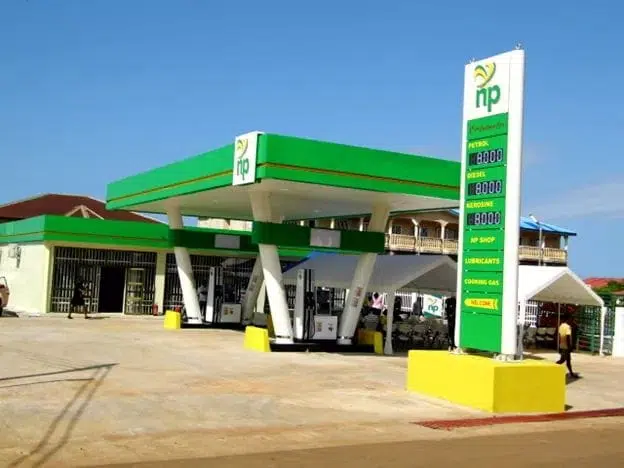
Today you can find the presence of the company in those countries, easily spotted by its green and yellow colours as well as its attractive well-constructed Filling Stations, which are very spacious to accommodate many vehicles, some having shopping marts, tire repairing/mending sections.

Because of its proactive stance with regards quality service delivery, with the avowed objective of always maximizing the interests of its numerous customers, within the petroleum business context, the company has earned the reputation of being 1st for Customer Care. This could not be dismissed as any theoretical attribution because the Shareholders and various Management team, over the years, have rolled out concreate steps and initiatives that still continue to give utmost satisfaction to all its customers everywhere the company is operating.

A realistic demonstration of doing so was borne out of the pragmatic step taken in the direction of securing and installing at its Filling Stations calibrated pumping machines, highly capable of pumping the correct amount of fuel, petrol or diesel, that a particular customer demand, displaying quantity in litre and the price. With such machines in place, obviously, customers always have the conviction that transactions are transparent which gives them the confidence to remain glued to a company that they trust. This is the situation in all the aforementioned countries where the company is steadily operating.

To enhance public safety and by extension that of its customers, the company made it paramount to clearly display precautionary measures at all its Filling Stations out of which these include but not limited to avoid smoking when within the precincts, not to light any naked flame, switch off mobile phones, engines of vehicles when fuel is being pumped. It is always ensured that there are fire extinguishers handy to be used in the event of any fire incidence.

Taking into cognizance that the company is dealing in highly inflammable products, the stance on the part of the Shareholders and Management to uphold best practice within the context of enhancing safety definitely falls within the purview of promoting customer care.

It has been established by development experts that there is a symbiotic relationship between strict implementation of a country’s Local Content Policy (LCP) and economic development. This had been justified on the basis of avoiding the over dependence on importation of what we use to produce and consume. Besides, sound implementation of this policy provides room for the utilization of local skills and materials in the production chain.

As for the National Petroleum-Sierra Leone Limited strict implementation of the country’s LCP is a top priority which must not be taken lightly.

It is against such a backdrop that the company gives preference to indigenes when it comes to employment. Except on exceptional and rare occasions when it comes to employment. For example, in The Gambia, the Management does not say because the parent company is from Sierra Leone therefore Sierra Leoneans should be given priority. No! If there are Gambians who are qualified they get the jobs.

The company has gained wide respect for this stance because it offers sources of livelihoods to those who were hitherto jobless, thereby empowering them to be gainfully employed to take care of responsibilities.

With the introduction of NP Smart Card, which has gone viral, the Card can be credited with money and the amount of money utilized to buy fuel is debited after every transaction. With the use of NP Smart Card, customers are saved the hassle of having to always move with physical cash in their possession in order to purchase fuel and indeed there are times when one may not have time to rush to the bank to make withdrawals. Customers, who are holders and users of NP Smart Card, are at the vantage position to properly budget, through the amount that is contained in the card to buy fuel, during a considerable period of time, say a week or a month. Indeed, NP Smart Card has become trending.

The company also markets NP Gas which is a cooking device that is manufactured in different cylinder sizes and sold at the company’s Filling Stations across the country. It can be easily refilled with gas, is said to be non-hazardous to the health of individuals and easy to operate. Its performance has been rated high and many are indeed going for it.

Within the realm of churning out its Corporate Social Responsibility, the company recently proved that it is always ready to stand by the side of the Government and People of this country ,especially during trying times. This was recently demonstrated when the company donated one billion Leones to the Government as its own token of contribution towards the fight against COVID-19 which the country is grappling with at the moment.

Indisputably, from the foregoing ,it can be firmly asserted that when we count companies that have made solid marks within the business landscape of the West African sub-region there is no way that the National Petroleum Sierra Leone Limited could not be mentioned as the company is greatly contributing to socio-economic growth wherever it has a presence. And the good news is that the company is doggedly poised to expand its operations.

Housemates Salone Audition Ends Today

By Amin Kef Sesay

Viewers who have watched the audition for Housemates Salone 2 on Facebook have attested that there is a lot of fun in stock when the actual competition commences after the successful applicants would have entered the House on the 14th October 2020.  The audition will end today Wednesday 9th September 2020.

As pointed out in our last edition, the fanfare that is conspicuous around the audition, which is taking place at the Africa Young Voices (AYV) Media Empire Office on Wesley Street in Freetown, continues to create a hilarious scene.

The aspirant, who was accompanied by a fleet of Okadas, the other with a brass band as well as others with their support groups with all the pomp and pageantry have all being adding glamour to the ongoing audition.

Although the applicants were asked questions in Krio and expected to respond in the same, however, some deliberately choose to express themselves in the English Language. It was against the backdrop of attempting to please and convince the judges that certain applicants unknowingly were painstakingly murdering the Queen’s Language. Others got viewers laughing out their sides through the performances they were putting up to exhibit what they have inter alia submitted that they can do very well.

Though the audition may appear to be a simple qualifying test, however, some of the questions posed by the judges were really tricky triggering various responses with some giving impressive answers were as others did not even understood the questions and were therefore off target.

Questions like why the decision was taken to apply for the competition, what do they know about Housemates Salone, what is the meaning of the theme, “Quarantine Drama”, what do they think they have that will give them an edge, what would they do with the prize money etc seemed simple but indeed they gave some of the aspirants tough time as they needed thorough thinking to provide the right answers. It was in trying to do so that some faltered and the responses given created a lot of laughter.

Housemates Salone has in store for the lucky winner the whopping sum of Two Hundred and Fifty Million Leones (Le250M) plus undertaking a round trip to Dubai.

Apart from bagging the Star Prize of Two Hundred and Fifty Million Leones (Le250M), all other participants will be entitled to their daily allowances of Le100, 000 each, whilst they still remain in the House and accumulatively given to them whenever they are evicted.

Interestingly, during a particular stage of the Show, based on the percentage of votes scored by a particular Housemate such will determine if he or she will be evicted from the House. Evictions will continue until the ultimate winner emerges.

The underlying rationale for the organizers to package this entertainment show goes beyond providing mere entertainment to that of Youth Empowerment. With twenty young Housemates, from different backgrounds,” Quarantined” under one roof for up to about two months, they will be taken through certain mental and physical exercises that will impact their personalities and it is certain that after the competition they will never be the same again.

They stand to benefit from being guided to be motivational speakers, to think critically as well as rationally, how to healthily interact, how to solve problems, to set goals, to cook, how to eat and dress for different occasions, to sing, dance, control emotions and stress. They will have the opportunity to learn from what visiting guests from certain corporate institutions will teach them, learn how to play games and a host of other things that are aligned to coping mechanisms as well as development of strong characters.

However, what the judges will be keenly watching for is originality. The Housemates should do things naturally instead of faking certain performances.

Another good thing about the show is that it will put all the Housemates in the spotlight as the Reality TV Show will be viewed by many in and out of the country via AYV Television Channel 34. People will come to know them, the talents that they possess and what they are capable of doing. The show could be a window of opportunity for the Housemates as some people out there could be interested in tapping the talents that they have seen displayed which could end up in changing their fortunes for life. Indeed something has to start somewhere!

Some people may be having reservations as to whether it is apt to stage the show amidst the coronavirus. To allay such a fear, the organizers have put all the necessary modalities in place to ensure that all the Housemates to enter the House are coronavirus free, that precautionary measures are observed and the House is kept safe.

For now Housemates Salone is the most talked about upcoming social event that continues to dominate conversations in social circles and many are looking forward to be viewing an entertaining and educative programme from which a lot could be learnt.

As the expectations are running high, the organizers are methodologically and meticulously putting finishing touches to once again avail viewers a lively, tantalizing and thought-provoking Reality TV Show.

Statistics SL Partners with AYV

By Amin Kef Sesay

Statistics-Sierra Leone, the institution that is charged with the responsibility of collecting, processing, analysing and disseminating  accurate, clear, relevant, timely and high quality statistical information on social, health, demographic, economic and financial aspects to serve the needs of users including Government, International Partners  and the general public, on Tuesday 8th September 2020 signed a Memorandum of Understanding with the Africa Young Voices (AYV) on the terms of popularizing and disseminating  the institution’s activities especially the upcoming Mid-Term Census.

In his opening statement, Samuel Wise Bangura, spokesman for the AYV thanked Statistics-SL for the confidence reposed in them culminating in partnering with them underscoring that which the institution made no mistake in doing so.

He furthered that AYV will create the platform for statistical analyses to be done on a broader spectrum in order for decision makers to get full knowledge of  relevant issues in order to make informed decisions based on the accurate data produced by Statistics-Sierra Leone.

He furthered that the relationship entered into by the two institutions has set the agenda for development to properly continue in Sierra Leone.

In his statement the Statistician-General, Malam O Sankoh, stated that what AYV will be doing is not only for Statistics SL but should be looked at as a national services.

He furthered that all what his institution is doing is for the public to be informed underscoring that if the public is not made to be aware of what they are doing then there is no need for them to conduct their activities.

The Statistician-General stated that they do not only want the public to know about the end process but to also follow the process.

He stated that Statistics SL is the body that conducted the 2015 National Census, but when he took over in 2018, he realized that there were challenges and questions coming up which was why they approached the Government and donor partners to conduct a Mid-Term Census in order to address some of those challenges.

He stated that the December 3rd Mid-Term Census will produce the most credible data which is why they want the process to be an inclusive one that will capture everyone where he or she sleeps on the eve of the commencement of  census.

Mallam  .O. disclosed how Stats- SL has set up an Advisory Committee  comprising senior members of all  the Political Parties in the country.

Duramani Ezecikel Lakoh, Managing Director of AYV assured Statistics- SL that AYV will get all they desire. He disclosed that AYV is not only a media house but also a Media Consultancy Firm.

“AYV is a national entity because it reaches all the four corners of Sierra Leone and beyond with a term of professional broadcasters,” he added.

He underscored that AVY is not a political institution and so is open up to work with all institutions to develop Sierra Leone.

The signing of the Memorandum of Understanding by the Chief Executive Officer of AYV, Anthony Navo Jrn and the Statistician General of Statistics-Sierra Leone  Mallam O formed the highpoint of the programme.