Home Blog Page 749

Body of Christ to Host Acceleration Conference 2022 in Freetown

Body of Christ

By Millicent Senava Mannah 

During a Media Press Briefing that took place on the 1st June, 2022, which  was organized by the Body of Christ in the country geared towards updating media practitioners in the country about its forthcoming Acceleration Conference that will commence from the 14th to the 16th June, 2022 at the New Life Ministries on Ross Road in Freetown, it was categorically stated that the event will be held in collaboration with the presiding Bishop of the Redeemed Evangelical Mission in Nigeria, Bishop Mike Okonkwo.

Further highlighted was that the conference is meant towards impacting, empowering and encouraging pastors, church leaders and church workers on how to run the ministry of God.

Founder of the New Life Ministries, Bishop Archibold Cole, intimated that Bishop Mike Okonkwo will be the Guest Speaker during the conference adding that the Bishop, who is now 75, has over 50 years of experience in Church Ministry.

Bishop Cole also revealed that it will mark his third time of visiting the country continuing that his first visit was in 1992 and he came 12 years after stating that during that time Bishop Mike influenced them positively to form the Pentecostal Fellowship of Sierra Leone.

He disclosed that there will be sessions in between the conference within 9a.m and 5:30p.m during the days of the conference.

Bishop Julius Laggah of the Harvest Intercontinental Ministries Sierra Leone, who happens to be the Vice-Chairman of the Acceleration Conference 2022 Committee, said the Conference will empower Ministers, church workers, and church leaders, and also edify them for the work of the ministry.

He furthered that though the main targeted beneficiaries of the conference are mainly church leaders, however, anybody that is interested will be warmly welcomed.

The Man of God also disclosed the conference is fully funded by the guest speaker, Bishop Mike Okonkwo

Rev Yarie Kabia, Founder and Co-General Overseer of the Shalom Ministries revealed that over 400 pastors from the provinces will be in attendance also disclosing that food and transportation will be provided for them.

She added that there will be buses at different locations around the city to collect pastors and interested persons to the conference center.

As Big Female Conference to Hold in Freetown this June… Yemi Alade Set to Thrill First Ladies & Other VIPS

Yemi Alade

By Elisha Harding

Internationally acclaimed Nigerian Afropop songstress, Yemi Alade has confirmed to the 10th Africa Conference on Sexual and Health Rights organizers to be hosted in Freetown from June 27 to July 1 that she will be in the country to take part in the 5-day extravaganza.

This was revealed last week at Radisson Blu Hotel at the press launch of what has been described to be the largest conference hosted in Sierra Leone since at least the 1980s.

The Conference’s Honorary Chief Patron and Sierra Leone’s First Lady, Madam Fatima Bio, acknowledged that the UNDP Goodwill Ambassador for the SDGs, particularly on inequality, empowering women and creating awareness of global climate change, has agreed to come and perform on the eve of the opening ceremony of the main conference alongside top Sierra Leonean entertainers.

In addition, the First Lady disclosed that she has also invited eleven other First Ladies on the Continent, but will wait to reveal those that will be in the country once they have confirmed their availability. United Nations Resident Coordinator, Dr Babatunde Ahonsi, said that the United Nations is mobilizing financial resources for the conference with the theme, “accelerating the elimination of sexual and gender-based violence in Africa,” and that $USD 190,000, including from the Spotlight Initiatives has been committed to the programme.

Additionally, the United Nations System in Sierra Leone is expected to provide technical and other logistical expertise through the coordination of UNFPA. At the Press launch, Mr Chernor Bah, CEO of the Host organization, Purposeful, said that the conference marks a critical and defining moment for all those who care about ending violence against women and girls in this lifetime. He emphasized that through his girl-focused feminist organization, the conference will be an invitation to join hands, discuss, debate, strategize and share ideas “that will build the Africa we know is possible – free of all forms of violence and discrimination.”

Yemi Alade

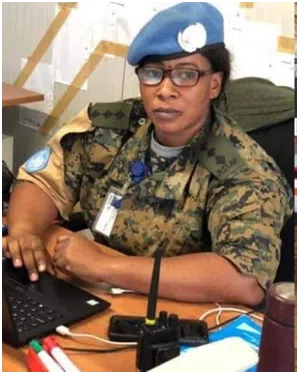
UN Honours Fallen Sierra Leonean Peacekeeper- Captain Christina Fefegula

Captain Christina Fefegula

By Elisha Harding

Ambassador Alhaji Fanday Turay, the Sierra Leone’s Permanent Representative to the United Nations, has on Thursday 26th May 2022, accepted an award on behalf of the family of the fallen Sierra Leonean peacekeeper who was attached to the United Nations Multidimensional Integrated Stabilization Mission in the Central African Republic (MINUSCA).

The late Captain Christina Fefegula of the Republic of Sierra Leone Armed Forces was involved in a fatal road accident in the Central African Republic.

The ceremony was presided over by the United Nations Secretary-General Antonio Guterres and it marked the Annual International Day of UN Peacekeepers in which the Dag Hammarskjold Medal was awarded posthumously to the peacekeepers, who made the ultimate sacrifice for the cause of peace, during the preceding year.

It is important to note that   Sierra Leone currently contributes military and police personnel to the UN peace operations in Abyei, the Central African Republic, the Democratic Republic of the Congo, Lebanon, Mali, Somalia, South Sudan, and Sudan.


To Dramatically Improve Learning Outcomes… Gov’t Needs to Pay Great Attention to Teachers

teachers

By Ranger

Reduced teacher time on task is considered one of the greatest challenges toward inclusive and quality education.

Thus, it is crucial that the Government negotiates with teachers towards meeting them half with regard to their salaries and work conditions because, since the start of this term, many teachers hardly enter their classrooms. The direct losers of this go-slow strike action by teachers are the pupils who do not receive instruction.

It is imperative that in trying to improve learning outcomes, the Government and all education partners should seek out findings that will inform workable solutions and policies that help increase opportunities for children to learn and ultimately, improve their life and work opportunities.

In this direction, in November 2020, important new research on teacher absenteeism in sub-Saharan Africa was launched at a regional online workshop of national and international education stakeholders organized in Nairobi, Kenya.

The report which would be instructive to MBSSE offered insights into the drivers of primary school teacher absenteeism, a major obstacle in efforts to address the learning crisis in children of low- and middle-income countries around the world.

Produced by the UNICEF Office of Research – Innocenti, the report synthesizes findings from eight sub-Saharan countries with a focus on the many complex factors that affect teacher time on task across the region.

The study provides robust evidence on the challenges faced by teachers and to improve policies on teacher working conditions, accountability and motivation.

Teacher absenteeism has a lot to do with the finding that many of our children finish primary school unable to read and understand a simple text.

Teachers attending lessons and spending time on task is a prerequisite for learning. This clearly indicates that more attention should be paid to supporting teachers and improving policies for a more motivated and effective teaching workforce, one of the most important factors for addressing the learning crisis.

Thus, even though the Bio Government has invested heavily in its FQE program, yet teacher absenteeism is still prevalent.

There is the need to carefully study teacher absenteeism and provide critical insights into the factors that underpin the multiple forms of teacher absenteeism and time on task. What is crucially needed is strengthening education systems.

Effective and consistently applied accountability, training and support, career development and remuneration systems – remain critical to improving teachers’ attendance and time on task.

The persistent focus on the multiple factors affecting teacher attendance will help mobilize policymakers, citizens, donors, and other stakeholders to take the necessary steps to improve teacher working conditions, accountability, and motivation, and thereby improve learning outcomes.

Empirical evidence shows that teacher absenteeism is higher in rural areas than in urban/peri-urban areas and higher in public schools than in private schools.

‘Moonlighting’ teachers, who hold multiple jobs, are more likely to report being absent compared with teachers who receive income exclusively from the teaching profession, as are volunteer teachers compared with non-volunteer teachers.

In schools where school heads monitor the attendance of teachers, they spend more time in school and teaching.

Stronger parental and community engagement in teacher monitoring is also associated with improved teacher attendance;

Teachers who receive their salary on time and with relative ease report lower rates of absenteeism than teachers who face delays and difficulties in collecting their pay.

 Main Policy Recommendations

Strengthen inter-sectoral collaboration to address factors beyond the education system, in particular health and infrastructure;

Ensure that head teachers are trained in management and leadership including monitoring and oversight, curriculum implementation and supervision;

Boost parental and community involvement to include a monitoring role and strengthening of their representation on school councils and management boards;

Remove obstacles to receiving pay including increased pay points in remote areas and establishing a Rota system to ensure schools continue to function at pay collection time.

Ensure that teacher training has a strong practical component and is not organized in a way that leaves students without a teacher or a substitute teacher.

Make distribution of teachers across schools more equitable including incentive strategies to make postings in rural and hardship areas more attractive.


Honourable Attorney-General and Minister of Justice, Mohamed Lamin Tarawalley Esq

By Amin Kef-Ranger

In a keynote address delivered by the learned Honourable Attorney-General and Minister of Justice, Mohamed Lamin Tarawalley Esq at the 2022 World Justice Forum on the theme: “The Global State of Justice and The Rule Of Law”, at the Hague on the 31st May 2022 he called for a collective action to support SDG 16, the creation of a peaceful, prosperous, just and inclusive global community.

According to the AG, the recent WJP Rule of Law Index shows that “globally more countries declined than improved in the overall rule of law performance for the fourth consecutive year”.

WJP Rule of Law Index reported that in a year plagued by the COVID-19 pandemic, 84.7% of the world’s population or approximately 6.5 billion people globally experience a decline in the performance rule of law.

The Attorney General (AG) argued that a decline in rule of law performance puts nations at risk of failing to achieve the 2030 Agenda and, more frustratingly, seeing their hard-won development gains reversed.

He emphasized that establishing justice and strengthening the rule of law is a long-term investment that amasses massive dividends for the global village.

However, the AG noted that the Government of Sierra Leone has made series of strides in this direction, adding that one of the Government’s top priorities at the moment is a national action-oriented approach that seeks to advance the rule of law and access to justice in order to ensure a well prosperous, peaceful, just and inclusive society.

He opined that in order to achieve global order in terms of justice and strengthening of the rule of law the fundamental starting point to develop justice and the rule of law is at the national level. “It is my firm belief that what is usually practiced at the national level is what is translated or manifested at the global stage.”

The AG further explained that the Government of Sierra Leone continues to eliminate threats to democratic freedoms and human rights and further stated that the resolve of the Government in addressing all concerns in the Justice Sector is evident in every sphere of Government administration.

“The Government of Sierra Leone has made tremendous strides in addressing various justice demands that touch and concern the socio-economic and political wellbeing of its subjects.”

He highlighted that among these are meaningful improvements in the areas of: free quality education, school feeding programmes; national water resources management mechanisms; reformation of the citizenship law to end discrimination against women who could not pass on citizenship to their children; adopted policies and laws aimed at strengthening gender equity and protection and guarantee women’s empowerment; development of laws eliminating inequality and discrimination; increasing of the maximum penalty for rape and sexual penetration of a child decriminalization of half a century libel law by virtue of the amendment of Public Order Act (POA) 1965 that used to criminalize freedom of expression; the lifting of the ban on pregnant girls attending schools and the abolition of the death penalty and strengthening of the protection of the right to life.

However, conscious of the damaging impact of corruption on justice and rule of law, the Minister of Justice explained that the Government of Sierra Leone has put a robust fight against corruption.

In the fight to eradicate extreme poverty and sustainable socio-economic development, he said, “the Government of Sierra Leone amended the Anti-Corruption Act in 2019 which gives more powers to the ACC it increases the fines, sentences and other powers of the Commission.”

Furthermore, he said the Government took further steps by setting up three independent Commissions of Inquiry (COI) the purpose of this inquiry is to combat corruption, bring accountability in governance and foster economic growth for the people of Sierra Leone.

The Commission made findings at the conclusion against persons of interest and made adverse findings against the previous administration. Adding that most of these persons of interest at the COI are having their appeals heard before a fair, independent, and competent Court of Appeal in Sierra Leone.

Moreover, he said Sierra Leone has launched a new national anti-corruption strategy (NACS).

However, in terms of other relevant structural implementation indicators, the AG noted that ,“the Government of Sierra Leone signed on 9 December 2003 and ratified on 30 September 2003 the United Nations Convention against Corruption and signed on 9 December 2003 and ratified on 3 December 2008 the African Union Convention on Preventing and Combating Corruption and Related Offences.”

The AG maintained that the fight against corruption in Sierra Leone has been and, is radically entrenched and successful. He revealed that countries in the sub-region such as Liberia, Ghana, and Nigeria have sent researchers to come and study our anti-corruption strategies for onward implementation in their own countries.

“The indicator lights of these success stories speak for themselves. All thanks to the appointment of a young, robust and competent Anti-Corruption Commission (ACC) Commissioner, and the political and legal space given to him by the Government,” he said.

Transparency International 2019 Global Corruption Barometer for Africa identifies Sierra Leone as one of the success stories in the fight against corruption with 66% of Sierra Leoneans believing that the Government is doing a good job in the fight against corruption.

Prior to the appointment of the current Anti-corruption commissioner, the Minister of Justice explained “Sierra Leone was in the position of 49% in the Millennium Challenge Corporation’s Control of Corruption (MCC) Scorecard, which under his astute leadership and full support of the government, the country has moved to a comfortable and respectable position at 71%, 79%, 81% and an excellent 83% in 2018, 2019, 2020 and 2021 respectively.” Similarly, according to the Afro Barometer survey in 2020, corruption prevalence in Sierra Leone has reduced from 70% in 2015 to 40% in 2020.

He said President Bio-led Government’s strategy in the fight against corruption has helped position the country on a firm and consistent path to sustainably keep corruption under control and set the stage for: accountability, effective service delivery, democratic good governance, and sustainable development.

“This mode of fighting corruption and success stories have made Sierra Leone to be selected for the Multi-Million Dollar US Government’s Compact award,” he underscored also adding that today, Sierra Leone is one of the top ten Performers in the Lower Income countries, which is a sign of commitment in controlling corruption.

The AG reiterated that Corruption indeed has been largely responsible for poverty across the world which in turn is contributing considerably to stagnating justice and the rule of law.

With regards to engagement with the Universal Periodic Process (UPR), the Minister of Justice that the Government of Sierra Leone has demonstrated consistent and effective engagement with the Universal Periodic Review (UPR) process in its determination to make progress on human rights promotion and protection adding that Sierra Leone is honouring its reporting obligations under the relevant human rights conventions.

The AG said that there has been an expansion of legal aid services to indigent and under-served persons through the Legal Aid Board scheme which provided free legal representation, advice, and related services to over 400,000 Sierra Leoneans in 2020, recording a 93% increase from 2018. Special courts to fast-track cases for sexual offences, social security, corruption, and small claims were established.

On the international front, the Minister of Justice said that Sierra Leone has graciously contributed to the strengthening of Justice and the rule of law at the international level as well. “At the international level, my country is deeply committed to the implementation of its international obligations.” Sierra Leone became the 100th member of the United Nations in 1961 and ratified most of the major human rights treaties or instruments, the foundation of which was built by the Universal Declaration of Human Rights (UDHR).

Sierra Leone is a signatory to: the International Covenant on Civil and Political Rights 1961 (CCPR), the International Covenant on Economic and Social and Cultural Rights 1966 (CESCR), the Convention on the Elimination of All Forms of Discrimination against Women (CEDAW) 1979, the Convention against Torture and Other Cruel and Inhuman or Degrading Treatment or Punishment (CAT) 1984,  the Convention on the Rights of the Child (CRC) 1989, the African Charter on Human and People’s Rights (ACHPR) 1981 and, African Charter on the Rights and Welfare of the Child.

“Most of these treaties have been domesticated in our country,” he said.

The Minister of Justice also explained that in a bid to curb impunity, Sierra Leone, after 11-years of brutal conflict, requested the United Nations to assist in establishing a Special Court for Sierra Leone to try and punish violations of human rights.

In 2002, a bilateral agreement was signed between the Sierra Leone Government and the United Nations to establish a Special Court with a mandate to bring to justice “those who bear the greatest responsibility” for war crimes, crimes against humanity, and other violations of international humanitarian law committed in Sierra Leone since 30th November 1996.

The Special Court was the first ‘hybrid’ international criminal court to be established – ‘hybrid’ in the sense that it involved a mixture of international and domestic laws and personnel. The said Court is described by independent international observers as a radical departure from the model of the ad hoc tribunals for the former Yugoslavia and Rwanda (ICTY and ICTR) on the one hand, and the International Criminal Court (ICC) on the other, and was welcomed by many as a potentially more effective and efficient form of international criminal justice.

The Special Court for Sierra Leone concluded its mandates in 2013 and a Residual Special Court for Sierra Leone has been instituted to continue to monitor the sentences of the Special Court.

The importance of the RSCSL in ensuring the legacy of the Special Court for SL through carrying out the numerous legal and practical obligations that did not end with the conclusion of trial and appeal hearings cannot be overstated. One indictment remains outstanding- that of a former rebel leader Johnny Paul Koroma. The RSCSL continues to be an important legacy tool of deterrence in Sierra Leone where it has the confidence of the people of Sierra Leone. Respect for the rule of law, legislative reforms, capacity building, and the court and its predecessor’s impact on legal and judicial proceedings in Sierra Leone are all part of its important legacy

The AG reiterated that to gain global justice and strengthen the rule of law, “a great place to start is in our respective national settings.” He said the road towards a world of justice, prosperity, and inclusiveness for all is not without assailants. “Oftentimes, the surge in the demand for justice has been endless and seemingly impossible to redress. Therefore, we must draw the strings of our collective efforts together in bringing about a peaceful, just, and prosperous global society.”

He calls for all hands on deck as “justice exists for all but realizing it goes with huge sacrifices.”

“As an optimist, I have all rays of hope that we will someday get there. So, let’s continue to act and to fight,” the AG implored.


 

Chinese Ambassador Takes Unimak Students through China’s Development Stages

Chinese Ambassador to Sierra Leone, H.E. Hu Zhangliang

By Elisha Harding

The Chinese Ambassador to Sierra Leone, H.E. Hu Zhangliang, has on the 31st May, 2022 through a virtual meeting, engaged the faculty and students of the University of Makeni (Unimak) and shared with them the secrets of China’s development success.

The virtual meeting was attended by the Vice Chancellor of the University of Makeni Prof. Joseph Turay, Deputy Mayor of Makeni City Council Santigie Sesay, Paramount Chief of Bombali Sebora Bai Kasangha, other senior faculty staff and students of Unimak, representatives of Sierra Leone-China friendship organizations and media friends.

Ambassador Hu explained to the participants that the remarkable achievements made by China in the past 72 years are a result of adhering to the leadership of the Communist Part of China (CPC), unity and hard work of the Chinese people, following the path of socialism with Chinese characteristics, keeping independence and self-reliance, actively embracing the world and promoting the building of a community with a shared future for mankind, being fearless of hegemony and resolutely defending national core interests.

Vice Chancellor Turay said the experience of China’s development achievements is admirable. He expressed gratitude to China for its long-standing support to Sierra Leone. He said that Sierra Leoneans are willing to continue to work with China for mutual benefit and win-win cooperation and jointly safeguard international justice. The teachers and students of Unimak expressed their willingness to contribute more to the promotion of friendly cooperation between Sierra Leone and China.

To Uphold Good Governance… Prince Jacob Macauley Believes Section 41 (b) of the 1991 Constitution Must be Expunged

Prince Jacob Macauley

By Foday Moriba Conteh

The action Prince Jacob Macauley, a renowned  Economist, has decided to embark on, which entails placing an application to the Supreme Court of Sierra Leone for expunging Section 41(b) of the 1991 Constitution of Sierra Leone, is being done for a reason of putting right what for too long, he quite believes,  has been wrong.

Most Sierra Leoneans were never happy when the decision was taken to oust former VP Alhaji Sam Sumana after he was expelled by the All People’s Congress party, to which he was a member then, but at the end of the day the law is the law and the powers of the Constitution supersede all other laws.

If the constitution says that one of the qualifications, among others, to become either a President or Vice President is for one to be a member of a political party, then by the expulsion of Sam Sumana from the APC party means that he was no longer qualified to remain in that office as VP.

The case which was more or less a futile one for the former VP did go to the Supreme Court of Sierra Leone which was to rule against the plaintiff, Sam Sumana, on the grounds of him mainly no longer being a member of a political party.

Mr Macauley, who nurses the desire of becoming the 1st Independent President of Sierra Leone, is going to ask the Supreme Court to consider first, the reason why it is suitable for one to contest a Parliamentary Seat as an Independent but not the Presidency.

He also looks forward to or wishes that the Supreme Court will consider the effect of Section 41 (b) on future generations whereby radical elements of a political party may rise up and  rebel against a sitting President and ask for his expulsion from the party to which he belongs.

Under the present status, there has to be at least an amendment of the Constitution to protect future Presidents from facing such embarrassments which will create a Constitutional crisis in the country.

In the next issue, Mr. Macauley will explain his plans in fulfilling his ambition.


Orange SL Cloud Services Available to Aid Digital Transformation of Companies

Orange Sierra Leone
Orange Sierra Leone

By Elisha Harding

Orange Sierra Leone, one of the leading telecommunications service providers operating in the country has made available a catalogue of cloud services geared towards supporting companies in their digital transformation drive.

Enterprises which are customers of Orange SL can now benefit from the IT infrastructure. The catalogue of cloud services are simple to use and the offers will allow the company’s customers to be more agile in the development of their business and their competitiveness. It is worthy of note that Orange SL is also available to customers for personalized support.

The offers include a Virtual Server which is quickly deployable for IT development or application hosting and the new and secured platform facilitates the deployment of an organization’s or business entity’s IT projects.

Another is a Virtual Datacenter which includes a set of computer resources to host an entire information system. It is a secured cloud infrastructure that allows a person or entity to calmly manage the deployment of information systems.

With Back up as a Service this can easily and automatically save one’s data in the Orange Secure Cloud and the solution allows one to backup and restores the data of servers and workstations as needed.

For Physical Server Hosting this provides safe and secure space for one’s physical “hardware” infrastructures in Orange SL’s Secure Datacenter. For more information contact :enterprisebusiness@orange-sonatel.com or call +23273420420.


President Bio Strengthens Bilateral Ties with President Uhuru Kenyatta in Kenya

His Excellency Uhuru Kenyatta

By Elisha Harding

President Dr Julius Maada Bio on the 30th May, 2022 met with his colleague, His Excellency Uhuru Kenyatta, during which period the two Heads of State discussed bilateral relations between the two countries.

President Kenyatta welcomed and thanked President Bio for being a Guest Speaker at the United Nations Peacekeepers Day and for celebrating Kenya’s Independence Day as a special guest.

He added that the two countries had been great friends and had supported each other at continental and international levels.

He further noted that the friendship between the two countries should be moved to the next level, where the full potential of both countries would be harnessed and utilized, saying that the peoples of Sierra Leone and Kenya should continue to work together to move trade and investments.

“Your Excellency, let me use this opportunity to thank you and welcome you and your delegation to Kenya. Do have a pleasant stay,” President Keyatta concluded.

In his response, His Excellency President Dr Julius Maada Bio thanked his counterpart, His Excellency Uhuru Kenyatta, for the warm reception and hospitality accorded him and his delegation, adding that the cordial relations and bonds of friendship between the two countries had existed since the days of former President Jomo Kenyatta and continued till today.

President Bio further commended the Republic of Kenya for their role in the peace process in Sierra Leone, adding that he appreciated President Uhuru Kenyatta for the opportunity to discuss bilateral, regional, and global issues with him.

“I want to use this opportunity to thank you for the donation of 20,000 tablets and power banks in support of the Government’s effort to conduct the Mid-Term Population and Housing Census in Sierra Leone. Thank you for the invitation. I wish you and your people the very best as you continue to contribute to regional and global peace and good governance,” President Bio concluded.


Op-ED Diaspora Appointees Ruining the Country’s Economy

By M. B. Jalloh (Press Attache to Saudi Arabia)

The idea of giving preference to our Diaspora brothers and sisters to serve in Government sprouted up notably in the previous Koroma – led APC administration, that created a special Diaspora office to coordinate the activities of Sierra Leoneans who support the then governing All People’s Congress (APC), and how to tap from their skills and expertise.

The office was right at State House as an indication of the importance erstwhile President Dr. Ernest Bai Koroma had attached to Diaspora affairs. Giving the opportunity to Sierra Leoneans in the Diaspora to serve their country in various capacities in Government wasn’t a bad idea introduced by former President Koroma.

However, that opportunity had its attendant demerits, in that most of our brothers and sisters who were given responsible positions in the then Koroma administration had their families abroad. Consequently, the better part of their salaries and emoluments had to be remitted overseas to maintain the upkeep of their families and paying for mortgages with much telling effect on the national economy. Former President Koroma might have merely prioritized Diaspora affairs in his Government because the number of Diaspora brothers and sisters he engaged in his Government would pale into oblivion, if you consider the number of Sierra Leoneans His Excellency President Julius Maada Bio has employed from the Diaspora.

I stand to be corrected that about 40% of presidential appointees in the SLPP Government are from the Diaspora, notably from the United States of America and United Kingdom where Brig. (Rtd) Julius Maada Bio had sojourned whilst studying at the Bradford University where the current Minister of Foreign Affairs and International Cooperation, Dr.  David Francis was lecturing. He even came in contact with his wife Fatima Jabbe Bio in the UK through a Sierra Leonean nicknamed London Jet, who had been in contact with the woman when they were in social business.

The two major political parties in the country – the ruling SLPP and the main opposition APC have to a very large extent encouraged our brothers and sisters from the Diaspora to participate in Government without realizing that the better part of their salaries and emoluments are remitted to their families abroad. These remittances could run into millions of United States Dollars, hence one of the reasons for the constant depreciation of the Leone against the US Dollar. If more dollars in remittances are sent abroad without Sierra Leone exporting abroad to attract more foreign exchange, our economy will continue to degenerate every time remittances are sent abroad.

Since the SLPP Government assumed power in April 2018, the dollar rate has continued to soar because the exportation of minerals and agricultural products are not impacting positively on the economy. The situation is exacerbated by the rampant remittances of the dollar abroad by our Sierra Leonean brothers and sisters in Government to sustain their families, many of whom are pupils and university students who are in very expensive universities, colleges, and schools abroad.

By and large, the marginalization of the home-based politicians, who are very much conversant with the political and economic landscapes of the country, because of material reasons has affected our economy to an extent that the Leone continues to depreciate against the dollar in rapidity. The dollar rate against the Leone was very much steady during the reign of the late former President Alhaji Dr. Ahmad Tejan Kabbah until when Ernest Bai Koroma took the reins of power and included hundreds of our Diaspora sisters and brothers in Government. The Leone automatically started to depreciate against the Dollar because the Diaspora politicians were remitting millions of US Dollars to their families abroad for the upkeep of their welfare. The Bio administration has worsened the situation by employing more Diaspora politicians from whom he reportedly received financial and other support as opposition politician.

Be that as it may, the inclusion of so many Diaspora politicians in Government has been the Hercules’ heel of the erstwhile Koroma and the current Bio administration whose campaigns were largely funded by Sierra Leoneans in the Diaspora and both Presidents had and have the penchant to compensate them for their efforts. Most of them, because of their being away from home for a very long time, are not conversant with the political landscape of the country; they are far removed from the grassroots, and have consequently failed to deliver to the disappointment of vulnerable Sierra Leoneans. One year after his ascendancy, President Bio visited the SLPP party office and the angry supporters booed at the diaspora appointees. The supporters claimed that the diaspora guys were only focusing on themselves forgetting the ordinary men and women who toiled, suffered and faced all sort of challenges, but they remain steadfast in the party.

For the Leone to stop depreciating rapidly against the US Dollar, the remittance of the Dollar abroad by our Diaspora politicians occupying mouth-watering positions in the Bio administration should be constantly monitored by the Financial Intelligence Unit (FIU) to determine how much should be remitted abroad.

Sadly, many of the diaspora guys who served under the Koroma administration were quick to board flights to return to UK or US when the party lost in 2018, while the local politicians had no place to run to; the only option they had was to face the elephant in the room. Take a deep look at the APC now from Parliament to Old Railway Line who are the people that have sacrificed for the party during these four years; they are the home – based politicians. Similar fate will befall the SLPP one day when they are out of power.

Based on the above, many would advise future Presidents to prioritize national interests over personal obligations to friends whose sole interest behind their financial support might exclusively be to enjoy the fat returns as a compensation for their meager financial support. Former President Koroma and President Maada Bio have both fallen into this trap. Perhaps, their intentions behind appointing the Diaspora brothers and sisters were two fold – first, to demonstrate that they are grateful; second, they might have thought that these Diaspora compatriots might deliver better goods than the grassroots politicians on the ground. Away from grudges, many observers have concluded that these appointed Diaspora brothers and sisters have by and large have disappointingly underperformed, and thus have turned out to be more or less a liability to the ongoing plummeting economy.

That said, instead of focusing on the recognition of good deeds to one (despite the importance of expressing gratitude), Presidents should primarily be looking for some  professional and high-tech Diaspora compatriots who have got a proven track of their competence, skills, professionalism, and expertise in their fields of specialization regardless of their political affiliations . Appointing this category of men and women would unequivocally pay dividends, as they would be better positioned to deliver the goods expected of them, and as they would definitely serve in the interest of the country in a wider range other that partisan narrow area.

Unfortunately, on the other hand, there are a host of highly skilled and professional compatriots living in the Diaspora who might never be considered for any positions by the Government simply because they are not part of the political clique. So, in so doing, what is largely applied here is the old adage that says: ‘It is NOT a matter of what you know and what you can do; but rather, it is a matter of who knows you’. When this applies, it is the country and nationals that suffer the consequences. And sadly this is often the case.

Hope readers, especially our Dispaora brothers and sisters, will read this piece with an open mind; as I have nothing against them.