
The World Food Programme (WFP) in Sierra Leone has released the Zero Hunger Strategic Review (ZHSR) Report which was officially launched on 16 October 2019 on World Food Day. The Strategic Review is a product of the inclusive review process, a comprehensive analysis of the challenges faced and strengthened the country’s institutional capacity to develop agriculture effectively.
The review also identifies priority actions to achieve SDG 2 “Zero Hunger.” These priorities inform the plans of national stakeholders and partners in Sierra Leone. The Lead Convenor oversaw the whole process together with a full fledge technical research team.
From 2017 to 2019, the review involved of a wide range of national stakeholders, government ministries, departments and agencies, civil society members, private sector partners, donors, and international organizations. WFP commends the leadership of the Ministry of Planning & Economic Development, and the Ministry of Agriculture and Forestry in Sierra Leone for all their efforts. WFP also expresses its sincere thanks to sister agencies, namely FAO and UNICEF, for also playing a big role in the process.
In a startling revelation, a total of 73,468 people are living with HIV in Sierra Leone, authorities revealed recently. Abdul Rahman Sesay, Director General of the National HIV Secretariat in Sierra Leone, confirmed that among them, over 30,000 are currently undergoing treatment.
He noted that they are working with the Network of Persons Living with HIV, and also collaborating with communities to create people’s awareness of the disease. He called on development partners to work with the HIV Secretariat to reduce the rate of HIV in Sierra Leone.
Sierra Leone’s currency, the Leone, has lost over 100 percent of its value to the US Dollar since 2016, according to Bank of Sierra Leone. The Bank noticed the general public in a press release dated 20 August, 2019 that it is illegal under the country’s laws to quote prices in foreign currencies. The law states that all prices in the domestic market have to be in Leones. However, Bank of Sierra Leone operates in a setting of weak law enforcement.
Therefore, section 26 (4) of the Bank of Sierra Leone Act, 2019 are largely violated. Large part of the economy is dollarized with impunity. The prices of renting a house, booking for hotel and flight ticket, renting a car, consulting fees, wages of foreign workers are among the economic activities largely quoted in US Dollars instead of the legal tender, the Leone.
However, illegal dollarization is not the only currency problems of Sierra Leone. Bank of Sierra Leone depends heavily on exports), especially exports of minerals, to build its foreign exchange reserves to be able to influence the exchange rate of the Leone in the international foreign exchange market. However, export of minerals is very volatile. The share of mineral exports fell from 90 percent in 2013 to 30 percent in 2018, according to latest figures from the National Advocacy Coalition on Extractives (NACE).
Even a booming natural resource sector in the early 2010s could not make the exchange rate appreciate; suggesting that the exchange rate in Sierra Leone depends little on capital inflows, including Foreign Direct Investment (FDI) in mineral extraction, in agriculture, in manufacturing, in construction and service, international aid, loans from lending institutions such as the World Bank and IMF, remittance etc.
It seems the real exchange rate is more depended on terms of trade (import and export) than capital inflows. The prices of exports including minerals, agriculture and manufacturing are fixed in the international market. Exports of minerals have fallen so sharply primarily because of the dramatic fall in prices of minerals in the international market since 2013. Moreover, capital inflows have favored natural resources at the expense of agriculture and manufacturing. It suggests that government contractors, especially in construction and service, are the winners and famers and local producers are the losers in a booming natural resource economy.
Sierra Leone imports almost everything including high-tech goods, fuel, basic staple and textile to meet local demand. High food imports reflect the trade deficit problems or rapid depreciation of the exchange rate. The Ministry of Agriculture said last year that Sierra Leone spent $350-400 million on food imports alone, about 10 percent of the GDP in 2018. It implies that the low productivity of agriculture and manufacturing sectors contribute greatly to weak currency or sharp depreciation of the exchange rate.
Government spending in construction and service is perceived to have falling dramatically over the years like exports of minerals. The government depends heavily on mineral revenue to construct roads and houses, provide public service such as education, healthcare, and transportation. Therefore, Sierra Leone’s economy has been suffering from a very painful recession since 2013. The World Bank says on its website that “Sierra Leone’s economy grew by 7.8 percent on average during 2003-2014 but contracted by 21 percent in 2015 following the Ebola outbreak and a decline in the price of iron ore, the main export product”.
The working population is losing their hard-work or livelihood to inflation. Workers including health workers and teachers with fixed income have seen their standard of living going down dramatically. Prices of basic food commodities including the staple rice usually go through the roof. For example, a 50kg bag of rice cost 200 000 Leones (about $1.2) in 2018 but price has increased to an average of 300 000 Leones (about $1.7) per bag in 2019, almost 67 percent increase in prices. The price of a peak tin powered milk (400g) has increased by over 65 percent in one year or from 25 000 Leones (about $2.5) in 2018 to 38 000 Leones (about $3.8) in 2019.
The currency crisis has intensified further inequality and poverty. The 7 million residents of this former British colony have a GNI per capita of only $500 in 2018, according to the World Bank. Sierra Leone ranked 184 out of 189 countries in the United Nations Human Development Index (HDI) in 2018, figures from United Nations Population Fund (UNFPA) in 2017 shows that the West African country surfers from one of the world’s highest maternal mortality ratio of 1,165 deaths per 100,000 live births.
The way forward
The above discussion suggests that currency or the monetary economy could be a curse rather than a blessing in a setting of weak law enforcement. Therefore, Sierra Leone must implement its laws to boost the Leone. Authorities will have to clamp down on black markets or parallel economies including illegal dollarization fraught with corruption, money laundering and organized crime. The private sector will continue to quote prices in US Dollar with impunity if local laws such as the Bank of Sierra Leone Act, 2019 are not effectively enforced.
Moreover, FDI, especially in mineral extraction, would contribute less to job creation, economic growth and institutional building if the laws are largely violated. NACE says contribution of mineral extraction to GDP fell from 1.4 percent in 2013 to 0.7 percent in 2019. Therefore, agriculture and manufacturing policies must be geared towards increasing local production that might help reduce imports and help boost the Leone in the international currency market.
The private sector could also contribute less to local productivity if FDI does not employ nationals. The Local Content Act of 2016 that makes provisions for the private sector to employ citizens must be implemented. Effective law enforcement and empowering and training citizens might reduce the number of foreign workers. Nobody knows with precision how much the Leone loses value to the US Dollar whenever foreign workers and companies repatriate their wages and profits to their respective countries.
However, the laws could not implement themselves. Strong and accountable state, political and social institutions are needed. Protecting citizen’s rights to voice their concerns and grievances is a first step toward building social institutions that could, among other things, demand that laws be implemented. The more voices are heard the more Sierra Leoneans might perceive a strong, self-interested stake and mobilize to defend their political and economic wellbeing. Stakeholders including government of Sierra Leone and development partners, civil society and media should promote reforms aimed at protecting civil liberty and human rights.
Dep. Minister, dep. Ambassador, MOHS officials and participants
By Foday Moriba Conteh
China CDC in collaboration with Ministry of Health and USAID/PMI are organizing a three day training program for technicians that will be able to diagnose Malaria at the Bintumani Hotel.
Declaring the training opened, the Deputy Minister of Health Dr Jonathan Sandi said malaria is the prime cause of death among children so the training will be of utmost importance to help solve the maternal and mortality problem in the country.
“With all the decisions and remedies taken, yet there are still challenges in this fight, so we are happy that this training will change the cause of treating malaria as diagnosis will be done first to know the extent of the sickness and the drugs that should be administered.”
He said there is nothing like malaria typhoid and so long the diagnosis is done properly, the correct sickness will be detected and treated.
Chief Medical Officer (CMO) Dr Amara Jambai who was the chairman of the program made it very clear that this is the kind of help the ministry is looking as said this is not the first training being done by China CDC.
He said after this training and if it is expanded with cut down the number of death in the country. He called on the technicians to make good use of the training as they have a role to play in cutting down the number of death in the country.
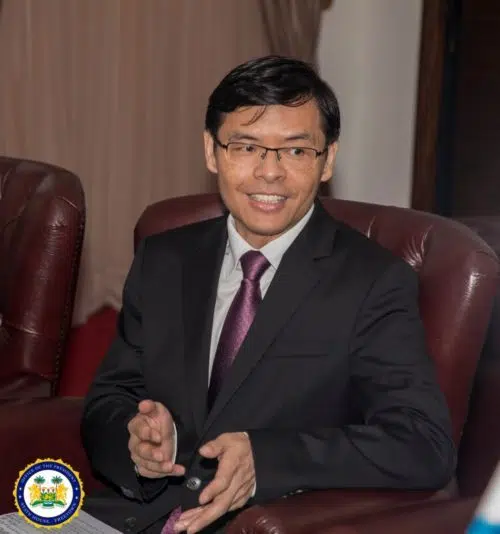
The Deputy Chinese Ambassador Wang Xinmin said there were 216 million malaria cases and 445.000 malaria deaths all over the world in 2017. Recognizing the large global disease burden, the United Nations Sustainable Development Goals for 2030 include combating malaria.
Also, Malaria is very serious in Africa. According to the estimates in the World Malaria Report 2018, there were 194 million malaria cases (89.8% of the world) and 407,000 malaria deaths (91.5% of the world) in Africa. In the African continent, Sierra Leone is one of the countries severely affected by malaria with a high prevalence and deaths.
Although it has made an ambitious goal, malaria control and elimination is still a big challenge. In order to share the latest knowledge and experience on control and prevention of malaria as well as the progress on operational researches, and to explore the potential approaches towards forming an international collaborative network of malaria control and elimination in Africa, China CDC and The Ministry of Health and Sanitation of Sierra Leone jointly organized this Training. “We are delighted to have some Chinese experts with extensive experience in malaria prevention and control to share their ideas and knowledge with local experts in the next one week, and explore potential barriers and approaches towards control and eliminating malaria in Sierra Leone and other African countries.”
He said he believes that this training will have positive and far-reaching impact on China-Sierra Leone public health cooperation, especially for malaria prevention and control cooperation. I hope that all experts will work together to make this training a great success. Professor Duan the team lead at China CDC said Sierra Leone is one of the most severely malaria-burdened countries in Africa. Malaria causes a severe and great socio-economic impact for people here.
The professor said the efficient response to tackle malaria cases require effective diagnostic techniques, which includes RDT and microscopy for malaria. Therefore, on this demand, China CDC in collaboration with MOHS/ NMCP developed a training course for Laboratory technicians in the hospitals, Community Health Centres and the Public Health Reference Laboratory, which aims to strengthen the capacity of malaria diagnosis.
“Our Facilitators have excellent experience on malaria prevention and control, especially in malaria diagnostic techniques. I believe all trainees can benefit a lot from this course. No one should die from a disease that is easily diagnosed and treated- and that is the case with malaria. In the1960s, about 30 million people were infected by malaria each year in China. With the great effort of government and professional experts, China has reported no indigenous malaria cases in 2017.”
“One of Chinese experts, Tu Youyou, discovered artemisinin, and she won the 2015 Nobel Prize in Medicine. Artemisinin has saved millions of lives in the world, especially in African countries. And I hope, by the efforts and contribution of all Health Development Partners and the government of Sierra Leone, no one would die of malaria in Sierra Leone in the near future.”
Other speakers includes Dr Donald Bash Taqi and Dr Smith as they commended the China CDC for training and appeal that more of such will be done so that all District will have these technicians.
Findings of the Civil Society in Sierra Leone on the recent Choithram Hospital misunderstanding over comments by the Indian Vice President, when he recently paid a visit to this country, are now in the public domain. In a release dated 28th October, the Consortium for Civil Society said it was concerned over the Ministry of Information and Communications position statement contained in a press release on Choithram being a charitable hospital.
After investigations, the Consortium said it found two issues very disturbing. First is that Choithram hospital was named as Choithram charity; and secondly Choithram hospital an absolute charitable hospital. In its findings, the Consortium said that the description given by the Ministry of Information and Communication was wrong as the hospital was not found to be a charitable hospital
Instead, the hospital was doing charitable treatment of persons without economic status to pay the cost of fees for certain ailments and this was done all by itself without either government subvention or international aid from India.
Even the hospital’s name is not found to be CHOITHRAM CHARITY HOSPITAL rather CHOITHRAM HOSPITAL. In conclusion, the Consortium advised the public to discountenance the rumour that has brought misconceptions about the hospital. Another point also found is that Choithram Hospital lacked proper records of their charitable treatments they are giving out. The Consortium also advised the hospital to do publications of all free medical operations and treatments each year.
The Government through the Ministry of Information and Communications was cautioned to verify its records before making claims contained in public policy documents. It would recalled that Choithram Hospital is not being funded by either a Government of Sierra Leone subvention or funds from India and it should find other sources and not depend on proceeds from the hospital to run it alone.
Two Sierra Leoneans, Mr. Abu Bakarr H. Kargbo, Audit Officer at the Irish League Credit Union Foundation (ILCUF) Ltd. and Mr. Jaiah Kaikai, Secretary-General of the Supervisory Committee of the National Cooperatives Credit Union Association Sierra Leone (NACCUA) and Chairman of the Bo District Teachers Credit Union have returned home successfully after attending this year’s 20th Annual Congress of the African Confederation of Cooperative Savings and Credit Associations (ACCOSCA) congress held from 14th-18th October 2019 at the Pride Inn Paradise Hotel in Mombasa, Kenya.
The theme for the congress was ‘Embracing Servant Leadership and Inclusivity Through Financial Co-operatives.’ The conference had over 800 participants drawn from 30 countries worldwide including Sierra Leone’s delegation which was sponsored by Irish League Credit Union Federation Ltd. (ILCUF) in order to expose them to what credit unions are doing in other parts of the world.
In an interview with this medium, the two participants said this year’s theme was more align with the principles of the Cooperative Business Model and Servant leadership as both are people-centered. They underscored that ACCOSCA strongly holds the view that they should practice leadership that actively listens and empathizes with their members’ unique circumstances and positions to be able to meet the objectives of the sector.
They enlightened that ACCOSCA has envisioned a scenario where all are focused primarily on the growth and wellbeing of people and communities to which they belong underscoring that this can only be realized if ACCOSCA allows itself to follow and practice in its fullness the principles of cooperatives and understand their original objectives.
They also articulated that there is deeper penetration and acceptance of the model and they were encouraged because it is heading towards financial inclusion for all.
There were discussions critical for all members on inclusive growth, membership growth, financial capability, regulatory gains and digital financing among others which highlighted if they get these right in addition to embracing the concept and practices of servant leadership, they should be able to make the difference they are seeking affirming that they trust that the discussions would be beneficial to all participants.
The two participants continued that they seek to provide through the congress a platform for credit unions in Africa and all stakeholders to have candid discussions that would culminate into deliberate and innovative strategies towards achieving Financial Inclusion.
The first two days of the congress were allocated to training on the following topics: Liquidity Management, Board and Management, Successor Planning, Effective Communication, Cyber Security Safeguards and Resource Mobilization.
In Kenya and the entire East Africa where Credit Unions are well-established, Mr. Abu Bakarr H. Kargbo said that over 50% of the population are members of Credit Unions with some people joining two or more Credit Unions including medical doctors, police, armed forces, teachers, farmers and drivers etc.
Sources further state that teachers have the largest Credit Unions in Africa, and it is mandatory for all to join Credit Unions in Kenya. Normally, their contributions are deducted from sources.
Back home, the two men have called on the Ministry of Trade and Industry to review the Cooperative Act in order to amend it to join Credit Unions that would help reduce poverty and unemployment as well as improve the lives of the people.
A two-day training on how Credit Unions attended by Mr. Jaiah Kaikai was useful because he became so vigilant and independent thereafter to effectively perform his responsibilities at home more than ever before especially how to retain employees .
Other topical issues discussed were electronic financing, diversity in leadership, gender, region, bringing the physically-challenged on board, religion and unity in diversity through cooperatives and how to build a succession plan.
Highlights of the congress were experience sharing between different Credit Unions on how they have become successful as well as their challenges, thematic sessions on techniques to develop the capital base of Credit Unions, launch of the first African Cooperative Youth Network to encourage savings at a young age or catch them young as the congress observed that youth participation in financial institutions is low globally, the official flag parade of all participating countries while the congress was officially opened by the Kenyan Minister of Industry and Trade.
ACCOSCA Congress in Kenya is one of the many exposures made by Credit Union leaders, staff and regulators this year. At the beginning of the year three representatives from Sierra Leone (Mrs Mary Bundu NaCCUA treasurer, Mr Issa Bangura Chairperson Tawopaneh and Ms Esther Bangura ILCUF staff) attended and participated in West African block of credit unions in Gambia.
In August, the Acting Registrar of Cooperatives Mr. Newton R A Marlin and Deputy Director Other Financial Services from Bank of Sierra Leone Mrs Esther Johnson participated in ACCOSCA Regulators round table for all Credit union regulators from Africa in Nigeria. At the end of September, the Chairperson of NaCCUA Mrs Lilian Songo participated in International Partners Conference in Ireland.
The Irish League of Credit Unions Foundation (ILCUF) has been supporting credit unions in Sierra Leone since 2011. The mission of the Irish League of Credit Unions Foundation (ILCUF) is to alleviate poverty in developing countries by providing financial and technical assistance to credit unions, their representative bodies and other co-operative type organisations to enable them to bring about socio-economic development. ILCUF Ltd is funded by Credit Unions in Ireland and Irish AID.
A credit union is a cooperative financial institution that is formed and democratically directed by people who come together to meet common economic, social, and cultural needs. Credit unions provide both lending and saving services to their members.
Founded on the principle of participatory governance, credit unions are governed by those who use their services: their members. Credit unions only offer their services to their members who purchase shares in the credit union. Credit unions are not-for-profit organisations, who distribute their surplus as dividends to their members and also provide interest on savings. Members save regularly every month, and this form a pool of money which is lent to members by way of loans at reasonable rates of interest charge.
On Thursday, 24th October Conservationists gathered at the Tacugama Chimpanzee Sanctuary in Regent, West of Freetown to exchange ideas and information on the vital components of Tacugama’s work in Sierra Leone and as a Chimp Sanctuary that has immensely contributed to building the capacity of teachers and supporting children in Sierra Leone.
The workshop was facilitated by Teaching and Education expert, Dr. Debbie Tuckwood, BA. (Hons) PGCE Doc Soc Sci, who conducted the ‘Focus on Teaching and Learning Workshop for 13 Teacher-Coordinators of the Roots & Shoots School Clubs at Tacugama Chimpanzee Sanctuary. The aim of the workshop was to explore best practice teaching techniques to help inspire students and make learning stick.
Roots & Shoot is a youth empowerment programme that inspires and enables young people to become compassionate leaders who are globally mindful and locally active by guiding them through youth-led, community environment–related projects that help people, animals and the environment.
In February this year, World-renowned primatologist, Dr. Jane Goodall visited Sierra Leone and formally announced the launch and partnership with the Jane Goodall’s Institute (JGI) to establish Roots & Shoots in the country. This event has made Roots & Shoots now active in Sierra Leone amongst other countries around the world.
The club is now in 13 secondary and primary schools whose teachers were drawn from 8 schools within and outside of Regent. Five secondary and 3 primary school teachers will have to serve as coordinators of the club in their respective schools and at the same time serve as ‘Ambassadors’ for Tacugama guiding students to take responsible actions towards environment/wildlife protection.
The trainer, Dr Tuckwood is a skilled educator from the UK who regularly presents and writes about best practice in education. She has been involved for over 40 years in teaching (primary, secondary and adults), curriculum development, examinations and occupational standard setting.
Dubai based Elite Agro has been engaged and lured over to invest in Sierra Leone in the agricultural sector. This was disclosed from the UAE capital where President Dr. Julius Maada Bio met with the Chairman of Elite Agro, Sultan Alshamsi on Saturday 26 October 2019 and discussed about possible ways of investing in food cultivation in Sierra Leone.
Elite Agro is the leading producer and distributor of agricultural commodities in the UAE, engaging in growing, sourcing, importing and marketing a wide range of high-value agricultural products through world-class technology and effective distribution chain with the most economic use of natural resources. The company operates in several countries in Africa and around the world.
During their talks, President Bio told Agro Elite the importance of food security as part of his human capital development priorities. H said the country needs adequate food production in order for the overall developmental plan of the government to succeed.
Our government has been encouraging investors in the agricultural sector to be able to produce more food, create jobs, and reduce the importation of foodstuff, particularly rice – the staple food of the country. He also noted that Sierra Leone was a perfect place for agricultural activities because of its fertile land and added that with the required modern technology, the country would return to its past glory of being a rice exporting nation. He also mentioned that he was looking at possible ways of transferring modern skills to locals, saying that that was the best way of taking people out of poverty.
“We want to produce more food to feed our people and reduce rice importation and as well begin to export food items to other parts of the world. We have landed the African Free Trade which means we also have a big market of 1.2 billion to sell our products. We also want improved technologies because that will help us get improved variety of crops,’’ he said.
The Chairman of the Elite Agro, Sultan Alshamsi, was very elated at the report given by the president about his country. Sultan Alshamsi said that they were interested in investing in Sierra Leone because of the favourite climate they had seen. As a result, he assured of readiness to help the West African nation grow its own food to feed its people with enough to export, which would help boost the local economy.
Other areas of investments like skills transfers to locals, etc, all in a bid to ensure that the country produces enough food for sustainability. The president was accompanied by the First Lady Mrs Fatima Maada Bio, Sierra Leone’s Ambassador to the UAE, Rashid Sesay, and other senior members of government, was also taken on a conducted tour of various operating farms of the Elite Agro in Al Ain, UAE ‘s inland oasis city on the eastern border with Oman.
Although ignorance of the law is no excuse, ignorance of facts is a complete defense. What happened at the Basharia Mosque last Friday for which many views have been expressed clearly showed the importance of Sierra Leoneans to be fully conscious that religion is a source of value, identity etc. Its fundamental principle is the oneness of God and his highest creation – human beings should love one another, serve and respect each other at all times.
In a pluralistic society like ours, religious communities have power and influence and they must be careful to avoid the temptation to use religion as a yardstick influence opinions or change. This can prompt one in a dangerous direction.
Political parties are mixed with many other interests. The goals of politics are quite different from those of religion. Therefore religion must promote external values and not allow political programmes and persons to use it for egotistical interests at the expense of others.
Thus, as a nation, we must focus on how to make religious values instrumental for a better society, and not as a tool to divide and sow the seeds of animosity and hate among us.
As such, religion should promote freedom, justice, care for and respect for the freedom of conscience of all, not only for those who belong to our religious group.
In this light, religion should not be used for political gains or to seek support for political power in advancing its goals. To do otherwise will set the stage for the abuse of the rights of sections of the citizens.
Sierra Leone is a secular state and this should be used by all people not to divert the values of religion and politics together. Instead, it should be used for the good of society to build national cohesion.
The state of Sierra Leone is inherently a democratic one in which the equality of all constitutes becomes a fundamental tenet because of it is a sovereign state and everyone is equal in all respects, including thought and conscience.
Certainly, it would be a contradiction to think of a state that imposes a dominant religious or political belief on others, either expressly or insidiously. Thus, a denial of religious liberty is the most invidious means available for those that contrive to dehumanize their fellows.
The right to religious freedom is a fundamental prerequisite for every other right, both physical and conceptual, and the worst form of abuse and discrimination that can happen to any human being is to be persecuted for the reason of how one conceives and practically relates to God.
Religion shall be respected and the State shall protect churches, mosques and places and objects of worship, provided they abide by the laws of the State. It is for this reason that international human rights instruments and the constitutions of African States guarantee the right to freedom of thought, conscience and belief in addition to religion.
Thus, we are not against the right of ‘religion’ being guaranteed by the State, rather are of the strong belief that socio-economic and political circumstances do not favour the marriage between the State and religion and that any such relationship is subject to exploitation and could be dangerous for the image of the particular religion and for the cohesion and stability of the State.
In a liberal constitutional democracy, when citizens or officials seek publicity to justify their policies, they should rely only on reasoning accessible to all rational citizens, and should refrain from invoking reasons, such as religious justifications, that are not cogent to all rational people.
We sincerely hope that the point is made – that Sierra Leoneans are one, and that we should never allow religion and politics to divide but unite us at all times; even in the diversity of our religious and political convictions.
Following a widely circulated video from two American Tour Bloggers about the Ministry of Health Staff attached to the border crossing with Liberia extorting $150 from them in a fake scam about Cholera Vaccine, the Anti-Corruption Commission’s Scorpion Squad have arrested and detained three identified staff, including two tourists, for further investigation.
The Scorpion Squad was immediately invoked by the Commissioner after reviewing the video last night and they moved in and set an intelligence perimeter around the border crossing point at night. They then moved in with precision to arrest the said staff as they came in the morning for work having confirmed their identities and locations. They were transported to the Commission in Freetown by the ACC team stationed in Bo to answer for the shame and disrespect they have brought to the country and its people should the investigations confirm their alleged actions.
The ACC is currently taking steps to locate the tour bloggers so they can assist with the investigation and have the money taken from them refunded. The Commission said they will be grateful if anyone who knows their whereabouts can contact them before they leave for Guinea.
The ACC is assuring the Public that it will leave no stone unturned to help launder the image of the country and to hold the corrupt responsible for their actions and crimes.