
Home Blog Page 1339

Big Brother 2019 to emerge soon

As at present free voting for the Big Brother 2019 is going on intensely as the competitors are fighting tooth and nail to convince the judges to select them to the final stage. Already, 40 contestants have been shortlisted the Big Brother 2019 is fever pitch as people are looking forward to watch an interesting TV Reality show.
The Judges decided to shortlist 40 finalists but at the end of the day it will be 20, 10 male and ten female, who will be allowed to enter the House on 14 February 2019. The stage is now set for the finale.
It will interest readers to know that, for transparency sake, the organisers of this TV Reality Show, have decided to give the general public the opportunity to participate in the selection of the 20 contestants who should enter the House. The opportunity will take the dimension of the public voting through the Africell Sierra Leone TOLL FREE LINE – 5500.
In the final analysis, the first twenty participants with the highest votes will qualify to enter the Housemates Salone 2019 House. Voting is absolutely free.

This will be the premier Big Brother Reality Show in this country but ironically despite the name, it will be a mixed combination of male and female housemates in the House.
The organisers continue to remind the public that every housemate will receive Le100, 000 for every day they stay in the House with the exception of the winner and the criterion for staying in the House depends on the amount of votes the individual polls per day.

Would be housemates are encouraged to galvanise their fans and supporters to be in readiness to cast their votes for them if they fall in the number of the 20 housemates selected to be in the House.

The competition is going to be keen, especially after Sierra Leoneans have enjoyed a successful Big Sister Salone and saw the handing over of the star prize to the eventual winner.

The show is another opportunity for the Africa Young Voices Media Empire (AYV) to not only entertain, but to empower young people to showcase their talents and at the same time create new millionaires among Sierra Leoneans.

With the launch of this latest TV Reality show, Big Brother Housemates Salone 2019, AYV in partnership with Africell seeks to further raise the stakes and empower more youths.

Following a successful nationwide audition, the Judges of the Housemates Salone 2019 Television Reality Show have released the list of Top 40 Applicants for the show.

The public is hereby invited to vote for their favourite applicants.

The Top 20 Applicants with the highest votes will make it to the House on February 14th 2019.

Remember that voting through Africell’s 5500 is completely free.
Below are the names of the 40 shortlisted contestants:

1. Abu Turay
2. Affise Odubella
3. Alusine Kamara
4. Amina Konneh
5. Aruna Lamin
6. Bintu Kaba
7. Derick Kelvin
8. Diana Decker
9. Dwight Smith
10. Dyllis George
11. Emmanuel Coker
12. Enid Boston-Jones
13. Fatmata Sankoh
14. George Wyndham
15. Habbi Jalloh
16. Hassan Hallowell
17. Henry Fonah
18. Monica Yeani Ghaliwa
19. Ibrahim Shuhab
20. Ibrahim Sorie Barrie
21. Isata Marion Musa
22. Ishmael Mauzi
23. Jalikatu Conteh
24. Jennifer Jabba
25. Jonathan Fitz John
26. Kenchine Palmer
27. Kariatu Mansaray
28. Magdalene T Williams
29. Marvina MK Davies
30. Mohamed Alie Jalloh
31. Moriana Walker
32. Precious Kamara
33. RaIford Rollings-Bull
34. Rashid Dyfan
35. Regina B Jombo
36. Saheed Komkanda Bangura
37. Salamatu Kargbo
38. Salim Sahid Kamara
39. Sebatu Bright
40. Suad Koroma

Sierra Leone Strike fails to slow Iluka

Full-year zircon production rose from 312,000 tonnes in 2017 to 349,000t last year, with the boost coming from the higher ore grades and improved recoveries at Jacinth-Ambrosia in South Australia and additional release of zircon in concentrate.
Demand for zircon did slow in the fourth quarter although demand in Europe and India slowed more than Iluka expected, but there was minimal impact to Iluka’s sales attesting to strong underlying demand in China, although that remains contingent on a healthy global economy.

Rutile production for the year was down 46% to 163,000 tonnes, including just 122,000t from the Sierra Rutile business.
Lower rutile production had been expected with the end of processing in the Murray Basin, and the strike in Sierra Leone.

The strike, which the company considered unlawful, helped production fall almost 30% for the year, compounding commissioning and operational issues with the in-pit mining unit and dredge issues.

There has been some good news on Sierra Leone, where Iluka is progressing expansions, with an inaugural rutile resource for the Pejebu deposit, adjacent to current mining operations.

Pejebu consists of 23.4 million tonnes of 0.95% in situ rutile, containing 220,000t.

Synthetic rutile production was up 4% to 220,000 tonnes with production from the SR2 kiln in eastern Australia setting a new record for the 22-year-old facility.

The kiln will undergo am eight week major maintenance outage from February, and when it returns it will process around 200,000tpa of material from the new ilmenite-rich Cataby mine.

While the company was hit with operational issues, revenue was up 22% for the year to A$1.25 billion thanks to a 41% spike in average zircon prices to US$1351/t, and a 21% increase in rutile prices to an average $952/t but sales were down 7% to 827,000t due to the production constraints.

Overall fourth quarter zircon, rutile and synthetic rutile production eased 7000t to 187,000t, but pricing was higher with zircon commanding $1530/t and rutile $1038/t.

The company’s primary zircon mine, Jacinth-Ambrosia operated at full capacity over the course of 2018, delivering higher than anticipated ore grades and improved recoveries through the Narngulu mineral separation plant in WA.

The company ended the year with net cash of A$2 million.

Shares in Iluka, which have ranged between $7.02 and $12.20 over the past year, were up 3.2% to $7.75 earlier today, valuing the company at some $3.3 billion.

Secret Society on the rampage

Members of a secret society in Sierra Leone went on a rampage in the South-East of the country to protest a new ban on initiation rites prompted by deadly unrest, Police said on Thursday.
Vowing to defy the ban, the assailants attacked the village of Liema, near the third city of Kenema, on Wednesday, storming the police station and freeing detainees, said police spokesperson Brima Kamara.
“They targeted peaceful citizens in Liema village chanting Poro songs and forcing the inhabitants to hide,” Kamara said, adding that they looted homes.
Poro societies – widespread in Sierra Leone and other West African countries – carry out initiation rites for boys involving ritual scarring during retreats in “sacred woods” that can last for several months.
The ban followed clashes on Monday near a site occupied by agricultural giant Socfin, which residents accused of trying to occupy land they say belongs to a local secret society.
Sierra Leone police said they had opened an investigation into two deaths during the clashes, which also left one of their officers injured.
In a separate incident, a secret society kidnapped nine people as they travelled to work for mining firm Sierra Rutile in Moriba, in the southwest of the country.
“We will go ahead with our secret society initiations because it’s our tradition,” a member of the Poro society affirmed from Kenema.
More than 90% of Sierra Leoneans are thought to undergo such rites of passage.
Girls undergo a Bondo ritual, which follows a similar pattern but also involves female genital mutilation (FGM), a practice banned in many countries and condemned as potentially lethal by the World Health Organisation.
Sierra Leone has one of the highest rates of FGM in the world.

Pres. Bio blasts against rape and sexual violence

“This is disgraceful, shocking, and callous! It is shameful for us as a nation,” a visibly angry and deeply emotional President Julius Maada Bio has said in reaction to graphic and disturbing details of the nature and numbers of rape and sexual violence cases.

He had requested the meeting to learn more about the work of the Rainbow Centre and to solicit their views on how to stem the alarming increase in the number of reported cases of sexual violence and abuse all over the country. The Rainbow Centre is a national non-governmental organisation that works with survivors of sexual violence and abuse.

Dr. Gladys Claudius-Cole, a medical doctor who had worked pro bono with the centre since its establishment in 2003, presented a history of the establishment and expansion of the centre around the country, stressing that they were overwhelmed by cases of rape and sexual violence but were also dismayed that the rate of successful prosecution was abysmal.

She furthered that in spite of the anxiety about acquiring a sustainable funding stream to support their work, more interagency collaboration is needed especially with the Ministries of Health and Gender and the Sierra Leone Police’s Family Support Unit (FSU).

The justice sector had also been continually engaged, Dr Cole continued, adding that the trend is worrisome, particularly because of the ages of the victims and perpetrators and the cruelty of violence meted out to the survivors.

“Girls below 10 years and as young as 3 months have been subjected to sexual violence. The perpetrators are also getting younger and there have recently been multiple cases of gang-rapes by children as young as 12,” Dr Cole pointed out.

She concluded that significant deficiencies in existing laws and legal processes meant that fewer than 5 per cent of reported cases countrywide were successfully prosecuted.

Dr Bintu Mansaray, another medical doctor who volunteers at the Rainbow Centre, added that the complexity of cases is daunting, especially as a higher number of rapes and sexual violence had ended in unwanted teenage pregnancies. She recalled that there had also been recent cases of necrophilia and bestiality and more cases of HIV and STD transmissions in addition to rabies after a perpetrator set a dog on a victim.

Dr Mansaray also discussed the issue of safe homes for survivors as there had been multiple cases of survivors being raped again by their perpetrators who were family members. Social responses to and perceptions of sexual violence had resulted in silence, compromise, and outright complicity by families and communities, she said.

She also lamented the worrying trend of video centres, across the country, showing pornographic films to audiences of underage children, emphasising the point earlier made by Dr Cole and calling for forensic facilities. She called for a change in the legal processes so that rape experts, rather than just registered medical professionals, could testify in court in order to increase prosecution rates throughout the country.

Daniel Ketoh, Executive Director of Rainbow Centre, disclosed that the NGO was 100 per cent donor-funded but that was not assured and not sustainable. He added that a recent increase in the number of centres, to five regional headquarter towns had led to increases in the number of reported cases of sexual violence. He also drew attention to the fact that the centre is presently staffed by mainly interns and volunteers and that Government could play a role in enhancing cooperation between the FSU and the Police Medical team.

Responding, President Bio thanked the Rainbow Centre for its selfless but relentless work in treating survivors and providing training for police and the judiciary in order to develop their capacity to deal with sexual violence. He offered that a holistic approach to the issue was more desirable and promised to immediately constitute a taskforce comprising the experts at the Rainbow Center, the judiciary, Police, MDAs, and other stakeholders.

The President announced that he had already directed the Ministry of Social Welfare to comprehensively review the Sexual Offences Act but he also believes that Government could take a lead in a comprehensive plan of action, including part funding, interagency support, the provision of mobile and other forensic labs, and dealing with cultural attitudes towards rape and sexual violence.

“We must face this menace boldly. We must face this challenge and we must win as a nation,” the President concluded.

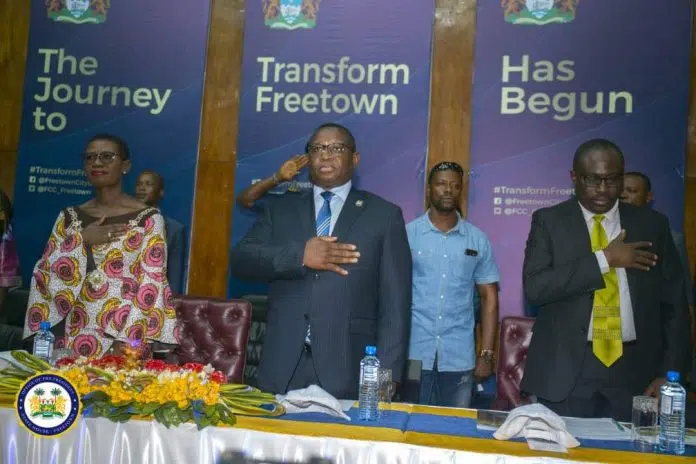
Pres. Bio Launches Transform Freetown Initiative

His Excellency President Julius Maada Bio has unveiled the ‘Transform Freetown’ initiative by Freetown City Council (FCC), expressing his excitement about central government’s involvement because the blueprint aligns very closely with the New Direction’s priorities and vision.

In his keynote address, the President said that the insistence on purposeful planning, local participation and engagement with the private sector and other stakeholders, public accountability, improving the efficiency and quality of public service delivery, were all aimed at training citizens, providing opportunity, and making Freetown a better, more liveable and more resilient city that resonated very strongly with him.

He added that the three-year development plan for transforming Freetown deserved and would get the full support of his government.

“PAOPA, our Freetown will be clean. So within the last 8 months in governance, my government has supported the Freetown City Council with direct financial disbursements of 18.3 Billion Leones. My government is committed to working for Freetown and in making our Freetown a better city for all of us,” he assured.

President Bio also asked questions, in the form of well-intentioned suggestions, about FCC’s proposed plans on municipal assets, congestion in the city, disaster management during the rains, leveraging ICT to boost revenue mobilisation, promoting tourism and the informal settlements as they relate to bigger issues of social exclusion and social injustice.

“In the past, we saw how municipal assets were illegally appropriated by the politically powerful and their rogue agents. My question is, does the initiative aim to recover those assets?…And is it not possible to plough back proceeds from value-added city assets into the development of the city especially in new infrastructure for sewage disposal, water supply, and sanitation?” he asked.

The Mayor of Freetown Municipality, Yvonne Aki-Sawyerr, said that circumstances in Freetown had been challenging over the years, adding that there was so much pressure in Freetown on housing, environment as well as the growing need to provide basic social facilities for residents.

She congratulated the President for his commitment to decentralisation and said that his appearance at the Transform Freetown initiative event was a testament to that statement.

“We want to ensure that by working with the central government Freetown will be restored to its lost glory. The Freetown City Council has sought to align its agenda with that of the national development plan,” the Mayor said, adding that they wanted to create the necessary jobs within Freetown that would deter the youth from embarking on difficult migration journeys.

The Minister of Finance, Jacob Jusu Saffa, commended the Mayor for moving in the right direction and aligning their programmes with the vision of the New Direction, adding that because local council resources were always scarce, it was the responsibility of government to provide funding for councils.

Deputy Minister of Local Government, the Honourable Philip Tetema Tondeneh, said that FCC had developed a shared vision for the betterment of Freetown, adding that the vision of the council could not be realised without support from the central government.

He also recognised that key progress was being made by the FCC and thanked them, in particular, for automating the local tax collection system. He commended the President for reintroducing the monthly cleaning exercise, which he credited for reducing cases of flooding in the city, adding that developing Freetown was imperative because it accounted for 30 per cent of the country’s Gross Domestic Product.

Davos: Africa boosts free trade while global barriers go up

A new African free trade area could be just weeks away as the last few countries ratify an agreement signed last year. The plan to boost intra-African trade by half is gaining much attention in Davos this year.
When you ask Tony Elumelu if Africa would profit from free trade, the Nigerian entrepreneur and philanthropist does not have to think long. “If we look at other parts of the world, intra-regional trade helped significantly. For us to develop in Africa, we must embrace this,” he told DW at the World Economic Forum in Davos. “We need to develop and broaden the market. We need to integrate Africa by trade also.”

He might not have to wait much longer for this to happen. Last year, 49 African countries signed the Continental Free Trade Area (CFTA) agreement, which is supposed to do away with tariffs on most goods and other trade barriers.

The agreement will come into force once 22 countries have ratified it. With only seven more to go, it might only be a matter of weeks. So in times when others are erecting trade barriers once again, leaders on the continent are edging closer towards establishing the largest free trade area since the World Trade Organization’s inception.

It would create a market with a combined GDP of around three trillion dollars and, according to the African Union (AU), boost intra-African trade by 52 percent. As enterprises will get the chance to enter new markets, unemployment is predicted to fall and economic output to go up. And the effects in the long-run could be even more substantial.

“Those nations who trade in raw materials are the ones that are poor. Those that actually trade in value-added products are the ones that are rich,” Akinwumi Adesina, president of the African Development Bank, explained. But as African economies will be able to cooperate more closely, he hopes companies will create more elaborate value chains to produce higher-quality goods.
Also, he considers the CFTA a big chance to attract investors. “Africa is open for business, the opportunities are there,” he said. “When people look at Africa, think of the population, think of the middle-class, think of the huge opportunities to invest across borders.”
Investments would come at a crucial time when it is estimated Africa lacks up to $100 billion (€88 billion) for infrastructure projects alone.

Making it work for the 99 percent
But as rosy as the economic future may seem, there are, of course, also challenges that governments will have to overcome. Winifred Byanyima, the head of Oxfam International, warned leaders of what freewheeling globalization can lead to.

“We have richer countries, richer companies, richer people gaining from trade liberalization and many others left behind,” she said. Whether Africans with lower incomes will also benefit from the CFTA would depend on what measures of success those in charge apply. “The most important measure is the good quality jobs that will be produced for our young people and for women.”

A new era — also for Nigeria?
Despite these words of caution, euphoria for the CFTA is high. Before Africa lies the beginning of a new economic era; and some regard it as only that, a start. Bernard Gautier of French investment company Wendel, for example, has already called for even deeper integration by means of common currencies.
And Tony Elumelu advocates to not only let goods flow freely. “We need to carry common passports or at least simplify the border entrance so that people can move freely intra-Africa. People who move freely can trade – and not otherwise,” the billionaire said.

NATCOM & Civil Right Coalition schools students on Cyber Security and Data Protection

The National Telecommunication Commission (NATCOM) and the Civil Right Coalition on Monday 21st 2019 engaged students on Cyber Security Data Protection at the Atlantic Hall, National Stadium.
In his opening statement, Deputy Director General of NATCOM, Daniel Kaitibi said NATCOM has always been under attack from criminally minded people (419ers) who perpetuate illegal activities. He pointed out that the engagement is geared towards raising awareness in tackling such criminal issues. He underscored that they are working with Civil Society Organizations (CSOs), the Police, GSM Operators and others partners.
“Seeing a lot of young people here today makes me feel good because most times they are the ones engaged in such practices either because of lack of jobs or sometimes do so deliberately. But again it not only limited to hear it but there is need to take proactive steps to deal with them squarely as people have suffered and lost millions in the hands of these criminals,” he maintained.
On his part the National Coordinator for Civil Rights Coalition, Alphonso Manley, said the issues of Cyber Security, Data Protection, one Gibe Fraud, Sim box fraud and Money Fraud, have become too alarming in the country which is why they have become a big concern. He noted that they are not experts in that area of fighting cyber-crimes which is why they decided to approach NATCOM, the Police and the Mobile Operators wereas they will continue to raise awareness and sensitization on those issues. He thanked NATCOM for responding to this national call.
Alphonso stated that they are targeting the youth because they make the bulk of the population that use the social media.
He added that his organization will champion the raise alarm against Cyber-crimes just as they are championing sensitization of the Free Quality Education that was initiated by President Bio.
Thaimu Ballah Sesay of the Sierra Leone Police stated that the Cyber Crime Unit was established in 2009 but at that time there were not much of such crimes other than sandbox fraud, but the magnitude of Cyber-crime is now alarming in the country because of emergence of the social media. “We also have Bank fraud, internet fraud, Electronic Money transfer fraud, phone theft, robbery and murder and all these crimes are connected with Cyber-crime,” he stated.
He stated that the Electronic Money transfer fraud (Airtel Money and Africell Money) is really alarming right now as the criminals are using the name of high profile authorities to defraud people.
He stated that political rivalry, student rivalry, are some of the factors that are responsible for committing Cyber-crimes and it is common among youths especially students. The use of the social media to publish false stories to malign others is again is another issue, he added.
“We are faced with serious challenges in terms of laws to penalize perpetrators. We only use the Public Oder Act of 1965, and the fines are too small. For sim box fraud we use the 2005 NATCOM Act which is why we welcome the repealing of it,” he furthered.

NGOs & INGOs call for review of new policy

In what they refer as preventing hampering their activities, Non-Governmental Organizations and Civil Society in Sierra Leone are calling on the Government to review a new policy aimed at tightening regulation of their operations. Activists say the policy, which is soon to become law, will hamper their work as watchdog in society if it is implemented in its current state.
The new Development Framework Document is the brainchild of the administration of former President Ernest Bai Koroma, which had argued that it wanted to increase government’s oversight of the activities of the non-state actors thereby ensuring the effective utilization of public resources.
Among other things, the policy requires NGOs, both local and international, as well as CSOs, to register with an umbrella organization for NGOs in the country. It also requires them to have in place a minimum of four staff, which does not include cleaners and drivers, before commencement of operations.
An even more controversial provision is that all NGOs and CSOs should align their work or development programs to the government’s development program. In other words, the government’s identified priorities should be the priorities of the NGOs.
The activists say this has the tendency to prevent rights-based organisations, for example, from pursuing human rights issues. In December 2018, Cabinet under the current President Julius Maada Bio reportedly approved the document.
Last week the campaign against the policy was reintroduced. Some of the country’s leading CSOs and NGOs convened a press conference in Freetown where they called on the new government to review the document.
Ibrahim Tommy, Executive Director of the Center for Accountability and Rule of Law, is one of the leading voices against the document. He said these are just three of many “entry barriers” created by the new policy and which has the tendency to curtail their operations.
“Our work is such that we do not receive tax money. People have to apply for funds before they start implementing such ideas,” he said. He added: “Government’s role is to provide an enabling environment for these organisations to operate as citizens because there is freedom of association.”
When the last government announced plans to introduce the policy, civil society and NGOs at the time expressed concern over it. And there have been wide range of consultations between activists and government representatives.
But according to Mr Tommy, the last government decided to ignore most of the recommendations they made.
“That is why we want government to review this document again and work on the language so that the objective of this policy, as we have been told by the government, which is to promote coordination, accountability and transparency will be achieved collectively in a way it cannot restrict the space for us in the sector,” he said.

QCELL another telecoms “Gam” in town!!!

The latest telecommunication company, QCELL, which, with his entry, has raised expectations from various quarters to be one of the best that will outwit others like Africell and Orange has turned out to be a big disappointment at this initial stage of its operations. Many are now having second thoughts about the effectiveness of QCELLl in terms of offering sound telecommunication services.
Frustrated subscribers of the company have bitterly complained that though the company’s internet service is on and initially was speedy but it now very slow. Again, various attempts made to connect to whatsapp have been quite impossible. What is rather queer is the fact that there are certain QCELL numbers that have been connected to whatsapp wereas others get the reply from the company that certain numbers are not recognized, meaning they cannot access whatsapp. The other bizarre thing is that whenever Customer Service is contacted on 111 they always promise that they will respond but such never transpires.
An embittered subscriber,Sallu Kamara, put to us this bitter complaint and at the same time proffered a recommendation or suggestion : “The proclaimed savior ( Qcell ) internet is now slow, very very slow, I have called several times to complain but yielded no fruits. Why don’t they stop the selling of sim for now and do monitoring and evaluation of the customers to see if it can take more? It is now taking me more than 5 minutes to open a status, 10 minutes to open Facebook and YouTube is now a MESS. I live here in Freetown (around Siaka Steven Street) so they should not tell me the network is not good here.”
In a bid to get the Management of QCELL to comment on the following aforementioned inadequacies or lapses a battery of journalists went to the company’s headquarter on Cockrill North, Wilkinson road, where it was discovered that even though there is a reception but shockingly were informed that they don’t have a receptionist. There were only security guards at the gate but they were very arrogant and rude in responding to questions that were put to them. The action of the Press men was not at all surreptitious as they identified themselves, displaying their identification cards, but that did not remedy the rude attitude caustically unleased by the security guards.
Getting in touch with the Administrative Manager of QCELL, one Michaela Mackintosh, via the phone she informed the journalists that she is out of the office but she faithfully promised that someone will talk to them. The journalists waited patiently for up to three hours without being contacted. It was at that time the journalists again contacted Michaela but this time around she responded that unfortunately nobody will talk to them as the entire staff were engaged in a meeting. What was so baffling is the fact that how could an entire staff be engaged in a meeting for over three hours without a receptionist or any personnel to attend to visitors?
An outstanding Social Commentator, James Andrew, opined during a privilege conversation that QCELL should not give the flimsy excuse that both their network or system is not properly in place and they are trying to fix it up. “They should have ensured that everything is intact before they commenced operation in the country,” he firmly maintained adding that the National Telecommunications Commission (NATCOM) must be very mindful of these shortcomings and execute the appropriate monitoring steps.
In a vox-pox conducted it came out clearly that most people are not impressed with this initial way QCELL l has started its operations calling for improved service delivery but frankly stated that for now QCELL is a “Gam” or a mess.
When we called Customer Care on 111 and raised the issues the response we received was that the company is having some technical hitches but they are working on it.

Electrifi empowers Bumbuna II hydroelectric project with $3.5 million

Energy is very important to any country for any country’s development but it must be noted that it is very much expensive to provide it countrywide. Indeed, recently this country has made commendable strides in the provision of electricity supply and many parts in the provinces are now benefitting from solar energy.
Just recently, Electrifi has granted $3.5 million to the development company for the Bumbuna II hydroelectric project in Sierra Leone. The investment represents 50% of the financial mobilisation deployed on the dam, whose work is scheduled to begin at the end of 2019. The 143 MW facility will accelerate economic growth while reducing the ecological footprint of a country where only 20% of the population has access to electricity.
As phase two of the Bumbuna hydroelectric dam is coming to an end, the European Union’s Electrification Financing Initiative (ElectriFI) is committing $3.5 million to finance 50% of the external development costs required for the financial closure of the project. “We are delighted to have received ElectriFI’s support at this critical stage of the dam’s development. Our team is now focused on completing the remaining activities so that construction of this important project can begin,” said Andrew Cavaghan, founder and executive chairman of Joule Africa Limited, the company responsible for developing the project.
Located on the Seli River in Bumbuna, a town 200 kilometres northeast of the capital Freetown, the hydroelectric plant will have a capacity of 143 megawatts (MW). According to Joule Africa Ltd., the work will take four years.
By signing the funding agreement on January 16, 2019 in Freetown, Dominiek Deconinck, ElectriFI fund manager, indicated the meaning of the support provided by his organisation. “Bumbuna II is essential for the Sierra Leonean government. It will stimulate the energy sector and support the economic growth strategy. The energy produced will indirectly encourage investment in transmission and distribution networks. Aware of these advantages, the government made a commitment in August 2017 to purchase the energy produced by the plant for 25 years.
The realisation of the Bumbuna II hydroelectric project is also guaranteed by a feasibility study carried out in 2017. It was this study that recommended that the Sierra Leonean authorities review the capacity of this structure, from 365 MW to 143 MW, in the interest of the people and nature. As far as nature is concerned, the vegetation cover will be less affected by attacks from people who use wood fire lighting, as the structure will enable Sierra Leone to increase its national electrification rate from 20% to 30%.