Home Blog Page 635

Milton Margai University Court Exonerates Prof. Philip John Kanu

By Foday Moriba Conteh

At the well-attended General Assembly of Staff and Students held on Tuesday, 6th December 2022 at the Milton Margai Technical University Great Hall, Goderich Campus, the Milton Margai Technical University Court has exonerated the Vice-Chancellor and Principal of the University Prof. Philip John Kanu from allegations made against him by former staff of the university. This pronouncement was made by the Chancellor of the university Dr. Victor Kabia.

It could be recalled that the Permanent Secretary of the Ministry
of Technical and Higher Education, Gilbert Cooper, in a letter suspended the Vice-Chancellor and Principal of the University Prof. Philip John Kanu and requested the University Court to investigate him.

Addressing the gathering on the outcome of the court meeting, the Chancellor of Milton Margai Technical University Dr. Victor Kabia said the University Court was properly constituted and independent, that MMTU was established by the University Act 2021 and is administered on structures, that the Court has established various structures as well as developed committees to address issues as and when they arise.

He also encouraged staff to upgrade themselves as recommended by the Tertiary Education Commission (TEC) which pointed gaps in staff capacity, lamented that some staff absent themselves for months, while others conduct lectures and examinations at home with others employed in two jobs or take leave or study leave without approval or reference to their conditions of service.

Highlighting some of the challenges facing the institution, Dr. Kabia, observed that some lecturers wanted to disrupt the comprehensive examinations, non-payment of backlog arrears owed to the institution by Government for over three years, difficulty in accessing Government grants-in-aid, land grabbing, late payment, non-payment of staff benefits of Le.26.6 billion and payment of rent allowances to staff due to the lack of funds.

He went on to identify flaws in the University Act 2021, revealed that the Vice Chancellor and Principal of MMTU, Dr. Philip John Kanu has fulfilled all the conditions to serve in the capacity including mobilizing resources and assured that he would continue to do good works for the institution.

The Minister of Technical and Higher Education, Dr.  Alpha Tejan Wurie said Government has secured funding to rehabilitate the University, called for classes to commence now as he wants MMTU to do well underscoring that Sierra Leone has high-quality students citing those who just returned from India where they excelled in a global competition.

He also reiterated that MMTU would grow after the upheavals, that students have the right to belong to political parties of their choice, that Sierra Leone is not doing badly compared to other countries in the world and is effectively managing its resources and economy and appealed to all to bury the hatchet as he wants the administration to start functioning immediately.

In his statement, Dr. Philip John Kanu affirmed that he wholeheartedly accepts the report of the Committee, that he would return to the MMTU with an open heart and would not offend anyone as MMTU is close to his heart, that the committee is competent, that the President has demonstrated true leadership and apologized for the hate speech audio that went viral emphasizing that everything is past and is looking towards the future and has also forgiven the lecturer who rebelled against him.

He also assured students that he is back to seek their welfare and protect them, that while on suspension people called and insulted him and even his mother, assured that he would not mention any of the issues that caused the disturbances, that the future is in their hands and appealed to lecturers to do their work diligently asserting that even in his absence the institution was effectively managed as the World Bank and other delegations visited the MMTU.


 ‘Craving 4 Development’ Hosts Symposium On Strengthening Agri-food Supply Chains In Africa

By Foday Moriba Conteh

As part of their efforts towards strengthening Agri-food Supply Chains in Africa, Craving 4 Development, in collaboration with SL Agcelerator has on Wednesday concluded a three days Pan African Symposium on agriculture: strengthening agri-food supply chains in Africa.

The three days symposium, which marks the 3rd edition of the Pan African Symposium on Agriculture: Strengthening Agrifood Supply Chains In Africa was held at the Bintumani Hotel on Aberdeen in Freetown.

Speaking to this medium the Founder of Craving 4 Development, Aminata Kane Balde  said the vision of the symposium is to create a regional knowledge and partnership based platform that help harness the power of youth involvement in Agriculture and the potential of agricultural innovation, food sovereignty as well as investments and connected supply chains in Africa.

She added that the Symposium aims at setting in motion an initiative that allows practical knowledge sharing, export readiness, and exposure to systems, businesses, enablers, and innovations in order to build robust frameworks and agro-industrial companies, with enhanced human capital, interconnected networks of experts, well-structured and accessible markets, and opportunities for sustained collaborations.

Aminata Kane Balde stated that this year’s event marks the third edition of the Pan African Symposium on Agriculture bringing 23 African countries together from December 5th to 7th 2022 with a focus on Strengthening Agrifood Supply Chains in Africa. The event recorded 11 million engagements on social media and trended in 8 African countries for its 2nd edition held in Dakar, Senegal in November 2021.

She said that the overall objective of the Symposium is to support African youth to take advantage of the great African opportunities in terms of sustainable production and value addition, access to markets, partnerships and investments, furthering that at the end of the symposium, they should be able to provide better opportunities to develop linkages between African markets, build capacities and transfer technologies, and to ensure that young Africans are equipped to foster sustainable production and value addition in the agricultural sector.

Aminata Kane Balde revealed that the Symposium was structured to suit the varied needs and diverse stakeholder expectations. The various themes were discussed in breakdown sessions to allow a more thorough understanding of the issues: The villages were set up to showcase products and services as well as innovations that are representative of the African ‘Agri-entrepreneurial’ potential.

The Pan African Agrifood Chain which was founded by Aminata Kane Balde and co- founded by Tafadzwa Chiganga and Tolulope Aina in many African countries were represented and a Rainbow of African expertise and diversity were also displayed.

U.S Embassy Supports 8 Community Organizations with $40,000 Grants

Ambassador’s Special Self-Help (SSH)

By Foday Moriba Conteh

The United States Ambassador to Sierra Leone, David Reimer has through the Ambassador’s Special Self-Help (SSH) Program presented grants totaling USD 40,000 to eight Sierra Leonean-led community organizations that are working to improve economic and social conditions at the local level. The presentation took place during a press conference held at the U.S. Embassy in Freetown.

The funds will support projects in seven districts in the east, west, north, and south of Sierra Leone.  Projects receiving funds this year include those doing programs to support adolescent girls and women with limited economic opportunities through skills training, those providing clean water and conducting campaigns to promote hygiene best practices to reduce the risk of contracting water-borne diseases and support income generation and food security through aquaculture, rice cultivation, plantain and banana cultivation and grain store construction.

In his address, the Ambassador congratulated the grantees and noted the important role played by the communities themselves, who are actively engaged in the planning and implementation of each project.

These initiatives are funded by the Ambassador’s Special Self-Help (SSH) Program, which supports small, community-based projects throughout Africa.  These projects are designed in cooperation with community members, who contribute their own resources, usually in the form of labor and in-kind donations.

He informed that gathering that the Special Self-Help Fund was suspended for several years due to the COVID-19 pandemic, and they are so delighted this year to be restarting this initiative to help hard-to-reach communities in Sierra Leone using local organizations.

He stated that the grants is one of his favorite programs because it allows them to respond directly to community requests and to fund projects that have an immediate impact on communities in Sierra Leone.

He maintained that there was a lot of competition for funding as they received quite a number of good proposals, but the fortunate organizations were among the top 10 percent of all applicants.

“The work that you will do is more important now than ever. Many of your communities have been hit hard by the disease, floods, the effects of climate change, rising prices, and other economic hardships. I’m happy that the U.S. Embassy can help cushion these impacts of these events through the good works of your organizations,” he revealed.

He said that some of the projects will provide clean water and conduct sanitation campaigns to reduce the risk of getting infected with water-borne diseases while others will help support agricultural programs in rural communities and others will help adolescent girls and women with limited economic opportunities.

He underscored that while the focus of the projects varies, all will have a direct impact and help vulnerable members of their communities help themselves.


Cowbell Supports National Inter-School Brass Band Competition

Cowbell, one of the brands marketed by Premium Divine Trading Company Limited, a food distribution company that operates as an agent for Promasidor Holdings, a leading distributor of quality food products in Sierra Leone has supported the grand finale of the 1st ever National Inter-School Brass Band Competition.

The 1st ever National Inter-School Brass Band Competition was launched on the 10th April 2021 by C&K Consultancy in partnership with one of the leading telecommunications companies in the country, Orange Sierra Leone at the National Stadium Main Bowl in Freetown.

Since the launch of the first ever inter Secondary School Brass Band Competition which is an opportunity for participating schools to show case the talents of the competitors and make their schools proud, various Secondary Schools  have been battling to ultimately arrive at the final outcome.

9 schools, which include the St. Joseph’s Secondary School, Vine Memorial School, Prince of Wales School,  Government Model School etc. made it to the finale.

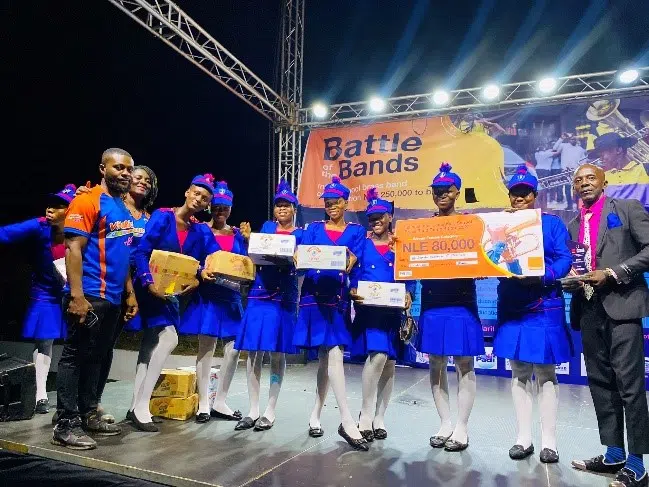
After the nine schools competed in the grand finale competition St. Joseph’s Secondary School emerged as winner in the female category and they were awarded the sum of Eighty Thousand New Leones (Le80, 000).

Prince of Wales School also emerged winner in the male category of the competition and they were awarded the sum of One Hundred Thousand New Leones ( Le 100,000) followed by Government Model Secondary School that emerged winner in Co-Education category and was awarded Seventy Thousand New Leones (Le 70,000).

All the top 3 schools in all the categories received cartoons of Associated Cowbell Products as consolation prizes.

Speaking at the ceremony, the Country Manager of Premium Divine Trading Limited, Kenneth Konuah, said that Premium Divine Trading Limited deemed it fit to support the 1st ever National Inter-School Brass Band Competition as part of their Corporate Social Responsibility in the country.

He said that the Premium Divine is a quality food company and they are committed to ensuring that everybody enjoys good food.

Kenneth Konuah stated that Cowbell products come in 14g sachet, 20g sachet, 360g sachet and 400g tins for the milk.  Also, cowbell food drinks package sizes are 40gs for the Coffee, Strawberry, Coconut, Choco-Malt and Cowbell Mocha. They are all produced in Ghana by Promasidor Ghana Limited for export sales to some West African countries including Sierra Leone.

He used the opportunity to inform all that the Company also distributes and markets, Onga, Miksi Chocolate and coffee drinks, Xploza, Kremela, and Yumvita, the latter being an infant cereal with milk also containing wheat, rice, and maize.

The Country Manager stated that as a company they can guarantee the availability of quality food products for consumption by everyone with Cowbell products.

He concluded by appealing to all to always buy the quality food products of Premium Divine Trading Company Ltd especially Cowbell milk because it is enriched with all the necessary nutrients needed for growth in the family.


Rainbow Initiative Ends Walk with GBV Survivors 

By Foday Moriba Conteh

As part of their efforts in showing solidarity with survivors of Sexual and Gender-Based Violence in the country and across the globe, Rainbow Initiative has on Saturday 3rd December 2022 held a one-day 25-Kilometer walk in solidarity with survivors of Sexual and Gender-Based Violence in the country and across the globe on the theme: “Be a Champion and End Sexual Violence”. The one-day 25-Kilometer walk started at Up Gun East End of Freetown and ended at Lumley Beach in Freetown.

Speaking at the climax of the event, the Executive Director of Rainbow Initiative, Daniel Kettor, said that the walk with survivors is in commemoration of this year’s 16 Days of Activism against Gender-Based Violence which is an annual international campaign that kicks off on the 25th November, the International Day for the Elimination of Violence against Women, and runs until the 10th December, which is Human Rights Day.

He said that Rainbow Initiative is one of the leading organizations that is advocating towards eliminating Sexual and Gender-Based Violence in the country and in that regard they deemed it fit to organize the walk-in showing solidarity with survivors of Sexual and Gender-Based Violence in the country and across the globe.

The Executive Director added that the event reaffirmed the organization’s commitment towards ending Sexual and Gender-Based Violence in the country and also to reiterate their commitment towards supporting survivors with their services which includes free medical treatment, sanitation and counseling in order for these survivors to be able to reintegrate in their various communities.

He informed all that from their 6 Rainbow Centers from January to October 2022 they have supported 2,180 cases of Sexual and Gender-Based Violence in various communities in the country.

Daniel Kettor said that at the end of the 25-Kilometer walk wit, and for SGBV survivors, they calling for an END to all forms of Sexual and Gender-Based Violence especially those committed against women and girls in the country.

The German Ambassador to Sierra Leone, Jens Kraus Masse, commended Rainbow Initiative for the initiative towards walking in solidarity with survivors of Sexual and Gender-Based Violence in the country.

He said that the 16 Days of Activism against Gender-Based Violence  is an annual international campaign that organizations all over embark on in order to end Gender-Based Violence in their society.

Jens Kraus Masse called on all to show commitment towards ending all forms of Sexual and Gender-Based Violence against women and girls in the country.

The HR Director at Partners in Health, Alusine Bangura, said that Sexual and Gender-Based Violence is a menace in our society of which he called on all to be ambassadors in their schools, communities etc. in order to end the menace in the country.

He said that if Sexual and Gender-Based Violence continues to exist in the society it will create a threat to women and girls.

The Country Director of Trocaire, Laura Lalor, said that as an organization they will continue to stand in solidarity with survivors of Sexual and Gender-Based Violence.

She added that the 16 Days of Activism is used as an organizing strategy by individuals and organizations around the world to raise awareness and demand justice for victims of SGBV of which she described the walk as very important towards the Elimination of Violence against Women and Girls in the country.


MRCG Unveils State of the Media Report 2018-2021

By Foday Moriba Conteh

The Media Reform Coordinating Group (MRCG) has on Monday 5th December, 2022 officially unveiled the State of the Media Report 2018-2021. The report that is led by the Faculty of Communication, Media and Information Studies, University of Sierra Leone with support from the National Endowment for Democracy (NED) was launched at MRCG’s Office on Circular Road in Freetown.

In his address, the National Coordinator of Media Reform Coordinating Group (MRCG), Dr. Francis Sowa said that the Report presents a critical overview of the prospects and challenges in media freedom and development in Sierra Leone, with a special focus on the 2018-2021 period, as well as the role of the media in the country’s sustainable development pathways.

He pointed out that is it is broadly divided into two parts: the first presents an overview of the media landscape during the period under review focusing on freedom, professionalism, performance, state- media relations, regulations, management, ethics, etc.; while the second presents academic articles on the role of the media and access to information in sustainable development.

“As this Report shows, Sierra Leone has in the past four years made progress in the entire gamut of press freedom and freedom of expression ecosystem; thanks largely to the historic repeal of Part V of the Public Order Act, 1965, which contained the offences of Criminal and Seditious Libel. But the report notes that there are still some challenges relating to the safety and security of journalists and investment in the media landscape as media poverty continues to affect the industry,” he revealed.

He concluded by informing pressmen that the Report is a continuation of the last edition published in 2018 which largely contained issues and events in 2017.

On his part, the Chairman of the Independent Media Commission, Victor Massaquoi, PhD, described the report as a critical piece of research designed to test many questions bordering on human rights, freedom of expression, policy environment and the media landscape in the country.

He said that the report is rich in information, knowledge and content. He informed all that by several measures the state of the media in the country has drastically improved between 2018-2021.

“Over the years we have registered many newspapers and radio stations and we will continue to register media houses across the country. Despite the challenges, which include, a reduction in the revenue of the media, cutbacks in terms of newsroom staffs, improvement in terms of policy but at the same time the media continues to strive in the country,” he maintained.

Head of Journalism Department Faculty of Communication, Media and Information Studies, Fourah Bay College, Joshua Nicol, said that since the inception of the Media Reform Coordinating Group the then Mass Communications now Faculty of Communication, Media and Information Studies, University of Sierra Leone has been playing a leading role in terms of coloration of literature regarding the media landscape in the country.

He added that the State of the Media Report 2018-2021 has closed a lot of critical gaps in the media literature of the country.

Launching the report, the President of the Sierra Leone Association of Journalists, Ahmed Sahid Nasralla commended the Reform Coordinating Group (MRCG) for putting together and launching of the State of the Media Report 2018-2021.

He said that there has been a lot of development within the media landscape in the country, although there are challenges but efforts have been made so far to address those challenges within the media landscape.

Ahmed Sahid Nasralla said that SLAJ is very concern about the welfare of journalists of which he said some steps has been taken to address the issue of the welfare of journalists in the country.

The President concluded by officially launching the State of the Media Report 2018-2021.


Sierra Leone Urban Research Centre holds City Learning Platform Meeting

By Millicent Senava Mannah

The Sierra Leone Urban Research Centre, in collaboration with the Freetown City Council and with support from ACRC, on the 6th December 2022 held a City Learning Platform Meeting on the theme, “Translating Research into Impact”.

The meeting, which was held at the YMCA Conference Hall, situated on Fort Street in Freetown was geared towards exploring ways to translate research findings into impact on the example of the African Cities Research Consortium Project.

Giving the overview of the City Learning Platform, Executive Director SLURC, Joseph Mcarthy, intimated that their research was conducted in three informal settlements; Susan’s Bay (Coastal), Moyiba (Hillside), and CKG (Coastal).

He furthered that they sought to facilitate and coordinate knowledge sharing, bringing together all sets of stakeholders that are involved in addressing critical urban issues and challenges.

The Executive Director stated that, according to research they did in 2016, the residents of Freetown, the capital city of Sierra Leone, experience serious disparities in relation to their access to basic housing, infrastructure, and services. He maintained that currently Freetown’s informal economy is estimated to provide jobs for as much as 70 percent of Freetown’s population.

He affirmed that taking forward concrete actions to improve the social, physical, and environmental conditions of the lives of informal settlement residents, should be at the center of Freetown’s concerns.

“The last decade has witnessed more and more efforts to work collectively to resist evictions and improve the conditions of informal settlements, with the emergence and consolidation of community-based organizations such as the Federation of the Urban and Rural Poor (FEDURP), and the creation of community structures around saving groups,” he disclosed.

“The City Learning Platform (CiLP) is a space for learning and sharing, in which different actors can gather to discuss experiences, current urban issues and identify solutions, coordinate, and develop proposals for the upgrading of informal settlements in the city of Freetown,” the Executive Director stated.

He maintained that the City Learning Platform will provide a model of engagement that targets three major elements; firstly, creating a democratic platform for policy dialogue, debate, and discussions.

He furthered that, secondly, creating a feedback chain from the community to the city level, and vice versa, allowing scaling-up of practices from particular communities to more informal settlements within the city, and institutionalizing and disseminating participatory planning methodologies that foster pathways to urban equality.

Thirdly, providing concrete solutions on how participatory processes can shape and solve developmental challenges in Freetown, deepening current understanding of informal settlements conducive to enable actions at different scales.

The Director of Research and Training, Braima Koroma, stated that, the City Learning Platform contributes to the informal sector (employment) of the city’s economy, and according to him, provides labour for household chores to residents in the city.

He noted that, even those deemed to be the most influential in the settlement- the chief and elected councilor struggle to have any voice at the city or national level in terms of ensuring that basic goods or services are delivered for residents of the settlement. According to him, their influence is very much limited to the settlement itself.

“Given prevailing political dynamics in the settlement- where one party dominates- there is no significant need for even political actors to even deliver basic services as part of a vote-winning election promise and as a result residents don’t stand to benefit informally or formally from political office holders. NGOs are the service providers to the settlement,” Braima Koroma stated.

He stated that Community organizations are small in terms of numbers of members and not well coordinated. According to him, that dynamic could be changed with the recent creation of the Local Chairman position, and how for now, there is a lack of a strong collective voice to put pressure on reforms.

The meeting was climaxed with a question and answer session, followed by a group work and group presentations.


World Bank Approves $100 Million to Consolidate Transparency & Accountability

World Bank

In a Press Release dated the 5th,  December, 2022  it was stated that  the World Bank Group Board of Executive Directors has approved the Second Inclusive and Sustainable Growth Development Policy Financing (DPF) – a $100 million grant which will support the Government of Sierra Leone to improve natural resource governance, enhance inclusiveness, and strengthen accountability and transparency in public finance.

This DPF, the second in a series of three operations, builds on a programmatic reform plan to support sustainable, robust, and inclusive growth in the country.

“Sierra Leone’s capabilities to eradicate extreme poverty and boost shared prosperity rest on sustained macroeconomic stability, robust growth, and a solid enabling environment for leveraging its abundant natural resources. This financing will help address immediate fiscal challenges, while improving overall governance to build resilience and enhance the delivery of services to the people of Sierra Leone,” said Abdu Muwonge, World Bank Country Manager for Sierra Leone.

Sustainable and inclusive growth has been constrained by the country’s exposure to multi-dimensional exogenous shocks (economic, epidemic, climactic), pervasive governance weaknesses, and limited fiscal space and fiscal risks, which inhibit the ability to promote pro-poor growth through public investment. Sierra Leone’s economy has been affected by back-to-back crises, which have aggravated inflationary and fiscal pressures, and increased the risks to debt sustainability. The reforms supported by this operation will help address several critical developmental challenges while also helping to meet increased financing needs of the Government.

“Ongoing structural reforms, including those supported by this operation in input markets such as land, labor, and natural resource management will support sustainability and resilience in the economy. The World Bank will continue to support the Government’s commitment to tackle crucial structural reforms to promote inclusive growth,” said Smriti Seth, World Bank Senior Economist and Task Team Leader.

The DPF is aligned with the Government’s Medium-Term National Development Plan (MTNDP 2019-2023). Mining reforms supported by the operation will help improve revenue collection, while reforms in auditing and state-owned enterprises’ governance will help control expenditures, easing fiscal pressures and creating space for growth-promoting investment.

It must be noted that the program builds on the strong foundation established by the first operation in this series, which initiated landmark legislative reforms, including promoting decentralized and inclusive land management, strengthening governance and licensing practices in the mining sector, and promoting gender inclusivity in education and employment.


President Bio Attends 62nd Ordinary Session of ECOWAS Authority of Heads of State

ECOWAS

President Dr Julius Maada Bio returns to Freetown on the 5th December, 2022 after a successful meeting of the Authority of Heads of State and Government of the Economic Community of West African States ( ECOWAS) that swears in the new President of the ECOWAS Commission and discusses governance, peace and security and other reports.

At the opening of the Sixty-Second Ordinary Session of the Authority of Heads of State in the ECOWAS, he took part in the swearing-in of the new President of the ECOWAS Commission, His Excellency Dr Omar Alieu Touray, the Gambian diplomat and development professional, who was appointed by the ECOWAS Authority of Heads of State and Government on 3 July 2022.

In his acceptance speech, Dr Touray presented four strategic objectives to include enhanced regional peace and security; deeper regional integration; good governance and inclusive and sustainable development as well as two enablers – capable institutions and equitable partnership.

The closed-door session also had on its agenda the 2022 annual report on the state of the Community, special reports of the ECOWAS single currency, a memorandum on the high-level mission of Heads of State to the Republic of Mali, date and venue of the next ordinary session and most importantly the draft declaration on the reform of the Security Council.

It is important to note that President Julius Maada Bio, as Chairperson of the African Union Committee of Ten (C-10) on the reform of the United Nations Security Council (UNSC) continues to provide leadership on such platforms as the ordinary session of heads of state and government.

It could be recalled that in his report, on the efforts of the C-10 in Addis Ababa, Ethiopia, on 6 February 2022, he made a stronger case to reform the UNSC, emphasizing at the time that although they had made progress, by embarking on a number of high-level consultative meetings, including the Summit of C-10 Heads of State and Government and the Meeting of Foreign Ministers, they must also remain steadfast to amplify the call for Africa to have an effective voice in the decision-making processes of the UNSC.


NaTcA, NMOS, CSOs Agree to Normalize Tariff

NaTcA, NMOS, CSOs Agree to Normalize Tariff

By Amin Kef (Ranger)

Mobile Network Operators, including Orange – SL, Africell, and Quell have on Friday 2nd December 2022 held a Consultative engagement with key stakeholders in what was described as Public Private Dialogue (PPD) on the need for a review on the cost of tariff across these Network Service Providers.

This, according to them, came against the backdrop of the unprecedented hike in dollar exchange rate in the nation which has had significant adverse effects on their operations as Mobile Network Operators (MNOs) such as what they spend in building new network sites, paying of huge capacity of staff, cost of fuel and their usual gesture in the form of Corporate Service Responsibilities (CSR) among other things.

These critical stakeholders included Operators, Consumers and Regulators.

The Director General of the National Telecommunications Authority (NaTcA), Daniel Bobson Kaitibi, said that while they understandably empathize with the MNOs, but the proposal would have to be critically looked into further recommendations adding that even if an increment in the cost for tariff would have to set in, let it be minimal so as to make their networks not only accessible but also affordable and available.

Mr. Kabia, who happens to be one of the Commissioners at NaTcA, recommended also that much as he endorses the need for an increment in the price for tariff, given the prevailing circumstances as advanced by MNOs, he advised that let it be minimal relying on Section 118 (2) (a) of the NATCA Act as amended adding that the networks should not only be accessible and affordable, but should be available and acceptable.

While making their remarks, both the Minster and Deputy Minister of Information and Communications – Mohamed Rahman Swaray and Solomon Jamiru (Esq.) respectively recommended to MNOs that wider consultations with consumers should be undertaken or embarked on

It must be noted that in a recent compelling statement issued during a Media Retreat and CSOs Engagement; Mobile Network Operators (MNOs) in Sierra Leone stated that they have good reasons for to increase Tariff in order to improve connectivity and sustainability.

Speaking to journalists, the telecommunications companies’ representatives said their sector has been one of the key drivers towards the development of ICT in the country and their contributions over the years towards the implementation of the President’s manifesto remains enormous.

They said their apparent commitment can be seen in being the biggest taxpayers and one of the largest employers and CSR Contributors of this country.

Over the years, they added, they have expanded their networks to reach remote areas with telecom services resulting to the construction of over 1000 sites and achieving a population coverage exceeding 90%.

The companies went on that they have launched 4G and 4G+ technologies for enhanced data speed and today their internet prices remain one the cheapest in the sub-region.

“We have created job opportunities for over 100,000 Sierra Leoneans with direct and indirect employment and remain a strong pillar for CSR and sponsorships in the country. We have launched foundations, Data, learning and e-learning centers, and have provided support for every facet of society in the media, entertainment, sports, entrepreneurship, and many other industries in this country. We have also renovated hospitals, health centers and supported disability and vulnerable members of our society, we have also built many schools, equipped classrooms, supported artists, football clubs and premierships, the national football team and provided learning courses nationwide to both primary, secondary, and tertiary institutions” they stated.

In a press statement, the companies said: “All of these contributions and achievements from our sector could not have materialized without their vast collective investments.”

For them to continue on the same trajectory, the telecommunications sector must be able to continue investing in infrastructure, making devices available and affordable and most importantly promoting a mutually beneficial relationship amongst all sector players and their valued consumers.

They added that whilst they understand the global economic challenges that affect the fabric of every nation today their sector is at an even worse position with the resultant effect being an exponential hike considering the cost of providing their services whilst trying to cope with the devaluation of the country’s currency having a fundamentally negative impact on their businesses and remain an impediment to their investment aspirations.

The telecommunications companies stated that whilst all other businesses have the freehand to increase their costs reflective of inflation and the devaluation of the Leone against the USD and other international currencies, their tariffs remain stagnated.

They complained that since the last tariff adjustment in 2017, the combined increase on some of their key cost variables stands at an alarming rate of 698% negative. These include the following:

Increase in Foreign Exchange rate against the Leones:

The present day value of the UD Dollar is at Le. 18,000 (Old Leones) to $1. This records an increase of 148% since the last GSM tariff change in 2017 when the exchange rate was Le. 7,258 (Old Leones) to $1. 50% of their costs go to CAPEX which is in dollars. How do we continue investing and sustaining our business when 50% of our CAPX alone has increased by 148% whilst our selling price remain the same?

Increase in fuel cost:

Fuel price is at Le. 25,000  (Old Leones) against Le. 6,000 per litre 5 years ago when the sector tariff was last reviewed. This records a colossal increase of 317% for a product that account for about high proportion of their total Opex.

Cost of Electricity Tariff and cost of Powering our Sites:

Even electricity tariff which is a similar utility service and a cost driver for their businesses has witnessed a significant increase of 78% from Le. 1,890 (old Leones) to Le. 3,364 (New Leones) as at July, 2022.

Cost of Internet (Zoodlabs):

Previously, the cost of 1 Mbps data from Zoodlabs was $ 8. Today, it is $13 per GB recording 63% increase and continues to increase when the Leone’s value to the USD increases. To make matters worse, Zoodlab’s price is not only fixed in dollars they are charged at the commercial bank rate.

Cost of Terrestrial Fiber (Leoncom)

The cost of terrestrial fiber from Leoncom has also gone up significantly.

The Cost of Site Construction Materials (Steel and Cement)

Whilst the cost of Cement per bag and steel per ton were Le 65,000 and Le 6,000,000 (Old Leones) in the past, they presently stand at Le. 145,000 and Le. 11,500,000 respectively accounting for 92% increase.

Inflation

Inflation as at today stands at more than 20% and could increase to 30%.

They said although they have struggled to absorb those increases over the years, the prevailing challenges are stifling their businesses and the situation is no longer sustainable.

“If our sector is left unattended to address the challenges we face today, the effect will be such that jobs will be lost, QoS will be impacted, our contribution towards CSR will be grossly reduced, rural sites that are heavily subsidized will be shut down,” the aggrieved telecommunications companies stated.

They emphasized on the criticality and the urgency to salvage their cry for tariff review, as that will foster and strengthen the sustainability of the telecommunication sector to increase their contributions to the development of ICT, whilst at the same time impacting the population of Sierra Leone and improving daily lives.

The companies are therefore calling for the immediate intervention of their regulatory stakeholders as their ability to further invest in Sierra Leone is dependent on resolving the prevailing challenges.

They concluded that the sector remains committed towards providing the best telecoms services in Sierra Leone and assured every Sierra Leonean that together they will fight and overcome the effects of the global economic challenges to become stronger and better.