
Home Blog Page 641

Residents of Calaba Town Vow to Throw Weight behind Mohamed Cellu Bah

By Millicent Senava Mannah

The Calaba Town Community is one of the fastest growing communities in the East End of Freetown with people from diverse backgrounds residing there with the location of few manufacturing industries that offer mainly menial jobs certain and support certain community-driven projects as a way of honouring or rolling out their Corporate Social Responsibilities.

As the population within the community continues to expand the vast majority of residents are grappling on a daily basis with easily accessing basic social amenities like pipe-borne drinking water, proper medical facilities, good road networks, getting commercial transport easily etc all putting a heavy toll or strain on especially children who have to trek long distances in order to fetch water with the resultant negative consequences of encountering fatalities from accidents, getting unwanted pregnancies and kids performing abysmally in their academic pursuits.

When recently a reporter of this medium visited the community with the aim of sound views of community residents on various issues related to the community,  many were very willing to share brilliant ideas and proffer workable recommendations.

With mixed reactions, some expressed the view that their past political representatives did little to enhance development taking place within the community as their main focus mainly directed to personal aggrandizement instead of seeking the general good.

However, there is another school of thought with the strong conviction that the negative attitudes of certain residents to always set development back, their lack of participation in undertaking development projects could speak volumes why certain constraints cannot be easily surmounted.

They argue that as a matter of fact, these are the very individuals who are destroying transformers and other Government properties with reckless abandon.

The greatest problem that was often mentioned as responsible for the constraints the majority are currently going through has been largely attributed to ineffective representation by those whom they entrusted the authority to champion their affairs.

“Although some of them made very lofty promises when lobbying for our votes yet when they succeeded in attaining political power they became strangers to us,” they expressed disgust with an elderly man, by the name of Osman Karankay lamented disclosing how this time round they will not repeat the mistake of voting for someone who promises big things only ending up paying them intermittent visits instead of residing with them, know their felt needs and find ways of bringing the people together to solve certain societal ills.

When a cross section of young people of the Calaba Town community was engaged to have their opinions of Mohamed Cellu Bah vying for the Parliamentary Seat most of them overwhelmingly stated that they believe that he (Mohamed Cellu Bah)has been divinely directed to boldly step forward in order to vie for the position of Member of Parliament vehemently pointing out that they are of the strong conviction that his leveled headedness, charisma and networking skills are all innate assets he possesses to provide the effective representation that residents of Constituency 114 have been yearning for as they strongly believe that he has all the wherewithal, the requisite skills necessary to facilitate development to transpire and the masses from the teething challenges they are confronting daily to access basic amenities needed to keep body and soul together.

“Mohamed Cellu Bah is no stranger to us,we know him, he has lived with us  and we are quite aware of what he is capable of doing and that is why we are strongly giving him our total support,” they said unanimously with one of them wittingly saying that the devil that is known is better than the angel that has not been seen.

The Calaba Town residents reiterated that they decided to throw their weight behind the dynamic and progressive young man in the person of Mohamed Cellu Bah with most of them vowing that they will go at extreme lengths to ensure they effectively campaign for him and ensure that he emerges as the elected Member of Parliament for Constituency 114, Calaba Town, after Wellington in the East End of Freetown.

Most of those engaged were eager  to inform that Mohamed hails from an influential business family within the Calaba Town Community  but stressed that despite the fact he is from a very good family background, nevertheless, he is not the type of proud person  as he is always seen rubbing shoulders with the high and low in society.

“As long as he is contesting under the All People’s Congress Party we will give him our mammoth support because we believe in the party and in him in as much as we have so far seen what he has done,” a guy popularly known as Gibo confidently stated.

They spelt out the good things that Mohamed has  so far donein rendering scholarships to primary, secondary school pupils and those in tertiary institutions  as well as helping others to get the subject requirements needed to enter Universities.

“It is only a person with a golden heart, love and compassion that will exhibit such a passion to help the needy and he is someone  whom we believe could effectively represent us if given the opportunity to do so,” a middle age woman operating a cookery shop spoke glowingly.

Some explained that when disasters befell the community in the past, Mohamed Cellu Bah led others ,to go about  a search and rescue operation. He as well personally provided shelter for the homeless, food and non-food items for the affected victims wishing them God’s protection and healing.

From what was also discovered, Mohamed Cellu Bah is the current Director of the National Emergency Advocacy Team-Sierra Leone (HEATS), a Civil Society Organization, that is mainly focused on advocating for the rights and privileges of the down trodden, the marginalized and disadvantaged members of society with premium being placed on promoting the welfare of women and children, considered to be the most vulnerable in society.

This advocacy team, which he personally founded, was very supportive to victims during various disasters that have befell residents in that part of the country with the provision of food and non food items to those that were affected.

As a matter of fact the Civil Society Organization developed an App which was able to capture the exact data of victims of the flash flood disaster that recently affected a community in Freetown, with the information or data turning out to be very significant to the National Disaster Management Agency (NDMA) and other Non-Government Organizations in their response interventions.

This medium was intimated that Mohamed Cellu Bah is fully paid up member of the APC Party and has played crucial roles in advancing the interests of the party forward. He is always present at any important party function and highly respected for the love he has exhibited for the party which why most of the residents our reporter spoke with said they have no doubt or hesitation that the elders of the party will endorse his election bid.

When our reporter caught up with the man of the moment, Mohamed  Cellu Bah, he informed  that his willingness and determination to turn around or improve on the terrible road network within the Calaba Town community, when he becomes the elected Member of Parliament of Constituency 114 and his stance to continue his educational empowerment of young people within and out of the Calaba Town Community through his sponsorships will be top on his development agenda.

By all indication and based on the thorough findings and investigation that our reporter conducted it seems that the majority of residents of Calaba Town are willing to choose Mohamed Cellu Bah as the next APC Member of Parliament for Constituency 114.


10 ways China is quietly working behind the scenes at the Qatar World Cup


One: World cup buildings are getting green electricity from a next-generation power station which harvests only solar energy,  built by the Power Construction Corporation of China.

Two: People are taken where they need to go in a fleet of 888 fully electric buses, made by Yutong Bus, a Chinese firm that has quietly become, as far as I can tell, the world’s biggest bus maker.

Three: The main stadium was built by China Railway Construction Corporation: that’s the firm that pops up in Africa and Europe and around the planet, known for its extraordinary ability to create infrastructure in difficult environments.

Four: What’s a sporting event without souvenir merchandise? It’s estimated that almost 70 per cent of World Cup related goods, from footballs to flags to jerseys to whistles, came from a single location in China, a southeastern city called Yiwu.

Five: A purpose-built extra-large reservoir is providing clean drinking water for sports people and fans. It was constructed by Gezhouba Group, from Wuhan.

Six: The stadium-building operations needed huge amounts of heavy equipment, from massive earth movers to cranes – nearly 100 of these were supplied by China’s Sany Heavy Industry, one of the world’s biggest construction firms.

Seven: The most innovative venue is Qatar’s Stadium 974, which can be disassembled and reassembled anywhere. Designed by a Spanish architect, the 974 building blocks were made by China International Marine Containers.

Eight: Notice all the LED floodlights everywhere? They come from the Unilumin Group of China.

Nine: Most people say air conditioners are a must for survival in that environment – and China’s Midea Co supplied 2,500 aircons for the event.

Ten: Last but not least, this is the most expensive sporting event in world history, and needed a lot of support from businesses. Nineteen China firms signed up to sponsor the event.

There’s a wonderful paradox about sports. Sports divides us into competitors—yet at the same time it gives us shared goals and so magically unites us at the same time. Gotta love it!


The Revealing Consequences Of The Declining Health Sector In The Country

Report by; Farid Kefel, for the Calabash Newspaper

The health system in Sierra Leone can be routinely characterized as a space of failure. This became especially evident during the Ebola outbreak and the Covid pandemic when the tragic inability of public health facilities and hospitals to diagnose, isolate or care for patients or to protect health workers was widely reported in global media, often via tragic images and sensationalizing descriptions of suffering. An important barrier to accessing health services is the cost of services and the inability of the population to financially access services. To address financial inaccessibility the Free Healthcare Initiative was introduced in 2010 to abolish user fees for all pregnant and lactating women and under-five children.

The Sierra Leonean health system faces challenges due to chronic underfunding, a heavy disease burden, vastly insufficient numbers, and skewed distribution of skilled Human Resources for Health (HRH). Capacity, both in terms of numbers, skills, and distribution of HRH, is one of the main barriers to improving health care. The National Action Plan for Primary Health Care, a planning document of the Sierra Leonean Ministry of Health for the restructuring of the country’s rural health services, is analyzed in its social, economic, and historical context. It appears to be an attempt of the national government to gain control over the highly devolved healthcare delivery system, but the state has neither the political will nor the power to achieve this goal. The utility of the document is therefore in doubt, which raises two important questions: Whose interests does this plan services, and at whose cost?

The alarming rate at which both young and experienced doctors are dying is a call for concern for not only the citizens of this country but also the government, as it shows the illuminating declining health sectors’ decay over the years. The lack of support and encouragement for doctors over the seeded years past and present has led to a massive shortage of professionalism and commitment within the health sector. Sierra Leone has long struggled with some of the world’s worst health outcomes—including a maternal mortality epidemic in which a woman’s lifetime risk of dying in pregnancy or childbirth is 1 in 20. Extreme poverty prevents most families from accessing health care. And often the care they need isn’t available, given the country’s severe shortage of trained clinicians, health infrastructure, and medical supplies. While health workers at Connaught often found the conditions under which they worked deeply demoralizing, on numerous occasions we witnessed people make unscripted interventions in patient pathways to improve their trajectories.

We observed many small, mundane acts that bridged gaps in technical and bureaucratic systems and ensured the continuation of patient care across different departments, institutions, and staff. Such acts included the physical transportation of a laboratory request form to another department, a phone call to retrieve missing information about a patient from another hospital, and the bringing of a patient’s sample to a private laboratory (where lab tests are completed) free of charge through a trust fund set up by junior doctors.

The leading direct causes of maternal mortality in Sierra Leone are obstetric hemorrhage (46 percent), hypertension (22 percent), obstructed labor (21 percent), and sepsis (11 percent). According to the Centers for Disease Control (CDC), Sierra Leone has the highest maternal mortality rate in the world, and one of the highest mortality rates for children under five: out of 1,000 live births, over 13 mothers and 111 children under five die. To address this issue and prevent death among children under age five, CDC helped establish the Child Health and Mortality Prevention Surveillance (CHAMPS) network in partnership with the Ministry of Health and Sanitation (MOHS) and the Bill & Melinda Gates Foundation.

In Connaught Hospital, descriptions and experiences of health system failure are often rooted in breakdowns in the temporal and spatial coordination of patient care. Samples went missing, lab results were not collected, a stamp was put on the wrong form or medical files disappeared. These small instances of breakdown were rarely dramatic or climactic events. They did not compare emotional weight, for example, to moments when doctors had to triage scarce resources, such as when one junior doctor had to ‘play God’ by deciding which patient should receive the only oxygen machine on the ward. Nonetheless, health workers were aware that frequent small lapses in coordination could have huge ramifications for patient outcomes. Patient care is always temporally and spatially distributed in a hospital: biological samples are extracted from patient bodies and transported to the laboratory (and in some cases private laboratories off-site), and multiple specialist doctors who move between patients’ bedsides depend on medical files to ensure that important information is shared.

With such a challenging combination of circumstances, it is not surprising that the health statistics for Sierra Leone are within the bottom quartile for least-developed countries (LDCs). In its Health Sector Report, 3 life expectancy is 51.3 years and less than 5 mortality is between 120 and 156 per 1000 live births. At Connaught Government Hospital in Freetown, where ethnographic research was carried out, staff often described the challenge of caring for patients in the face of an absent or broken system. Health workers pointed to a chronic shortage of essential equipment and resources, including diagnostic machines, laboratory reagents, and essential medicines, as major impediments to the accurate diagnosis of disease and the effective treatment of patients. But beyond noticeable material absences, health workers also described the less visible daily grind of working to coordinate care across different people, departments, institutions, and technologies in the busy hospital when ‘systems don’t work.


Catholic Archbishop Laments that a Dark Shadow Hangs over Peaceful Elections

By Abubakarr Harding

The Archbishop of the Catholic Archdiocese of has said leading political parties in Sierra Leone have given peace initiatives in the country a wide berth, the Archbishop of the Catholic Archdiocese of Freetown has said, and expressed concern that the conduct of the parties casts a dark shadow over the possibility of the country having a peaceful poll in June next year.

During an interview on Friday, November 25 interview with ACI Africa, Archbishop Edward Tamba Charles noted that a majority of parties registered for the country’s forthcoming elections have chosen to remain noncommittal to peaceful polls, and that many had refused to sign a document that would otherwise cement their commitment to a peaceful election next year.

The Archbishop who also serves as the President of the Inter-Religious Council of Sierra Leone (IRCSL) said that the council, having observed the protracted high political tension in the country amid fears of “a more violent” poll in 2023, had summoned all political parties to convince them to show their commitment to a peaceful election.

Unfortunately, Archbishop Tamba Charles said, not all political parties had sent their representatives to the July meeting, and that leading political parties, in particular, had completely ignored the call.

“Against the background of previous elections, in July the inter-religious council in Sierra Leone held a meeting with the representatives of the 17 registered political parties to convince them to sign a Memorandum of Understanding (MOU) to commit them to avoid the use of violence during the coming elections,” Archbishop Tamba Charles said.

He added, “After all our persuasion, only five of the political parties signed the MOU. Up to now, the other political parties, including the ruling SLPP (Sierra Leone Peoples’ Party), the main opposition APC (All Peoples’ Congress), and others have not yet signed the MOU.”

The Catholic Church leader further said that copies of the MOU that have been sent to the parties for signing had been ignored, noting that this had been interpreted as a lack of commitment to having a peaceful election.

The President of the inter-religious council in Sierra Leone noted that the country had been witnessing various acts of violence pitting civilians against the police, and also between opposing parties in parliament. Some of these, he said, had involved physical assault, with legislators hurling objects against each other in Parliament.

“As much as I can remember, Sierra Leone has had the rowdiest parliament in the last four years. We have seen MPs fighting and throwing things and insults at each other. There was another one this past Wednesday. The fight was over the Proportional Representation System of voting, which the Electoral Commission wants to use this time because the August 10 riots disrupted the constituency boundary delimitation process,” the Sierra Leonean Archbishop told ACI Africa.

He continued, “If the ‘Honorable’ Members of Parliament can fight each other in Parliament, what will stop them organizing violent attacks at election time?”

Highlighting a recent violent exchange between civilians and the police in the West African country, Archbishop Tamba Charles said,

“We had a very violent riot on 10th August 2022 that led to the loss of many lives – officially six policemen and 21 civilians and destruction of property.”

“What started as a peaceful demonstration against the high cost of living in the country soon turned into violent riots in many parts of the country, especially in the major strongholds of the opposition APC,” he said.

The Catholic Church leader who started his Episcopal Ministry in May 2008 as Archbishop of the then Archdiocese of Freetown and Bo noted that in Sierra Leone, some people have described the August 10 incident as “an insurrection” as the rioters were using slogans like “Bio [name of the President] must go!”

Some rioters, he said, had guns and other dangerous weapons such as machetes, and were planning to occupy the State House.

He said that preliminary investigations into the riot had shown that the members of the opposition APC had something to do with the rioters, even though they publicly denied any relationship with them.

Apart from Freetown, the riots took place mainly in the APC strongholds in the North and the North-west: Makeni, Magburaka, Binkolo, Kamakwie, Lunsar, Port Loko, and Lungi.

“The economic hardship is being felt all over the country, but there were no riots in the South and in the Eastern parts of the country,” Archbishop Tamba Charles told ACI Africa during the November 25 interview.

He said that the IRCSL had “roundly” condemned the 10th August violent riots and called for an investigation that would identify its organizers, planners, and financiers.

The Catholic Archbishop recounted that the political situation in Sierra Leone was relatively calm until the final results of the 2018 presidential elections.

Since then, he said, and particularly with the change of power from APC to SLPP, “the political temperature went high and has not gone down.”

“The election of the Speaker of the House of Parliament was marred by violence. Some members of the opposition APC lost their parliamentary seats as a result of court petitions, all of which were interpreted as a result of the manipulation of the judiciary by the Executive arm of Government,” the President of Sierra Leone’s inter-religious Council said.

And now, what the IRCSL fears the most is that the June 2023 election may be marred by violence, with politicians being the biggest orchestrators of the violence.

“Our fears are many: that the electioneering campaigns might be marred by violence; that the credibility of the elections might be undermined by the violence that might be orchestrated by some politicians; that the country might be further divided on tribal and ethnic basis, as some politicians are already doing,” he said.

In the interview with ACI Africa, Archbishop Tamba appealed to the Electoral Commission Sierra Leone, the body that is in charge of overseeing the electoral process in the West African country, to do all that is “humanly possible” to ensure that the electoral process is free of corruption.

“Let the electoral process be credible so that the results may be accepted by all,” the IRCSL President said.

He went on to urge the Sierra Leoneans to only vote for leaders who have the development of the country at heart and to resist the temptation to plunge the country into violence.

“Let us vote for the candidates we believe will work in the interest of our country for its people; that is, for the development of our country and the advancement of its people. Let us also allow others to choose their own candidates and to vote for them without fear of being victimized,” Archbishop Tamba said.

“Let us also avoid the use of violence and hate speeches before, during and after the elections. May we accept the results of the elections and allow the candidates that win to govern the country with our fullest cooperation,” he further said, adding, “Sierra Leone is the only country that we can call our home. Therefore, after the elections, the winners and the losers embrace each other and work together for the development of Sierra Leone and its people.”


Government Secures 1st Batch of Vehicles made in Nigeria

By Amin Kef Sesay (Ranger)

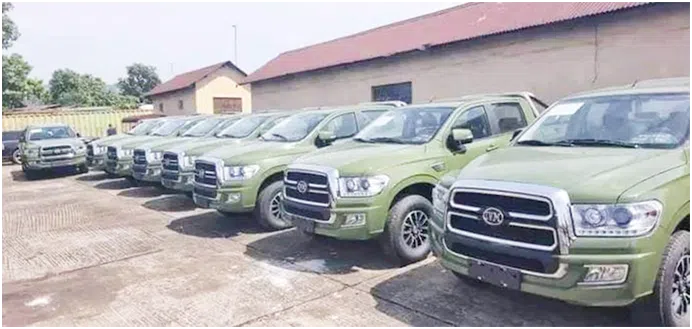
The first batch of vehicles manufactured for the Government of Sierra Leone by  Innoson Vehicle Manufacturing Ltd (IVM), has been delivered to the West African country by the Nnewi-based indigenous automaker.

The export of Innoson is coming two years after President Muhammadu Buhari signed the AfCFTA agreement in July, 2019.

The vehicles, which arrived at Freetown on Monday, November 21, 2022, were built to the order by Sierra Leone’s Ministry of Defence.

The request for the made-in-Nigeria vehicles was made during a working visit to Innoson Vehicles by top hierarchy of the Sierra Leone Defence Ministry led by Edward Soloku, the Minister of Internal Affairs as well as Sierra Leone Road Transport Corporation (SLRTC) led by its President  Isaac Ken-Green.

Head of Corporate Communications, Innoson Group, Cornel Osigwe, said in a statement that various models of vehicles bought within that dispensation were for the present administration.

Osigwe explained that subsequently, the Government of Sierra Leone led by President Julius Maada Bio placed an order for the manufacturing of Innoson Vehicles valued at $4.7 million  for the officers of Republic of Sierra Leone Armed Forces (RSLAF).

The first set of the vehicles supplied from Nigeria to Sierra Leone were as Monday leaving Queen Elizabeth 2 Port (Sierra Leone’s sea Port “Water Quay”) in Free Town for distribution to military officers across the country.

Reacting to the development, the people of Sierra Leone have been commending their President, Julius Maada Bio, for acting in line with the spirit of the continental agreement by opting for an African (IVM) brand of vehicles for the use of the country’s Armed Forces.

In one of the many reports in the local media on the purchase of the made-in-Nigeria vehicles, a popular blog in Sierra Leone, Focus News Blog, hailed President Bio for believing “that our Army Officers deserve better.”

The post, which showed a line-up of the IVM products from Nigeria, informed Sierra Leoneans that the vehicles would soon be “ready for distribution to military officers across the country” by the Government.

“Innoson Group has penetrated the vehicles market over the years. It is currently serving as one of the few wholly African car assemblers.

One of the effusive commendations for President Bio by a Sierra Leonean, Francis Ken Samu, remarked, “We are on top of the situation in times of security. Bravo HE President Bio. Keep the Military Colour Flag going up higher than ever before in de history of Sierras Leone.. God bless you, HE President Bio for equipping the RSLAF.”

This development is indeed a step towards the acceleration of intra-African trade as facilitated by the implementation of the African Continental Free Trade Area (AfCTA).

With the arrival of the Innoson vehicles in Free Town, Sierra Leone has become the first country in West Africa whose armed forces are using the IVM products outside Nigeria.

Four years ago, the Nigerian Army signed a partnership agreement with the Nnewi auto plant for the supply of purpose-built vehicles for its personnel.

The agreement also includes identifying requirements for the production of the armoured fighting vehicle in Nigerian Army Central Workshop in Kaduna and enhancing the capacity of Nigerian Army personnel to actively participate in the successful implementation of  joint ventures.


Political Parties Regulation Commission Bill Enacted in Parliament

The Parliament of Sierra Leone has on the 24th November 2022 passed into law the Bill entitled: “The Political Parties Regulation Commission Act, 2022”, with some amendments came into existence on the 24th of November,2022 after the Bill was passed into law.

It was a Bill seeking to provide for the continuation of the Political Parties Registration Commission as the Political Parties Regulation Commission, to provide for the regulation, including the registration of political parties by Sections 34 and 35 of the 1991 Constitution of Sierra Leone, and to provide for other related matters.

The Bill was piloted by the Deputy Attorney General and Minister of Justice, Umaro Napoleon Koroma.

The Bill had been debated and went through the various legislative stages with some amendments before final enactment into law.


Parliament Brouhaha…3 MPs & A Driver Accused

By Amin Kef Sesay (Ranger)

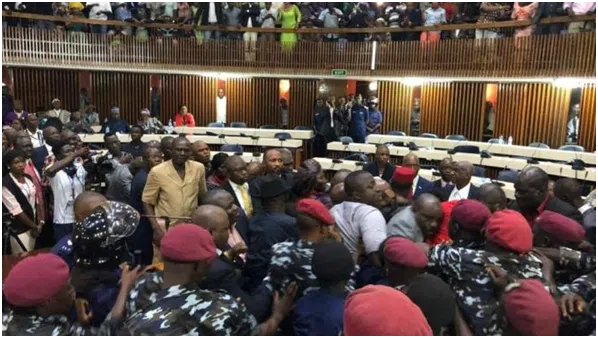
Parliament was, on the 23rd November, 2022 very tense as a brawl broke out in Sierra Leone’s Parliament in Freetown Wednesday (Nov 23) as MPs were in session.

Members of Parliament debated a proposed change to the electoral system to allow for proportional representation in next year’s election.

In video footage, representatives from the ruling Sierra Leone People’s Party (SLPP) and the opposition All People’s Congress (APC) party are seen fighting and throwing chairs.

The Electoral Commission for Sierra Leone advised switching to a proportional representation system for next year’s local and parliamentary elections excluding presidential polls.

The opposition claims the move would be unconstitutional when the Government backs the plan.

However, for it to be passed, it requires parliamentary approval.

Lawmakers torn apart equipment and broke a vase.

The fight erupted around 1100 GMT and had quieted down by afternoon. It was reported that an attack on the Mace attempted considered to be contempt.

According to local reports, the police intervened to calm down the riotous scene and expel disruptive MPs from the chamber.

In a related development the Clerk of Sierra Leone Parliament, Dr. Paran Umar Tarawally has submitted a report of Wednesday 23 November 2022 mass brawl in the well of Parliament.

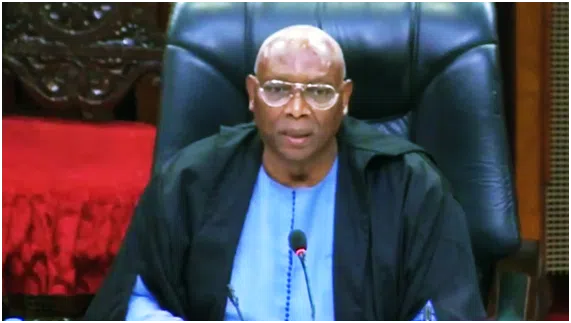
The report was submitted to the Speaker of Parliament, Hon. Abass Bundu to be acted upon. Part of the Report stated that there was an attack on the Chamber of Parliament by Members of Parliament and some strangers in the Speaker’s Gallery. As a result of this attack, the sittings of 23 November,2022 was disrupted; persons injured, and properties destroyed.

It continued that from eye witnesses, coupled with official Parliamentary footages captured by  CCTV cameras, cameramen and ICT Department, the following persons are considered perpetrators of the November 23″ attack on the Chamber of Parliament: Hon. Aaron Aruna Koroma- Constituency 048, Hon. Lahai Marah Constituency 042, Hon. Abdul Karim Koroma Constituency 059 and the Driver of Hon. Kellie of Lungi.

Properties destroyed during the fracas is said to be in the tune of Total Cost =NLe380,000.

MNOs Call for Immediate Intervention of Regulatory Stakeholders

By Foday Moriba Conteh

During the Media/CSO Engagement 2022 organized by the Ministry of Information and Communications at the Kenema City Council Hall, the Mobile Network Operators (MNOs) in the country have called for the immediate intervention of their regulatory stakeholders as their ability to further invest in Sierra Leone is dependent on resolving their prevailing challenges.

A joint Press Statement was read by Head of Legal and Regulatory at Orange Sierra Leone, Denetta Younge and Human Resource Director at Africell Sierra Leone, Abdul Fatoma.

Delivery a statement, the MNOs said that their sector has been one of the key drivers towards the development of ICT in this country and their contribution over the years towards the implementation of the President’s manifesto remains enormous and their apparent commitment can be seen in being the biggest taxpayers and one of the largest employer and CSR contributor in this Country.

They maintained that over the years, they have expanded their networks to reach remote areas with telecom services resulting to the construction of over 1000 sites and achieving a population coverage exceeding 90%, adding that they have launched 4G and 4G+ technologies for enhanced data speed and today our internet prices remain one of the cheapest in the sub-region.

“We have created job opportunities for over 100,000 Sierra Leoneans with direct and indirect employment and remain a strong pillar for CSR and sponsorships in the country. We have launched Foundations, Data, learning and e-learning centers, and have provided support for every facet of society in the media, entertainment, sports, entrepreneurship, and many other industries in this country. We have also renovated hospitals, health centers and supported disability and vulnerable members of our society, we have also built many schools, equipped classrooms, supported artist, football clubs and premierships, the national football team and provided learning courses nationwide to both primary, secondary, and tertiary institutions,” they revealed.

They disclosed that for them to continue on the same trajectory, their sector must be able to continue investing in infrastructure, making devices available and affordable and most importantly promoting a mutually beneficial relationship amongst all sector players and their valued consumers.

They pointed out that whilst they understand the global economic challenges that affect the fabric of every nation today; their sector is at an even worse position with the resultant effect being an exponential hike considering the cost of providing services whilst trying to cope with the devaluation of the currency.

Such has a fundamentally negative impact on businesses and remain an impediment to investment aspirations, stating that whilst all other businesses have the freehand to increase their costs reflective of inflation and the devaluation of the Leone against the USD and other international currencies, their tariffs remain stagnated.

The MNOs said that since their last tariff adjustment in 2017, the combined increase on some of their key cost variables stands at an alarming rate of 698% negative.

The Mobile Network Operators underscored the following that the present day value of the UD Dollar is at Le. 18,000 (Old Leones) to $1. This records an increase of 148% since the last GSM tariff change in 2017 when the exchange rate was Le. 7,258 (Old Leones) to $1.

50% of their cost goes to CAPEX which is in dollars. How do they continue investing and sustaining their business when 50% of their CAPX alone has increased by 148% whilst their selling price remain the same?

They also noted that fuel price is at Le. 25,000 (Old Leones) against Le. 6,000 per litre 5 years ago when their sector tariff was last reviewed. This records a colossal increase of 317% for a product that account for about high proportion of our total Opex, adding that even electricity tariff which is a similar utility service and a cost driver for their business has witnessed a significant increase of 78% from Le. 1,890 (old Leones) to Le. 3,364 (New Leones) as at July, 2022.

The MNOs also elaborated that previously, the cost of 1 Mbps data from Zoodlabs was $ 8. Today, it is $13 per GB recording 63% increase and continue to increase when the Leones value of the USD increases. To make matters worse, Zoodlab’s price is not only fixed in dollars, they are charged at the commercial bank rate, furthering that whilst the cost of Cement per bag and steel per ton were Le 65,000 and Le 6,000,000 (Old Leones) in the past, they presently stand at Le. 145,000 and Le. 11,500,000 respectively accounting for 92% increase.

“Although we have struggled to absorb these increases over the years, the prevailing challenges are stifling our businesses and the situation is no longer sustainable. If our sector is left unattended to address the challenges we face today, the effect will be such that jobs will be lost, QoS will be impacted, our contribution towards CSR will be grossly reduced, rural sites that are heavily subsidized will be shut down,” they maintained.

They emphasized on the critical nature and the urgency to salvage their cry for a tariff review as that will foster and strengthen the sustainability of the telecommunication sector to increase their contribution to the development of ICT, whilst at the same time impacting the population of Sierra Leone and improving daily lives.

The MNOs therefore called for the immediate intervention of their regulatory stakeholders as their ability to further invest in Sierra Leone is dependent on resolving the prevailing challenges.

They ended up maintaining their sector remains committed towards providing the best telecoms services in Sierra Leone and assured every Sierra Leonean that together, we will fight and overcome the effects of the global economic challenges to become stronger and better.


Ministry of Information Concludes Annual Media/CSOs Engagement

By Foday Moriba Conteh

In a bid to review the key achievements of the New Direction Government headed by President Julius Maada Bio vis-a-vis his key manifesto commitments, the Ministry of Information and Communications has on the 27th of November 2022 concluded 3rd edition of a 3-day Annual Media/CSO Engagement on the theme: “ Consolidating Democracy: Our Collective, Shared and Patriotic Responsibility”.

The engagement, which is in line with the Ministry’s vision to bring information to the people and bridge the information gap between the  Government and the people ,was held at the Kenema City Council Hall.

The engagement brought together MDAs, Media practitioners, and Civil Society representatives to deliberate on President Dr. Julius Maada Bio’s policies and programs as reflected in the Medium Term National Development Plan 2019-2023.

Giving his keynote address, the  Vice President of the Republic of Sierra Leone, Dr. Mohamed Juldeh Jalloh showcased the remarkable achievements of President Julius Maada Bio’s New Direction Government in four years of governance of the State.

He disclosed that Sierra Leone is the number three country in the world utilizing 22% of its GDP to invest in education because President Bio believes that human capital development is the right path to sustainable development.
According to him, the Government is taking care of 2.6 million kids from pre-primary, primary, basic and senior secondary schools in a bid to build the human resource capacity of the country.
VP Juldeh Jalloh added that Government has increased its budgetary allocation in the health sector from 6% to 11.7% with 3.4% remains to be the first country in Africa to attain the Abuja Declaration call of 15% investment from its GDP on the health sector for improved health service delivery.
As energy is key for the productive sector in the country he said President Bio’s has increased access to energy from 16% in 2018 to over 34% with over fifty towns nationwide accessing electricity supply.

He further spoke about the ongoing energy projects to light up all district headquarter towns and other major towns which will increase electricity generation, supply and transmission to 50% by mid-2023.
The Vice President reiterated on the roads construction projects and bridges that will increase connectivity of people from one chiefdom, district, region to another and neighbouring countries to enable businesses to grow in the country.

He said that the Government has invested in many reforms in the tourism, fisheries and agriculture sectors making them viable to contribute to the economic growth of the state.

“Investment in the energy, infrastructure and agriculture sector will attract many companies in the country that will create job opportunities for the people in the country. If you cannot deliver development to the people, you cannot deliver democracy in any country,” VP Juldeh Jalloh averred.
He said Sierra Leone is on record of doing extremely well in implementing Sustainable Development Goals (SDGs) and attaining other international benchmarks.
Minister of Information and Communication, Mohamed Rahman Swarray said the cardinal responsibility of his Ministry is to help bridge the communication gaps between the Government and the citizens underscoring that the Media &CSOs Engagement is one way of achieving that

He further underscored the significance of this year’s theme saying the governance of the State is a shared responsibility to ensure peace and stability stressing that without peace even the economy will not matter in the country.

Earlier speaking on the importance of the retreat, the Minister of Information and Communications, Mohamed Rahman Swarray maintained that the Government of HE President Julius Maada Bio is committed to run an open, transparent and accountable Government that seeks the best in terms of the interests of the people.

He said the cardinal responsibility of his ministry is to help bridge the communication gaps between the Government and the citizens which he said the media &CSOs engagement is one way of achieving it.

The Information Minister further underscored the significance of this year’s theme saying the governance of the State is a shared responsibility of all to ensure peace and stability stressing that without peace even the economy will not be matter in the country.

SLAJ President, Ahmed Nasralla said that the collaboration between the media and Government through the Ministry is very productive pointing out that no journalist is in jail which he said they need to celebrate compared to the past.

He said that the removal of Part five in the 1965 Public Order Act that criminalizes journalists by this Government is one of the biggest gains of the media and that has brought recognition of SLAJ and the country in many global media conferences.

Comments, clarifications, suggestions, questions and answers after presentations by MDAs’ of their achievements under this Government climaxed this year’s Media and CSOs engagement.


SLAJ President Underscores Collaboration with Government is not Sell Out

By Amin Kef Sesay (Ranger)

The Ministry of Information and Communications organized the 3rd Civil Society Organization & Media Engagement, with the theme  “Consolidating Democracy: Our Collective, Shared and Patriotic Responsibility”, in the Eastern Province of Sierra Leone which was held at the Kenema District Council Hall and lasted from the 24th-27th November, 2022.

In attendance were the Information Minister, Mohamed Rahman Swaray, a cross section of staff of the Ministry, other Government Officials, representatives of various Civil Society Organizations and media practitioners from different Media Houses.

Delivering a statement during the opening ceremony, the President of the Sierra Leone Association (SLAJ), Ahmed Sahid Nasralla, extended thanks to the Information Ministry, especially the Minister for organizing the CSO and media engagement for the third consecutive year.

He highlighted that the forum brings the Government of Sierra Leone (GoSL) and its agencies, CSOs and the media to track delivery of manifesto promises and provides an opportunity for the media and CSOs to interrogate activities of critical agencies of the GoSL.

The President of SLAJ, Ahmed Sahid Nasralla highlighted that over the last three to four years, SLAJ has been collaborating with the MIC to address the challenges facing the media because they believe the GoSL has a sacred responsibility to support the growth of independent and thriving media to help our democracy function well.

He was quick to point out that the collaboration should in no way be misconstrued as SLAJ selling out journalism or the GoSL buying out journalism.

“We are not selling, and the GoSL is not buying,” he reiterated adding how at no point in the period of the collaboration has anyone in GoSL called journalists to influence their work or position on national issues that they feel very strongly about.

“This collaboration is partly us working together to fulfilling the collaborative role of the media- to work with relevant agencies of Government and agencies outside of Government, to promote the media development and, by extension, the national development agenda.

Ahmed Sahid Nasralla pointed out that they are encouraged that the media generally continues to perform the radical role of scrutinizing the collaboration, and holding the GoSL and its agencies to account on a daily basis stressing that SLAJ don’t have control over. “We don’t determine the editorial policies of the media houses operating in the country nor do we tell them what to report or not report,” he stated adding how they absolutely don’t have that power.

He intimated how there are many positives that have come out of the collaboration expressing the view that the foundation upon which they are together building a new media landscape is the historic repeal of the criminal libel law; an obnoxious law that took the country more than 50yrs to delete from its law books.

Nasralla catalogued series of positive developments that have transpired prompting him to state that there is free media here.

He stated that because of all of those achievements Sierra Leone was encouraged to join the Global Media Coalition- a high level platform where Governments engage and peer review their commitments to enhancing freedom of expression and free media.

“We have had initial meetings with the Coalition to understand their work, their objective and how SLAJ and the GoSL could benefit from their interventions” he disclosed.

Referencing the media viability and investment conference held in June of this year, he said, progress made so far after that historic conference has been very encouraging.

He said Sierra Leone has for the first time being listed as one of 17 countries in the world to benefit from the International Fund for Public Interest Media (IFPIM). According to him, in preparation for that intervention, they have worked with support of all the stakeholders, including GoSL, under the platform of the Media Reform Coordinating Group (MRCG), to begin to put the structures in place.

He intimated about the establishment of the National Fund for Public Interest Media (NFPIM), a Multi Stakeholders Board (MSB) and a Technical Working Group (TSG) to administer the fund.

Ahmed Sahid Nasralla told the gathering that a project proposal has been submitted which, when approved, will see Sierra Leone benefit from a 100 thousand United States Dollars from the international fund.

Based on what he said, 50 percent of that will go towards setting up of the structures, which have already started putting in place, and the other half will be a grant to NFPIM.

“We also expect a counterpart funding from the GoSL as one of its commitments during the conference,” he expressed optimism.

The SLAJ President underscored how this will be the first time in the history of the media in Sierra Leone that a locally-owned-and-managed Fund will be giving out small grants to media houses, or groups of journalists, that are committed to doing public interest media- embarking on in-depth and investigative reporting on governance issues of accountability, transparency, and service delivery at the local and national level.

He told the audience that meetings of the MSB and TWG have commenced to discuss the legal status of the fund; finalize the criteria, guidelines, and tools to operationalize the fund.

The President informed that a workshop on drafting the definition of Public Interest Media within the context of Sierra Leone will soon be held.

“By December 2022 to January 2023 we hope that some form of activity will commence,” he expressed hope.

He said, however, the conference also challenged the media in Sierra Leone to review their governance and leadership structures to attract the much needed investment, ensure accountability and sustainability.

It was suggested that the media should also explore new business and revenue-generation models and move away from the traditional way of doing things which is now very old-fashioned.

Also proffered was that the GoSL and its partners should work to provide scholarships, training and capacity building opportunities for journalists among other reforms he highlighted.