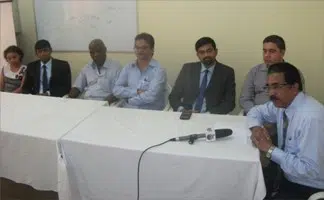
Her Excellency, Agnes Dugba Macauley, Deputy High Commissioner of Sierra Leone to the United Kingdom
By Alim Jalloh
Over 50 investors from across the globe attended a 2-day Trade and Investment Conference held at the Radisson Blu Hotel in Aberdeen, an event that was organized by the Government of Sierra Leone through the relentless efforts of Her Excellency, Agnes Dugba Macauley, Deputy High Commissioner of Sierra Leone to the United Kingdom in collaboration with SLIEPA.
The program, which commenced on Monday 28th October and ended on Tuesday 29 October 2019, attracted business moguls in the country and frank discussions were held on various issues.
In an exclusive interview with Deputy High Commissioner after the program, she disclosed that the conference was a follow up of the June Forum held in the UK which was attended by President Bio and team disclosing how the investors who came were from the UK, China, Germany and Nigeria. “They are in the country to have first-hand information about the country’s preparedness for investment,” she intimated adding that the investors have various interests in the fields of Infrastructure, Fisheries, Education, Tourism, Energy, Agriculture etc.
“These investors wanted to meet and talk with the authorities on their respective areas of interests,” she also disclosed. She expressed pleasure over the presentation made by the Ministry of Trade and Industry, the Banks and other organizations.Her Excellency further disclosed that her relationship with Sierra Leoneans in the diaspora is cordial and they are thinking of forming an association to further trade between Sierra Leone and the UK. She added that she has been stressing to investors that Sierra Leone is not only ready for investment, but ready to implement what they entered into and is hopeful that the visiting investors will make up their minds positively, as the concerns among many had been the peaceful situation in the country, which is a prerequisite for investments to thrive.
Speaking on the measures taken by the Government in respect of foreign currency transactions in the country, the Bank Governor allayed the fears of investors that the moves were laws that were in existence long before the present Government took power and were being followed by investors. He further maintained that all investors following the dictates of the law have nothing to worry about. Sierra Leone’s fiscal policy is investor friendly. He stressed that investors can transfer their profits overseas and remit funds into the country but they will have to go through the banking system.
“The Government will not allow investors leave the country with suitcases loaded with money, albeit profits made. This is to ensure financial stability in the country,” he pointed out.
On his own part, the Minister of Trade, Dr. Hinga Sandi, said that the Government is not taking hasty decisions to get investors in the country, but is taking careful steps to ensure that the investors coming to invest in the country are credible and good and will provide job opportunities for Sierra Leoneans.
The conference is geared towards boosting investor confidence so that at the end of the day it will be a win-win situation for both the country and the investors. Sierra Leoneans will be able to learn from investors and be in positions of trust. He is hopeful of a positive outcome from the conference.
Family Planning 2020, a global coalition of countries on family planning, has on Tuesday 29th October, 2019 held a one day Youth and Adolescents Conference on family planning with the theme: “Strengthening Youth and Voices as a Movement for Investment, Action
and Accountability on Family Planning “at the British Council Hall in Freetown. The event was geared towards educating young people on family planning activities across the country.
In his keynote address, Minister of Youth Affairs, Mohamed Omar Bangura, disclosed that society most times frown at discussing issues relating to sexual reproduction among young people, which he said has contributed to the ignorance of many on such issues.
He said stakeholders are not playing justice to this present generation with regards the aspect of sexual reproduction, adding that if we much move from the negative to the positive side of sexual reproductive education there should be key information generating discussions among the current generation of young people.
He called on the Inter- Religious Council, parents, teachers to discuss the issue of sexual reproduction with young people as they are people they trust so much in society.
He said that sexual reproductive education does not have any negative impacts on adolescents but rather empowers them on issues relating to the said subject matter.
Youth Focal person, Family Planning 2020,Marian Pleasant Kargbo, disclosed that Family planning 2020 is a global coalition of countries to which Sierra Leone signed its commitment in 2012, adding that one of the commitments signed to by the Government of Sierra Leone is to increase the budgetary allocation for family planning.
She said that even though Sierra Leone is a signatory to the Family Planning 2020 there is still no budget line for family planning in the Ministry of Health and Sanitation. Marian urged Government to ensure that it lives up to its commitment.
She noted that according to statistics 80 percent of young people don’t take contraceptives saying such is a concern and we need to step up and save the next generation.
Secretary General of the Inter-Religious Council, Rev. Dr. Usman Jesse Fornah, said that the Inter-Religious Council of Sierra Leone does not have a position statement on the use of contraceptive, but they do respect and uphold the various views and stance of their membership bodies in the spirit of religious tolerance and peaceful co-existence.
He noted that the Constitution maintains that one of the purposes for the establishment of IRSL is “To promote the sharing among religious communities of their respective traditions, principles and values which can be related to building a peaceful and just society in Sierra Leone and the world at large.”
“One of our key member bodies, The Catholic Church, is opposed to artificial contraception and sexual acts outside of the context of marital intercourse; this church believes that using contraception is intrinsically evil in itself, regardless of the consequences. Catholics are only permitted to use natural methods of birth control. The only form of birth control permitted is abstinence,” he maintained.
He disclosed that as for Islam, the Quran does not make any explicit statement about the morality of contraception, but contains statements encouraging procreation, adding that the Islamic Prophet (Muhamed) is reported to have said, “Marry and Procreate,” According to him there existed a primitive form of birth control as a known practice at the time of the Islamic Prophet and his companions engaged in it but the Prophet knew about this, but never advised or preached against it.
Executive Director of Health, Alert Victor L. Koroma, who doubles as the CSO Focal person on Family Planning 2020 disclosed that gathering adolescents across the country in a Family Planning 2020 Conference is to inform them on the commitment made by the Government of Sierra Leone to address the issue of Family Planning. He said that in 2012 the Government made a commitment in addressing the issue of Family Planning in the country.
He noted that they are including young people as they are the beneficiaries, adding that the conference also brought together key partners like UNPFA, USAID, Ministry of Health, Inter- Religious Council, PPSL etc in order to dialogue the issue of Family Planning and urged the Government to own their commitment.
The National Petroleum Company is an integral part of Sierra Leone’s multi diverse sectoral approach. The activities of the company are impinging positively on overall socio-economic development of Sierra Leone.
NP employs unbiased solutions to customer care with the kind of approach usually to draw support from them which no rival company does.
Amongst the foremost or primary tasks is giving customers their desires in getting access to high grade petroleum products at reasonable prices. Equipped with high-tech and calibrated pumping machines installed at all Filling stations, customers are assured of quality and quantity of supply of gas, fuel, and other lubricants used by vehicles and other machines.
The success has led to shareholders and management smiling as the company makes money due hard work . Suggestions, opinions and concerns of the public always rank number one within the company’s mandate. This synergy that exists between the company and end users has turned out to be the basis of mutual trust and respect keeping bonds alive and kicking.
Today, people have more fuel in their smart cards than before. Literally, it is the most recent technological device introduced by the company in town. The NP Smart Card is now the latest ‘swag’ in town that is saving many from the hassle of spending time to cash money. With the use of the NP Smart Card an individual could procure the requisite number of litres of fuel needed without any physical financial exchanges. This brings a lot of convenience to customers and has been widely applauded.
To make life more comfortable for people, NP-SL-Ltd also has on offer for sale user-friendly NP Gas used for a variety of cooking purposes. It is safe for all environmental purposes and can be used for domestic cooking. No wonder why the mad rush now for the product. Those who have tried it speak very well of its high performance and therefore recommend its use to others.
Corporate Social Responsibility too has added its own value to customers as it is making impressive ways to meaningfully transform the lives of people. All of this has been complementing Government’s efforts in its development trajectory to improve conditions of living.
If all the gestures that the company has made over the years are chronicled then such will come out in the form of epistles and there is limited space to accommodate such but it is an established fact that as a way of giving back to society the company is socially and economically contributing to overall national development.
Such could be juxtaposed with the offering of job opportunities to many who hitherto were dreaming of getting sources to derive income, the timely payment of taxes to Government. For all the right reasons Sierra Leoneans must be very much proud of NP-SL Ltd and give it all the necessary support to ensure that it continues to flourish and be relevant to society.
The second plenary session at the 2019 Russia-Africa Summit at the Sirius Park of Science and Art in Sochi, Russia, 24 October 2019
By James Kajue
RUSSIAN companies have offered African countries solutions based on the internet of things (IoT) and artificial intelligence (AI) to boost mining production. The offers follow the realisation that traditional means are becoming increasingly expensive, with productivity falling due to technical maintenance costs, unreliable equipment, reactive troubleshooting, a lower equipment utilisation coefficient and accidents connected to the transgression of safety regulations.
This was the prevailing theme at a panel discussion entitled: “The Mining Industry in Africa: New Russian Technologies and High Efficiency” held as part of the recent Russia-Africa Summit and Economic Forum in Sochi. Igor Bogachev, Chief Executive Officer of ZYFRA, said the company was offering Africa an automated mining and transport management system as well as robotic technologies.
He said the system of production control allowed for efficiency of the mine fleet and optimise ore production and transportation, increasing mining volume by 15 percent. The robotic trucks performance is 20 percent higher than that of the usual technology.
“Our autonomous dump trucks are already operational in Russia and Morocco,” Bogachev said. David Francis, Prime Minister of Sierra Leone, said a country-wide aerial survey of geological resources had recently been conducted.
“We now know the approximate volume and quantities of mineral resources that our country possesses,” he said. “We know that Russia has accumulated the knowledge and experience to help Sierra Leone evaluate all the information, enabling us to verify and confirm the amount, type and estimated value of the natural resources.”
George Oyema, head of General Maniema Mining Company in Democratic Republic of Congo (DRC), said remote control technologies were effective in raising safety levels and increasing the company’s productivity.
“This satisfies the interests of the labour unions, employers, owners and, ultimately, the state. It also increases the productivity of the industry in a safe way,” Oyema stated. The mineral industry is key to the industrial potential and export of many African countries. Almost 75 percent of foreign investment is destined for that sector.
The World Food Programme (WFP) in Sierra Leone has released the Zero Hunger Strategic Review (ZHSR) Report which was officially launched on 16 October 2019 on World Food Day. The Strategic Review is a product of the inclusive review process, a comprehensive analysis of the challenges faced and strengthened the country’s institutional capacity to develop agriculture effectively.
The review also identifies priority actions to achieve SDG 2 “Zero Hunger.” These priorities inform the plans of national stakeholders and partners in Sierra Leone. The Lead Convenor oversaw the whole process together with a full fledge technical research team.
From 2017 to 2019, the review involved of a wide range of national stakeholders, government ministries, departments and agencies, civil society members, private sector partners, donors, and international organizations. WFP commends the leadership of the Ministry of Planning & Economic Development, and the Ministry of Agriculture and Forestry in Sierra Leone for all their efforts. WFP also expresses its sincere thanks to sister agencies, namely FAO and UNICEF, for also playing a big role in the process.
In a startling revelation, a total of 73,468 people are living with HIV in Sierra Leone, authorities revealed recently. Abdul Rahman Sesay, Director General of the National HIV Secretariat in Sierra Leone, confirmed that among them, over 30,000 are currently undergoing treatment.
He noted that they are working with the Network of Persons Living with HIV, and also collaborating with communities to create people’s awareness of the disease. He called on development partners to work with the HIV Secretariat to reduce the rate of HIV in Sierra Leone.
Sierra Leone’s currency, the Leone, has lost over 100 percent of its value to the US Dollar since 2016, according to Bank of Sierra Leone. The Bank noticed the general public in a press release dated 20 August, 2019 that it is illegal under the country’s laws to quote prices in foreign currencies. The law states that all prices in the domestic market have to be in Leones. However, Bank of Sierra Leone operates in a setting of weak law enforcement.
Therefore, section 26 (4) of the Bank of Sierra Leone Act, 2019 are largely violated. Large part of the economy is dollarized with impunity. The prices of renting a house, booking for hotel and flight ticket, renting a car, consulting fees, wages of foreign workers are among the economic activities largely quoted in US Dollars instead of the legal tender, the Leone.
However, illegal dollarization is not the only currency problems of Sierra Leone. Bank of Sierra Leone depends heavily on exports), especially exports of minerals, to build its foreign exchange reserves to be able to influence the exchange rate of the Leone in the international foreign exchange market. However, export of minerals is very volatile. The share of mineral exports fell from 90 percent in 2013 to 30 percent in 2018, according to latest figures from the National Advocacy Coalition on Extractives (NACE).
Even a booming natural resource sector in the early 2010s could not make the exchange rate appreciate; suggesting that the exchange rate in Sierra Leone depends little on capital inflows, including Foreign Direct Investment (FDI) in mineral extraction, in agriculture, in manufacturing, in construction and service, international aid, loans from lending institutions such as the World Bank and IMF, remittance etc.
It seems the real exchange rate is more depended on terms of trade (import and export) than capital inflows. The prices of exports including minerals, agriculture and manufacturing are fixed in the international market. Exports of minerals have fallen so sharply primarily because of the dramatic fall in prices of minerals in the international market since 2013. Moreover, capital inflows have favored natural resources at the expense of agriculture and manufacturing. It suggests that government contractors, especially in construction and service, are the winners and famers and local producers are the losers in a booming natural resource economy.
Sierra Leone imports almost everything including high-tech goods, fuel, basic staple and textile to meet local demand. High food imports reflect the trade deficit problems or rapid depreciation of the exchange rate. The Ministry of Agriculture said last year that Sierra Leone spent $350-400 million on food imports alone, about 10 percent of the GDP in 2018. It implies that the low productivity of agriculture and manufacturing sectors contribute greatly to weak currency or sharp depreciation of the exchange rate.
Government spending in construction and service is perceived to have falling dramatically over the years like exports of minerals. The government depends heavily on mineral revenue to construct roads and houses, provide public service such as education, healthcare, and transportation. Therefore, Sierra Leone’s economy has been suffering from a very painful recession since 2013. The World Bank says on its website that “Sierra Leone’s economy grew by 7.8 percent on average during 2003-2014 but contracted by 21 percent in 2015 following the Ebola outbreak and a decline in the price of iron ore, the main export product”.
The working population is losing their hard-work or livelihood to inflation. Workers including health workers and teachers with fixed income have seen their standard of living going down dramatically. Prices of basic food commodities including the staple rice usually go through the roof. For example, a 50kg bag of rice cost 200 000 Leones (about $1.2) in 2018 but price has increased to an average of 300 000 Leones (about $1.7) per bag in 2019, almost 67 percent increase in prices. The price of a peak tin powered milk (400g) has increased by over 65 percent in one year or from 25 000 Leones (about $2.5) in 2018 to 38 000 Leones (about $3.8) in 2019.
The currency crisis has intensified further inequality and poverty. The 7 million residents of this former British colony have a GNI per capita of only $500 in 2018, according to the World Bank. Sierra Leone ranked 184 out of 189 countries in the United Nations Human Development Index (HDI) in 2018, figures from United Nations Population Fund (UNFPA) in 2017 shows that the West African country surfers from one of the world’s highest maternal mortality ratio of 1,165 deaths per 100,000 live births.
The way forward
The above discussion suggests that currency or the monetary economy could be a curse rather than a blessing in a setting of weak law enforcement. Therefore, Sierra Leone must implement its laws to boost the Leone. Authorities will have to clamp down on black markets or parallel economies including illegal dollarization fraught with corruption, money laundering and organized crime. The private sector will continue to quote prices in US Dollar with impunity if local laws such as the Bank of Sierra Leone Act, 2019 are not effectively enforced.
Moreover, FDI, especially in mineral extraction, would contribute less to job creation, economic growth and institutional building if the laws are largely violated. NACE says contribution of mineral extraction to GDP fell from 1.4 percent in 2013 to 0.7 percent in 2019. Therefore, agriculture and manufacturing policies must be geared towards increasing local production that might help reduce imports and help boost the Leone in the international currency market.
The private sector could also contribute less to local productivity if FDI does not employ nationals. The Local Content Act of 2016 that makes provisions for the private sector to employ citizens must be implemented. Effective law enforcement and empowering and training citizens might reduce the number of foreign workers. Nobody knows with precision how much the Leone loses value to the US Dollar whenever foreign workers and companies repatriate their wages and profits to their respective countries.
However, the laws could not implement themselves. Strong and accountable state, political and social institutions are needed. Protecting citizen’s rights to voice their concerns and grievances is a first step toward building social institutions that could, among other things, demand that laws be implemented. The more voices are heard the more Sierra Leoneans might perceive a strong, self-interested stake and mobilize to defend their political and economic wellbeing. Stakeholders including government of Sierra Leone and development partners, civil society and media should promote reforms aimed at protecting civil liberty and human rights.
Dep. Minister, dep. Ambassador, MOHS officials and participants
By Foday Moriba Conteh
China CDC in collaboration with Ministry of Health and USAID/PMI are organizing a three day training program for technicians that will be able to diagnose Malaria at the Bintumani Hotel.
Declaring the training opened, the Deputy Minister of Health Dr Jonathan Sandi said malaria is the prime cause of death among children so the training will be of utmost importance to help solve the maternal and mortality problem in the country.
“With all the decisions and remedies taken, yet there are still challenges in this fight, so we are happy that this training will change the cause of treating malaria as diagnosis will be done first to know the extent of the sickness and the drugs that should be administered.”
He said there is nothing like malaria typhoid and so long the diagnosis is done properly, the correct sickness will be detected and treated.
Chief Medical Officer (CMO) Dr Amara Jambai who was the chairman of the program made it very clear that this is the kind of help the ministry is looking as said this is not the first training being done by China CDC.
He said after this training and if it is expanded with cut down the number of death in the country. He called on the technicians to make good use of the training as they have a role to play in cutting down the number of death in the country.
The Deputy Chinese Ambassador Wang Xinmin said there were 216 million malaria cases and 445.000 malaria deaths all over the world in 2017. Recognizing the large global disease burden, the United Nations Sustainable Development Goals for 2030 include combating malaria.
Also, Malaria is very serious in Africa. According to the estimates in the World Malaria Report 2018, there were 194 million malaria cases (89.8% of the world) and 407,000 malaria deaths (91.5% of the world) in Africa. In the African continent, Sierra Leone is one of the countries severely affected by malaria with a high prevalence and deaths.
Although it has made an ambitious goal, malaria control and elimination is still a big challenge. In order to share the latest knowledge and experience on control and prevention of malaria as well as the progress on operational researches, and to explore the potential approaches towards forming an international collaborative network of malaria control and elimination in Africa, China CDC and The Ministry of Health and Sanitation of Sierra Leone jointly organized this Training. “We are delighted to have some Chinese experts with extensive experience in malaria prevention and control to share their ideas and knowledge with local experts in the next one week, and explore potential barriers and approaches towards control and eliminating malaria in Sierra Leone and other African countries.”
He said he believes that this training will have positive and far-reaching impact on China-Sierra Leone public health cooperation, especially for malaria prevention and control cooperation. I hope that all experts will work together to make this training a great success. Professor Duan the team lead at China CDC said Sierra Leone is one of the most severely malaria-burdened countries in Africa. Malaria causes a severe and great socio-economic impact for people here.
The professor said the efficient response to tackle malaria cases require effective diagnostic techniques, which includes RDT and microscopy for malaria. Therefore, on this demand, China CDC in collaboration with MOHS/ NMCP developed a training course for Laboratory technicians in the hospitals, Community Health Centres and the Public Health Reference Laboratory, which aims to strengthen the capacity of malaria diagnosis.
“Our Facilitators have excellent experience on malaria prevention and control, especially in malaria diagnostic techniques. I believe all trainees can benefit a lot from this course. No one should die from a disease that is easily diagnosed and treated- and that is the case with malaria. In the1960s, about 30 million people were infected by malaria each year in China. With the great effort of government and professional experts, China has reported no indigenous malaria cases in 2017.”
“One of Chinese experts, Tu Youyou, discovered artemisinin, and she won the 2015 Nobel Prize in Medicine. Artemisinin has saved millions of lives in the world, especially in African countries. And I hope, by the efforts and contribution of all Health Development Partners and the government of Sierra Leone, no one would die of malaria in Sierra Leone in the near future.”
Other speakers includes Dr Donald Bash Taqi and Dr Smith as they commended the China CDC for training and appeal that more of such will be done so that all District will have these technicians.
Findings of the Civil Society in Sierra Leone on the recent Choithram Hospital misunderstanding over comments by the Indian Vice President, when he recently paid a visit to this country, are now in the public domain. In a release dated 28th October, the Consortium for Civil Society said it was concerned over the Ministry of Information and Communications position statement contained in a press release on Choithram being a charitable hospital.
After investigations, the Consortium said it found two issues very disturbing. First is that Choithram hospital was named as Choithram charity; and secondly Choithram hospital an absolute charitable hospital. In its findings, the Consortium said that the description given by the Ministry of Information and Communication was wrong as the hospital was not found to be a charitable hospital
Instead, the hospital was doing charitable treatment of persons without economic status to pay the cost of fees for certain ailments and this was done all by itself without either government subvention or international aid from India.
Even the hospital’s name is not found to be CHOITHRAM CHARITY HOSPITAL rather CHOITHRAM HOSPITAL. In conclusion, the Consortium advised the public to discountenance the rumour that has brought misconceptions about the hospital. Another point also found is that Choithram Hospital lacked proper records of their charitable treatments they are giving out. The Consortium also advised the hospital to do publications of all free medical operations and treatments each year.
The Government through the Ministry of Information and Communications was cautioned to verify its records before making claims contained in public policy documents. It would recalled that Choithram Hospital is not being funded by either a Government of Sierra Leone subvention or funds from India and it should find other sources and not depend on proceeds from the hospital to run it alone.
Two Sierra Leoneans, Mr. Abu Bakarr H. Kargbo, Audit Officer at the Irish League Credit Union Foundation (ILCUF) Ltd. and Mr. Jaiah Kaikai, Secretary-General of the Supervisory Committee of the National Cooperatives Credit Union Association Sierra Leone (NACCUA) and Chairman of the Bo District Teachers Credit Union have returned home successfully after attending this year’s 20th Annual Congress of the African Confederation of Cooperative Savings and Credit Associations (ACCOSCA) congress held from 14th-18th October 2019 at the Pride Inn Paradise Hotel in Mombasa, Kenya.
The theme for the congress was ‘Embracing Servant Leadership and Inclusivity Through Financial Co-operatives.’ The conference had over 800 participants drawn from 30 countries worldwide including Sierra Leone’s delegation which was sponsored by Irish League Credit Union Federation Ltd. (ILCUF) in order to expose them to what credit unions are doing in other parts of the world.
In an interview with this medium, the two participants said this year’s theme was more align with the principles of the Cooperative Business Model and Servant leadership as both are people-centered. They underscored that ACCOSCA strongly holds the view that they should practice leadership that actively listens and empathizes with their members’ unique circumstances and positions to be able to meet the objectives of the sector.
They enlightened that ACCOSCA has envisioned a scenario where all are focused primarily on the growth and wellbeing of people and communities to which they belong underscoring that this can only be realized if ACCOSCA allows itself to follow and practice in its fullness the principles of cooperatives and understand their original objectives.
They also articulated that there is deeper penetration and acceptance of the model and they were encouraged because it is heading towards financial inclusion for all.
There were discussions critical for all members on inclusive growth, membership growth, financial capability, regulatory gains and digital financing among others which highlighted if they get these right in addition to embracing the concept and practices of servant leadership, they should be able to make the difference they are seeking affirming that they trust that the discussions would be beneficial to all participants.
The two participants continued that they seek to provide through the congress a platform for credit unions in Africa and all stakeholders to have candid discussions that would culminate into deliberate and innovative strategies towards achieving Financial Inclusion.
The first two days of the congress were allocated to training on the following topics: Liquidity Management, Board and Management, Successor Planning, Effective Communication, Cyber Security Safeguards and Resource Mobilization.
In Kenya and the entire East Africa where Credit Unions are well-established, Mr. Abu Bakarr H. Kargbo said that over 50% of the population are members of Credit Unions with some people joining two or more Credit Unions including medical doctors, police, armed forces, teachers, farmers and drivers etc.
Sources further state that teachers have the largest Credit Unions in Africa, and it is mandatory for all to join Credit Unions in Kenya. Normally, their contributions are deducted from sources.
Back home, the two men have called on the Ministry of Trade and Industry to review the Cooperative Act in order to amend it to join Credit Unions that would help reduce poverty and unemployment as well as improve the lives of the people.
A two-day training on how Credit Unions attended by Mr. Jaiah Kaikai was useful because he became so vigilant and independent thereafter to effectively perform his responsibilities at home more than ever before especially how to retain employees .
Other topical issues discussed were electronic financing, diversity in leadership, gender, region, bringing the physically-challenged on board, religion and unity in diversity through cooperatives and how to build a succession plan.
Highlights of the congress were experience sharing between different Credit Unions on how they have become successful as well as their challenges, thematic sessions on techniques to develop the capital base of Credit Unions, launch of the first African Cooperative Youth Network to encourage savings at a young age or catch them young as the congress observed that youth participation in financial institutions is low globally, the official flag parade of all participating countries while the congress was officially opened by the Kenyan Minister of Industry and Trade.
ACCOSCA Congress in Kenya is one of the many exposures made by Credit Union leaders, staff and regulators this year. At the beginning of the year three representatives from Sierra Leone (Mrs Mary Bundu NaCCUA treasurer, Mr Issa Bangura Chairperson Tawopaneh and Ms Esther Bangura ILCUF staff) attended and participated in West African block of credit unions in Gambia.
In August, the Acting Registrar of Cooperatives Mr. Newton R A Marlin and Deputy Director Other Financial Services from Bank of Sierra Leone Mrs Esther Johnson participated in ACCOSCA Regulators round table for all Credit union regulators from Africa in Nigeria. At the end of September, the Chairperson of NaCCUA Mrs Lilian Songo participated in International Partners Conference in Ireland.
The Irish League of Credit Unions Foundation (ILCUF) has been supporting credit unions in Sierra Leone since 2011. The mission of the Irish League of Credit Unions Foundation (ILCUF) is to alleviate poverty in developing countries by providing financial and technical assistance to credit unions, their representative bodies and other co-operative type organisations to enable them to bring about socio-economic development. ILCUF Ltd is funded by Credit Unions in Ireland and Irish AID.
A credit union is a cooperative financial institution that is formed and democratically directed by people who come together to meet common economic, social, and cultural needs. Credit unions provide both lending and saving services to their members.
Founded on the principle of participatory governance, credit unions are governed by those who use their services: their members. Credit unions only offer their services to their members who purchase shares in the credit union. Credit unions are not-for-profit organisations, who distribute their surplus as dividends to their members and also provide interest on savings. Members save regularly every month, and this form a pool of money which is lent to members by way of loans at reasonable rates of interest charge.